Scene of the Crime
For a visual history of Los Angeles’ most famous and infamous crimes, you’d be hard-pressed to find anything better than Scene of the Crime: Photographs from the L.A.P.D. Archive. The book (which has an excellent introduction by James Ellroy) is a collection of over one hundred L.A.P.D crime scene photographs taken from the 1920s to the1970s: the graphic and haunting photographs from cases such as the Black Dahlia, the murder of the Two Tonys, the Onion Field killing and ransom notes from the Symbionese Liberation Army are included. Perhaps more moving than the images from these famous cases are the pictures of crimes that happen everyday. There’s one of a beaten woman. Her face looks slightly away from the camera as though unsuccessfully trying to hide her wounds. A man is hanging from an unseen ceiling beam. Why did he commit suicide? The image will haunt you more for not knowing.
If you can’t get your hands on the book right away, take a look at some photographs of historic crime scenes that I took on a recent research trip to L.A.
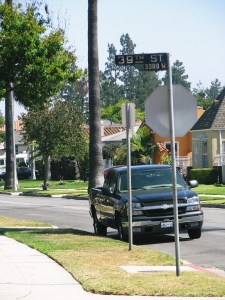
On January 15th, 1947 the tortured, severed body of a Miss Elizabeth Short was found at Leimert Park, 39th and Norton, in L.A. Miss Short was dubbed the ‘Black Dahlia’ by the press, most likely due to her black hair and the black clothing she often wore. The ‘Black Dahlia’ case is still officially unsolved, and it is the most publicized case in L.A.P.D history. At the time, the area where her body was dumped consisted mostly of vacant lots, now, like the demographics of L.A., it has changed irrevocably and become part of the city’s wealthy suburbs— a fact alluded to in John Gregory Dunne’s excellent novel based on the Dahlia case, True Confessions. In Dunne’s novel, the prologue is first person narration by Detective Tom Spellacy. Spellacy’s words are both racist and strangely elegiac about the changing face of L.A.
Anyway. 39th and Norton two weeks ago. It’s a Jap neighbourhood now, Jap and middle-class colored. No empty lots, no bungalows, no Hudson Terraplane. The Neighbourhood Association has put up streetlamps that look like gaslights and there are topiary trees and over on Crenshaw there’s a Honda dealer and a Kawasaki dealer and Subaru and Datsun and Toyota dealers. The colored all have Jap gardeners and the Japs have colored cleaning ladies, and right where Frank Crotty said, “You don’t often see a pair of titties as nice as that,” there’s this Jap-style house and just about on the spot where we found Lois Fazenda’s bottom half, this Jap family has put up one of those cast-iron nigger jockeys.
Son of a bitch if they haven’t.

June 22nd 1958, El Monte, California, the body of Geneva Hilliker was discovered by some kids playing baseball. The body was lying face down in an ivy patch on a road beside the playing field of Arroyo High School. She had been strangled with a thin white cord and her own nylon stocking. The case is still unsolved. Her son James Ellroy was merely ten years old at the time. Unlike 39th and Norton, the crime scene has barely changed with the passing of time, although much of the ivy is now gone. In 1994, Ellroy (now the legendary Demon Dog of Crime Fiction and the author of The Black Dahlia) would reopen the case with Bill Stoner a retired homicide detective from the Los Angeles County Sheriff’s Department. The subsequent reinvestigation is the basis of Ellroy’s book My Dark Places.
Arroyo High School gained another footnote in crime history when in 1969 a recently graduated student, Steven Earl Parent, became one of the victims of the Charles Manson Family. My thanks to the indispensable local resident Ronda Logan for her help in El-Monte.
Read my follow-up post, Ellroy in LA.
Lawrence Block on Writing Mysteries
In an essay at mysterynet.com Lawrence Block has the following to say about writing:
If you’ve got something to say, hire a hall. If you want to send a message, call Western Union. But if you’ve gotten nothing more than the urge to write and a talent to amuse, just sit down and write your book. Even if you don’t change any lives, you might get somebody through a bad night or two. [Link]
The Russia House
The fall of the Berlin Wall and the end of the Cold War presented Spy fiction writers with something of a dilemma. The intricacies of espionage could no longer be rendered concisely in a narrative of East and West, Communism and Capitalism. Spy novelists found their books dated and old-fashioned. One writer who was ahead of the curve in reinventing the genre was John Le Carre. The Russia House is LeCarre’s moving elegy to the traditional spy novel. Published in 1989 (although set in 1987 a clever device by LeCarre which ensured the story would not be overtaken by events) the plotting still carries the hallmarks of the mystery genre. Niki Landau is a rep for a British publisher on a visit to the Soviet Union when he is contacted by a beautiful mysterious Russian woman named Katya. She claims to be carrying a manuscript written by a friend Yakov that needs to be urgently delivered to Landau’s boss, the jazz-loving, heavy drinker Barley Blair. However, the manuscript is not the kind of material Barley is used to handling, it contains Soviet State secrets and Barley soon becomes a pawn in the hands of British and American Intelligence determined to exploit Katya and Yakov as part of their espionage game. But when Barley finds himself falling in love with Katya will his love of country hold firm?
LeCarre skilfully avoids the clichés of the Spy genre. This is a novel less concerned with double agents and secret microfilm than it is of the changes happening in Russia at the time. What makes the book such a pleasurable read is the portrayal of the lives of ordinary Russians living in the age of Glasnost and Perestroika. The scenes in which Barley is debating and drinking with his Russian friends are a delight to read. LeCarre personally observed these Russian traditions whilst doing research in the Soviet Union. He had been lobbying to visit the country for years, and the thawing of relations between East and West during the Gorbachev era gave him the opportunity. This level of research and attention to detail gives the novel its sense of realism.
The novel veers (somewhat untidily) between first and third person. The first person narration is by Harry Palfrey, a mid-level British civil servant who becomes one of Barley’s Intelligence handlers. Yet Palfrey is not central to the novel, like the other characters he is merely an observer to events bigger than himself. Palfrey only appears in certain scenes: his narration is conveyed through memory and what the principal characters have confided to him. This cast of Rosencrantz and Guildenstern figures is allegorical of the reader’s relationship with the major events of their own time. There are no heroes in LeCarre’s world. Spies are cuckolds, adulterers and divorcees. Indeed, Palfrey reappears in LeCarre’s later novel The Night Manager (1993) as a minor character who has completely given himself up to corruption. Those characters who do try to behave honourably often find themselves betrayed, alone and unable to reconnect with the innocent overt world which no longer exists for them. Anyone who has been following the bizarre and sad recent case of the former MI5 whistleblower David Shayler, now a transvestite who thinks he is Jesus, would acknowledge that LeCarre’s portrayal of spying is in no way overblown or unrealistic. Human frailty is presented with sympathy and understanding. Indeed, it is often not the individuals who are at fault: their suffering is due to a malaise in national institutions. The manuscripts Barley and Katya are handling contain the biggest open secret of the age— The Soviet Union’s military and nuclear capacity is years behind American technology. But will the British and American Intelligence Services accept this inconvenient truth or is it in fact a ruse by the Russians to spread disinformation? On a human level, it is Barley and Katya who pay the price for this complexity. The Russia House is a thoughtful and moving novel, and in retrospect it does not read much like a Spy novel at all.
The Mysteries of Melville Davisson Post
Melville Davisson Post came from an important farming family in West Virginia and after a brief career as a lawyer he became one of the most highly paid magazine story writers of the early twentieth century. His characters, including backwoods detective Uncle Abner and crooked lawyer, Randolph Mason, brought him wealth and fame. He died in 1930 and since then several stories and inconsistencies about him have come to be thought of as true. The first of these concerns his birth year, which is given wrongly on his death certificate as 1871, a date that subsequently found its way into reference sources as respectable as Webster’s Biographical Dictionary. It was in fact April 19, 1869; 140 years ago this year. He was apparently nominated for the Nobel Prize in 1922 (except he wasn’t), and perhaps was also a candidate for President of the United States in 1924. Except that in that election, the famous ‘Klanbake’ election, Calvin Coolidge won by a landslide from Democrat John Davis. An excellent article on Post at First Things gives a more convincing explanation. In 1892, the year he graduated in Law, Post
was selected as one of the Democratic party’s electors in the national presidential election. (He was subsequently chosen by the Electoral College to serve as its secretary, the youngest person ever to hold the position.) But upon his return home, perhaps feeling that he was rising too fast, the West Virginia party chairman rejected him for a political run, and he settled down to practice law in Wheeling.
Post, who travelled widely in Europe, is an underrated writer whose reputation has perhaps been damaged by the sometimes overblown intensity of his religious and moral attitudes. But he does not need these myths; what Post did achieve is remarkable enough in itself. He was a highly successful writer and a supreme plotter and innovator in detective fiction. Among his admirers was William Faulkner, who studied his stories while writing the six mystery stories in Knight’s Gambit (1949).
More on the mystery of Post’s birth date on my personal blog.
The Venetian Vase
This site began life as a supporting site for two books: 100 American Crime Writers and 100 British Crime Writers. These books are co edited by Chris Routledge and Esme Miskimmin and will be published by Palgrave Macmillan in their Crime Files series. When I was contacted by Steven Powell, who is one of the writers on the book projects, asking if he could contribute to the original site it quickly became clear that we would have to do something different. The blog will be edited and maintained primarily by Steven and me. So here is The Venetian Vase.


