Crucible: An Interview with John Sayles about his latest novel
John Sayles is one of the great storytellers of our age. His films include such classics as Matewan (1987), Eight Men Out (1988) and Lone Star (1996). They grapple with such themes as individual and institutional corruption, moral complexity, American identity and its place in the world. While this may sound heavy, Sayles is first and foremost an entertainer: To step into any of the fictional worlds he creates is a compelling and enriching experience.
In addition to his extraordinary output in the cinema, Sayles has also had a distinguished career as a novelist since his debut work, Pride of the Bimbos, was published in 1975. In recent years he has become more prolific as a novelist, averaging a book a year. His latest work Crucible is an epic tale covering fifteen years in the history of the Ford Motor Company. It begins with the introduction of the Ford Model A car in 1927 and ends with America at war with the Axis powers in 1943, and also at war with itself as race riots burn through Detroit. In the interim we have a panoply of characters and scenes – Henry Ford policing his River Rouge plant with an ICE-like private army; Diego Rivera turning up to paint a mural; gangsters, middle managers and organised labour all jockeying for power and influence and, most fascinating of all, Ford’s disastrous attempts to establish Fordlândia, an industrial town in the Brazilian Amazon that sinks all of its inhabitants into a Heart of Darkness-style nightmare.
The rapid-growth of the Ford Company parallels the ascendancy of the United States as a world power. War brings out the full might of America’s industrial power but at what cost?
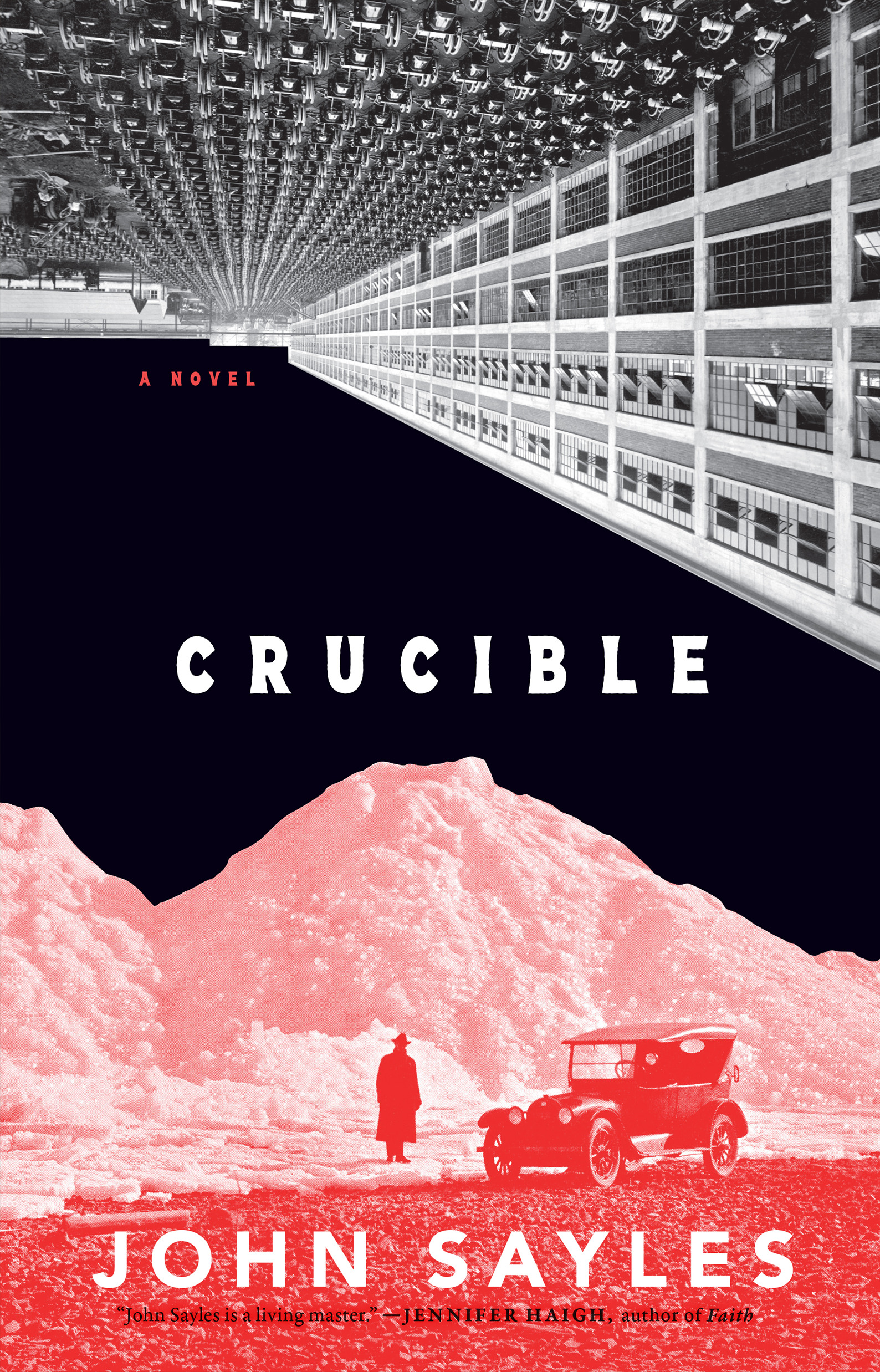
Crucible is a novel that comments on the America of today by shining a light on its past. I had the good fortune to talk to John Sayles about his latest work:
Interviewer: You have covered so many locales in your art, from Texas to Alaska to the American occupation of the Philippines, what made you pick the setting and locations of Crucible to tell this story?
Sayles: I’ve spent some time in Detroit, was very aware of the 1967 race riot there, and became very aware of it as more of a high-pressure crucible where American political and cultural forces collided than the more benign ‘melting pot’ we like to think of. When I read Greg Grandin’s Fordlandia (some producers wanted to turn it into a mini-series) the last, imperialist, part of the equation fell in for me and I started on the novel.
Interviewer: Before reading Crucible I had, rather lazily, bought into the idea that Henry Ford was an American hero. You offer a much richer and more complex portrayal of the man. When did your interest in Ford begin?
Sayles: I’d always seen Ford as the last of the great private capitalists- he and his son Edsel were the sole owners the giant international motor company- with the megalomania that kind of success and power often comes with. The more I learned about him, the more complex a man he was revealed to be- his relationship with his adoring son Edsel is really tragic.
Interviewer: In Crucible you weave a tapestry of sub-plots, from prohibition bootlegging to the doomed utopian Fordlandia scheme. How did you manage to bring all of the disparate the plot strands together?
Sayles: Detroit became a crucible because of Henry Ford- he pushed prohibition (Michigan went dry before America followed), paid black workers the same wages as white, and was fascinated with the underworld, directing his ‘enforcer’ Harry Bennett to make side deals with the local mobsters. History gives you a template and a timeline the plug your characters into, they can help tell different parts of the big story and eventually start to cross paths in interesting ways.
Interviewer: Crucible presents some stark parallels with the current political climate in the US. Does America still need men like Henry Ford or will they inevitably become tyrants?
Sayles: All of society benefits from men like Ford the tinkerer- finding a better way to do something that needs doing. But as my version of Ford says late in the novel, people aren’t machines, and any inflexible social or economic formula will eventually fall apart. Our zillionaires today are mostly interested in controlling people and living in securely guarded bubbles, though a few dare to go the Elon Musk route and start dictating how everybody should live.
Tokyo by Mo Hayder, reviewed for Ellroy Reads
This week’s episode of Ellroy Reads is a little different, as I want to share with viewers some of the biographical research I have conducted since Love Me Fierce in Danger: The Life of James Ellroy was published. So this episode isn’t particularly about James Ellroy and his reading choices. Instead, the focus is on the extraordinary life of the British author Mo Hayder and her brilliant novel Tokyo (also published as The Devil of Nanking).
This episode is something of a one-off. Next week I’ll be back to talking about Ellroy and the books that have inspired him. In the meantime, thank you for watching me discuss my current research, and don’t forget to subscribe to the channel and share the content.
The Night Manager Returns – Dawn of the Night Owls
I have always loved the story of The Night Manager. Even before the TV show, I was gripped by John le Carré’s novel. It’s hard not to be enamoured with the perfect blend of intrigue, romance and adventure as the reader follows Jonathan Pine. Plucked from his job as a hotel night manager by British Intelligence to infiltrate the arms dealing operation of arch-villain Richard Roper, Pine is at once charming and deceptive, out of his depth and uniquely qualified. I was hooked by the 2016 television adaptation of the novel, and impressed by how it broadly stayed faithful to the book while cleverly updating the geopolitical setting to the events of the Arab Spring. While I was initially sceptical of the final episode, which veered from the novel and delivered a completely different ending for the characters of Pine and Roper, I eventually grew to appreciate how this version of the story was aiming for a more emotional response from the viewer than the novel delivered.
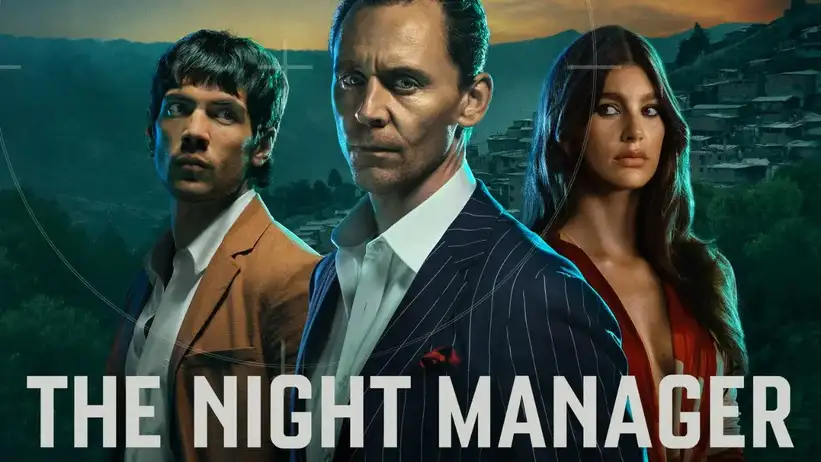
So, after ten years The Night Manager has finally returned, and I’m happy to say that I enjoyed the story all over again, although I did experience, no hotel metaphor intended, some reservations about the whole exercise. Jonathan Pine (Tom Hiddleston) is still working for British Intelligence, heading up a unit known as the Night Owls, whose job it is to monitor the suspicious nocturnal habits of foreign guests at London hotels. There are shades here of le Carré’s world of scalphunters and lamplighters, and also a nod to more recent spy fiction by Mick Herron (Slow Horses). When Pine spots a former mercenary of Richard Roper’s at an exclusive hotel it sets off a chain reaction of violent events. Pine’s senior colleague Rex Mayhew (Douglas Hodge) is found dead in an apparent suicide, and Mottram has left behind a series of messages for Pine which links MI6 Chief Mayra Cavendish (Indira Varma) to Colombian arms dealer and self-styled philanthropist Teddy Dos Santos (Diego Calva). Pine follows the trail to Madrid, where half of his Night Owl unit are killed. Operating outside the Service with two loyal agents, Pine’s death is faked and he travels to Colombia to infiltrate Dos Santos’s operation in Cartagena. It’s not long before Pine finds himself chasing some very old ghosts. Dos Santos models himself as the heir to Richard Roper, and this is true in more ways than one.
To be clear, there are plenty of flaws in The Night Manager’s return to television. There are scenes where Pine conveniently overhears crucial conversations, and it beggars belief that no one spots him eavesdropping. There are false notes when Pine’s attractive neighbour asks him out to dinner after returning his stray cat (did she think asking for a cup of sugar was too obvious?) and a puzzling scene where Mayra Cavendish intimidates an underling to handover some files – she’s the Chief, why doesn’t she just order him to handover the files? Oh, and don’t get me started on the $300 million Pine stole from Roper at the end of series one and which he has kept stashed in a Luxembourg bank account for ten years. Are we seriously meant to believe that this money hasn’t accrued any interest over the past decade, and that Pine is happy to live off a civil servant’s salary when he has enough money to buy a Premier League football club?
And yet there is much to admire in The Night Manager. The story is as compelling and pacy as ever. The acting, from the ubiquitous Tom Hiddleston as Pine to new additions to the cast such as Diego Calva as the sinister Dos Santos to Camila Morrone as the sexy and enigmatic Roxana Bolaños, is uniformly excellent. The story veers off into preposterous territory more than once, but the overall production has enough wit and verve to win you over. The Night Manager was always one of le Carré’s most adventurous and action-packed tales, and this adaptation captures that spirit. It may not be a spy classic in the same mould as Smiley’s People, but Jonathan Pine might just be the spy we need for our screens in 2026.

‘Murder, Obliquely’ and the Fallen Angels Noir Anthology Series
In this week’s episode of Ellroy Reads, I look at Cornell Woolrich’s short story ‘Murder, Obliquely’. I talk a little about Woolrich’s life and the story itself, and then use this as a segue to discuss the Fallen Angels television show which ‘Murder, Obliquely’ was adapted for, as was James Ellroy’s short story ‘Since I Don’t Have You’.
Subscribe to the channel if you haven’t already. You won’t find this behind the scenes content anywhere else. Enjoy!
Death at the Altar by Donna Gowland – Review
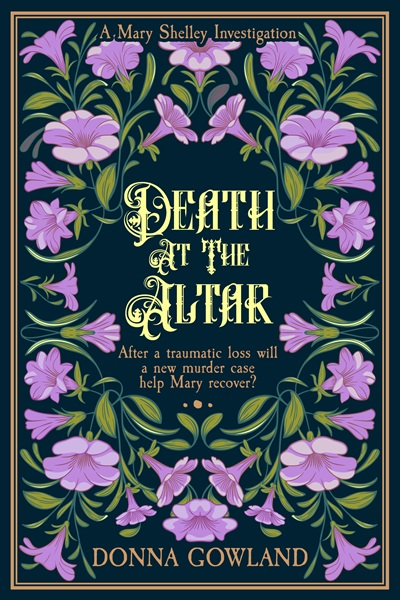
Mary Wollstonecraft Godwin (Mary Shelley) is in the grip of a deep depression. Her baby daughter has died. The baby’s father Percy Bysshe Shelley is too preoccupied with the literary life to provide Mary much solace. Her stepsister Claire Clairmont has her own designs on Percy, but soon gets distracted by a campaign to woo Lord Byron. And life in early-nineteenth century London is generally bleak and difficult, especially for young women who have given birth to the child of a married man. Percy was still married to his first wife Harriet Westbrook at this point.
So when Mary receives an invitation to the wedding of an old school friend in Scotland, Percy thinks a break from London will do them both good. However, violence and tragedy seem to stalk Mary and Percy wherever they visit. The phrase shotgun wedding had, most likely, not yet entered the lexicon, which is a shame as a country parson is shot dead at the wedding Mary and Percy attend and such events are not supposed to happen in polite society. The culprit is quickly found hanged, presumably a suicide brought on by overwhelming guilt. But Mary knows that the mystery is only just beginning to unravel.
Regular readers of this blog will know that I am a big fan of the ‘Mary Shelley Investigations’ series. Donna Gowland knows her literary detective well. Gowland’s expertise on both Mary Shelley and the times she lived through is brought to vivid life on the page. Death at the Altar is the third book in the series and the best so far. My advice is to buy and read all three volumes in the series. Gowland writes some of the best gothic fiction being published today.
The Caine Mutiny by Herman Wouk, reviewed for Ellroy Reads
Happy new year, dear readers! I hope you have enjoyed the holiday season. 2026 promises to be an important year for James Ellroy with the release of his new novel Red Sheet in July. This will be a very active website over the next twelve months as I cover all Ellroy and crime fiction related-news.
Today, I bring you the latest episode of Ellroy Reads in which I discuss Herman Wouk’s classic novel of World War Two – The Caine Mutiny. Ellroy has always admired Wouk’s novel about life in the US Navy as one of the greatest studies of how people behave under intense pressure. I hope you enjoy the episode and remember to subscribe to the show.
Wildcat Play by Helen Knode, reviewed for Ellroy Reads
For the latest episode of Ellroy Reads I look at Wildcat Play, Helen Knode’s excellent sequel to her debut novel The Ticket Out. In The Ticket Out, Knode’s heroine Ann Whitehead is a film critic working in Los Angeles whose life is turned upside down by a murder. In Wildcat Play Whitehead has quit her job as a critic and is now working in the oil industry in the San Joaquin Valley, but it’s not long before another murder drags her back into a world of danger and intrigue.
This is the final episode of Ellroy Reads for the year. The show will return in January 2026. Thank you to everyone who has supported the show and this website this year. Subscribe to the show if you haven’t already. 2026 is going to be an epic Ellroy year!
Stainless by Todd Grimson – reviewed for Ellroy Reads
On January 29th of this year, the author Todd Grimson died as the result of a bizarre traffic accident. He was only 73. Grimson’s premature death deprived American literature of a daring and transgressive writer. In the latest episode of Ellroy Reads I examine Grimson’s fascinating life, his friendship with James Ellroy and his classic vampire novel Stainless.

Warrant for X by Philip MacDonald – Ellroy Reads
In this week’s episode of Ellroy Reads I discuss Philip MacDonald’s classic mystery Warrant for X. James Ellroy read Warrant for X in 1965, the same year Stephanie Gorman was shot to death in her family home in Los Angeles. I discuss the unusual connection between Warrant for X and the murder of Stephanie Gorman. Ellroy investigated the Gorman homicide and wrote about it in his GQ article ‘Stephanie’.
I hope you enjoy this mix of literary analysis, true crime investigation and stories from Ellroy’s incredible life. If this type of content is your sort of thing, consider subscribing to the channel.


 The Venetian Vase