Mary Shelley Investigations: An Interview with Author Donna Gowland
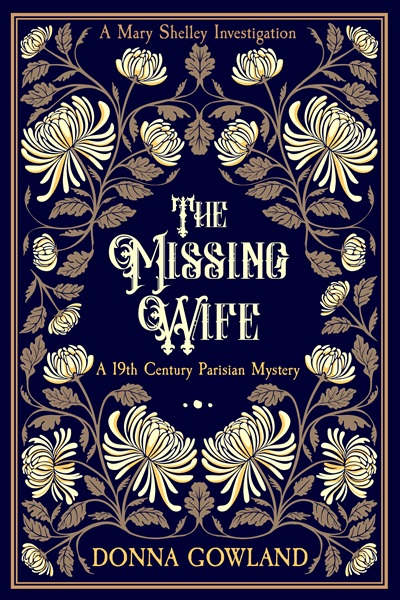
The Missing Wife is a new historical novel by Donna Gowland published by Sapere Books. The year is 1814 and 16-year-old Mary Godwin feels trapped in her prominent but stifling family. So when the Romantic poet Percy Shelley comes blazing into her life, threatening to commit suicide unless Mary runs away with him, she jumps at the chance of love and adventure. However, the love begins to sour when Mary and Percy find themselves in Paris, still a hotbed of revolutionary intrigue, low on cash and with ambiguous feelings for each other.
The Missing Wife works on two levels. Firstly, it is a brilliant depiction of young and naive love. This romantic portrayal leads the reader into the second storyline – the mystery of the missing wife, an investigation Mary and Percy pick up in Paris for some extra cash, when their passion for each other is already dimming. Donna Gowland weaves both of these storylines together brilliantly. You get a tangible sense of the literary life, complicated by young love, and the investigation goes from being a sidenote to a gripping mystery which places our young couple in mortal peril. But make no mistake, Mary is the dominant one in this pair, and as this is the first novel in a new series of ‘Mary Shelley Investigations’ then I cannot wait for her to return.
Donna Gowland agreed to answer some questions about The Missing Wife for the Venetian Vase.
Interviewer: Why did you choose Mary Godwin as your literary detective?
Donna Gowland: I have always been fascinated by the story of Mary Wollstonecraft Godwin Shelley (that’s a lot of surnames!) and felt that Frankenstein has overshadowed her life story. When you look at her story, it’s quite the tale – the early death of her mother Mary Wollstonecraft, her uneasy relationship with her stepmother and stepsisters, school in Dundee, meeting and romancing Percy Shelley and finally eloping with him to Paris when she was just sixteen years old. That is quite the starting point for a story.
Mary’s resolve, resilience and spirit has all too often been overlooked, or she has been seen as an adjunct of Percy Shelley, but she is a fascinating, multi-faceted character with great intelligence and pluck; I thought these characteristics would make her an excellent detective!
What I like about her as a detective is that through the course of the series she learns. She is not the complete article at the start of the story, the character goes on the journey with the readers; Mary is much wiser, maturer and sure of her skills by book six!
Interviewer: How would you describe your research process? Did you get to follow in Mary and Percy Shelley’s footsteps?
Donna Gowland: You would think I would have followed them to Paris, but I didn’t – I followed them to Geneva! (The location for book four), maybe I will go to Paris this year.
I knew something of Mary’s life story and the background to her meeting and falling in love with Percy Shelley, but what I love about writing historical fiction is the ability to use existing information as a framework and to populate the unspoken spaces with the key points of the narrative. That’s what I always aim to do.
I started out by building a timeline of 1814 from when they met to when they eloped and when they came back to London and built the fictional world around it. I read everything I could by and about Mary Shelley, her fiction, her letters and journals (and those of Percy Shelley and Claire Clairmont) and tried to picture the key points along the way and used that to research some of the details that make you feel like you are on the trip with them – Mary refusing to swim naked in a lake is a true story, so is their purchase of a donkey (though I don’t think it was called Napoleon!). For me, it is important to fuse the historical and the fictional to create an immersive, engaging experience for the reader – I have lost count of the readers who have told me the donkey is their favourite character!
The next step was building the characters and the nuances of the murder-mystery plot, ensuring there was cohesion in the plot and characters and a satisfying resolution. I really enjoy the research process – as much as (if not more than) the writing process.
Interviewer: Was there anything about the characters that surprised you as were writing the book?
Donna Gowland: The ebbs and flows of the relationships between the characters surprised me, how naturally it had the sense of characters trying to ‘fit together’ when they were thrown into a completely alien environment. Jane (now known as Claire Clairmont) and Mary’s relationship dynamic shifted substantially once Mary being romantically attached to Percy Shelley and it was interesting to write the way they all navigated the relationships.
Percy Shelly disappointed me a little bit too. I’ve always seen him as something of a romantic hero, but the more research I did into him as a character the more his human foibles were exposed, and they translated onto the page as someone with a bit of a disconnect between the ‘myth’ and ‘reality’ of the man. The depth of feeling between him and Mary was undeniable though, it’s a shame their love story had such a tragic end after so many trials, tribulations and turns.
Interviewer: Could you name some of the authors who have inspired your writing?
Donna Gowland: Agatha Christie is the first one who springs to mind, the absolute queen of the genre: Patricia Highsmith, Arthur Conan Doyle, James Ellroy – so many! I’ve got quite a vast and eclectic taste, so I take inspiration from anywhere and everywhere. There are lots of authors whose writing makes me put down the book and wish that I had written that! Jenn Ashworth’s short story ‘The Women’s Union of Relief’ is one of the best short stories I have ever read in my life, it is right up there with Shirley Jackson’s ‘The Lottery.’ Jane Burn (poet) and Amanda Huggins (particularly her amazing short stories about Japan) weave words like nobody else. I really enjoyed Laura Martin’s ‘Jane Austen Investigations’ and Alexandra Benedict’s ‘Murder on The Christmas Express.’
I really enjoy well-carved writing; where every word does something, every word counts! My first English teacher told me my writing was verbose, I crave clean, crisp sentences.
Interviewer: Could you give a little hint as to Mary’s next adventure.
Donna Gowland: In ‘The Lost Girls’ (to be released on August 15th, 2025) Mary, Percy and Claire have returned to London triumphant but penniless and the months of penury are taking their toll on relationships. Claire witnesses a murder, but when they go back to the scene of the crime the body has disappeared! Mary’s friend and former housekeeper calls upon her to investigate a run-away servant which leads them on to an adventure involving the criminal underworld of London, science, and galvanism!


 The Venetian Vase
Trackbacks