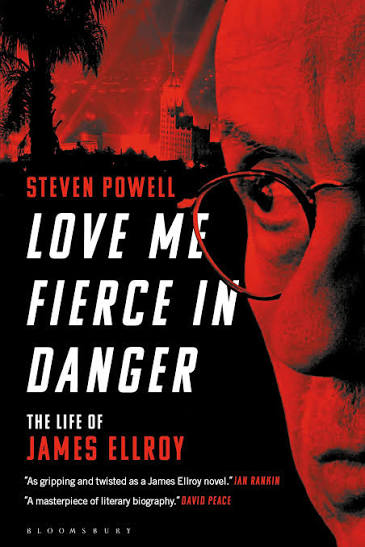
Biographical Conversations with James Ellroy
The phone rang and I heard the unmistakable sound of James Ellroy’s voice on the other end of the line.
“Hey, hey” was how Ellroy greeted me.
He was clearly in a buoyant mood, and he had every right to be. This was our first conversation since I had landed the contract with Bloomsbury to be his biographer, and he was delighted that I was the one who had the nerve to put his life-story, with all its triumphs and disasters, into print.
“You’re sitting on a pot of money, Steve” he said by way of congratulations as ‘You’ve got the CONTRACT’ and vowed that he was “going to tell me everything.”
Candour seemed to be the initial theme of our work together. You might say that intimacy was the first order of business as he was insistent that I interview his ex-partners, which I duly did, and had some in-depth conversations with them which greatly benefitted the book, although Ellroy would get nervous when he knew I was getting ready to talk to someone who he thought had an axe to grind. He warned me that one of them ‘is going to rat me out. Call me a racist, sexist, homophobe, fascist etc.’ He couldn’t have been more wrong about this. Ellroy’s ex-partners gave a very balanced portrait of the man and author they had been in a relationship with for several years. Naturally, embarassing details would sometimes crop up, such as how Ellroy had argued with a girlfriend over Dave Chappelle. She was a fan. Ellroy was not.
‘Dave Chappelle was a good cat’ Ellroy enthused to me, when I brought this to him. ‘I had a blast with him on Conan, and he wanted me to do the town with him afterwards, but I said no, I don’t cheat on my wife.’
I found this response bizarre at first, but telling in retrospect. Chappelle was not inviting him to a sex party but was simply asking him to socialize. Ellroy was eager to ease my discomfort when such matters came up in conversation. ‘You never have to worry about telling me anything, Steve’ he said, at his most disarming, once we had wrapped up the talk.
I would periodically update Ellroy on my progress. Those conversations could be stressful or agreeable, depending on the nature of my research at the time. Sometimes Ellroy could be disarming if he could tell I was worried about breaking bad news. For instance, one time I informed that an ex-girlfriend had felt ‘haunted’ by their former relationship.
‘She was haunted by me’ he said in disbelief, ‘…well, good.’
Sometimes he would brief me prior to a conversation with an ex-partner. One relationship, which he had immortalised in his novel Blood’s a Rover, gave Ellroy some consternation when I sent out an interview request. He had spoken to the lady in question once since their break-up in a phone call which she instigated but Ellroy found to be ‘completely perfunctory’ and ‘I had the feeling that something was on her mind’. Ellroy was pleased when she told him that she had read The Hilliker Curse, another book he had written covering the relationship, ‘but astonishingly she hadn’t read Blood’s a Rover’. Ultimately, ‘I’ve got no idea how she’ll respond’ he told me.
The response, when it came, was not good. The ex-partner rejected to being ‘fictionalised’, even though I made it clear that I was writing a biography and referred to her former fiancée dismissively by his surname. Ellroy was taken aback when I reported back to him, ‘she really said that about me?’ Then the humour returned to his voice, ‘it’s a good dog’s name isn’t it – ELLROY!’
He was calm and objective in giving me advice on how to respond to such setbacks: ‘Well, I would stress to her that it’s not fiction, it’s a scholarly biography’ Ellroy replied calmly, ‘and assure her that you won’t contact her again. Cease and desist.’ But his mood changed when I told him about other things she had told me about the relationship. ‘That is not going in the book. She’ll sue you. She’ll sue me. She’ll make both of our lives miserable.’
Not every difficult moment related to an ex-partner. Ellroy, for instance, was dismissive of the reinvestigation of his mother’s murder for My Dark Places, claiming her knew early on, ‘We’re not gonna find the guy. I’ve just gotta go through with this.’ His ill-feeling towards that time had ultimately led to the end of his friendship with Bill Stoner, although he declined to give a specific reason, merely stating that they had lost touch and it was ‘one of those things’. He still carried a lot of respect for Stoner. A feeling that was mutual. Perhaps no friendship could have survived the nervous breakdown Ellroy suffered while on The Cold Six Thousand book tour in 2001, which he firmly believed had its genesis in My Dark Places.
But ultimately most of the problems would come back to the thorny issue of Ellroy’s ex-partners. After I interviewed one woman who had been treated particularly shabbily, Ellroy responded ‘I’ve expressed racial animus before, it’s wrong.’ The woman in question accused Ellroy of making racially-charged comments to her. ‘It’s a sin’. The comment might sound like a platitude, but it was Ellroy’s way of conveying genuine remorse by examining his behaviour through the Christian lens of being a sinner. He could repent about it and move on. My dilemma as a biographer was how to balance Ellroy’s private life, or ‘sins’ as he might put it, against his stunning accomplishments in American literature.
The reader will be the judge.