A James Ellroy Playlist: South of the Border
A shorter post today. I’m swamped with work on other projects right now, which gives me less time for this site. However, continuing my series on James Ellroy and music, I am going to highlight a couple of musical pieces which have been inspired by the Demon Dog’s work. Any artist who takes inspiration from Ellroy is not afraid to go to some dark places, and today’s choices have a rather mystical, dangerous or downright head-tripping flair.
Pour yourself a shot of tequila and prepare to ‘go with the music – spin, fall with it.’
Tijuana Bible
Tom Russell is a singer-songwriter, author and painter with an enigmatic persona to match Ellroy. In an interview with Craig McDonald, Russell tacitly admits that his song ‘Tijuana Bible’ was inspired by Ellroy’s writing. The song is rich in story and character. McDonald describes it as ‘Ellroy’s entire LA Quartet distilled down to a single, intoxicating song’:
LA mobster Mickey Cohen’s stooge Johnny Stompanato gets shanked by movie queen Lana Turner’s daughter, Cheryl Crane. “Stomp” rides “an ice truck down the brand new Harvard freeway.” A MacArthur Park-based PI investigates. Seeking a treasure map, the Eye digs up Johnny’s corpse, looking for riches… and finds an LA Confidential-style “Tijuana Bible” full of smutty sketches of Cary Grant doing the nasty with Donald’s drifting squeeze Daisy Duck “in a Tijuana bedroom.”
And here is the song. It’s a fantastic song crammed with LA lore and a quintessentially noir sense of humour, which reminds me of a joke the author Steve Hodel once told me. – ‘I remember back in the Fifties as a young man trying to learn a new dance. It was called, “The Stompanato Stomp”. It’s where the girls cut in.’
Out Walked Bud/in Walked Bud
Double Naught Spy Car are a band that provided atmospheric background music to several of James Ellroy’s public readings during the mid-1990s. Variously described as ‘surf noir, jazz on acid, spaghetti middle eastern, and “difficult”’ Double Naught Spy Car have produced great instrumental music, as colourful and surreal as the world of Ellroy’s fiction. Their first album, Comb in Blue Water, was released in 1998, shortly after their collaborative readings with Ellroy. It’s a great album to play while reading Ellroy (particularly if you’ve just bought a copy of Widespread Panic). Below is one of my favourite tracks, ‘Out Walked Bud/in Walked Bud’. It’s a homage to the Thelonius Monk tune ‘Bud Walked In’, but for our purposes, play it with Bud White in mind. And pity the wife-beater who opens their door one evening to find the ‘Ghost of Christmas Past’, inviting them to ‘dance with a man for a change’.
Widespread Panic by James Ellroy – Review
Fred Otash is back! Actually, he’s dead. He’s stuck in ‘Penance Penitentiary, Reckless-Wrecker-Of-Lives Block, Pervert Purgatory’. Otash decides to pen a confessional in the hopes of improving his eternal fate. The action jumps back to 1950’s LA, and Freddy’s in his prime.
Dig: He’s verifying salacious stories for the scandal-rag Confidential. He’s an informer for LAPD Chief William H Parker, who wants to lure Confidential into a honeytrap that will topple its tabloid crown. Freddy’s got the goods on everyone in Hollywood. He knows that James Dean is the ‘Human Ashtray’ gimp for his studio masters, aka Nazi-obsessed Afrika Korp fetishist director Nicholas Ray.
Look alive Kats: Ray is a flamer who flings himself at good-looking starlets and actors faster than he can get into bed, figuratively speaking, with Caryl Chessman. Chessman is the robber, kidnapper and rapist whose scheduled appointment with the green room in San Quentin has become a cause celebre to Hollywood figures such as Ray and Marlon Brando who are determined to halt the execution.
Woof Daddy-O: Otash sees the libertine, hypocritical side of Hollyweird which is closed off to the public. He knows that Phyllis Gates ain’t gonna turn her husband Rock Hudson straight, but frankly the portrayal of that couple is relatively tender given the sordid conduct of everyone else. Then Otash falls in love with the actress Lois Nettleton, and we are reminded that behind the glitz and glamour, Hollywood is still the land of dreamers and hopeless romantics.
Tomorrow is a drag, man! Tomorrow is a king-sized bust!: This is the dawn of the age of Camelot, and a certain Senator for Massachusetts with Presidential ambitions can’t help but dip into the boudoir delights that Hollywood has to offer. Such is the confluence between politics and entertainment, tabloid journalism and the silver screen, which makes the Devil’s work and Fred Otash’s payday in Widespread Panic.
The world I am describing could only stem from the fertile mind of James Ellroy, and Widepread Panic is a wild jazzy ride that readers will storm through in one or two breathless sittings. Reviewing the book for the Financial Times, Barry Forshaw describes Widespread Panic as the novel that will ‘win back the legions of fans who have deserted him’. It’s a sobering thought to think that Ellroy has lost fans. I would argue that they have become a bit jaded by the excessive demands that Perfidia and This Storm put on the reader. With Widespread Panic, Ellroy has found a comfortable middle-ground. The tone here is comic, but not in the outrageous-style of the Danny Getchell novellas. It’s Freddy’s first-person narration and Ellroy has a nice distance from the character. In interviews, Ellroy goes to great pains to specify that although he may have liked Otash and found him a veritable goldmine of information, he never actually respected or admired the man. He does succeed in reining in Otash’s more callous, venal nature at crucial junctures, such as in his love for Nettleton.
The structure is also Ellroy at his creative best. Widespread Panic is composed of three novellas – ‘Shakedown’, ‘Perv Dog’ and ‘Gonesville’- – which, when taken together, can also be read as a single novel. Widespread Panic may not be as epically perfect as Ellroy’s best work, but it will, I suspect, reassure a few waverers. And, as Ellroy has already indicated that there are more Fred Otash books to come, it signals a return to the 1950s Los Angeles setting of which he is the undisputed master.

Spreading the Word
Recently, I’ve been contributing to the wider blogosphere/podcast world and spreading the word about the Demon Dog. Firstly, the Ellroy Boys invited me on to their podcast to discuss LA Confidential, both novel and film. I had huge fun discussing all things Ellroy with Sam, Brendan and the rest of the guys. You can listen to the podcast here.
I was also interviewed by Hannah Stevenson for her blog The Dorset Book Detective. We talked about my love of crime fiction, the books I’ve written and, of course – the Demon Dog! You can read the interview here.

A James Ellroy Playlist: Set It To Music
Over the course of my series on James Ellroy and music, I have focused on the various musical genres, performers and composers that have inspired Ellroy and how he has worked these influences into his writing. This latest instalment is a bit different. I am going to explore how Ellroy’s fiction has inspired an eclectic range of music in film, theatre and symphonies. As I, and many readers of this website can attest to, engagement with Ellroy’s work encourages obsession and inspiration. So, I’m writing this as a tribute to the musicians who have produced great work by daring to enter the noir world of the Demon Dog.
Here’s to them.
The Victor
LA Confidential is the best of the four films that have been adapted from Ellroy’s novels, and a great film in general (although Ellroy’s opinion of it has cooled in recent years). The setting, story and characters of the film are accentuated by a beautiful score by Jerry Goldsmith. Goldsmith composed the score to Chinatown, so he knows the noir milieu of Los Angeles well. The highlight comes with the piece which concludes the film, ‘The Victor’. It commences with a lonely, elegiac trumpet which switches to fast-tempo action which plays as the credits roll. Exley is triumphant, having both killed Dudley Smith and played the system so adroitly that he is hailed to the press as a hero. Bud White’s severe injuries from the Victory Motel shootout have left him disabled and his police career is over, but in many ways he is the more fortunate of the two men. He has a woman, Lynn Bracken, who loves him and will care for him in a new home far away from the City of (Fallen) Angels. Exley just has his rank, gold medals and a helluva a lot of ghosts in his head. As Lynn says, ‘Some men get the world. Others get ex-hookers and a trip to Arizona.’ Which would you choose?
Jerry Goldsmith died in 2004. His reputation as one of the greatest composers in Hollywood history is unassailable. Ultimately, Goldsmith’s beautiful composition ‘The Victor’ reminds me of Ellroy himself. If you know anything about his remarkable life-story, then you’re likely to conclude he could also be the victor of the title.
The Lee Ellroy Show
SOIT are a Brussels based performance group who set about the ambitious task of staging Ellroy’s life through dance and theatre. The Lee Ellroy Show is loosely inspired by Ellroy’s memoir My Dark Places and the unsolved murder of Jean Ellroy. Directed by Hans Van der Broeck, and with Jacob Ingram-Dodd and Anuschka Von Oppen performing all of the roles, The Lee Ellroy Show is wild, surreal and has enough wonderful weirdness in it to surprise even the most dedicated Ellroy readers. Below is a clip from the show. You can watch the entire performance here.
Black Dahlia
If the murder of Jean Ellroy can be depicted through dance, then the unsolved murder of the Black Dahlia herself, Elizabeth Short, seems a ripe subject for musical interpretation. Mark Isham’s soundtrack to the film version isn’t bad at all, but a great soundtrack needs a great film and Brian De Palma’s adaptation doesn’t have any of the grandeur or epic scope that made LA Confidential such a wondrous melding of film and music.
Instead, I’d like to focus on Bob Belden’s jazz opera Black Dahlia which was released in 2001. Variously described as based on or inspired by Ellroy’s Dahlia novel, Belden described his take on the story:
“Essentially, my piece is about dying and how to get there,” Belden quips. “James Ellroy created a world around the Black Dahlia murder case but he really didn’t delve into her character, he delved into the Los Angeles that he grew up with and had in LA Confidential. And so for Ellroy, it was just a matter of taking that murder and creating a story around it. I was more interested in the character of Elizabeth Short, what she was thinking and feeling right up to the moment of her death.
I’m not sure I agree with Belden’s analysis of the novel. Bucky Bleichert’s first-person narration introduces the story with the line: ‘I never knew her in life. She exists for me through others, in evidence of the ways her death drove them.’ By learning about Elizabeth, he discovers more about himself, but he can never truly know her because she’s gone, and unlike the heroine in Laura, she is not coming back. Belden tries his best to understand Elizabeth Short and ‘to create music around what I imagined she was feeling and thinking.’ The result is a fantastic noir album, haunting and thrilling in equal measure. Sadly, Belden died of a heart attack aged only 58. He left behind an impressive body of work, of which Black Dahlia is definitely a highlight. Below is the title track. You can watch a performance of the entire work here.
A James Ellroy Playlist: Golden Oldies
James Ellroy has always understood the power of nostalgia. In one sense, he is trying to demystify the past as a more placid or conservative time. Take, for example, his portrayal of policing in the LA Quartet, or political corruption during the Kennedy era. At the same time, Ellroy is not immune to the charms of nostalgia. He often claims to ‘live in the past’ and, judging by the fact that he doesn’t use a computer or a mobile phone, he is not being disingenuous. Ellroy views nostalgia as a form of merry-go-round. It’s easy to be taken in by the schmaltz and the music of the ride, but eventually (as in the climax of Strangers on a Train), the carousel will come off the hinges and everything and everyone on it will come crashing down.
Hop on:
Come Go With Me
Blood on the Moon begins on Friday, June 10th, 1964, ‘the start of KRLA golden oldie weekend’. Two school thugs, Larry ‘Birdman’ Craigie and Delbert ‘Whitey’ Haines are planning to viciously assault their fellow pupil, Theodore ‘the Poet’ Verplanck, who has mocked their masculinity in the High School Poetry Review. They play the radio to drown out Verplanck’s screams during the assault, which unexpectedly escalates into a rape. Quite a few musical artists are mentioned as playing on the radio during the build-up, occurrence and aftermath of the assault. Ellroy name-checks the Fleetwoods, the Beach Boys and Elvis Presley. It’s worth noting though that Oldies Stations didn’t appear until the early 1970s, and many of the acts that are referenced in the scene would have been at the height of their career in 1964. Nevertheless, the build-up of nostalgia-tinged music is crucial to making the violent climax of the scene all the more shocking. One song is specifically mentioned as Birdman and Whitey are planning to ambush Verplanck:
Their plan of disrobing, beating, genital painting, and shaving was hatched. Now, if it all worked out, was the time. Larry watched Whitey trace swastikas in the sawdust with a two by four. The Del-Viking’s rendition of ‘Come Go With Me’ ended and the news came on, meaning it was three o’clock. Larry heard the whoops a moment later, then watched as the workmen gathered up their handtools.
Note the disturbing sexual language used to describe their plans, which perhaps makes the rape less of a surprise than it appears on first reading. After the attack takes place, ‘Cathy’s Clown’ by the Everly Brothers comes on the radio. This is the more symbolic song to the plot. Verplanck literally becomes Kathy’s Klown to Kathy’s Kourt, the female poetry group whose titular leader is the object of Verplanck’s affections. Whitey and Birdman lured Verplanck into a trap by writing a letter, in Kathy’s name, inviting him to a rendezvous. Rereading the scene though, I was struck by the symbolism of ‘Come Go With Me’. The doo-wop vocals set a saccharine tone, but as the song progresses the singer sounds increasingly desperate, until the heartbreaking final line ‘You never give me a chance’. Verplanck woke up on June 10th, 1964 thinking he had a date with Kathy. The murderous ramifications that came from the trap set by Whitey and Birdman would last for decades. Truly, he never had a chance.
Runaway
In an interview with Ian Johnston for PURR magazine, Ellroy claimed:
I like the good old romantic golden oldies of my youth, like Del Shannon’s ‘Runaway’, spring 1961 when I was at junior high school and in love with this girl.
Ellroy was chasing girls when Del Shannon’s song ‘roared up the pop charts on its way to #1’. Ellroy didn’t have any luck with the opposite sex at the time. In the wake of his mother’s murder, he had too many emotional issues to make much of a boyfriend. But his love of women, and of this song, would grow in adulthood. He references it again in Brown’s Requiem, when Fritz Brown is steeling himself for his violent confrontation with Haywood Cathcart.
I rose the next morning from a troubled sleep populated by my old patrol partner Deverson, a mad collector of Fab 40 records and women’s pubic hair. The songs were all there in my dreams: ‘Runaway’ by Del Shannon.
Note the mixing of vintage nostalgia with perversion here, Deverson collects ‘Fab 40 records’ and ‘pubic hair’. It’s notable how often Ellroy uses cultural references in anticipation of and during violent scenes. In addition to his song-filled dreams, Brown composes a poem, or rather it comes to him in an epiphany. When he finally does confront Cathcart, the two men discuss classical music. ‘Runaway’ is a reaction to losing a woman, ‘she ran away / And I wonder where she will stay / my little runaway’. It’s a melancholy nostalgia, not giving much hope for a future. Perhaps this is why Ellroy uses Golden Oldies as a warning – safety is in the past, the present is fragile, and violence is to come.
‘Runaway’ has been covered countless times. The best cover was by Shannon himself, as the theme tune to Michael Mann’s TV series Crime Story. Sadly, Shannon died on a self-inflicted gunshot wound at the age of 55.
Unchained Melody
The final scene of American Tabloid (Spoiler Alert) takes place in a dive bar in Dallas on November 22, 1963. Mob hitman Pete Bondurant has gone to watch the cabaret act of his new bride, Barb Jahelka. Bondurant is complicit in the Kennedy assassination, so he knows what the crowds gathering around Dealey Plaza don’t know. The pomp and circumstance of a presidential visit is about to come to a brutal end:
The combo mauled an uptempo number. Barb blew him a kiss. Pete sat down and smiled his “Sing me a soft one” smile.
A lacklustre crowd was watching the show – maybe a dozen lunchtime juicers total.
A roar ripped through the place – HE’S COMING HE’S COMING HE’S COMING
Every patron and barmaid and kitchen geek ran for the door.
As the bar staff and lunchtime drinkers rush to get a glimpse of the Kennedy cavalcade, Pete and Barb are left alone in the bar. The song she picks at his silent prompting is ‘Unchained Melody’. One of the best songs about yearning for a lover that the singer knows, deep down, they have lost, ‘Unchained Melody’ is an intriguing coda to the novel. Is Ellroy urging the reader to let go of the myths surrounding Kennedy’s Camelot?
The timing of the scene is interesting in relation to the history of the song. The definitive version of ‘Unchained Melody’ was recorded by the Righteous Brothers in July 1965, almost two years after the Kennedy assassination took place. But the song had been a huge success from the moment in was released in 1955, with three artists having Billboard Top 10 hits of the song that same year. Many female artists, Patti Page, Cyndi Lauper, Leann Rimes, have covered the song brilliantly, so one can assume Barb Jahelka would have knocked her version out of the park.
It was originally written for the prison drama Unchained. As this seems the most closely related to the melancholy nature of nostalgia in Ellroy’s work, I have posted a clip of the film below. Performed by Todd Duncan, the song was nominated for an Oscar:
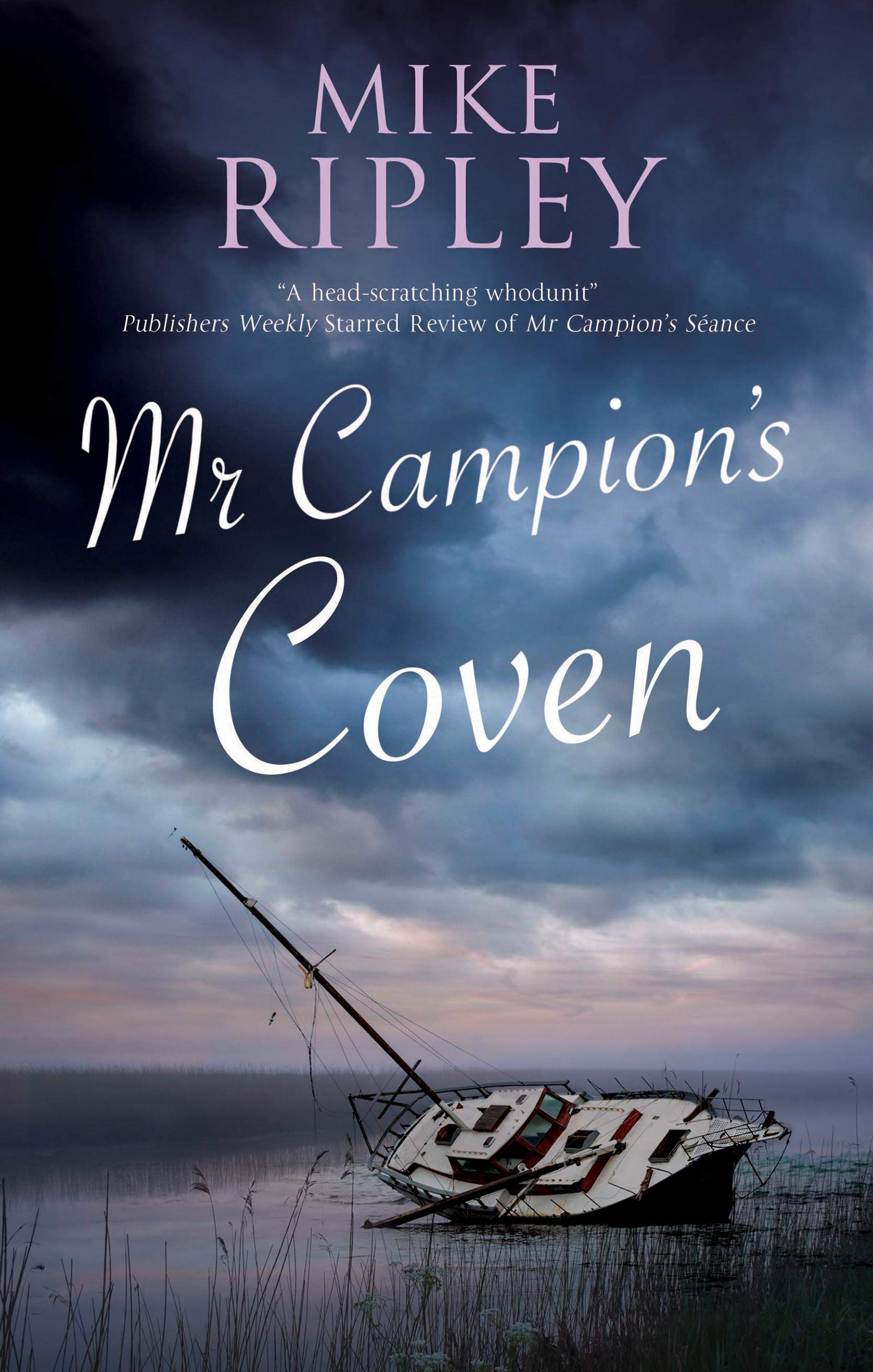
Mr Campion’s Coven by Mike Ripley – Review
UK, 1971. Strikes, flying pickets, and all manner of industrial strife dominate the news headlines. Northern Ireland is going up in flames, and flares are running down the legs of Britain’s long-haired youth. Not that all of this cultural and social change matters much to the aging Albert Campion. If you mentioned Glam Rock to the Toffish detective he’d probably think it was the title of an obscure geological journal. Nevertheless, this is the changing Britain of Mike Ripley’s brilliant series of Albert Campion novels, which have developed the much-loved character who first appeared in Margery Allingham’s The Crime at Black Dudley (1929).
Wicken, an Essex village where the yokels make the inhabitants of Summerisle look positively normal. The place is a treasure trove to Harvard student Mason Lowell Clay. He’s writing a thesis on a group of settlers who travelled from Wicken and landed in Harker’s Island, North Carolina. Campion is on hand to help him with his research, but the strange doings around Wicken have already lured Campion to the village. The noted actress Dame Jocasta Upcott’s yacht has run aground on a Wicken mudbank. Dame Jocasta wants Campion to find her missing dog Robespierre, whose disappearance concerns her far more than the yacht or the fact that the captain has been found dead. Campion has a mystery to unravel, but where do the answers lie? Is it a case of smuggling gone wrong, or a sinister tale of the clash between Christian and Pagan traditions?
Ripley’s novels have always had a great sense of locale and, as a former archaeologist, he knows this mud-splattered topography well. Essex is a bellwether among the Home Counties. It was key to the electoral success of Thatcher, Blair and now Boris. Thus, it is a perfect setting for a crime story grappling with the spiritual battle between covenanters and wicca pagans. A narrative best described as a cross between Deliverance and The Midwich Cuckoos. Emotional spoiler alert: Several pooches go missing in the course of the story, but dog-lovers need not worry, all of the canines fare better than the human characters in this novel or indeed, the real-life Robespierre. There is affection though in Ripley’s comic sketches of characters. I was fond of the haughty diva Dame Jocasta, and the boozy theatrical agent Maxim Berlins, a fine tribute to the great Marcel Berlins.
I don’t wish to overplay the darkness of the story, after all what is a Campion tale without lashings of wit. And Mr Campion’s Coven has wit in abundance. I found myself looking forward to the hour a day I’d put aside to read it, and rather like an indulgent cocktail hour, that sixty minutes was often extended.
A James Ellroy Playlist: Composure
Classical music is one of James Ellroy’s greatest passions, and his novels are littered with references to it. For my latest piece on Ellroy and music, I am going to examine the personalities of two of Ellroy’s favourite composers and look at how their obsessions influenced his writing.
Anton Bruckner
In Brown’s Requiem, the lead character Fritz Brown, a repo-man cum private detective, is an admirer of the Austrian composer Anton Bruckner: ‘I heard the Bruckner Third the other night on KUSC. Haitink and the Concertgebouw. Lonely Anton at his peak.’ He takes inspiration from Bruckner’s chaste dedication to his craft, although Brown is too worldly a man for abstinence. He is addicted to booze and women. His admiration for Bruckner’s ideals, yet failure to adhere to them, haunts him in his final confrontation with the antagonist Haywood Cathcart. Having tracked the vicious killer Cathcart to his house in Del Mar, Brown holds him at gunpoint. Rather than beg for his life, the wounded Cathcart asks Brown to look inside his desk drawer. To his surprise, in the drawer Brown finds two ‘loving mounted likenesses of Anton Bruckner’. Cathcart proceeds to lecture Brown on Bruckner’s character:
You love Bruckner. But you don’t understand him. What his music meant. It’s about containment. Refined emotions. Sacrifice. Purity. Control. Duty. The muted melancholy throughout his symphonies! A call to arms. A policeman who loves Bruckner and you can’t feel his essence. He never wed, Brown. He never fucked women. He wouldn’t expend one ounce of his creative energy on anything but his vision. I have been Anton Bruckner, Brown. You can be, too.
Brown shoots Cathcart dead before he can continue his speech. He is emotionally devastated that a morally repugnant man like Cathcart could love Bruckner’s music as much as he does, and even understand it better. All of which might seem highly unlikely and overwritten for a crime novel. But, if you adore Ellroy’s early novels as much as I do, you can admire how Ellroy the young writer, newly sober and rebuilding his life, is emotionally engaging on a very pure level with Bruckner’s music and his Romantic ideals.
Here is Bruckner’s Symphony No.3 in D minor, conducted by Bernard Haitink for the Royal Concertgebouw Orchestra. Listen to this while you chew over the ideals of ‘lonely Anton’. Just don’t get upset if someone you can’t abide enjoys Bruckner’s music just as much you do!
Ludwig van Beethoven
Probably no other composer has been as influential on Ellroy’s life as Beethoven. He first heard the composer’s work in junior high school, ‘One day in class Hines (his art teacher) dropped a needle on a record. “Da-da-da dunnn. Over! It was just over. Immediately.”’ Ellroy still keeps a bust of Beethoven on his writing desk. In an interview I conducted with Ellroy, the author talked at length about his admiration for Beethoven:
What I love is the worse it got, the greater he got. In his famous quote when he started to go deaf, “I will take fate by the throat.” It’s just almost unfathomable courage. And the older he got, and he was dead at fifty-six, the more unfathomable and great and uncategorisable his music.
“I will take fate by the throat” became the epigraph to Ellroy’s memoir The Hilliker Curse. Ellroy alludes to parallels between his life and Beethoven’s in that when things went bad for Ellroy from 2001 onwards – the nervous breakdown, addiction issues, affairs and divorce he details in Hilliker Curse – artistically things started to get better. After recovering from this emotional meltdown, Ellroy wrote his comeback novel, Blood’s a Rover, which is among his most critically acclaimed. It features two female characters who could be considered Ellrovian versions of Beethoven’s ‘Immortal Beloved’. The Immortal Beloved was the addressee of a love letter Beethoven wrote in 1812. For years scholars have debated the identity of the woman Beethoven was writing to, and it has even inspired a feature film. In Blood’s a Rover, ‘Comrade’ Joan Rosen Klein and Karen Sifakis are based on real women Ellroy became romantically involved with. The dedication reads, ‘To J.M. Comrade: For Everything You Gave Me’. In the novel, FBI agent Dwight Holly is having an affair with the married and pregnant Karen. He drives by her house at night, to catch a glimpse of her domestic life which he can never fully call his own, ‘She’d sense him on the terrace and blast Beethoven string quartets. She’d leave a kitchen light on to pinpoint the sound.’
I tend to associate Beethoven with Eurythmics, and Annie Lennox would be many a man’s Immortal Beloved. In Hilliker Curse, Ellroy describes his crush on the ‘mesmeric mezzo’ Anne Sofie von Otter. He owns several posters of her over the years, one of which was gnarled to pieces by his dog Barko. Embedded below is von Otter singing Beethoven’s ‘An die Geliebte’ (To the beloved), which the musicologist Maynard Solomon has argued must be dedicated to the same woman of the Immortal Beloved letter. Enjoy this lieder while you think of your own Immortal Beloved:
A James Ellroy Playlist: New York Stories
For the latest instalment in my series looking at music in the work of James Ellroy, we are going to look at three episodes from Ellroy’s life in New York City, with three accompanying pieces of music. Perhaps it’s appropriate for the melting pot that is New York, that none of the artists mentioned here were born in the Big Apple, although the city often factored into their lives in a big way.
Paperback Writer
Ellroy moved from Los Angeles to Eastchester, NY in 1981. Although he never actually lived in any of the five boroughs, Ellroy wanted to be close to the Mecca of American publishing that is NYC. Ellroy begins chapter seven of The Hilliker Curse with the words ‘Paperback writer’ in reference to The Beatles’ song which is structured as a query letter, ‘Dear Sir or Madam, will you read my book? / It took me years to write, will you take a look?’
The Beatles storming of America, and the British Invasion in general, began in New York with their appearance on The Ed Sullivan Show on February 9th, 1964. Seventy-three million people tuned in to watch as the Fab Four performed a five-song set which included ‘I Want to Hold Your Hand’, another song Ellroy references in The Hilliker Curse. When it comes to global fame, it’s probably impossible to top The Beatles. As John Lennon quipped, even Jesus struggled to match their popularity. Ellroy arrived in New York with a formidable ego and dreams of fame, but he would soon be disappointed with the muted reaction to his debut novel Brown’s Requiem:
It hit the stands in September ’81. It sold scant copies. There was no author photo and no woman with a cello represented. The cover sucked Airedale dicks. Fuck – a man with a gun and a golf course.
John Lennon was shot dead outside his apartment building, The Dakota, in December 1980, only a mile or so from the Ed Sullivan Theater where The Beatles first wowed US audiences sixteen years earlier. Ellroy did not write a New York Times bestseller, and by extension achieve a measure of the fame he craved, until the publication of his seventh novel The Black Dahlia in 1987. Broadly speaking, that was good for him as a writer. He honed his skills as a stylist and self-publicist in the intervening years so when his opportunity came, he grabbed it and has never looked back.
Here is that great Beatles tune which should serve as a warning to any wordsmith out there. Don’t chase fame until you have mastered your craft:
Slow Hand
It wasn’t just the professional contacts in New York that were so alluring to Ellroy. He described Eastchester as ‘sexile’. New York was a great place to meet and date women. Ellroy describes one romantic assignation:
We had dinner and a nightcap at her place. She played me a new record – the Pointer Sisters, with ‘Slow Hand.’
‘Slow Hand’ was released in May, 1981 and was an international hit, peaking at No.2 in the US charts. It’s a great scene-setter for a female seducing a male: ‘I want a man with a slow hand / I want a lover with an easy touch’. Of course there is another seduction taking place at the same time, as Ellroy describes, ‘The bedroom faced north. The Empire State Building filled the window. The spire was lit up red, white and green’. New York had cast its spell on the paperback writer.
Below is the music video to ‘Slow Hand’. The nightgowns, clinking wine glasses and roaring fire make for some sexy viewing. Overkill? Not at all. Forty years on it feels like an erotic riposte to our increasingly pornographic popular culture. Only the polar bear rug is a mood killer!
Piano Concerto No.2 in C minor
Every romantic dreamer can you tell you about ‘what might have been’. Ellroy describes several of these moments happening over the course of one evening in The Hilliker Curse. It all begins when he meets a ‘preppy woman’ at a publishing party in Murray Hill. Ellroy is sensing a vibe with the woman, but when he returns from ‘the can’ he finds that she has gone. He interrogates the other guests so aggressively about her whereabouts that the party host asks him to leave. Strolling through the streets afterwards, Ellroy is lost in his thoughts. He meets another woman named Marge at Grand Central Station. They share a train to their respective destinations. Again, Ellroy feels a vibe. She’s a commercial artist and her career is at a low-point. She’s been receiving rejections all day. Ellroy cheers her up, makes her laugh and feel better about herself. He’s good at that. But, sensing the conversation might be heading in the wrong direction, Marge informs him that she’s married.
Ellroy’s stop is first. He departs the train and stands on the platform by her window, ‘She pressed her hand up to the side of the glass. I placed my hand over it.’ When he gets home, Ellroy tells his widowed landlady about the incident. She tells him about a British film, Brief Encounter, and how he might like the Rachmaninoff soundtrack. Ellroy tracks down a copy of the film:
A man meets a woman in a train station. She’s married, he’s not. They acknowledge their love and kowtow to propriety and circumstance.
I first saw Brief Encounter as a teen and, consumed with adolescent angst, found it to be emotionally devastating. Rewatching the film as an adult, I was struck by how, this time round, Trevor Howard comes across as a professional seducer, and Celia Johnson’s return to her husband seems a far happier ending than it once did. But the raw power of the film remains undiminished by either interpretation. Rachmaninoff moved to New York, fleeing the Russian Revolution, in 1918 and lived in the city until 1942. He died in Beverly Hills the following year. Brief Encounter was released two years later, and its haunting score makes the unrequited love all the more powerful and painful.
It’s good music to have in your head for a long train journey. Just beware of the baggage that comes with good-looking strangers, whether you find them at Grand Central or in a sleepy English village station:
A James Ellroy Playlist: Sing It Like It Is
James Ellroy has often described his work as an alternative or secret history of twentieth-century America. In this world, ‘Bad White Men’ are in power and they are determined to keep a firm hold on it. Power may stem from positions of influence in the White House or the FBI, but Ellroy prefers characters whose authority comes from their status as corrupt cops, entrepreneurial gangsters or ideological racists. These are the noir characters who have discarded conventional morality in order to ‘dance to the music in their own heads‘. Ironically Ellroy frequently references music which is beyond the understanding of his racist men. For Ellroy understands that music is language, and if you are outside of its rhythm, then you cannot gain access to the world it is creating. Therefore, Ellroy can utilise jazz, Motown or soul music to undermine or mock the authority of his Bad White Men.
Twisted
One of Ellroy’s most prominent racist characters is the Mormon tycoon Wayne Tedrow Sr in The Cold Six Thousand. Tedrow Senior’s son, Wayne Jr, is a Las Vegas Sheriff who despises his father. But when Wayne Jr’s wife is murdered by a black man, Junior somewhat ambiguously embraces Senior’s racist views. Tedrow Sr’s wife Janice has a string of affairs to escape her husband’s boorish behaviour. Tedrow Sr tacitly endorses Janice’s flings as it gives him blackmailing opportunities. But when Janice sleeps with the black saxophonist Wardell Gray he is furious with her as she has crossed a (racial) line. Wayne Jr learns that his vengeful father personally beat Wardell Gray to death. One of his father’s ex-employees tells him: ‘Mommy had this unauthorised thing with a coloured musician named Wardell Gray, and Daddy beat him to death with his cane.’
To exact revenge on his father, Wayne Jr begins his own unauthorised affair with his stepmother Janice. In James Ellroy: A Companion to the Mystery Fiction, Jim Mancall argues that ‘It is not a coincidence that when Tedrow Jr and Janice finally consummate their lust, Junior notices that “the hi-fi was on” playing “cool jazz or some such shit-matched horns discordant”‘. The discordance of the music indicates that vows, contracts and traditions are being broken. But on a higher level, the harmonies are speaking of a love and sexual satisfaction that the sadistic Tedrow Sr will never experience. He can only view it from afar, quite literally, as he records Janice making love with her partners.
The circumstances surrounding Wardell Gray’s death are still murky. Ellroy gives some insight into how he adapted Gray’s story into fiction in this interview with Robert Birnbaum. One of Gray’s most famous compositions is ‘Twisted’. Here’s his original tune. Annie Ross added lyrics and it became a hit song for the jazz trio Lambert, Hendricks & Ross in 1952. Their version is below. It’s a nicely comic number which now reminds me of the twisted trysts and love triangles of Tedrow Sr, Wayne Jr and Janice. Enjoy:
Tell It Like It Is
In Blood’s a Rover, Ellroy achieves some of his most effective and comical critiques of racism in his portrayal of the mental decline of FBI Director J. Edgar Hoover. Hoover might be considered the most powerful racist in Ellroy’s Underworld USA trilogy. However, by the late 1960s, he is gradually succumbing to senility and faces a new threat from President Richard Nixon who clearly thinks Hoover’s time has passed. Hoover mocks Nixon’s efforts to appeal to a younger, ethnically diverse demographic through his use of the phrase ‘Tell it like it is’. In conversation with agent Dwight Holly, Hoover remarks, ‘Your telex implied that you have bad news. “Tell it like it is,” as President Nixon often states in his fawning efforts to sound au courant with longhairs and insurrection-seeking Negroes.’
The genesis of the phrase, both in popular culture and as a campaign slogan, is fascinating. Roy Milton recorded a song ‘Tell It Like It Is’ in 1954. In 1966, two years prior to Nixon’s election as President, Aaron Neville had a major hit with his song ‘Tell It Like It Is’. His version is below. For a hilarious reading by Ellroy himself of Hoover and Richard Nixon using jive phrases, check out this video. The reading begins at around the 53 minute mark.
The Tighten Up
It’s not just jive phrases that seem to be bugging Hoover in Blood’s a Rover. He develops a fascistic fixation on Archie Bell & the Drells. Hoover mentions to Dwight Holly that he heard a ‘very disquieting song on the radio’. The song is ‘The Tighten Up’ which, according to Hoover, ‘carried the air of insurrection and sex’. Early in the novel, Holly isn’t sure whether Hoover is genuinely senile or just trying to test him. How is he supposed to respond when Hoover tells him that he has instructed the ‘Los Angeles SAC to open a file on Mr Bell and to determine the identity of his Drells.’ But as the narrative progresses, it becomes clear that Hoover is suffering from a sharp mental decline and all his attempts to deny it comically fail, ‘My physician, Dr Archie Bell, considers me to be an outstanding specimen’.
Here is the song that kickstarts Hoover’s dubious fascination with Archie Bell & the Drells. It’s a funky tune but I’m not sure why Hoover deemed it subversive. Maybe it’s the long intro. Bell always mentioned that the band was from Texas as after JFK’s assassination in Dallas, a DJ remarked ‘nothing good ever came from Texas’. Bell managed to prove him wrong:
For my latest instalment examining James Ellroy’s musical influences, I’m going to take a look at a genre of music Ellroy just loves to hate – Rock! The aim of this series was to establish that Ellroy’s musical knowledge extends far beyond his love of classical and jazz, so hopefully I can prove the Demon Dog has a sneaking admiration for Rock and its place in popular culture despite Ellroy once telling me that ‘I devoutly dislike rock ‘n roll and the mindset of rock ‘n roll, and the fact that there’s sixty-five and seventy-year old rock ‘n rollers out there in a state of perpetual reaction and perpetual rebelliousness.’
I guess I’ve always liked a challenge. Here goes:
Helter Skelter
Martin Plunkett is a unique character in Ellroy’s body-strewn literary works. He is a serial killer, the lead protagonist and narrator of Silent Terror. Ellroy’s preferred title for the novel was Killer on the Road and in subsequent reprints the novel was published under this title. The Doors song ‘Riders on the Storm’ features the lyrics ‘There’s a killer on the road, His brain is squirmin’ like a toad’. The song is a masterpiece in slow-burn menace and was reputedly based on the spree killer Billy Cook. However, Plunkett’s ability to evade the law is rooted in his anonymity. So perhaps a popular culture reference is better suited to a more visible, fame-hungry killer.
Early in his criminal career, Plunkett is somewhat in thrall to the reputation of the Manson Family. He meets two hippy Manson ‘recruiters’, Flower and Season. They give him their spiel about ‘Helter Skelter’, the supposed prophecy in The Beatles album of a coming apocalyptic race war. Later on, while serving time in the LA County Jail, Plunkett meets Manson. When he asks the self-styled prophet to explain ‘Helter Skelter’, Manson’s gives a rambling and incoherent response which includes an impromptu Beatles medley, “Hey Jude, don’t make it bad, let Helter Skelter make it be-et-ter. Remember, make the pigs get out of your mind-‘ Disgusted by what he sees, Plunkett proceeds to verbally humiliate Manson to the delight of some nearby deputies who cheer him on.
Bono once introduced a cover of ‘Helter Skelter’ with the words, “This is a song Charles Manson stole from The Beatles, well we’re stealin’ it back.” Footage of The Beatles performing the song is rare, but in recent years it’s become a staple of Paul McCartney’s concerts. Here’s a barnstorming rendition of the song by Macca at Glastonbury in 2004. The quickfire editing of the video footage behind the musicians evokes a suitably eve of destruction theme.
Blueberry Hill
Manson’s tenuous connections to the Sixties music scene have been well-documented. Broadly Speaking, Ellroy’s more powerful characters are the criminals who are less extreme in their thoughts or deeds than either Manson or Plunkett. Ellroy is particularly good at creating dreamers with more ambition than talent who are following some half-cocked scheme to get into showbiz.
In Suicide Hill, there are two criminal brothers – Bobby and Joe Garcia. ‘Boogaloo’ Bobby is the more malicious sibling, a sexually predator who likes to hum the Jaws tune. Joe is more sensitive and too weak-willed for the criminal underworld. For years he has been trying to write a song called ‘Suicide Hill’, set to the tune of ‘Blueberry Hill’. He makes some half-baked attempts at adapting the lyrics ‘and death was a thrill on Suicide Hill’ but he is never able to finish the song. The lead antagonist of the novel, Duane Rice, is using his criminal schemes to try and fund a music career for his girlfriend Vandy. But Vandy doesn’t love him and she has no drive to succeed, so the huge risks Duane takes are for nothing. This gives Suicide Hill its melancholy tone. Dreams go unfulfilled and talent is not utilised. In ‘Blueberry Hill’ the singer laments that time cannot stand still and he is unable to hold on to that moment before his true love abandoned him.
The ephemeral nature of time in ‘Blueberry Hill’ has made it well-suited to works with an apocalyptic theme. The song is used extensively in Twelve Monkeys, in which a virus released in 1996 wipes out nearly all of humanity. ‘Blueberry Hill’ was written in 1940, but the most famous and best version was by Fats Domino in 1956. The worst cover version was by Vladimir Putin.
(I’ll Love You) Till The End of the World
By the late 1980s Ellroy’s work was beginning to have an influence on the Rock genre. Sonic Youth were big fans of the Demon Dog, dedicating performances of their songs to him during concerts. Their song ‘The Wonder’ is loosely inspired by the concept of the Wonder that Ellroy explored in Clandestine. In the novel, Freddy Underhill describes the Wonder as ‘the wonderful elliptical, mysterious stuff that we’re never going to know completely’. The song is a little too Heavy for my tastes, but by reading the lyrics without the music you can see how Sonic Youth display an Ellrovian flair.
Nick Cave declared himself a big Ellroy fan in the mid-90s. In a newsletter to his fans Cave describes how his study contains photos, lined up side by side, of three seminal figures in his life – Jesus Christ, James Ellroy and John Lee Hooker. Unfortunately, when Cave met Ellroy in London in March 1995 it was not a happy affair. Cave described Ellroy as ‘Jet-lagged and clearly deranged, he ranted on about rock ‘n roll being nothing more than “institutionalized rebellion”‘. In turn, Ellroy was dismissive of Cave when asked about the meeting some time later.
At least one good thing came out of the meeting. Cave recalls that Ellroy ‘was charitable enough to reiterate his admiration for my song, “Till The End Of The World”.’ This makes me think that Ellroy was perhaps a bigger fan of Cave than he was prepared to let on. Tucked away on the soundtrack of the film Until the End of the World (1991) the song is hardly Cave’s or the Bad Seeds’ best known work. Until the End of the World is an apocalyptic sci-fi road movie that begins by aping Blade Runner before transforming into a wonderfully eccentric series of vignettes. The year is 1999 and an out of control satellite orbiting the earth causes mass panic in the big cities. It’s an interesting film that sadly died at the box-office and is barely remembered today. But check it out. The soundtrack is particularly good, and Nick Cave’s song of romanticism and despair should linger with you long afterwards, as it did with James Ellroy.


