THIEF – Michael Mann’s Classic Back on the Big Screen
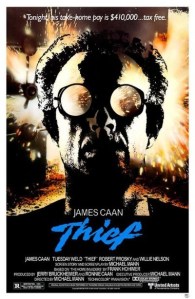 Yesterday, I introduced a special screening of Thief at Picturehouse at Fact cinema Liverpool. Set in Chicago in the early 1980s, Thief is one of the greatest crime films of modern times, and we were able to bring it back to the big screen in Liverpool via Ourscreen, which is also how I arranged a screening of Sorcerer last December (and my friend Dan Slattery organised a Christmas screening of Die Hard).
For such an esteemed noir tale, the plot of Thief is relatively straightforward. James Caan plays professional jewel thief Frank. When the fence from one of his heists dies in suspicious circumstances, Frank finds himself in the crosshairs of the Mafia. Mob Boss Leo offers to make him ‘a millionaire in four months’ if he will do heists for him. Frank’s plan is to do one or two really big scores and then go straight, but will his violent new employer let him? The narrative takes second place to the character study of Frank and the people around him: his beautiful girlfriend Jessie (Tuesday Weld), his likeable and trusted accomplice Barry (James Belushi), and his jailhouse mentor Okla (Willie Nelson). Frank is the archetypal sympathetic criminal that often populates Michael Mann films (think Larry Murphy in The Jericho Mile or Neil McCauley in Heat). He wants to raise a child and lead a normal life with Jessie, and he wants to arrange parole for Okla before a heart condition dooms him to die in prison. But to do all that he has to take down scores, and the people he loves the most will suffer for his sins.
Thief is based on Frank Hohimer’s memoir The Home Invaders: Confessions of a Cat Burglar. Hohimer was the pseudonym of professional thief John Seybold who wrote the book in his jail cell after turning informant and vowing never to go back to a life of crime. Seybold narrates his criminal career in a hypnotic street-wise prose, and is not an entirely unsympathetic criminal, but is a much meaner and rougher character than Frank his movie counterpart. Seybold specialised in home invasions, but Frank tells Leo in Thief that he will only rob from department stores and businesses. Also, Seybold was a suspect in the unsolved murder of Valerie Percy. Miss Percy was found beaten and stabbed to death in her bed on September 18, 1966. Seybold came under suspicion, alongside numerous burglars, as the Percy family lived in a plush Kenilworth mansion (Valerie’s father Charles was elected to the United States Senate) and it was assumed to be a case of a burglary gone wrong. Seybold denied any involvement, but admits in his book that he lied to the police about the case. He refrains from discussing the murder until the brief final chapter of the book, but, strangely, the photographs printed in the centre of the memoir certainly dwell on the case. Seybold spends much of the text ranting about the corruption of Chicago’s Criminal Intelligence Unit and how they were determined to frame him, but I can’t help feeling that he may have been fitted up for the Valerie Percy murder by his own book editor. This may have been for commercial reasons. The book sold well on its initial release (possibly due to interest in the Percy murder), but is almost entirely forgotten today and its fiendishly difficult to get a hold of a copy. I had to borrow my copy from the British Library who, I suspect, have the only copy available in the UK. In recent years Mann has tried to distance Thief from the book on which it was based, although in some respects the film is a fairly literal adaptation. Okla’s prison letter to Frank, for instance, is almost word-for-word identical in book and film. In an essay for the Blu-Ray edition of the film, Brad Stevens claims the film is based on the criminal exploits of John Santucci (stage name of John Schiavone), who acted as a technical consultant on the film and played the corrupt detective Urizzi. In another one of life’s little ironies former Chicago cop Dennis Farina makes his acting debut in the film as one of Leo’s hitmen. Farina had once arrested Santucci on burglary charges. Seybold himself is said to have been a technical consultant on the film, despite there being an outstanding FBI arrest warrant out on him at the time. Seybold would wind back in prison. Another problematic ‘technical consultant’ on the film was former CIU Chief William Hanhardt. He would later be convicted of running a jewellery theft ring and sentenced to prison.

Yours truly introducing Thief at Picturehouse at Fact in Liverpool
Thief is one of the best films for portraying the thin line between cops and criminals, and it is significant that it was one of the first films produced in Chicago after Mayor Richard Daley left office. Daley had made it difficult for studios to get filming permits for Chicago (there was a de facto 20 year hiatus) during his tenure as Mayor of the Windy City. Daley was apparently angered at the portrayal of Chicago as a haven for crime and corruption, and while Chicago native Michael Mann doesn’t shy away from the grit and grime of the city, it is clear he still loves its colourful and characterful bars and nighthawk diners. Fans of Heat and its famous diner scene with Pacino and De Niro will recognise a precursor to that scene in Thief. In many ways Thief is a stronger film than Heat. Upon revisiting Heat I found there to be far too much windswept hair, sunglasses and Armani suits. Thief is a far more realistic portrayal of criminals and the day-to-day drudgery of the criminal life, and yet Tangerine Dream’s pulsating score and Mann’s now trademark neon cinematography imbue the film with a haunting beauty.
It’s still a classic 37 years after its original release, and it was a privilege to bring it back to the big screen.
Postscript: As The Home Invaders is such a rare book today I felt it would be worthwhile sharing one of the anecdotes from its pages with you. Hohimer/Seybold describes burglarising an Indianapolis home and waking a ‘really beautiful blonde’ woman. He finds her unexpectedly chatty considering she has just surprised a burglar.
She said, “Could I talk with you a few minutes first?”
I said, “Sure why not it’s your home.”
Now I was mentally alert for any type of trick. She pointblank asked me how much I would charge to kill her husband (like I am an authority on murder and it has a set price). I said, “What would it be worth to you?”
She said, “Well I have never done this before so I don’t know, would ten thousand be correct?”
I said, “What about more like thirty thousand?”
“All right”
“Fine, we are in business. Do you have the money here in the house?”
“No.”
“Well how about a down-payment.”
“I have no money here, I can go to the bank tomorrow and get it.”
If she had the money in the house I would have taken it anyway and done nothing. I said, “Honey that would really be a smart move for me. I come to meet you and the police are waiting.”
“Oh no I wouldn’t do that.”
I was glancing at a phone book. I opened the first page and saw the FBI number and closed it. I said, “Honey I’ll tell you how we are going to work this so we can both be safe. Do you have a pencil handy?” She started to open a drawer, I said, “Don’t open that drawer, I’ll get it for you.” I was not about to take my eyes off that bitch for one second or let her stick her hand in no drawer. She was one cold blooded mother-fucker. We had just gotten through discussing the terms for murder and it meant no more to her than you discussing the latest book you read.
I gave her the pencil and the phone number. I said, “Now you call this number three days from now. When I answer the phone I’ll say FBI and that way you can be sure you’re talking to me, and you tell me what you want and I’ll be sure it’s you.” She wrote it down. I said, “Now I have to tie you up to make this robbery look good.” She said she understood, the maid would untie her in the morning.
When we got back to our car, I told Barry what the broad said, he wouldn’t believe me. To this day he thinks I am bullshitting. I been in a lot of homes and I never had that request before or after. I wonder if she made that phone call.

Each chapter of The Home Invaders begins with an illustration of an item from Hohimer’s burglary kit
In Dog Years: Ellroy at 70
Today is James Ellroy’s 70th birthday, and to mark the special occasion, we welcome back to the blog James Ellroy aficionado and all-round good guy Jason Carter…
A popular myth says that dogs age 7 years for every one year a human advances. Today, March 4, 2018 James Ellroy, the Demon Dog of American Literature, and our closest approximation to a human-dog hybrid, turns 70. With people living well past that today (70 is the new 20!) it’s no longer a number as daunting as it once seemed… until you actually get there yourself.
According to the dog to human ratio, Ellroy the dog at 70 is the canine equivalent of Ellroy the human at 10… As the Demon Dog himself often says, “Grok the groin-grabbing gravity” here!
Ellroy’s 70th trip around the sun is a seminal occasion in this old dog’s momentous life. At 10 years old, the central event of Ellroy’s existence arrived—the horrid and brutal murder of his mother. Ellroy has spent every waking moment since then reminding us all that he is still, and forever, that 10-year-old boy, beset with an ambiguous bereavement.
Ellroy’s L.A. Quartet begins and ends the exact same way… an old man looks back to a chaotic and beautiful time. As Ellroy completes his Second L.A. Quartet—an expansive immersion into the era immediately preceding the action of the original Quartet—the Demon Dog joins Bucky Bleichert and Dave ‘The Enforcer’ Klein in doing the exact same thing—looking back, and like so many of Ellroy’s bad men, coming to terms with his mortality.
When I suggested to Ellroy once that he introduce and screen one of the numerous documentaries about him at the Alamo Drafthouse as part of his now-iconic monthly Denver film series, the Demon Dog declined, replying in a manner even I wasn’t prepared for: “My ego’s not as big as it used to be…” For a man who has spent a lifetime making a brashly outsized ego an indelible component of his public shtick—indeed the flagship product of the Ellroy brand—this is a stunning admission.
Yet, Ellroy’s introspection—and its implicit capitulation—is at odds with the Demon Dog’s determined personal challenge to make every successive novel more complex and engrossing than anything that preceded it, an action which clearly invokes Dylan Thomas. And while Ellroy is famous for concluding his book readings with Thomas’ 1946 poem “In My Craft or Sullen Art,” it is another Thomas work—perhaps the Welsh poet’s most notorious—written just a year before Ellroy was born, that the Demon Dog is emulating most fervently: This devoted dog is rage, rage, raging against the dying of the light.
In a 2009 interview conducted by his then-girlfriend Erica Schiekel, Ellroy said “I don’t wanna be one of these older guys that write skinnier, and skinnier, and skinnier, and more and more solipsistic books… I wanna write big motherfuckers full of density, history, and I want to change.”
Perfidia, Ellroy’s first novel following that interview, certainly upheld that commitment, as the book—701 pages in hardcover—was the Demon Dog’s longest ever… Ironically while also being a comprehensive micro history—its story unfolding over just 23 sin-sational days in 1941.
In a January, 2015 appearance on PBS’ Overheard with Evan Smith, Ellroy sounded like a more cantankerous incarnation of Cormac McCarthy’s Sheriff Ed Tom Bell as the Demon Dog used Perfidia to denigrate the disingenuous distinctions of a classless era. “[Perfidia] is a broadside against minimalism, irony, and all things picayune in the [contemporary] culture… Everywhere you go [today], there’s a gigantic ad with blood sucking vampires, dystopian end-of-the-world hoo haw, poor people transported to the planet Jupiter, so rich people can inhabit planets closer; a quasi-Marxist vision made by movie studios looking to reap half-billion dollar profits… this is a good culture to deny. This is a good culture to time travel back to another era.”
A disdain for popular culture has remained an Ellrovian hallmark since the Demon Dog’s first novel Brown’s Requiem, a work in which the narrator and title character, Fritz Brown (Ellroy himself in all but name), rails against American “optimism, boosterism, and yahooism that [opts] for sentiment over truth every time”. Interestingly enough, in an introductory essay for a 1994 hardcover reprint of Requiem, the Demon Dog seems to chide the youthful naiveté of this quote when Ellroy says “It takes a while to learn to imply rather than preach.”
While Ellroy spurns popular culture, which ostensibly includes the goofy excesses of astrology, he is quick to tell you that 1948, the year of his birth, was the Year of the Rat in Chinese Astrology.
Criticisms of popular culture aside, it is worth noting that 2018 and 1958 are both Year of the Dog.
A typical Ellroy introduction at either a book reading or film screening will often include the Demon Dog’s recitation of “Little Gidding.” It’s a 1942 poem that stands as the last of T.S. Eliot’s Four Quartets, and explores the connections of the personal, historical, past, present, spiritual renewal, and the burden of experience, ultimately espousing Eliot’s belief that humanity’s gross mismanagement of life leads to severe imbalance and war. However, this turmoil can be overcome, Eliot assures us, by recognizing the lessons of the past—a softer way of saying “accept responsibility for your actions or inertia”—this is a prime educational tenet of Ellroy’s cannon also. The past, present and future are unified, “Little Gidding” tells us (or, as Ellroy often phrases it, “then is now.”), and understanding said unity is inescapably essential for salvation and growth.
Ellroy has said for decades that he believes his murdered mother mounted a valiant—though ultimately unsuccessful—fight for her life in her last moments, violently scratching and clawing at her attacker. It seems Jean Hilliker Ellroy’s only child is doing the same as he defiantly stares down the sunset. Rage, rage, rage.
Look at this bittersweet, elegiac moment as a neon-lit, kaleidoscopic fever dream panoply with a white noise soundtrack of TV fuzz:
Ellroy at 70.
Ellroy at 10.
2018.
THEN is NOW.
Closure is bullshit.
Ramification without end.
The Contained Apocalypse.
These mental machinations can drive a person insane.
The “Contained Apocalypse” is an Ellrovian construct that utilizes past violence, particularly that of the 1940s and 1950s, to allegorically explicate contemporary violence… a notion that also echoes the Demon Dog’s lifetime quest to obliterate the fatuous myth of “closure”. Ellroy discussed the concept at length shortly after the 1992 publication of White Jazz:
“[My books] reflect the 1990s. I’m just juxtaposing 90s violence in a more contained fashion, back to the 40s and 50s… And I think people want to know why… And I think I give them some answers… I think that The Big Nowhere was set in 1950—but 1950 is now… I think that the same things that were going on then, are going on today—only now everything has a name… Back then, everything was hidden… It was the more contained apocalypse…”
Twenty six years later, these words—originally spoken amid the chaos of the 1992 L.A. Riots—have lost no relevance. Ellroy is an elder statesman and a battle-weary warrior whose words injure as much as they instruct. The lesson this ninth grade dropout teaches is lingering, painful, and sparing of no one; something the Demon Dog alludes to when he says “If you find my books difficult to read, imagine how difficult they are to write.”
The years of struggle have certainly left their mark: Ellroy’s squamosal, coronal and lambdoidea skull sutures are clearly showing, and I can only imagine the ferociously obsessive and endless mental firestorms that pushed them to the surface, the same way that subterranean magma gradually sculpts the land above.
Still, the inevitabilities of age aren’t all doom and gloom… Ellroy has made his complete lack of hair a humorous refrain; something he often references when he encounters another bald patron (“Hey brother—LOVE your haircut!”), or—more frequently—when he sees an enviously full head of hair (“Can I get a hair transplant?!”). As my hair has always grown thick, full, and fast, I am often the subject of Ellroy’s tragically optimistic request. (In fact, Ellroy often introduces me at the Alamo Drafthouse as “This is Jason Carter… wouldn’t all of you like to have hair like Jason?” I often respond with “Anytime you want that hair transplant, Dog…”)
Ellroy loves pitbulls. When he signs books, he’ll frequently draw a likeness of one of his two pitbulls, Dudley, or the dearly departed Barko, on the page. They’re clearly his favorite dog breed, although Ellroy professes a passion for all animal life (something that compelled the Demon Dog to adopt a vegetarian diet for a time several years ago). When speaking about pitbulls, Ellroy frequently cites the dog’s legendary intelligence and loyalty as some of his favorite canine traits.
As a dog lover myself, I’ve always seen Ellroy as a German Shepherd, recognizing in the Demon Dog the shepherd’s strength, work ethic, athleticism, fierce intelligence and unsurpassed loyalty… It’s no wonder those dogs are the preferred breed for the military and police agencies.
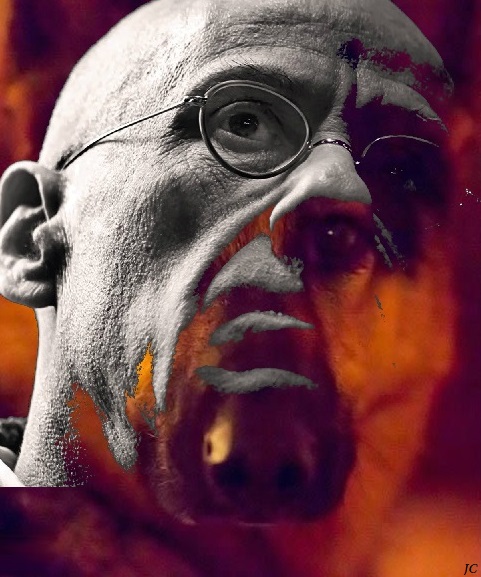 Ellroy’s energy is ecstatic and infectious. I’ve spent enough time with Ellroy the past two years to say with absolute certainty that the Demon Dog at 70 years old, has more energy—mental and physical—than many people one third his age. He’ll attribute his boundless stamina to his constant coffee consumption (“Can’t make the scene without caffeine!”), but I believe Ellroy’s spark originates from a deeply intrinsic need to outrun the squalid and feckless years of his youth (Ellroy’s 1996 memoir My Dark Places provides a raw and rapaciously readable account of this downward spiral).
With three more volumes to go in the Second L.A. Quartet, and Ellroy’s ruminations about a possible post-war trilogy after that, the Demon Dog’s final sprint is looking more and more like an ultra-marathon with no finish line, or at least an unwanted one…
Fuck closure.
Happy Birthday, Dog.
Jason Carter
McMafia – Gangsters in the Age of Globalisation
 The final episode of McMafia was broadcast last night, and while it may not have been the monster hit the BBC were hoping for, I would still rate it as one of the best dramas produced for television in recent years.
The story followed the fortunes of City of London banker Alex Godman (James Norton). The scion of a wealthy Russian family exiled in London, Godman at first comes across as your typical stiff upper lip English gentleman who wants nothing to with his father’s alleged involvement with organised crime. But when Godman’s uncle Boris makes the mistake of trying and failing to assassinate rival Mob Boss Vadim Kalyagin, Godman soon finds himself dragged into his family’s dangerous world by association. After Boris pays the ultimate price for crossing Vadim, Godman (whose legitimate business is failing) is courted by the shady Israeli politician/gangster Semiyon Kleiman (David Strathairn) who wants to continue the covert war against Vadim but can only do it with Godman’s help. There are strong parallels here with The Godfather, in which the good son (Godman/Michael Corleone) rejects the family business only to be sucked in regardless and, to his surprise, quietly enjoys the role of gangster. The deterioration in Godman’s relationship with his fiancee and the lost opportunity of fatherhood is also reminiscent of Michael and Kay in The Godfather. Even the reference to Veniamin (an ill-fated Russian crook whose grisly demise is used as a verbal warning) allusively reminded me of ‘Luca Brasi sleeps with the fishes.’ Does Godman’s name echo The Godfather as well? As the series progresses, it becomes clear he is certainly not the good man he thought he was, and he seems to have a God-like imperviousness to human emotions.
 The influence of fictional gangsters from popular culture on the drama is unusual as McMafia is based on non-fiction. Misha Glenny delivered an outstanding piece of investigative journalism in his book McMafia. He recounts in astonishing detail how the fall of communism led to ex-members of the Security Services in Eastern Bloc countries to launch their own mafias once they found themselves out of work. Spin the globe and Glenny examines how the Yakuza played an unusual role in rebuilding Japan (for a healthy slice of the profits) after the Second World War. In another chapter he focuses on how some of the most notorious internet email scams began in Nigeria. But how does this relate to the TV series? Show creators Hossein Amini and James Watkins have taken Glenny’s work as a font of inspiration for the series but did not have a strict linear narrative from the book to follow. I found this quite liberating as I could read the book without it having any spoilers for the TV series. Other non-fiction works such as Fast Food Nation and The Men Who Stare at Goats have been adapted this way. Certain parts of the text did feel like they were directly inspired by the book. For instance, Lyudmilla the Russian beautician who arrives in Cairo expecting to find legitimate work only to be kidnapped and trafficked into the sex industry in Tel Aviv is very closely modelled on a harrowing story from the book of Ludmilla, a Moldovan woman who was forced into the sex trade during what should have been an exciting adventure abroad. As a powerful drama with an epic scale, McMafia astounded me. Watch a gangster film like Goodfellas and you’re often seeing thugs with baseball bats beating people up over unpaid loans or petty insults. McMafia, by contrast, portrays a world in which drugs manufactured in India are sold in Africa, the profits are laundered in the Cayman Islands and wind up in London or Moscow bank accounts. Organised crime has become a global business.
McMafia has substantial flaws which led many viewers to switch off and stopped it from generating the ‘water cooler talk’ buzz that accompanied other BBC hits such as The Night Manager. It pains me to say this but James Norton is just too wooden as Godman. I understand he may have wanted to avoid comparisons with Bryan Cranston’s manic portrayal of chemistry teacher Walter White in Breaking Bad, and opted for a quieter introspective approach, but Godman felt too much like a blank slate. If anything, I felt more sympathy for Vadim the lifelong gangster who slowly finds his empire crumbling around him. Vadim knows his kind are not fated to die peacefully in their dotage, but his visible shock at the price his family pays for his misdeeds made me empathise with him. Also, the series was dogged with allegations of anti-Russian sentiment and anti-Semitism. I don’t think its controversial or wrong necessarily to portray gangsters of different nationalities. As Glenny writes in the book, almost every country on earth has produced gangsters, and the few countries that appear not to have an organised crime presence tend to have ultra-authoritarian governments such as in North Korea where the ‘state budget is decisvely dependent on the trading of narcotics to criminal syndicates in neighbouring countries’. However, in the show, Semiyon is not only a gangster he is a member of the Knesset, being assisted in a human-trafficking scheme by a Mossad agent. This was certainly one of the more over the top plotlines, and the forthcoming adaptation of John le Carre’s controversial The Little Drummer Girl, given the subject matter, will likely add to allegations of anti-Semitism at the BBC.
But if you can overcome these problems, and they are significant, then McMafia is still an astonishing feat of storytelling. In many ways it is a grittier, more realistic portrayal of organised crime than The Night Manager which had descended into a colourful caper by its final episode. McMafia is already making an impact on the real world as it seems to be influencing government policy. It may have lacked popular appeal, but McMafia still has many distinctions to recommend it.
Michael Mann’s Thief at FACT Liverpool
I’ve arranged a Ourscreen showing of Thief at FACT Liverpool on Saturday, March 10th at 12 noon. Thief is one of my favourite films, and I would argue one of the greatest crime films of the 1980s. The story behind the production of the film is fascinating, but I’ll talk more about that on the day as I’m introducing the film. You can book tickets through the Ourscreen website. Please note the screening only goes ahead if we sell enough tickets. Ourscreen kindly added Thief to their catalogue (as they did with William Friedkin’s Sorcerer last December) so I could arrange the screening. I’ll post a copy of my talk about the film after the screening, but why not come along so you can see it in person? Hope to see you there.

The Play That Goes Wrong – Review
I first came across the phenomenon that is the Cornley Polytechnic Drama Society when I saw the Christmas TV specials Peter Pan Goes Wrong and A Christmas Carol Goes Wrong. Those two productions were probably the funniest thing I’d seen on television for years. So, when I heard that the original The Play That Goes Wrong was touring in the UK I eagerly snapped up a ticket. The premise of each play is that the fictional Cornley Polytechnic mount productions which through a combination of incompetence, bad luck, raging theatrical egos and bizarre coincidences invariably go wrong. The fun for the audience is to watch these very amateur actors try and keep it together.
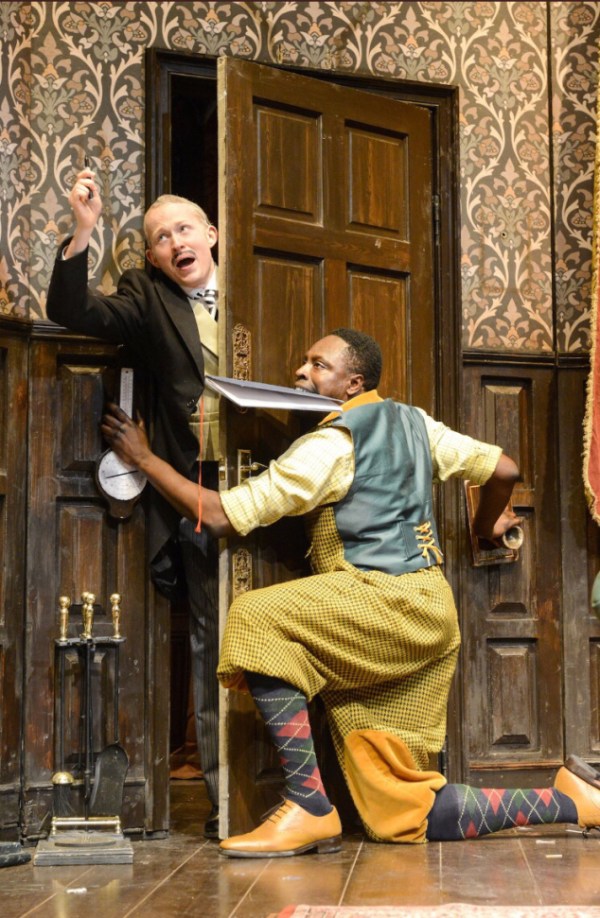
I’m glad to say that this material is as funny, if not more so, onstage as it is on the telly. While audiences members were still taking their seats, the cast engaged in some breaking of the fourth wall. One member of the ‘technical crew’ walks round asking if anyone has seen her dog, while cast and crew members fiddle with a door on the set that just won’t stay shut (this is a set-up for two gags that pay off in spades once the play begins). Then we get an introduction from Chris, director of Cornley Polytechnic and lead actor in The Murder at Haversham Manor (a spoof of Agatha Christie’s The Mousetrap). This play within a play has a classic Golden Age Mystery set-up. A dead body is discovered at the eponymous Haversham Manor. An Inspector arrives and everyone at the house (gardener, butler, fiancee to the victim etc.) are murder suspects. This ‘plot’ acts as the springboard for a non-stop series of gags, including slapstick, double entendres and sex farce (one rather fetching member of the cast spends almost the entire second act clad only in her negligee). The amateur thesps struggle to keep the play going as the set quite literally falls apart around them. The Play That Goes Wrong is so gleefully funny and joyfully entertaining that to attempt any critical analysis might take away from its charm, but I will say that the laughs come thick and fast and even moments that don’t seem amusing at first are often just the build-up for big punchlines later on. It features physical comedy which is up there with the best of Chaplin or Buster Keaton, and also nicely sends-up the traditions of the English country house murder mystery. All that remains to be said is go see it. You’ll laugh yourself silly.
I saw The Play That Goes Wrong at Chester’s impressive, and still relatively new Storyhouse theatre. You can find details of the nationwide tour here.
Need to Know by Karen Cleveland – Review
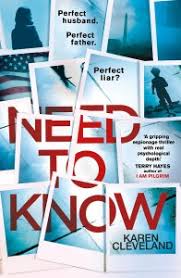 Need to Know is one of the most anticipated thrillers I’ve come across in years. Almost a year before publication date, it was reported that the movie rights had been sold and Charlize Theron will produce and star in the film adaptation. With such hype you might think any reading of the novel is bound to be a disappointment, but my initial reaction was one of surprise. Surprise that such a slow-burning intelligent spy novel could still be such a massive hit in an age of repetitive and action-driven vacuous franchises.
In Need to Know, Vivian Miller is a CIA counter-Intelligence analyst who seems like she has it all: a high-powered career tracking Russian sleeper cells in the US and a nice house perfect for raising her four kids with her loving, handsome husband Matt. But it’s not long before things start to unravel. A secret dossier at work reveals her husband is a Russian spy. She buries the evidence while she decides what to do. Cleveland gives us flashbacks to Vivian’s early relationship with Matt and how it developed. Suddenly, the mysteries of his character are beginning to make sense. Why did he always cancel planned visits for them to meet his parents at the last minute? Where did all of his money come from? The idea that you can never really know your partner is hardly new to the genre, and just when I thought this was going to be Gone Girl at Langley the story takes another turn. Vivian’s efforts to conceal her husband Matt’s true identity from her employers get increasingly dangerous, and the reader is left wondering if she choose between loyalty to her country or her love for her husband.
Cleveland spent eight years working as a CIA analyst, and she joins the growing ranks of retired spooks writing spy novels. Thankfully, she brings her knowledge of real-life espionage to add realism to this tale. This is a world wherein spies sit in front of computers and pore over financial statements and social media messages looking for threats to national security. And yet, even if the spy trade isn’t glamorous, Cleveland makes sure its never dull. Need to Know kept me guessing right to the end as the characters are involving and sympathetic. Vivian and Matt are not lazy caricatures of spies, they have the same problems as other couples, and the reader identifies with them as a consequence.
Just before Christmas, publishers traditionally rush out ghost-written, shallow memoirs by celebrities you’ve never heard of. So, this January, I needed to know that well-written and engaging novels are still hugely popular. Karen Cleveland did that for me.
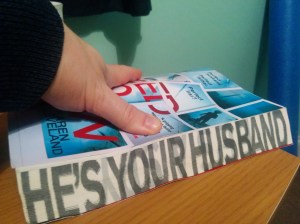
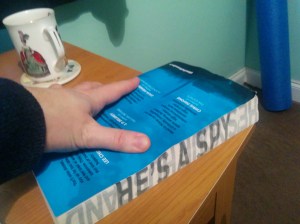
The proof copy of Need to Know had a hidden message for budding spies
Kiss Kiss, Bang Bang: The Boom in British Thrillers from Casino Royale to The Eagle Has Landed by Mike Ripley
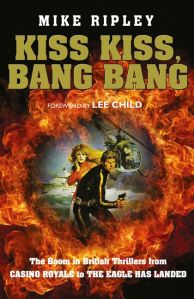 Do you remember whiling away a train journey or a long winter evening with a paperback World War II yarn by Alistair Maclean? Or a well-paced thriller by Desmond Bagley? Or an expertly detailed sea adventure by Hammond Innes? If so, have you ever wondered why you don’t see novels like this anymore? Then Mike Ripley’s Kiss Kiss, Bang Bang: The Boom in British Thrillers from Casino Royale to The Eagle Has Landed is the book for you. Although genres such as crime fiction and sci-fi have remained immensely popular and garnered increasing critical acclaim, the old fashioned thriller, as pioneered by the aforementioned writers as well as by luminaries such as Wilbur Smith, and in the US Robert Ludlum, have slowly started disappearing from our shelves.
In the end I couldn’t bear another airport lounge or AK-47 and I gave up. It was, it seemed to me, a sub-genre that had had its day. The thriller wasn’t thrilling any more
Die Hard on the Big Screen
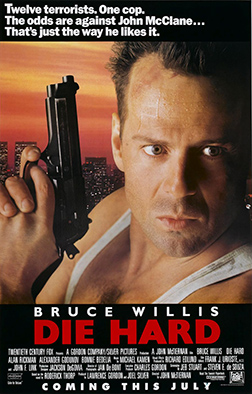 Over Christmas I watched the original Die Hard at FACT cinema Liverpool. The screening was arranged by my good friend Dan Slattery via Ourscreen, who had helped me arrange a screening of William Friedkin’s Sorcerer at FACT at the beginning of December. Needless to say, it was wonderful seeing the film in the cinema almost thirty years after it was originally released… and even better to see it over Christmas. Yes, I’m definitely in the Die Hard is a Christmas movie camp.
If you read this blog, I suspect you’ve seen Die Hard as many times as I have, so, instead of doing a traditional review, I thought I’d share some of the observations of the group I went to see it with, and my own musings, as we discussed the film in the bar afterwards.
Die Hard‘s screenplay has extremely tight writing: every plot point connects. Screenwriters Jeb Stuart and Steven E. deSouza clearly believed in the Chekhov’s Gun principle in narrative, and lots of little details that occur early in the film pay off beautifully as the story moves on, such as Holly Gennaro/McClane slamming down the framed family photo in her office.
Die Hard is considered a perfect example of a Three-Act structure: set-up, confrontation and resolution (thanks to Dan for pointing this out). It becomes increasingly clear during the second act that the terrorist plot will not succeed, but at the same time, the odds are never in favour of our hero John McClane surviving. Bruce Willis deserves great credit here – he created a hero that bleeds and the audience can almost feel every punch, kick, bullet and explosion he endures along the way.
As villains go, Alan Rickman balances malevolence with comedy perfectly and his performance started the trend of British theatrical actors playing villains in Hollywood films (and could have typecast Rickman). To my knowledge he only played one more major bad guy, a very over the top Sheriff of Nottingham in Robin Hood: Prince of Thieves. But, in Die Hard he gets the tone just right, relishing his evil lines and comic asides ‘Mr Takagi won’t be joining us for the rest of his life’, and never letting the all round excess of the story overwhelm his quiet menace.
The one scene I really don’t like is Sergeant Al Powell’s shooting of the terrorist Karl at the coda. It seems a triumphalist, utterly tone-deaf, way for him to overcome his accidental killing of a child years earlier which he confesses to McClane in one of the most touching scenes in the film. If it was being re-shot today, I doubt that scene would make it to the final cut. But in a way Die Hard never really ends. It was the beginning of a franchise that is still going strong today (let’s just forget about A Good Day to Die Hard), and spawned numerous imitators: Cliffhanger (Die Hard on a Mountain), Under Siege (Die Hard on a Battleship), and probably influenced the style of the later Bond films as well. Not bad for a Christmas movie.
L.A. Confidential the movie—20 years later
For our last post of 2017 we welcome back to the blog James Ellroy aficionado and all-round good guy Jason Carter. Here’s Jason’s bio:
Jason Carter is an unofficial Ellroy scholar with 20-years of Ellrovian tutelage under his belt. A devoted follower of Ellroy since the age of 14, Jason now has the enviable honor of calling Mr. Ellroy his friend. Although, don’t think of asking Jason for any personal details about Ellroy, as Jason is ferociously protective of Mr. Ellroy’s privacy. Jason, like Ellroy, lives in Denver, Colorado.
“My book, your movie…” This is James Ellroy’s expeditious way of distinguishing himself and his work from the output of Hollywood…it’s common knowledge to anyone who’s followed the Demon Dog’s work for any number of years.
In Reinhart Jud’s 1993 Demon Dog of Crime Fiction documentary, Ellroy, riding high on the then-newly published conclusion to his L.A. Quartet, White Jazz, left no one in uncertainty about how he views film versions of his books: “People option my books, they tell me ‘it’s going to be a masterpiece, so and so will direct, so and so will star in it,’ and I say to all of them except James B. Harris, [director of the 1988 James Woods film Cop, a forgettable take on Ellroy’s Blood on the Moon, with Woods as Lloyd Hopkins] HORSE SHIT! Don’t tell me it’s gonna get made, ‘cause it’s not gonna get made, and chances are if you do make it, you’re gonna fuck it up!”
This skepticism is perfectly consistent with Ellroy’s constant warnings that nothing is ever what it seems in Hollywood, and all is not right; in a phrase, disingenuous verisimilitude, a concept pervading literally every one of Ellroy’s books.
While Ellroy’s books have exposed Hollywood’s flaws with candor and unfettered honesty, he is hardly the only novelist to speak critically of Tinsel Town. I remember seeing a 1990s television interview with Michael Crichton, in which The Andromeda Strain author lambasted Hollywood as “a business of idiots!” (An astonishing statement, given Crichton’s decades-long friendship with a certain Hollywood A-lister named Steven Spielberg.) And it’s hard to forget Tom Clancy’s famous quote that “giving your novel to Hollywood is like turning your daughter over to a pimp.”
Curtis Hanson’s 1997 star-studded and Academy Award-winning adaptation of L.A. Confidential recently marked its 20th anniversary earlier this year. Even after two decades, the film is still the best, and most memorable Ellroy adaptation to date. (Please forget about over-rated auteur Brian DePalma’s $50 million defecational flop The Black Dahlia in 2006—just forget about it…)
In a making-of featurette attached to an early DVD of L.A. Confidential, Hanson said of the ensemble cast “My hope was to cast actors that the audience didn’t already know… Actors the audience could discover the way I had discovered them.” Both Russell Crowe (Bud White) and Guy Pearce (Ed Exley) were relative unknowns in 1997. For “Trashcan” Jack Vincennes, Hanson chose an established movie star then at the top of his game: The recently disgraced Kevin Spacey.
The 2001 Ellroy documentary Feast of Death begins with Ellroy’s declaration that “L.A. Confidential the movie is the best thing that happened in my career that I had absolutely nothing to do with… It was a fluke, a wonderful one, and it is never going to happen again, a movie of that quality.” Ellroy then tells of a now-famous encounter with an old lady at a Kansas video store that serves as a parable for the Demon Dog’s assessment of Hollywood. My book, your movie.
Curtis Hanson’s film L.A. Confidential, covering maybe 13% of the book (and roughly four of the novel’s 14 fully developed plotlines), is now 20 years old, and people can’t stop talking about it. By contrast, James Ellroy’s far more cinematic novel turned 20 in June, 2010, and no one, save for Ellroy himself, and maybe the Demon Dog’s publishers, said a word.
I’ve already told you about the disgust I felt over how Hollywood disingenuously treated my favorite character from the novel, rape victim Inez Soto. When I’ve mentioned this to Ellroy on several occasions in the past, he constantly reminds me that the actress who played Inez Soto in the movie, Marisol Padilla Sanchez, is now 44, and too old for me. I insist that I’m referring to the far more richly detailed character from the Demon Dog’s novel, but to no avail. This sardonically humorous exchange between Ellroy and I, coming across like a jazz refrain, makes an appropriate metaphor for the fatuous deference popular culture will blindly pile onto a film, while diminishing, ignoring and eventually forgetting its original inspiration or source. Ellroy is a master of nuance both on the page and in person, and I can’t help but wonder if this dismissive and odd constant response isn’t his allegorical indictment of mass-market disregard.
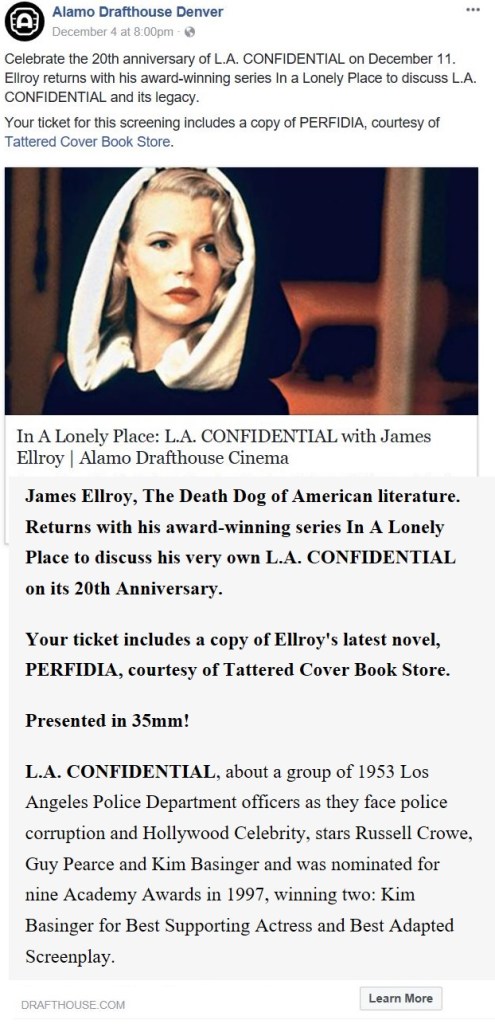 Introducing a film screening of L.A. Confidential is nothing new for the Demon Dog; he’s done it on countless occasions all over the world—most recently in Chicago in August, 2017. When Ellroy moved to Denver, Colorado in 2015 and began hosting his dynamite and award-winning monthly film series In A Lonely Place, he kicked off the series in September of that year with L.A. Confidential.
On Monday, December 11, 2017, Ellroy screened a scratchy, off-color 35 mm of his greatest film adaptation (a most non-digital print looking every day of its 20 years) once more, in honor of its 20th anniversary. With a hefty ticket price that included a copy of Ellroy’s latest novel Perfidia, courtesy of the Tattered Cover Book Store, a legendary Denver institution, the crowd was enormous.
After serenading the audience with a hilariously profane Christmas greeting Ellroy termed “Rudolph the Red Nosed Junkie,” Ellroy segued seamlessly into his timeless “peepers, prowlers, panty-sniffers…” intro and a lengthy recitation of T.S. Elliot’s poem “Four Quartets,” in short, a classic Ellroy introduction.
“L.A. Confidential the movie is an extraordinarily witty and lively depiction of L.A. in the 1950s,” Ellroy began. “It’s not a perfect motion picture, but it makes scandal-rag journalism, and the Sid Hudgens character, played by Danny Devito, fun… It makes the ruining of reputations and the American idiom—who’s a homo? who’s a lesbo? who’s a nympho? who’s a dipso? who fucks black people?—fun.”
This largely positive preamble soon gave way to Ellroy’s razor-sharp criticism. “[L.A. Confidential] is somewhat over-rated… It’s better than the over-rated Chinatown, but markedly over-praised.” Ellroy then railed quite loudly against the film’s “BAD miscasting,” declaring that “You feel nothing for Kevin Spacey, and you feel less than nothing for Russell Crowe and Kim Basinger.”
When Ellroy was asked whom he would cast if given free reign, he didn’t hesitate for a second: “A 1982 William Hurt as Ed Exley… Steve Cochran as Jack Vincennes… Sterling Hayden as Bud White [Crowe has actually cited Hayden’s performance in Stanley Kubrick’s The Killing as a model for the Aussie’s performance as White]… and a 50-year-old Albert Finney as Dudley Smith.”
 The most titanic irony of L.A. Confidential is that Ellroy wrote the novel with the specific aim to make it as cinema-unfriendly and unadaptable as possible. In an unwitting mockery of Ellroy’s efforts, the film would go on to win an Academy Award for—go figure—Best Adapted Screenplay. And while this is a well-known piece of history among the Demon Dog’s most devoted fans, Ellroy once again related the story of his novel’s bewildering journey to the silver screen, concluding with the warning that “If you write novels to be adapted into movies, you’ll always be on welfare…”
L.A. Confidential’s occasional bouts of anachronistically contemporary dialogue—particularly its Leathal Weapon-quality banter between Crowe and Pearce (Good cop, bad cop in 1953? Really?)—make it difficult to take the film seriously. However, the timing of this watershed anniversary couldn’t be more apropos, as it runs concurrent to a real world metastatic scandal that vibes paranoia like the best of Ellroy’s plotlines: The McCarthy-esque sexual assault malaise currently eviscerating Hollywood and the mainstream media, (indistinguishable entities as far as I’m concerned) and ruining plenty of reputations.
With Kevin Spacey in the dubious cross hairs of the on-going scandal, it was impossible not to talk about him. Ellroy handled the delicate matter with superb rectitude and equanimity: “I will not comment on the trouble that [Spacey] is currently embroiled in, except to say I could’ve predicted it!”
As a new high profile target emerges on an almost weekly basis, this “new McCarthyism” calls to mind the countless allusions Ellroy has made throughout his work to the ruthless sexploitation lurking behind the façade of Hollywood glamour. (Anyone remember the title of the Tijuana stag film Betty Short is coerced into in The Black Dahlia? It’s Slave Girls in Hell…Do you need another reminder?)
Juxtaposed against the scandal itself, Ellroy’s nuanced remark about Spacey deserves further scrutiny… Is Ellroy referring to a personal dislike of Spacey, or the Demon Dog’s career-defining fictional exposure of Hollywood’s pervasive dark side? As always with Ellroy, the answers are illusive and elliptical.
L.A. Confidential is indeed a uniquely prescient film for these dark times, even if it’s 20 years old.
For what it’s worth, happy 20th , L.A. Confidential. I was 16 years old when the film debuted and just two years into my Ellrovian Journey. I loved the film then, and I still love it now, but I’ll take Raymond Dieterling, Wee Willie Wennerholm, Kathy Janeway, and Dream-A-Dreamland (none of which were featured in the movie) any day over “Rollo Tomasi”.
I believe the words of demented patriarch Emmett Sprague from The Black Dahlia are especially relevant right now: “Hearty fare breeds hearty people…”
Skip the movie and read the book.
Last Sunday, I had the honour of introducing Sorcerer at Fact cinema in Liverpool. It was a somewhat nerve-wracking experience, not for the public-speaking aspect, which I enjoy, but at the thought that the audience wouldn’t like the film. After all, Sorcerer was a critical and commercial failure when it was released theatrically forty years ago, bringing to an end the tremendous hot streak director William Friedkin had enjoyed with the back to back success of The French Connection (1971) and The Exorcist (1973), and it arguably brought about an end to the New Hollywood era itself– that brief but wonderfully rich period in the 1970s when writers and directors had great sway in the studio system and it was relatively easy for them to tell the stories they wanted to tell and get their films made.
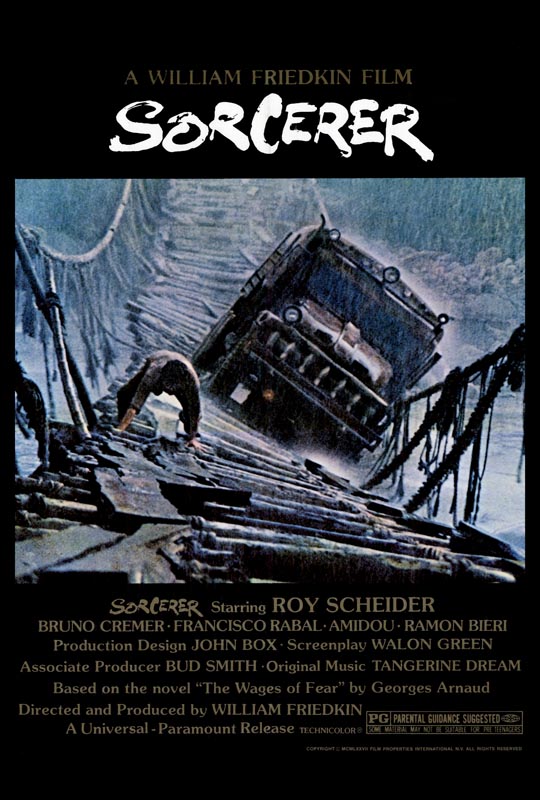
But I’m getting a little ahead of myself, if your unfamiliar with Sorcerer, let me tell you a little about the plot. A remake of the French film The Wages of Fear (1953), Sorcerer concerns four desperate men who, for varying reasons, are all on the run and find themselves in the Latin American village Porvenir. We have Jackie Scanlon (Roy Scheider) a member of the Irish-American Mob who robbed a rival Mafia Boss and wounded his brother. Then there is Victor Manzon (Bruno Cremer), a French investment banker whose involvement in a massive embezzlement scandal led to a suicide in the family. Kassem (played by Moroccan actor Amidou) is a Palestinian terrorist on the run after blowing up an Israeli bank, and then finally there is the hitman Nilo (Francisco Rabal), of whom the audience is told very little. In the prologue, Nilo commits a contract killing in Veracruz, before heading to Porvenir to lay low, but he remains an enigma throughout. With its poverty, rampant disease and generally squalid living conditions, Porvenir might be described as Hell on earth but it’s actually closer to Purgatory. None of the characters are able to leave, as without money, it is impossible to escape the remote location. An oil well fire offers a potential escape. The only way the fire can be extinguished is to use dynamite, but the nitroglycerine in the dynamite owned by the American oil company is old and leaking and will need to be transported through two hundred miles of jungle. Scanlon, Manzon, Kassem and Nilo are eventually selected to drive the dynamite in two trucks, Lazaro and Sorcerer, to the oil well. Only the promise of high pay and a ticket out of Porvenir would prompt these desperate men to take on such a dangerous job as every jolt or movement on the treacherous roads and jungle foliage they have to traverse could potentially trigger the dynamite to explode.
Their journey starts about halfway through the film, and that’s when the suspense, which had already been creeping upwards in a tense first half, becomes almost unbearable. The highlight is the rope bridge scene, where the two trucks have to be driven across a crumbling rope bridge in the most appalling weather. It’s an excruciatingly tense scene, and a marvel of innovative filmmaking which looks especially good today as audiences have become inured to CGI effects. Friedkin was renowned for taking dangerous risks for making his scenes as realistic as possible. The rope bridge was constructed in the Dominican Republic, where most of the film was shot. But during filming the water-levels of the river the bridge crosses started to go down, robbing Friedkin of the desired effect. The bridge was deconstructed, transported to and then reconstructed in Mexico at a cost of around three million dollars.
In addition to several stunning set-pieces, the acting and direction are also superb. Scheider is brilliant as Scanlon. Despite his role as a failed mobster, he is the everyman who guides us through this journey and projects a sense of humanity that we cling to in a relentlessly bleak film. And yet the film seems to find a humanity in every character: Manzon sincerely loves his wife despite his greed and venality; Kassem has a strong sense of loyalty and friendship, and even the quiet-lipped hitman Nilo is able to generate some sympathy. This is what sets apart Sorcerer from The Wages of Fear (which is a brilliant film in many respects). In the original, we don’t get the prologue scenes explaining why the four protagonists have ended up in Porvenir. While these scenes are brutal, they give the audience empathy for the characters as we get a better sense of their violent, desperate lives. I also think the ending to Sorcerer is superior to how The Wages of Fear ends. Without giving the game away, the ending to Sorcerer relates to how fate dogs our every move.
Friedkin has claimed (among numerous explanations he has given for the choice of title) that as a Sorcerer is a form of malevolent wizard then fate is the Sorcerer in this narrative and this justifies both the title and the gloomy tone. However, audiences at the time assumed that as this was the director’s follow-up to The Exorcist then it must be another supernatural horror movie. But Sorcerer is very different in tone to The Exorcist. It presents a brutally naturalistic world in which men, exiled from their urban environment, find that nature is indifferent to their need to survive.
Another factor that caused the movie to lose box-office potential was Friedkin’s inability to cast Steve McQueen in the lead role. McQueen loved the script, but Friedkin refused McQueen’s request to create a role for this then-wife Ali MacGraw so that they wouldn’t have to be apart for several months. Friedkin would come to regret his stubbornness, realising that McQueen’s name above the title would have lured audiences in. As a side-note, read Friedkin’s memoir The Friedkin Connection (2013): it’s one of the most contrite autobiographies I’ve ever come across by a Hollywood figure with so many achievements to his name, and he certainly owns up to the mistakes he made which lead the film to lose money. Roy Scheider, hot off the success of Jaws (1975), was cast at the producers insistence. Despite having worked together before on The French Connection, there was tension between Scheider and Friedkin as Friedkin had rejected the actor for the role of Father Karras in The Exorcist. Scheider’s casting led to a tense set. But finally, the biggest factor which lead to the failure of the film was that it was released around the same time as Star Wars which broke all box-office records and led to a slew of sci-fi imitators. By contrast, Sorcerer recouped less than half of its budget.
Three years after the release of Sorcerer, Michael Cinimo’s historical epic Heaven’s Gate was released in cinemas and received a shellacking from critics and disastrous box-office returns. Cinimo, briefly a darling of the critics after directing the oscar-winning The Deer Hunter (1978), had been indulged every whim by the studios eager for him to repeat his success and create a modern-day Gone With the Wind but it all went horribly wrong. If Sorcerer signalled the end of the New Hollywood period, then the failure of Heaven’s Gate only confirmed it. Studio executives regained full influence by the 1980s, and their grip has only tightened over the years as seen with the dreary repetitions of franchise reboots, remakes and re-imaginings. Now there are some critics who have argued that Heaven’s Gate is a neglected masterpiece. Frankly, I think that film may have deserved its critical drubbing, but I do believe that Sorcerer was unfairly maligned by reviewers upon its initial release. Fortunately, its reputation has grown over the years. Stephen King has named it as his favourite movie; Quentin Tarantino is a big fan, and film critic and Friedkin expert Mark Kermode has championed its re-release. As for the audience at FACT Liverpool that day, well I said in my intro that if anyone didn’t like it they were free to harangue me in the bar afterwards. I needn’t have worried, as there was nothing but positive feedback. If anyone didn’t like it, they kept it to themselves. But don’t take my word for it, a special edition Bluray DVD has been released to mark the fortieth anniversary of the film, so it will finally reach the wide audience it deserves. Sorcerer has taken a while to weave its magic, but it now stands out as one of the best films of the 1970s.
Maybe it was fated to be a hit after all.


