James Ellroy: The Poet in the Porno Bookstore
Perhaps it’s a sign of old age, but I’m looking forward to reading the critical reaction to James Ellroy’s new novel Perfidia almost as much as I’m looking forward to reading the novel. Ellroy has always been a canny writer in generating critical interest. On the one hand he is a wild man figure, the Demon Dog of American Crime Fiction decked out in garish Hawaiian shirts, spouting outrageous right-wing views and howling like a dog. And yet to many critics his writing transcends the crime genre and becomes something much more powerful. In France, his books are read as social commentary, and his deep knowledge of poetry is all too often overlooked despite frequent poetic allusions in his novels.
Ellroy’s skill as a publicist has been to merge these two roles, so the reader, critic or interviewer will never quite know how he will react and whether or not he is being sincere, or performing, or both. In his essay ‘Where I Get My Weird Shit’, Ellroy describes a period in the mid-1970s when his search for creative inspiration coincided with some of his worst experiences of drug and alcohol abuse:
I read books and shagged epigrams and insights. T.S. Eliot. Highbrow shit. “We only live, only suspire, consumed by either fire or fire.” A classy fuck flick: The Private Afternoons of Pamela Mann.
The Eliot quote, taken from ‘Little Gidding’ in Four Quartets, was to be the epigram of Ellroy’s unpublished novel ‘LA Death Trip’. The novel was extensively rewritten and re-titled Blood on the Moon (1984), with the Eliot epigram dropped in favour of a quote from Richard II. The Private Afternoons of Pamela Mann (1974) was a hardcore porn film directed by Radley Metzger and starring Barbara Bourbon in the eponymous role. I will leave it to Ellroy to describe the plot to you:
Pam Mann’s a horndog. She’s a passive punchboard and a seductress. She’s a nympho candide. She’s the poster girl for ‘70s excess. She fucks half of New York City in one day and comes home to fuck her husband. He’s the best. She really loves him. Her day was satire and a goof on inclusion. Sex is everything and nothing.
I haven’t seen the film (you’ll just have to take my word on that), but I have read up on it and there is a further twist (no pun intended) to the ending which I won’t reveal here. One of Ellroy’s first jobs was at the Porno Villa Bookstore, but he was fired after stealing from the till. Really, when you can’t trust pornographers what’s the world come to? Let’s assume Ellroy came across The Private Afternoons of Pamela Mann while he was working at the Porno Villa. It clearly left an impression on him, not just due to the ample charms of Barbara Bourbon, but because it was a memorable film with a strong story. Years later, he would weave the themes of pornography and voyeurism into his work. There are innumerable examples from his novels. The snuff film which features in the second Lloyd Hopkins novel Because the Night (1985) is memorably grisly.
The Eliot epigram from ‘Little Gidding’ never appeared in one of his novels; however, a writer as powerful as Eliot could easily influence Ellroy’s work in more ways than a mere epigram. Eliot, incidentally, was a keen reader of crime and detective fiction, so Ellroy’s admiration for him seems apt. As David E. Chinitz wrote in A Companion to T.S. Eliot (2009), Eliot may have preferred genre fiction to more serious, literary forms:
The fiction he (Eliot) admitted to reading was of another sort: the comic stories of P.G. Wodehouse, and the detective novels of Raymond Chandler, Agatha Christie and others. Eliot was in reality no friend of the sacralization of high culture that readers came to associate with him
I believe that the image of Ellroy (even if it is very carefully crafted by the author) working at the Porno Villa and jumping between porn and T.S. Eliot for creative inspiration as he nurtured his dreams of becoming a great crime writer, should appeal to fans of books of all genres.
I have found a trailer for The Private Afternoons of Pamela Mann. Apart from the grating narration, it does seem like a very good, Woody Allen-like, film:
Lunchtime Classics
I mentioned in a previous post that I’ll be talking about George MacDonald Fraser’s Flashman Papers on Wednesday, August 6th, 1pm, at Waterstones Liverpool One as part of their ‘Lunchtime Classics’ series. Here’s the itinerary of speakers, and works they cover, in the series: All talks begin at 1pm.
Weds 4th June: Slaughterhouse-Five by Kurt Vonnegut. Presented by Glyn Morgan (University of Liverpool).
Weds 11th June: Exegesis by Philip K. Dick. Presented by Nicole McDonald (University of Liverpool).
Thurs 19th June: House of Suns by Alastair Reynolds. Presented by Dr Will Slocombe (University of Liverpool). In Association with CRSF (Current Research in Speculative Fiction).
Tues 24th June: Butcher’s Crossing by John Williams. Presented by Lee Rooney (University of Liverpool).
Weds 2nd July: Castle of Otranto by Horace Walpole. Presented by Bethan Roberts (University of Liverpool). 250th Anniversary Special.
Mon 7th July: Waverley by Walter Scott. Presented by Dr Diana Powell (University of Liverpool). 200th Anniversary Special.
Weds 16th July: The Napoleon of Notting-Hill by G.K. Chesterton. Presented by Leimar Garcia-Siino (University of Liverpool).
Tues 22nd July: Fountains of Neptune by Rikki Ducornet. Presented by Maria Shmygol (University of Liverpool).
James Ellroy and Randy Rice

Taken from James Ellroy’s amazon.com page. No copyright infringement intended.
If you’re a regular reader of this blog, the chances are you read the work of James Ellroy, and if you’re an Ellroy fan, I have a question – have you heard the name Randy Rice? I began my PhD on Ellroy by studying the hundreds of interviews Ellroy has given over the course of his career. One name popped up regularly in Ellroy’s recollections: Randy Rice. Rice was Ellroy’s closest friend during his years of drug and alcohol abuse. They shared many of the same vices, but when Rice got sober this gave Ellroy the confidence to follow his lead. Despite this, I didn’t think Rice warranted much attention in a study of Ellroy. He appeared at first to be merely a footnote in Ellroy’s life. It was only when I was editing Conversations with James Ellroy (2012) that I began to think otherwise. Rice seems to be a ubiquitous presence in Ellroy’s life in the 1970s, and an allusive presence in his early novels, and in this blogpost I’m going to examine the level of his influence on Ellroy.
However, I should confess what I don’t know about Rice. I don’t know his date of birth or what he did for a living (I would guess, like Ellroy, he was unemployed for long periods of time). I’ve not been able to find a photograph, so I’ve no idea what he looked like. All I know for sure is that he was Ellroy’s friend, and this is, I believe, what’s important. Interviewer Paul Duncan described Rice as a ‘childhood friend’ of Ellroy’s, and this French website puts the year they met as 1961. In his second memoir, The Hilliker Curse (2010), Rice pops up briefly when Ellroy describes how he once sold his own blood plasma, got drunk on the money with Rice at the Pacific Palisades, and then woke up days later in bed with a woman who ‘weighed three bills easy’. To make matters more surreal, he discovered he was in San Francisco and had absolutely no recollection how he had got there. In an interview with Martin Kihn, Ellroy describes how he was living on the rooftop of Rice’s apartment building ‘at Pico and Robertson in West Los Angeles’ in 1975 when he began screaming uncontrollably and suffering hallucinations. Rice called an ambulance and, by doing so, may well have saved Ellroy’s life. A doctor diagnosed Ellroy has having post-alcoholic brain syndrome, ironically a consequence of the sobriety Rice had urged him to pursue. In the documentary Feast of Death (2001), Ellroy describes how he invented ‘Dog Humour’ with Rice. Ellroy fans will recognise Dog Humour from his interviews, book readings and even sections of his fiction. It has to be seen to be believed, but I would describe it as Ellroy developing his own schtick by being deliberately provocative and offensive in every conceivable way: sexually, politically, racially. Once every possible taboo has been broken the reader or audience will realise Ellroy is being tongue-in-cheek, relax and enjoy the humour on its own level. To be clear, I enjoy Dog Humor, and I don’t think for a moment that Ellroy is a bigot, although I can understand why some people have jumped to that conclusion.
Rice’s influence on Ellroy in formulating Dog Humour indicates that he was to have a considerable, but until now, unseen effect on Ellroy’s writing career. In an interview with Don Swaim, Ellroy said he and Rice would ‘spend HOURS hashing over the Black Dahlia case and talking about crime fiction.’ In Ellroy’s debut novel Brown’s Requiem (1981), which is dedicated to Rice, the titular character Fritz Brown’s closest friend is an unemployed alcoholic named Walter. For all his flaws, Brown regards Walter as an extraordinary person:
Walter has taken fantasy into the dimension of genius. His is pure verbal fantasy: Walter has never written, filmed, or composed anything. Nonetheless, in his perpetual T-Bird haze he can transform his wino fantasies into insights and parables that touch at the quick of life. On his good days, that is. On his bad ones he can sound like a high school kid wired up on bad speed. I hoped he was on today, for I was exhilarated myself, and felt the need of his stimulus: the power of a Walter epigram can clarify the most puzzling day.
As Ellroy based Brown on himself, there is no doubt in my mind that he based Walter on Randy Rice. At the end of the novel, Walter dies of cirrhosis of the liver and Brown is left devastated. In Ellroy’s second novel, Clandestine (1982), there is a minor character named Randy Rice, a mailman who provides the leading character, Freddy Underhill, with some information pertaining to a murder investigation. However, Rice’s appearance is fleeting and Underhill’s friendship with a fellow police officer who is killed in action may have been more closely based on Ellroy’s friendship with Rice. In an interview Rodney Taveira, Ellroy describes how a visit to the cinema with Rice gave him the inspiration for the character of Danny Upshaw, an investigator who begins to doubt his sexuality, in the novel The Big Nowhere (1988):
Here’s the genesis of Danny Upshaw: my buddy Randy Rice and I went to see the William Friedkin movie Cruising. So he’s a young cop, presumably heterosexual, played by Al Pacino, and there’s gay killings in Greenwich Village circa 1980, pre-AIDS and all that.
AWOL
Apologies for the lack of posts recently. There are lots of things I’m planning to blog about, but I have been swamped with work. Normal service will resume shortly. In the meantime, here are the details of some events I shall be speaking at in Liverpool. All are welcome:
I’ll be talking about James Ellroy to the Liverpool Gender Research Network at the Siren cafe on Sunday, May 18th at 1pm.
As part of their Lunchtime Literary Classics series I’ll be talking about George MacDonald Fraser’s The Flashman Papers at Waterstones Liverpool One on Wednesday, August 6th at 1pm.
I’ll be giving a talk ‘Royal Navy Films of the 1950s: A Voyage Through Post-War Britain’ on Thursday, October 2 at 126 Mount Pleasant, the Centre Lifelong Learning Building, 6:30 pm, and as a follow-up to that I’ll be introducing a screening of the classic war/noir hybrid The Ship That Died of Shame at the same location on Thursday, October 23 at 6pm.
The these last two events require enough people to sign up beforehand in order to go ahead, so if you are interested please contact the Centre for Lifelong Learning and book ahead.
Oh, and my better half will be giving a talk ‘Ice in the Blood: Women in Nordic Crime Fiction’ on May 3oth, 6pm at the Nordic Church and Cultural Centre.
Ice in the Blood: Women in Nordic Crime Fiction
I’ve been invited to speak on Women in Nordic Crime Fiction at the Nordic Church and Cultural Centre in Liverpool on May 30th. If you’re in Liverpool, and would like to visit this historical building (and eat some Scandinavian cake), please do come along (the event starts at 6 pm). I’ll be discussing depictions of women in Nordic crime fiction.

Two Theodora Keogh Novels Reissued

Theodora Keogh
A few years ago I wrote a piece for The Rap Sheet on Theodora Keogh’s novel The Other Girl (1962) for their Book You Have to Read series, otherwise known as Forgotten Books. I only discovered Theodora Keogh and her writing after reading her obituary in the Telegraph. She had a remarkable life and career but in her later years her work had fallen into obscurity. The Other Girl is a disturbing, sometimes thrilling novel loosely based on the Black Dahlia murder case. I would recommend it to anyone who enjoys a good read, but especially to people interested in the Black Dahlia as it is an important and overlooked cultural depiction of the case. I’ve just learned from a fellow Theodora Keogh fan that Pharos editions, a Seattle based press, has just reissued Keogh’s novels The Tattooed Heart (1953) and My Name is Rose (1956) in a single volume featuring an introduction by Lidia Yuknavitch. Apparently, this is the first time these novels have been reissued since the 1970s, although Olympia Press did reissue Keogh’s other novels between 2002 and 2007.
I very much look forward to reading this volume, and I hope it leads to a wider revival of interest in Keogh’s work.
Thank You David Letterman
 I was saddened to read that David Letterman has announced his retirement. Okay, he still has a year to go, and this announcement was not entirely unexpected but I, and I suspect many others, still felt a deep sense of loss. I remember a time when I was sitting in the pub with some friends discussing our favourite comedy shows. When I mentioned The Late Show with David Letterman everybody groaned. A lot of Brits just don’t get the exaggerated show-business style, the one-liners where you can see the punchline coming but laugh anyway, and the occasional outright silliness. Here in Britain we’ve become used to comedies being set on rundown council estates, mundane offices and inner-city parishes. Not that there’s anything wrong with that, and American audiences seemed to have lapped them up, but still, you can’t beat Letterman for sheer shameless, gleeful comedic entertainment.
I remember when I was an undergrad and was living in a house with seven other students (which was a disaster but I’ll save that story for another time). No one wanted to watch Letterman at 11 so I had to stay up to 6am to catch it. It would always be worth it for his opening monologue, the Top Ten, the comic sketches, the rapport with Paul Shaffer and Alan Kalter. I was less fussed about who the guests were. Letterman was the star. Alas, I never became famous enough to be a guest on the Late Show, but I would have the opportunity to sit in the Ed Sullivan Theatre watching the show being recorded.
Last year I visited New York for the first time. I was there partly to retrace the steps of James Ellroy during a particularly interesting period of his literary career and partly just as a tourist. Walking through Broadway, my wife and I stumbled across the Ed Sullivan Theater with the large picture of Letterman outside it. ‘Let’s see if we can get tickets’ my better half suggested. My English cynicism kicked in. I knew tickets were free but were allocated on a lottery basis and competition must be fierce. Still we put our names down and were told to call back later in the day. As neither of our mobiles worked abroad we called back from a phone box (not easy to find these days), only to be told that we hadn’t been selected. Still, call back tomorrow they said just in case anyone dropped out. We called back the next day merely as a formality, but to our delight we were told we were in. Queuing up in the Ed Sullivan Theater, chatting to Australian tourists, I felt somewhat apprehensive. We had no idea who the guests were and I was terrified that Letterman would pick on me on national television. Regular viewers will know he often engages people in the audience and more than a few of them come across as foolish. The interns (some of whom were quite fetching, no wonder he strayed) briefed us before we took our seats. Letterman feeds off your energy, they said. If he feels the audience is not involved he may hold back some of the best material for another show. We want hearty laughter and enthusiastic applause, even if you don’t find everything funny, but no cheering as it’s a distraction. So, they took us to our seats, and I was taken aback by how small everything was. The stage looks a lot bigger on TV and there were times when I thought the cameraman was going to knock over someone in the band. Before filming began, the audience was fired up with some funny videos and a stand-up comic. Letterman came on to say a few words. This was the only time it felt like he was talking to the audience directly. When filming began he was looking into a camera that was right in front of him, which I assume is a lot less nerve-wracking than looking out at an auditorium of several hundred people. There were TV sets in the auditorium so we could see the show in the same way it was broadcast that very night. The show itself was a joy to watch. The monologue was very funny. The Edward Snowden scandal was in the news and there were lots of jokes about his ‘hot, pole-dancing girlfriend’. One sketch I thought that dragged was trimmed down a lot when it was shown on TV. The guests were Idris Elba and Melissa McCarthy, both of whom were charming, although the films they were plugging looked awful. During the commercial breaks we were treated to several thumping rock songs by the ever-excellent Paul Shaffer and the CBS Orchestra. The closing musical act was Dale Watson and the Lone Stars performing the wonderful ‘I Lie When I Drink’.
Leaving the Ed Sullivan Theater that day I felt completely invigorated and overjoyed. Thank you David Letterman.
Detroit: An American Autopsy by Charlie LeDuff
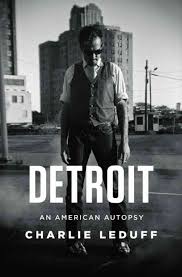 Before beginning my review of Charlie LeDuff’s Detroit: An American Autopsy (2013) it might be helpful to give a little personal background. My wife is from the Detroit suburbs. I first visited the city in 2006 and have been back many times. In spite of all its problems, I do love the city and am happy to call it home when I’m in the US. So, when my father-in-law bought me a copy of LeDuff’s bestselling, deeply personal view of Detroit, I was looking forward to reading it. Unfortunately, work commitments meant that I just didn’t have the time until just last week. After spending a night flashing the hash, I was rushed to hospital with abdominal pains and told that I needed my appendix removed. I read the book restricted to a hospital bed, doped up to my eyeballs, which you might argue is the perfect way to learn about Detroit.
LeDuff is a Detroit native who, like many of his fellow Detroiters, left the city in search of a better life and career. He has enjoyed a distinguished career as a journalist, contributing to a Pulitzer prize winning New York Times series and winning the Meyer Berger award. However, after finding himself somewhat bored with the direction of his career, LeDuff began to feel an irresistible urge to write about his hometown. But the big newspapers were not interested:
No thanks, they told me. Detroit was nothing. Besides, the newspaper and magazine businesses were crumbling and the last thing any executive editor was willing to do was spend the money to open a boutique bureau in Dead City.
LeDuff finally secured a position at the Detroit News, a newspaper whose money problems mirrored those of the city itself. The offices were dimly lit and LeDuff had to get use to broken chairs, broken tables and computers that didn’t work. Given his rather uncomfortable working conditions, it is perhaps no surprise that LeDuff has written an unconventional and eccentric book. If you are looking for a scholarly, chronological history of Detroit, then this is not the book for you. LeDuff begins on the day he was covering a ghoulish story – the discovery of a corpse encased in ice at the bottom of an elevator shaft in an abandoned building – and then jumps back to the riots of 1967, charting the history of the city from the corrupt mayoralty of Coleman Young to the recent ultra-corrupt mayoralty of Kwame Kilpatrick. Like many Detroiters, LeDuff has personally suffered from the decline of the city. His sister fell in with a group of bikers and became a prostitute. She died in a car crash. LeDuff also writes candidly and movingly about one time when his marriage was on the rocks, and he came close to committing a serious act of domestic abuse. There are many sad and sickening stories in this book, but there is also a great deal of humour in the indignation:
I was going to find out who was responsible for the outrage of murderers walking free while the city burned night after night. I was going to become a real reporter. Someone had to answer for this shit. The dignified burial of Johnnie Dollar and the demolition of Harris’s death house gave me confidence. The people of Greater Detroit deserved better than to be robbed by their leaders and forgotten by their neighbors.
I threw my cigarette butt into the sewer grate. I looked up into the rain. That’s when a bird shit in my face.
The chapters on Mayor Kilpatrick and his venal, money-grubbing minion Monica Conyers are particularly good. For readers not familiar with Kilpatrick, he is probably one of the most corrupt politicians in American history and is currently serving twenty-eight years in prison. Although LeDuff is on shaky legal ground when he explores longstanding rumours that a stripper, Tamara Greene, was assaulted by Kilpatrick’s wife Carlita at the Manoogian Mansion party. Greene was later murdered in a drive-by shooting and some commentators suggested a political conspiracy. Far-fetched? Yes, but in Detroit anything’s possible. Still, there’s something rather pathetic about Kilpatrick and Conyers, which makes it impossible to view them as complete villains. LeDuff reproduces text messages between Kilpatrick and chief of staff and lover Christine Beatty which are just hilarious, as LeDuff puts it:
While lacking meter and polish, the fire and passion in their electronified love sonnets must surely rate with those of Elizabeth Barrett and Robert Browning.
All in all, a fascinating and funny book. In an odd way, it made me look forward to going back to Detroit.
First Look at Perfidia Front Cover
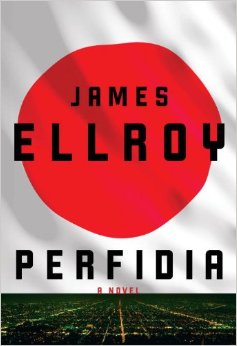 Amazon.com is now displaying the front cover of James Ellroy’s new novel Perfidia, and it’s quite striking. I expect a novel such as this will feature many different front covers over the years, but I thought I would say a few words about this one. The novel is set in Los Angeles, December 1941, during America’s entry into the Second World War. Ellroy has revealed that the notorious internment of over 100,000 citizens of Japanese heritage will be a major theme of the novel, although judging by this interview expect Ellroy’s portrayal to be controversial:
Although the story is very much about the injustice of the internment of the Japanese – most of them innocent – let me say, and this is very un-PC, the f*cking internment was not the Holocaust or the Soviet Gulag.
The cover then is very symbolic. The Japanese flag looms in the air over the lights of the City of Angels by night. Pearl Harbor, of course, was an aerial attack therefore the elevated flag seems appropriate. Also, the flag hangs ominously suggesting the widespread paranoia following Pearl Harbor that there was a Japanese Fifth Column in the US. At first I thought the cover was somewhat misjudged considering Japanese-Americans are, to a certain degree, the victims of this period of LA history. Why should the flag tower above LA as though they were more powerful than the city? However, the flag on the cover is the Japanese national flag. If I am not mistaken, the more aggressive symbol of Japanese imperialism at the time was the flag of the Imperial Navy:

It may be over-reading, but perhaps by choosing the Japanese national flag the cover designer is demonstrating that this is a story about Japanese-Americans as people and not about the Empire of Japan and its colonial ambitions, for which the Imperial Navy flag may have been more appropriate as the sun’s rays suggest expansion whereas internment completely overestimated Imperial Japan’s infiltration of the US.
Anyway, this makes me hungry to read the book so its fairly good advertising.
Two Writers on Liverpool
 I tend not to read much about my adopted home city of Liverpool as I see books as a form of escape. As much as I like Liverpool, I’d rather read about 1940s Los Angeles or nineteenth century India. However, I recently read two very different perspectives on Liverpool, both of which I’d recommend.
Firstly, Michael Macilwee’s excellent true crime book The Gangs of Liverpool (2007) depicts gang violence in late Victorian Liverpool . I was pleased to notice some parallels between the author and myself. Dr Macilwee works for John Moores University Library, whereas I work for their friendly rival the Sydney Jones, and we also studied for the same Master’s degree, Victorian Literature, a degree which every librarian in Liverpool seems to have taken.
Macilwee begins with the Tithebarn Street Outrage of 1874 and chronicles gang violence in Liverpool throughout the late Victorian era. Crime and poverty were rife in the city, giving Liverpool a reputation as a dangerous place. Nathaniel Hawthorne, who served as American Consul in Liverpool from 1853-1857, complained that even a man of his position couldn’t afford to live in Liverpool, then a great commercial city, and yet was shocked at the poverty in places like Tithebarn Street:
I never saw … nor imagined … what squalor there is in the inhabitants of these streets as seen along the sidewalks. Women with young figures, but old and wrinkled countenances; young girls without any maiden neatness and trimness, barefooted with dirty legs. Women of all ages, even elderly, go along with great, bare, ugly feet, many have baskets and other burthens on their heads. All along the street, with their wares at the edge of the sidewalk and their own seats fairly in the carriageway, you see women with fruit to sell, or combs and cheap jewellery, or coarse crockery, or oysters, or the devil knows what, and sometimes the woman is sewing meanwhile.
Macilwee meticulously traces the crimes of the Cornermen and High Rip gang, and the sentences imposed on them by the judges they feared. The book is at its strongest when looking at the parallels between Victorian and contemporary attitudes to crime. Every generation, Macilwee argues, seems to think it is living in an age when crime is spiralling out of control. This entails viewing the past as relatively crime- free and regarding each new crime in the present as plumbing new depths of depravity. It is easy to look at the Scallies of today and think the next generation is growing up without values,but people thought the same thing when the Teddy Boys emerged in the 1950s. Indeed, Macilwee examines whether the High Rip gang, fierce and notorious by reputation, ever actually existed. Were the High Rippers a single criminal entity or the product of persistent rumour? Did the sensationalist press coverage fuel public fear by labelling every crime as the latest High Rip outrage?
After reading The Gangs of Liverpool, I came across a very different perspective of the city. A friend recommended Alan Bennett’s play Kafka’s Dick (1986). Having read the play (which is very funny and highly recommended by the way) I found the edition contained a short diary by Bennett of some time he spent in Liverpool in the mid -1980s during the production of a film on Kafka he had written. Bennett clearly doesn’t like the city, and he expresses some hilarious views of Liverpool and its inhabitants, which could ruin a political career if spoken by a Tory MP, but he seems to be able to get away with as a left-wing playwright. One description of the centre of the city caught my eye:
Behind the war memorial one looks across the Plateau to the Waterloo Monument and a perfect group of nineteenth-century buildings; the library; the Walker Art Library and the Court of Sessions. Turn a little further and the vista is ruined by the new TGWU building, which looks like a G-Plan chest of drawers. A blow from the Left. Look the other way and there’s a slap from the Right – the even more awful St John’s Centre. Capitalism and ideology combine to ruin a majestic city.
 I think Bennett’s right to highlight the area around St George’s Hall as one of the most historical and beautiful parts of the city. As he was writing thirty years ago, you can see why he might not care for the TGWU building, as the city was in the grip of Militant. And as the country was in the grip of Thatcherism, he didn’t much care for St John’s Shopping Centre either. But times change. Today St John’s Centre comes across as an old-fashioned working class market. Most shoppers have been drawn away by the sleek, modern Liverpool One, and while there are still some big name stores in St John’s, its collection of tiny- family run barbershops and greasy spoon cafes seems like the perfect antidote to the consumerism Bennett detests.
Anyway, these were both entertaining reads on the city. If you have any recommendations of books on Liverpool I should read, I would love to hear about them in the comment thread.


 The Venetian Vase