James Ellroy: A Companion to the Mystery Fiction
 If you’re finding the wait for James Ellroy’s new novel Perfidia to be unbearably long, then I would recommend the recently released James Ellroy: A Companion to the Mystery Fiction by Jim Mancall. Mancall has written articles about Ellroy before and clearly knows his stuff. The book is arranged as an encyclopedia so L is for L.A. Confidential etc., and is a delight to dip in and out of. I was gratified to see Mancall references Conversations with James Ellroy quite a bit, including a close look at the intriguing Duane Tucker question. What I am enjoying most about the book so far, however, is the short biographies of Ellroy’s minor and major characters. It’s interesting to read about Duane Rice and Lenny Sands and Ross Anderson as individuals and not just as characters in a larger narrative. The companion is both an authoritative and enjoyable read.
The Great War’s Culture War
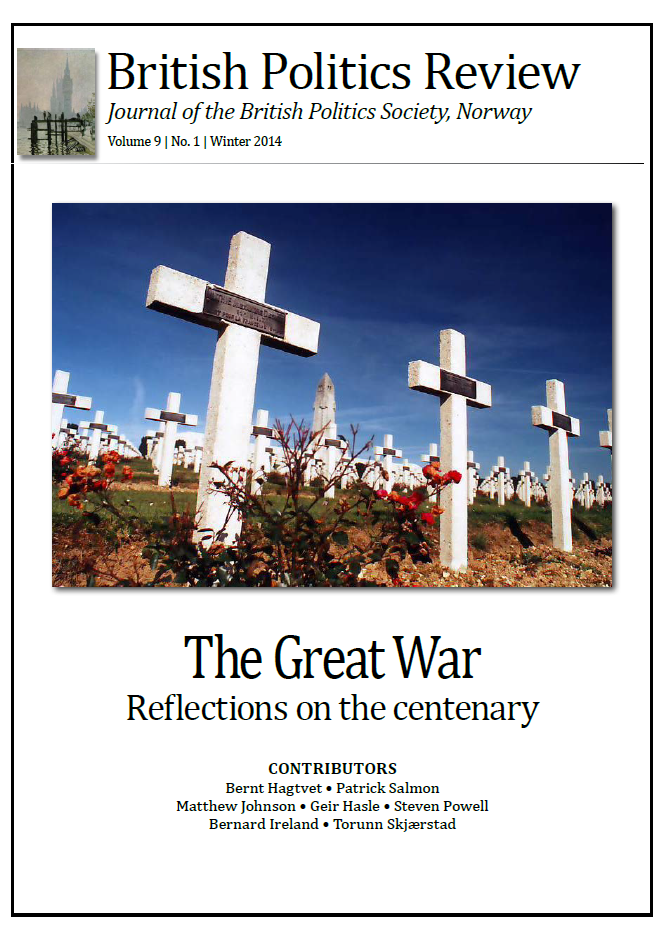
The latest issue of the British Politics Review takes as its subject the First World War. A few months ago I contacted one of the BPR’s editors Øivind Bratberg as I had an idea for an article about humorous depictions of the conflict. I was intrigued by the idea that there were relatively few comedic portrayals of the First World War in comparison to the Second World War. However, the humorous portrayals that have been made (Oh! What a Lovely War, Blackadder etc.) seem to have had a profound effect on both public and academic thinking on the subject. Anyway, I began writing the article, and then Michael Gove and Tristram Hunt began a war of words in the newspapers about almost the exact same subject. This was something of a mixed blessing in terms of writing the article, but it brought home how important and contentious cultural depictions of the war can be.
This is my third article for the British Politics Review, you can read the previous two here and here, and is titled ‘The Great War’s Culture War’. Here’s the link to the whole issue.
British Politics Review
James Ellroy: Faith of a Demon Dog

Let us Pray
Religion is a topic that has popped up occasionally in James Ellroy’s work. I have always found his views on the subject to be intriguing, but I have been reluctant to blog about it. After all, a man’s faith is private, and Ellroy has come across as tetchy when quizzed on it by interviewers. I don’t blame him, there is a danger Ellroy’s critics would try and use his religious views as a stick to beat him with. However, I do believe Ellroy’s statements on faith and the sometimes allusive, sometimes direct references to it in his writing are worth examining.
Ellroy’s first encounter with religion was as a child in the early 1950s. When his parents divorced, his mother Jean sent him to a Dutch Lutheran Church every Sunday on his own. Naturally, Ellroy resented her for this. His mother was trying to discipline him, and she thought some knowledge of Christianity, however vague, would shape him morally, but there was a whiff of hypocrisy. She was drinking heavily and dating men (by the social conventions of the time she may have been labelled promiscuous) now that her marriage was over. During one argument, she struck Ellroy viciously. At this stage of his life, Ellroy hated his mother and probably thought little of religious faith as a consequence. After her murder, Ellroy began to take a different view. He was now living with his father Lee, a chronically lazy man who made little effort to discipline him. As his father’s health deteriorated, Ellroy’s behaviour began to spiral out of control. The death of Lee Ellroy in 1965 meant that the last vestiges of restraint had disappeared from Ellroy’s life. His existence descended into a nightmare of drug and alcohol abuse, petty crime and sexual voyeurism. Ellroy was arrested over a dozen times and did several short stints, ‘soft time’, in the LA County Jail. In later years, Ellroy would note the irony of his life compared to his mother. She was indulging her vices at a time when it was taboo, and it may have led to her murder. As an adult, his behaviour had been marked with even less restraint, but changing attitudes in 1960s and 1970s society allowed him to indulge himself more freely.
A series of health scares led Ellroy to become fully sober in 1977. It’s fair to say that in his years of excess living between 1965 and 1977, religion was not at the forefront of Ellroy’s mind. However, in his second memoir The Hilliker Curse (2010) Ellroy describes a moment during this period when he was physically weak and without a place to stay for the night, and he had a spiritual experience which he believes saved his life. I won’t quote it here as it is on the last page of the book, but it appears to be the closest Ellroy has come to a Damascene conversion. Another theory is that Ellroy’s years of addiction and criminality were a form of spiritual lapse that he knew he was going to pull himself out of one day. Ellroy described to interviewer Martin Kihn how during one stint in jail he thought ‘[he] should’ve been in grad school somewhere’. Perhaps it’s no surprise then that when he turned to writing after sobriety, his thoughts on religion were to emerge.
Ellroy’s first novel Brown’s Requiem was published in 1981. It contains an intriguing reference to God. When, seemingly by chance, the lead character, Fritz Brown, spots a young Mexican woman connected to the case he is investigating, Brown ponders this coincidence: ‘Walter used to tell me that everything in life was connected. I didn’t believe him. Now I did. It was eerie, almost like proof of the existence of God.’ I love this quote, but I think Ellroy is primarily making a comment here about the crime genre, in a mystery of this kind, everything connects and the author is omniscient, seeing everything. Brown’s comment feels conspicuous in the novel as the character is a staunch atheist.
This would not be the only time Ellroy would use religion as a comment on the genre. In an interview I conducted with Ellroy he made a reference to Christ, and it was clear that he saw God and religion as having aesthetic purposes, defining not just his own faith but also his role as an author and distinguishing his writing from other cultural forms:
In his famous quote when he [Beethoven] started to go deaf, “I will take fate by the throat.” It’s just almost unfathomable courage. And the older he got, and he was dead at fifty-six, the more unfathomable and great and uncategorizable his music. So this is largely what Christianity asks of a writer in a secular world. Will you ascend to Christ’s example? What Beethoven asks of you, will you ascend to my example? Who do you want to be? Do you want to be Beethoven or do you want to be Hunter S. Thompson? I mean, really, do you want to go out and abuse women and use drugs and squander your potential because it’s cool. It’s one of the reasons that I devoutly dislike rock ’n’ roll and the mindset of rock ’n’ roll, and the fact that there’s sixty-five- and seventy-year old rock ’n’ rollers out there in a state of perpetual reaction and perpetual rebelliousness. And I see it a lot in Britain. These aged ass rock ’n’ rollers. Holy shit! And you’re sentencing yourself to a life of the puerile. And I would rather, and I’m not in any way saying that I’m Jesus Christ or Beethoven, I would rather always ascend because I have that knowledge that’s the way it’s supposed to be.
Of course Ellroy may have ascended as a writer but he also experienced the descent of crime and sin. The struggle between these two forces has formed the basis of some of his greatest characters, and the novel in which he addresses religion most directly is, I believe, Suicide Hill (1986). On the surface, the novel appears at first to have a strongly anti-religious undercurrent to the narrative. Of the genuinely religious characters, one is a psychotic and the other is an ambitious, ruthless policeman whose Evangelical group are attempting to take over the LAPD. Two brothers, Bobby and Joe Garcia, impersonate priests to solicit donations off elderly and vulnerable Catholics, and there is even a scene where a character walks into a pornography store where the desk clerk is reading the Jehovah’s Witness magazine, Watchtower. On the other hand, all of the characters are looking for redemption in whatever form they can find it. Bobby Garcia makes a confession to a Catholic priest shortly before he is murdered in church by fellow criminal, Duane Rice:
The poor box was on the side wall near the rear pews, ironclad, but too small to hold sixteen K in penance bucks. Bobby started shoving cash in the slot anyway, big fistfuls of c-notes and twenties. Bills slipped out of his hands as he worked, and he was wondering whether to leave the whole bag by the altar when he heard strained breathing behind him. Looking over his shoulder, he saw Duane Rice standing just outside the door. His high school yearbook prophecy crossed his mind: “Most likely not to survive,” and suddenly Duane-o looked more like a priest than the puto with the alligator fag shirt.
Bobby dropped the bag and fell to his knees; Rice screwed the silencer onto his .45 and walked over. He picked up the bag and placed the gun to the Sharkman’s temple; Bobby knew that defiant was the way to go splitsville. He got in a righteous giggle and “Duhn-duhn-duhn-duhn” before Rice blew his brains out.
Bobby is trying to atone for his sins by shoving stolen money into the poor box, but when he sees Duane, he realises only his death will fully pay for his sins. He faces his murderer with some bravery, but despite his new found righteousness there is part of his criminal life that seems to be pulling him back. He hums the the theme tune to Jaws before Duane shoots him, a reference to Bobby’s street name Sharkman which he acquired after a series of sexual assaults on young women.
Naturally Ellroy is a much better man than his ill-fated character Bobby Garcia, but the times he has come closest to Christian piety, he has always maintained a flicker of irreverence and playfulness similar to Bobby’s. In his essay ‘I’ve Got the Goods’ Ellroy describes how he was enjoying conversations about God with a Pastor in his then- home town of Kansas City, and he was interested in joining the Lutheran ministry.
My wife finds this calling dubious. She sees me as a man of soiled cloth. I wouldn’t hack divinity school. I’m too joyous and profane. I see God in foul language and sex. I’m more L.A. than Kansas City. The Lutheran Church would disdain me.
It’s not just the Lutheran Church that might find the Demon Dog a tad contentious for its taste. In his wonderful essay ‘Let’s Twist Again’ Ellroy writes of how he organised a High School reunion thirty-six years after he left John Burrough’s High. One of his former classmates, Howard Swancy, had become a pastor. In some respects, Swancy was not dissimilar to Ellroy. He had an interest in law enforcement but ‘flunked the screening process’ for the LAPD. He was also a dominant and charismatic performer who ‘liked to run the show’. Ellroy visited Swancy’s Peace Apostolic Church and makes it clear that what he heard of the exclusivist only Jesus saves theology, ‘restrictive housing law in Heaven’, was not for him. The essay ends with a touching moment when Ellroy spots a young boy in the congregation:
Howard cranked it out. I looked around the pews. I locked eyes with a tall black kid. He looked bored and agitated.
I winked. He smiled. The apostolic Church of Peace turned into the Peppermint Lounge.
I sent up a prayer for the kid. I wished him imagination and a stern will and lots of raucous laughs. I wished him a wild mix of people to breeze through and linger with over time.
It is as though Ellroy is seeing himself in the boy all those years ago in the Dutch Lutheran Church his mother made him attend. His discomfort in Swancy’s church may be just a clash of styles, as he doesn’t use it to argue atheism. Indeed, it is telling that he chose to visit. And yet, like the opposite of Chesterton’s ‘a twist upon the thread’ the most profound moment comes when he shares an empathetic look with a kid who is equally bored with Swancy’s fire-and-brimstone nonsense. As with Bobby Garcia’s death scene in Suicide Hill, the trace of the subversive drags him away from Christian piety.
Views change over time, of course, and it can be very difficult to truly know what another man thinks on a subject as big as God, especially as often we don’t know ourselves what we believe. As much as we might look at the aesthetic and subversive elements of Ellroy’s faith, it has become an increasingly direct and simple one. The subversion still remains, but any doubt seems to have evaporated. I once asked him whether he thought there was a presence of God in his writing, and his answer was as honest and direct as any interviewer could hope for:
Yeah I do. I do and I’m a Christian. I’m not an Evangelical Christian, but God and religious spiritual feelings always guided me during the worst moments of my life, and I don’t for a moment doubt it. […] And I always like getting in asides and putting it out there and stopping just short of preaching.
Mencken and Sara
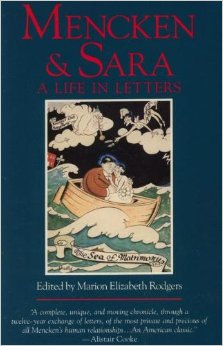
I’ve been a fan of the dying art of letter writing ever since I read the wonderful A Friendship: The Letters of Dan Rowan and John D McDonald, so I was delighted to come across Mencken and Sara: A Life in Letters (1992) edited by Marion Elizabeth Rodgers. H.L. Mencken was the renowned journalist, magazine editor and acerbic critic of American society. Sara Haardt was a professor of English Literature and promising young author. Their correspondence began in 1923 and ended with Sara’s death twelve years later from tuberculosis aged only 37. Rodgers divides the letters into two sections, ‘The Courtship Years’ and ‘The Marriage Years’. The attraction between Mencken and Sara is evident from the start of the collection, and despite the ‘Sage of Baltimore’s’ well-known opposition to marriage, they wed in 1930.
Part of my reason for reading the book was that I thought I might learn a few things about a particularly rich period in American crime fiction writing. Mencken was the co-founder of Black Mask magazine in which authors such as Raymond Chandler and Dashiell Hammett began their writing careers with short stories which defined the hardboiled style. However, on this point, I was disappointed. In his letters, Mencken talks at length about The American Mercury, the Monkey Scopes Trial, his disdain for President Coolidge and Romantic admiration for Imperial Germany, but he makes no mention at all of Black Mask and only one mention of his close friend and colleague James M. Cain, another creator of the hardboiled school. However, in her excellent seventy-page introduction to the book, Rodgers mentions Cain several times, and it is clear that, although he may not have intended to, Cain had a big impact on Mencken’s and Sara’s relationship. Mencken had been romantically linked with the famed silent movie actress Aileen Pringle who would later become Cain’s third wife. On the eve of Cain’s marriage to Pringle, Mencken wrote to Cain and warned him that he might begin to resent Pringle’s strong-minded personality. The comment, although tactless, proved to be quite prophetic as Cain’s stormy marriage to Pringle lasted only two years. Cain himself had been very close to Sara, although whether this was in any way romantic I don’t know. Cain was, to misquote John Inverdale, ‘never a looker’, but he seemed to have no problem in attracting beautiful women. As his biographer Roy Hoopes diplomatically put it, he was the type to come home ‘with lipstick on his collar’, although he was devoted to his fourth wife Florence Macbeth. Cain and Sara enjoyed the occasional dinner, and he recognised in her qualities that Mencken found so attractive. She had a quick wit and a wicked sense of fun, and this derived partly from the fact that she was such a good listener. Cain wrote that she could ‘see through most people’, and this helped Mencken to shed some of his more fair-weather friends. Perhaps Mencken had been yearning for this form of big lifestyle change for some time, as Rodgers writes that Cain believed that Mencken delayed marrying Sara until after the death of his domineering mother Anna. During one of her many illnesses Mencken recommended a clinic to Sara that Cain had attended when he was battling lung problems, and a few months after Sara’s death, Cain visited Mencken only to find him in a sad state, ‘wandering through the rooms, talking nonstop, almost mechanically.’
These are a few sketches of Cain I enjoyed taking from the book, but Mencken and Sara is about the two titular protagonists, and it is a informative, moving and witty read, which I would recommend to anyone interested in the history or literature of the era.
Ellroy and Hammett: The Tory and the Communist
 How can two writers with such diametrically opposed political views seem to share a similar worldview? James Ellroy has often tried to portray the birth of American crime fiction as a stylistic struggle between Raymond Chandler and Dashiell Hammett, with Ellroy himself drawing the bulk of his writing inspiration from Hammett. It’s a rather simplistic interpretation, but still, it resonates. In one of the interviews I conducted with him, Ellroy said:
I think he [Chandler] was lightweight compared to Dashiell Hammett. And I think that the language is overripe, the philosophy is gasbag. He came out of L.A., and he wrote in the first person. And it’s the L.A. of my early childhood and the L.A. before my birth, which is intensely romantic to me. And I sure as shit loved the books while I read them, but Hammett and Cain and Ross Macdonald have held in better in my mind. And I had to reread a little Hammett, because I wrote the Everyman Library introduction to one of their volumes, and was amazed at how my sensibility of the goon and the political fixer and the bagman and the hatchet man strike-breaker came out of that.
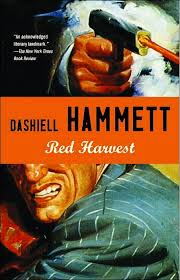
This ‘sensibility’ that Ellroy and Hammett share in their writing seems all the more remarkable given that Ellroy is a self-styled Tory and Hammett was a Communist. Both men’s political views informed their work, and both men, remarkably, share the same dark vision of America, where violence and corruption are ingrained into the political process and the public’s daily life. For Ellroy, Hammett’s greatest work was his ultra-violent indictment of industrial capitalism Red Harvest (1929), wherein his nameless detective the Continental Op is called on by the ailing newspaper czar old Elihu Wilsson to solve the murder of his son and clean up the mining town of Personville, which the Op is quick to christen Poisonville. From the very first page of Red Harvest, the reader will discern that they are entering a world where the normal rules don’t apply. The Op wanders from one hyperbolically violent scene to another as the characters settle their differences with bullets and dynamite. There is virtually no moral distinction in the narrative between politicians, gangsters and businessmen. As Ellroy put it in article on Hammett for the Guardian, ‘his workmen heroes refuse to soliloquise or indict – they know the game is rigged and they’re feeding off scraps of trickle-down graft.’ Even the detective himself must operate on this level, and in one of the most disturbing scenes he awakes from a surreal dream to find himself implicated in the brutal murder of the sultry but shopworn Dinah Brand.
I opened my eyes in the dull light of morning sun filtered through drawn blinds.
I was lying face down on the dining-room floor, my head resting on my left forearm. My right arm was stretched straight out. My right hand held the round blue and white handle of Dinah Brand’s ice pick. The pick’s six-inch needle-sharp blade was buried in Dinah Brand’s left breast.
She was lying on her back, dead. Her long muscular legs were stretched out towards the kitchen door. There was a run down the front of her right stocking.
Slowly, gently, as if afraid of awakening her, I let go of the ice pick, drew in my arm, and got up.
To the extent that Hammett was a direct influence on his writing, Ellroy has tried to transplant elements of Poisonville into his portrayal of 1940s and 50s Los Angeles. This was never more apparent than in White Jazz (1992), his most ahistorical novel, in which psychopathic killings and Mob-related violence push LA to the brink of anarchy. However, by the denouement, order has been restored and much of the corruption in the LAPD is still in place. I believe one scene may be inspired by the murder of Dinah Brand. The leading character and narrator of the novel, LAPD Lieutenant Dave ‘the Enforcer’ Klein, is heavily drugged and coerced into murdering fellow policeman Johnny Duhamel, essentially recreating the scenario of Red Harvest wherein the protagonist is unwittingly implicated in a murder, compromising his ability to go after the villains because there is no differentiation between him and them. Of course, neither character is an angel before the staged murder, with Klein having already committed several murders for the Mafia. The murder is taped and a horrified Klein watches the killing on film:
I thrashed – futile – sticky tape, no give.
A white screen.
Cut to:
Johnny Duhamel naked.
Cut to:
Dave Klein swinging a sword.
Zooming in – the sword grip: SSGT D.D. Klein USMC Saipan 7/24/43.
Cut to:
Johnny begging – ‘Please’ – mute sound.
Cut to:
Dave Klein thrashing – stabbing, missing.
Cut to:
A severed arm twitching on wax paper.
Klein narrates the scene as though he is the director or screenwriter, giving technical details such as ‘Cut to’. Ellroy not only breaks downs the barriers between cops and criminals, but also through Klein’s clipped, staccato first-person narration, he implicates himself in the anarchic madness of the text. It is another factor which links him to Hammett, and explains why he regards him more highly than Chandler:
Chandler wrote the man he wanted to be – gallant and with a lively satirist’s wit. Hammett wrote the man he feared he might be – tenuous and sceptical in all human dealings, corruptible and addicted to violent intrigue.
Ellroy is impressed by the contradictions of Hammett’s personality, describing it as ‘the Manoeuvre’ and dubbing him ‘the Poet of Collision’. Red Harvest was inspired by Hammett’s experiences as a Pinkerton operative, and he was once allegedly offered $5,000 to perform a contract murder. But his left-wing views were not entirely formed by his work, and he appears not to have a sudden conversion, rather as Ellroy put it ‘He stayed because he loved the work and figured he could chart a moral course through it. He was right and wrong. That disjuncture is the great theme of his work.’ Communism, that most inflexible of ideologies, did not negate Hammett’s patriotism, as his service during the Second World War indicates. Ellroy called it a ‘deep and troubled love for America’, but one that also made him an apologist for the Soviet Union. Ellroy’s Toryism is more knowingly rooted in disjuncture than Hammett’s Communism, and this awareness leads to greater nuance. Sure, Ellroy may behave like a right-wing nut at book readings or on chat shows, but that is part performance, as he refines his act as the wild man of American crime fiction. A closer examination of Ellroy’s political views reveal him to be a moderate conservative with a more optimistic view of his country than Hammett ever held. Hammett thought the universe was chaotic and therefore rules were arbitrary. Ellroy’s religious beliefs (which I will explore further in another post) allowed for a greater sense of a journey and meaning to emerge even from the violent chaos of White Jazz. Hammett believed the dehumanising nature of capitalism made people indistinct on several levels, but for Ellroy corruption fired characters individualism.
They may be generations apart, but Ellroy and Hammett were linked by their own disjuncture: Hammett the Communist, who thought order was impossible, Ellroy, the modern-day Tory and one of Hammett’s greatest admirers.
The Meaning of Perfidia: James Ellroy’s New Novel
We now know a little bit more about the plot of James Ellroy’s forthcoming novel, but the significance of the title, Perfidia, has not, to my knowledge, been commented on. Put simply ‘perfidia’ is the Spanish word for perfidy, meaning treachery or betrayal. It is also the name of a very popular song by the Mexican composer Alberto Dominguez released in 1939. The impact of the song on popular culture has been huge. It has been recorded by artists such as Julie London, Glenn Miller and Nat King Cole to name just a few and has appeared on the soundtrack of many movies, notably Now Voyager (1942) and Casablanca (1942). Ellroy has referenced the song before. In The Black Dahlia (1987), the lovers Kay Lake and Lee Blanchard dance to ‘Perfidia’ on New Year’s Eve, 1947. Their best friend Dwight ‘Bucky’ Bleichert looks on, realising he has fallen in love with Kay:
On New Year’s Eve, we drove down to Balboa Island to catch Stan Kenton’s band. We danced in 1947, high on champagne, and Kay flipped coins to see who got last dance and first kiss when midnight hit. Lee won the dance, and I watched them swirl across the floor to “Perfidia,” feeling awe for the way they had changed my life. Then it was midnight, the band fired up, and I didn’t know how to play it.
Kay took the problem away, kissing me softly on the lips, whispering, “I love you, Dwight.” A fat woman grabbed me and blew a noisemaker in my face before I could return the words.
We drove home on Pacific Coast Highway, part of a long stream of horn-honking revelers. When we got to the house, my car wouldn’t start, so I made myself a bed on the couch and promptly passed out from too much booze. Sometime toward dawn, I woke up to strange sounds muffling through the walls. I perked my ears to identify them, picking out sobs followed by Kay’s voice, softer and lower than I had ever heard it. The sobbing got worse – trailing into whimpers. I pulled the pillow over my head and forced myself back to sleep.

Scarlett Johansson as Kay Lake and Josh Hartnett as Bucky Bleichert
‘Perfidia’ is an apt song for the complicated trinity of Bucky, Kay and Lee Blanchard. The lyrics refer to a love ripped apart by betrayal ‘To you my heart cries out “Perfidia” / For I find you, the love of my life / In somebody else’s arms’. The behaviour of Ellroy’s characters in the above quote suggests an unusual interaction and reliance on trade-offs. Bucky loses the dance but wins the kiss, and it is the kiss that is the most revealing, as Bucky now knows that his outwardly platonic friendship with Kay is anything but.
It might be tempting to think that as Ellroy was referencing ‘Perfidia’ in his work as far back as 1987, his plans for his latest novel started then. That would be over-reading however. Ellroy only decided to write a Los Angeles Quartet after the success of The Black Dahlia, and he has not revealed precisely when he decided to write Perfidia, the first novel of a Second LA Quartet which will be prequels to the original (although the short stories which appear in Hollywood Nocturnes (1994) are basically mini-prequels to the first Quartet, which suggests he has been toying with the idea for some time). I think it likely that Ellroy must have heard ‘Perfidia’ when he was growing up in LA in the 1950s, and it stayed with him. He referenced the song in The Black Dahlia and kept alive the idea he would return to it one day, and now he has. This reworking is somewhat similar to his use of the title The Cold Six Thousand, which was originally planned for the fourth Lloyd Hopkins novel, but after he abandoned that project, Ellroy used it fifteen years later as the title of the second novel in the Underworld USA trilogy.
Perfidia is due to be released in the autumn, Amazon has the exact date as 9 September.
A New Year and the End of an Era
Last month I had the viva for my thesis and I passed. I do have some corrections to make, but I have essentially completed my PhD. I’m planning to continue publishing my research on James Ellroy both on this blog and, hopefully, in book form. Stay tuned. Looking back over my seven years of doctoral study, I’ve been thinking a lot about crime novels that gave me a great deal of pleasure in between the endless drafting, redrafting and editing of my thesis, so I thought I’d talk a little about them here.
White Jazz by James Ellroy
 I’m a fan of all of Ellroy’s novels and my favourite varies according to my mood. Right now I’m thinking it’s White Jazz (1992) as its just the most daring and subversive in terms of its depiction of LA and noir as a genre. The plotting is labyrinthine and almost impossible to summarise in just a few words. Narrated by LAPD Lieutenant Dave ‘the Enforcer’ Klein, White Jazz involves Mob contract killings, the Battle of Chavez Ravine, historical characters (including Jack Dragna, Mickey Cohen, Sam Giancana and Howard Hughes), a beautiful femme fatale and a grade Z horror movie. The first time I read this novel, I was shaking with excitement, exhilaration and fear when I got to the last page. David Peace summed up the novel’s power: ‘His novel White Jazz was the Sex Pistols for me. It reinvented crime writing and I realised that, if you want to write the best crime book, then you have to write better than Ellroy.’
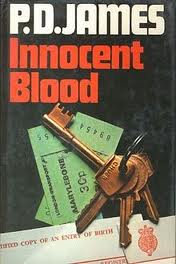 Innocent Blood by P.D. James
I only started reading P.D. James in the last year or two, and I think she is just one helluva of a great writer. The Cordelia Gray novels are excellent, the Adam Dalgliesh novels are even better, but my favourite so far is the standalone work Innocent Blood (1980). Phillipa Palfrey is the adopted daughter of a well- to- do couple. When Phillipa takes advantage of a new law allowing her to contact her biological parents, she discovers they were convicted of the rape and murder of a young girl. What follows is not a straight forward murder mystery, but a revealing character study with plenty of suspense. A sub-plot involves the murdered girl’s father plotting his revenge. James’ conservatism is evident in the early chapters, and she makes a strong case that you can’t legislate human behaviour. It is clear from her writing, however, that James understands human behaviour, and I can’t think of another novelist who can write about England so well.
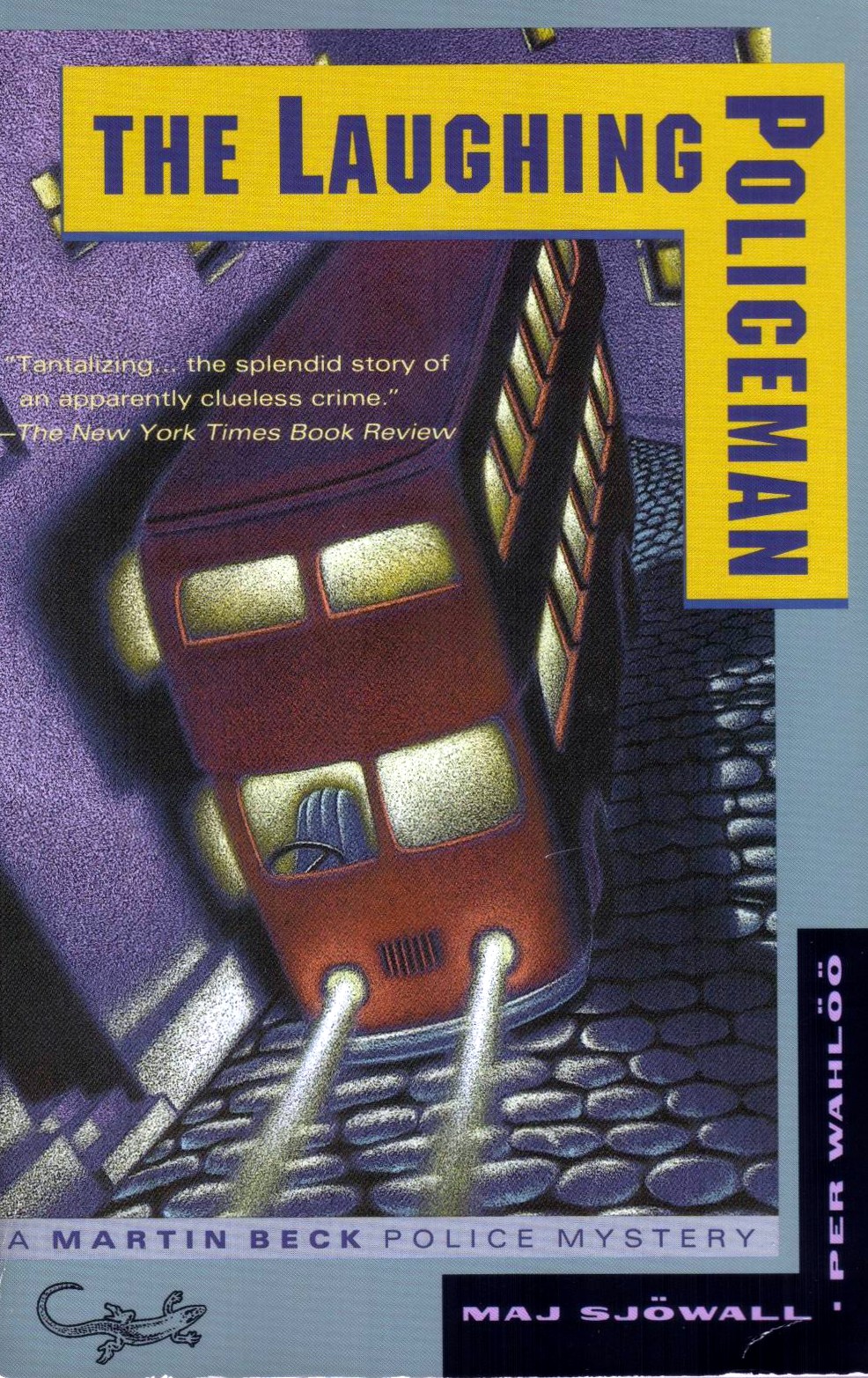 The Laughing Policeman by Maj Sjöwall and Per Wahlöö
I’ve just got to include a Scandi crime novel, and The Laughing Policeman (1968) might just be the best Scandi crime novel of them all! A massacre on a bus in a Stockholm street has left eight people dead and world-weary detective Martin Beck is forced to investigate. It’s a complex case with shades of Agatha Christie’s The ABC Murders (1936), and the final twist is stunning. Jonathan Franzen wrote, ‘I’ve read The Laughing Policeman six or eight times. Each time I reach the final twist on the final page, I shiver afresh.’ He neglects too mention it’s also a very funny conclusion.
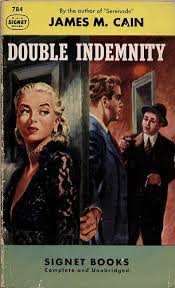 Double Indemnity by James M. Cain
James M. Cain’s reputation rests on four classic novels The Postman Always Rings Twice (1934), Serenade (1937), Mildred Pierce (1941) and Double Indemnity (1943). His later life was a sad story of a writer trying to build a more literary reputation while his career slowly crumbled. Double Indemnity, originally serialised by Liberty magazine in 1936, tells the story of an insurance agent and his lover plotting the murder of her husband to look like an accident and collect the insurance policy. Billy Wilder’s film adaptation is a classic, but he and screenwriter Raymond Chandler changed the ending. The ending to the film is still dark, but it doesn’t match the ending of the novel for sheer haunting beauty.
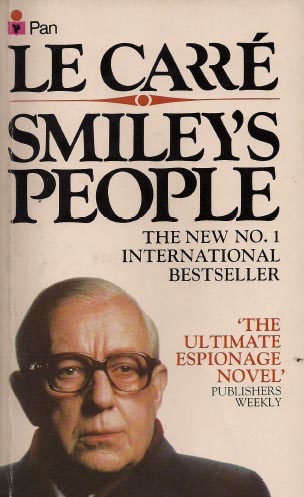 Smiley’s People by John le Carré
The Spy Who Came in from the Cold (1963) seemed to capture the anti-establishment mood of the Sixties; Tinker Tailor Soldier Spy (1974) was a classic work inspired by the Cambridge Five, particularly Kim Philby; and A Perfect Spy (1986) is le Carré’s most autobiographical work. But my favourite novel has always been Smiley’s People (1979). The case is complex, beginning with the murder of an Estonian emigre and ex-agent of Smiley’s, but it is never impenetrable for the reader. The way Smiley pieces it together bit by bit (and working almost entirely on his own for much of the novel) is ingenious. This was le Carré’s goodbye to Smiley (he pops up again briefly in The Secret Pilgrim (1990)) and the character was never more intriguing, both gentle and kind but ruthless when he needs to be. The ending is brilliant too, but unlike White Jazz which made me feel like I’d been hit with a sledgehammer, Smiley is understated in his final confrontation with his Soviet nemesis Karla, and the novel is all the more quietly moving as a result.
Death Comes to Pemberley: Crime Fiction Meets Jane Austen
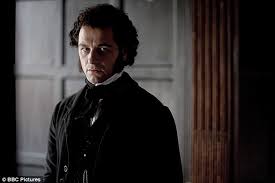 Telegraph critic Horatia Harrod described the recent BBC adaptation of P.D. James’ foray into Austen’s world as a ‘crime against literature’. I couldn’t disagree more.
Instead, I would argue that both James’ novel and the BBC’s adaptation bring to Austen’s world an immediacy not present in the controlled world of the original. Lizzie, as a single woman, had few demands on her time in Pride and Prejudice, allowing her to be a somewhat aloof though humorous observer of human nature. This is not possible for a woman moved to the centre of the action, as Lizzie is in Death Comes to Pemberley. For Elizabeth Darcy, the violent death of a soldier in Pemberley woods disrupts the stability of her role as mistress of Pemberley: her marriage to Darcy comes under particular strain (emphasized more in the adaptation than the novel) as the demons from her past– her uninvited sister Lydia, Wickham’s initial deception of Lizzie and her social standing (Lady Catherine de Burgh is always a funny reminder)– rise up to haunt her. Darcy wonders if in overcoming his prejudices to her family, he has made a sacrifice of his honour by associating himself with a family that will ultimately destroy Pemberley.
This disruption to the Darcys’ everyday lives also allows for more compassion for Lydia and Wickham, the latter ends up on trial for the murder of the soldier. There are times I find Austen to be a bit cold, especially when commenting on human weakness, but the BBC’s adaptation of Death Comes to Pemberley offered reasons why Lydia and Wickham might love each other besides their vanity. Rather than being cast aside as a beautiful, foolish girl and her rake husband, the audience had a glimpse of what being married to Wickham must be like. In one of the most moving scenes of the mini-series, Elizabeth tries to tell Lydia of Wickham’s affair with a young woman hoping to soften the blow, but Lydia interrupts, preferring to hear it from gossips so that she can dismiss it as false, rather than accept it from her sister as truth. The frivolous is a form of protection rather than a weakness to be mocked.
P.D. James, I would argue, also offers us a wider scope within the fictional world. Rarely does Austen venture beyond the country-house: the villain of Pride and Prejudice, George Wickham, has his nefarious deeds relayed through gossip, letter or through retelling– the same goes for Frank Churchill and John Willoughby in Emma and Sense and Sensibility respectively. Here, the courtroom and the crime are made central, with powerful first-hand experiences. But not only is Death Comes to Pemberley arguably a more exciting novel than Pride and Prejudice, in the novel, James also connects Austen’s fictional worlds: Wickham, for instance, has worked for Sir Walter Elliot (from Persuasion), and his illegitimate child will be adopted by Miss Harriet Smith (now Mrs Martin) and will play with Mr and Mrs Knightley’s children (from Emma).
Lastly, James’ adaptation has been accused of showing Georgian policing to be inadequate, and not just in comparison to today’s standards. However, this is often the aim of crime fiction, even the police procedural sub-genre can show the shortcomings of police work. In crime fiction, journalists (Stieg Larsson’s Girl Who novels, Liza Marklund’s Annika Bengtzon character), private detectives, and gifted individuals (Sherlock Holmes, Miss Marple) step-in where the law has fallen short. Crime fiction is fascinating in that it often critiques the very law it is trying to uphold by highlighting its inadequacies, a trait shared with Austen. I think the BBC’s adaptation understood this, asking ‘What is Justice?’ and ‘What is Duty?’ on a personal and collective level.
I enjoyed both book and adaptation, although I think the BBC made some changes to James’ material to accommodate fans of the 1995 Pride and Prejudice mini-series, such as having Elizabeth’s mother and long suffering father present (rather than Jane and Bingley) when the murder occurs (leading to some much-appreciated comic relief) and the rather badly done, cringe-worthy ending, with Elizabeth revealing to Darcy her second pregnancy (in the book she’s already had two children) and Georgiana’s beau riding up with his shirt undone for that telling embrace by the lake.
If anything, I felt that James was a bit too interested in getting the historical aspects of the courtroom right in the novel that it lost some of its dramatic edge; however, I think for Austen and James fans, the adaptation and novel successfully merged the work of two of Britain’s best-loved authors.
Season’s Greetings
This blog will be quiet over the next few weeks. I hope you all have a wonderful Christmas and happy new year where the only crime you experience is in the pages of a paperback novel. I’m hopeless at keeping up with new releases as I prefer to dip into crime fiction’s endless back catalogue, so next on my reading list for the holidays is PD James’ Innocent Blood (1980) and Mark Billingham’s Rush of Blood (2012), and I’ve also got lots of reading to do on the First World War as I’m writing an article on the subject for the British Politics Review. Thanks for reading over 2013. I’ll try and keep the posts just as interesting in 2014 to keep you coming back!
A Swedish Crime Fiction Christmas: The Bomber by Liza Marklund
 If you haven’t already chosen a good book to read this holiday season, I’d heartily recommend Liza Marklund’s Scandinavian thriller The Bomber (1998). Marklund’s tightly-plotted and well-written tale is set in Stockholm in the run up to the holidays, a stylistic choice which heightens the tension for her main protagonist, a thirty-something wife and mother and newly appointed chief crime reporter Annika Bengtzon. When a psychopath starts a bombing campaign targeting buildings related to the upcoming Stockholm Olympics, Bengtzon finds herself against the clock in more ways than one. Marklund cleverly structures the chapters around the countdown to Christmas beginning with ‘December 18th’, a technique which shows Bengtzon’s real struggle: balancing the competing demands on her time of being a good boss, a star reporter, a loving wife and mother. After a particularly rough day, she muses, ‘Not only was she an unbalanced head of section and a useless reporter, but she was a rotten wife and a hopeless mother, too.’ Such frankness is particularly endearing, and emerges in different forms, such as when she forgets to shower after a long shift and wonders if her shirt smells and feels guilty about not baking Christmas buns with her children when they try her patience. One of the most attractive aspects of Scandinavian dramas is their apparently flawed heroes/heroines and Annika Bengtzon is reassuringly normal.
In The Bomber, Marklund explores similar questions to Steig Larsson’s The Girl with the Dragon Tattoo in regards to gender, but where Larsson more sharply contrasts his ‘Men who Hate (and do not hate) Women‘, Bengzton describes a world in which sexism is the last resort of dinosaurs in the office, men, who in their fifties have neither the skill nor the dedication of Bengtzon and resort to a campaign of harassment when she is promoted above them. Bengtzon’s husband, like Birgitte Nyborg’s in the Danish drama Borgen, is the main caregiver to the children despite his own role in local politics, and the family purposefully chose a nursery where half of the workers are male. Despite this social renegotiation of traditional gender roles, the difficulties for women are still apparent. Unlike the coasting male reporters, the women in the novel must fight their ground, either by being exceptionally dedicated to their work and foregoing or discarding their family life, or, as with Bengzton, by reaching some kind of stressful compromise. The tension is too much for some, and the results are horrific.


 The Venetian Vase