Sabbatical
I have a publishing deadline for early December, so I’m taking a short break from blogging. Most of the work is completed, but there is still the checking, double checking and triple checking to be done. I’ll be blogging again in mid-December. See you then.
Beebo Brinker and Lisbeth Salander
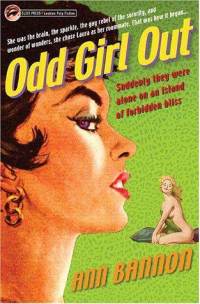
Ann Bannon's Odd Girl Out
I’ve been reading several novels in Ann Bannon’s excellent ‘Beebo Brinker Chronicles’ series, and I was struck by how much the stories reminded me of Stieg Larsson’s ‘Girl Who’ novels. On the surface the two series appear to be very different; Ann Bannon is the pseudonym of Ann Weldy who wrote five novels, Odd Girl Out (1957), I Am A Woman (1959), Women in the Shadows (1959), Journey to a Woman (1960) and Beebo Brinker (1962), which are now considered groundbreaking works of lesbian pulp fiction and form the Beebo Brinker Chronicles. Bannon’s only other novel, The Marriage (1960) is generally not considered part of the series, although it does feature several series characters. The series centres around the characters Beebo, Laura, Beth and Jack as they come to terms with their sexuality in late 1950s and early 1960s America. Beebo is sometimes considered the archetype of the stereotypical butch lesbian, but this is a somewhat unfair assessment as Bannon is highly skilled at subtle and plausible characterisations. Beebo does not even appear in the first novel, Odd Girl Out, which is set in a fictional midwestern university where Laura and Beth first meet and begin a friendship which develops into a romance. Unlike others novels belonging to the lesbian pulp fiction genre, such as Theodora Keogh’s The Other Girl (1962), the Beebo Brinker series contains little in the way of actual crimes. Instead, Bannon explores the emotional violence that entails from relationships complicated by feelings of misogyny and sexual jealously. Indeed, the sexuality of the characters is the crime to their society. Occasionally in the novels, the turbulent emotions of the characters does manifest itself in physical and sexual violence, such as rape. But for the most part, the Beebo Brinker chronicles have a literary feel which some critics would argue transcends crime fiction.

Noomi Rapace as Lisbeth Salander
So how does this connect to Stieg Larsson’s Girl Who novels? After all, Larsson’s series fully embraces all manner of crime fiction elements such as locked room mysteries, private detectives, corporate intrigue, espionage, international conspiracies and serial killers to name just a few. Well, in the character of Lisbeth Salander, Larsson created a protagonist who was socially ostracised in a manner not unlike Beebo Brinker and Bannon’s other characters. Lesbianism no longer carries the stigma it once did in 1950s America and elsewhere, but Salander’s bisexuality is by no means universally accepted nor is her Goth identity. Indeed, sinister bureaucratic figures often consider Salander criminal or mentally deficient partly because of her tattoos and body piercings. Another connection between the two series is that they destroy the facade of idealised societies by taking the perspective of characters who are not accepted by that society. The Beebo Brinker Chronicles are set in an America that had become the most prosperous and powerful nation in the world following the Allied victory in the Second World War. But her characters do not find happiness in these economic boom times, as they are either marginalised or have to live with deceit to protect their sexuality. By the time the last novel in the series was published in 1962, America was on the cusp of massive social change and painful upheaval with race riots and anti-Vietnam war protests in what would be a fractious period for the nation. Larsson, and fellow Swedish crime writers who came before him such as Henning Mankell, have thrillingly dramatised Sweden’s social and political ills. This has been culturally significant, as many readers in the UK and elsewhere had somewhat naively regarded Sweden as an ideal European state, almost entirely devoid of poverty, crime and political corruption. This is not to say that either Sweden or the United States are wholly dysfunctional societies masquerading as utopias, far from it. But it is noteworthy that both the Beebo Brinker Chronicles and the Girl Who novels created a certain revisionism as to how we have come to view these societies.
Are the Critics Wrong About Tinker Tailor Soldier Spy?
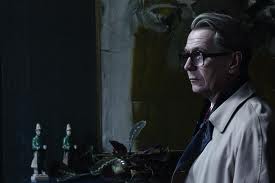
Gary Oldman as George Smiley
I finally got to see Tomas Alfredson’s new film adaptation of John Le Carre’s Tinker Tailor Soldier Spy last night. The film has been lavishly praised by critics for its acting, writing, direction and evocation of a 1970s British setting. Unfortunately, I found the film to be disappointing in all these regards. I’ve written on both Le Carre’s excellent novel and the superlative 1979 BBC production of Tinker Tailor Soldier Spy before and I think its one of the greatest pieces of spy fiction. Alfredson’s film sticks to the plot of the source novel fairly closely: there is a mole in a senior position at the British Secret Service (the Circus) passing highly classified information to the Soviets. A former British spy George Smiley is called upon by a high ranking civil servant to investigate and expose the mole. Smiley had been sacked from the Circus in the aftermath of an ill-fated British mission in Eastern Europe, so he must conduct his investigation from outside the Circus. Aided by his protege Peter Guillam, he gradually puts his case together interviewing ex-agents, most of whom have also been sacked as a result of a power struggle within the Circus. That’s the deceptively simple plot: there are a myriad of sub-plots and extensive back-story which all finally merge to form a remarkably complex narrative. The former head of the Circus, known only as Control, sent the agent Jim Prideaux on the ill-fated Eastern European mission in an effort to expose the mole. Control is sacked and dies after Prideaux is shot and captured on the mission. Smiley finds himself working through Control’s original investigation. The title is derived from a nursery rhyme which forms the codenames Control has given to the suspects who might be the mole; Tinker (Percy Alleline), Tailor (Bill Haydon), Soldier (Roy Bland), Poor Man (Toby Esterhase).
Alfredson’s new adaptation faces two big hurdles to overcome in adapting this story to the big screen; firstly, to prove the story is worth telling again after the novel has already been adapted for television and radio, and secondly, to successfully compress a long, detailed and complex story into a two-hour film. He succeeds at the first task but fails at the latter. The film moves at a breakneck pace, characters and scenes from the original narrative are jettisoned, and the complexity of the story is often rendered incoherent. Another problem is the plausibility of the film; Le Carre’s spy novels are noted for their realism, and Tinker Tailor was based on the Cambridge spy ring and more specifically the traitor Kim Philby. The film does not portray espionage with any sense of accuracy — in one embarrassing scene a British spy can clearly see through his hotel window into the apartment block across the way (curtains fully open) where a Russian spy is having sex with his mistress and his thugs are guarding the room outside. When the spy’s unfortunate wife walks in and catches them in bed together, she is savagely beaten by the husband. All of this takes place in plain sight for the British spy to see, and we are supposed to believe the Russian spy would be so incompetent to allow himself to be exposed like that! One unfortunate aspect to this production is the focus on violence, we see the grisly aftermath of several torture murders which are not necessary to the story and seem very unlikely. Alfredson previously directed the horror film Let the Right One In and the influence shows not only in the violence. The tone of the film comes across as somewhere between gothic horror and graphic novel, which to my mind undermines the 1970s setting of the story. In fact, the setting consistently comes across as more like 1940s wartime Britain. Much of the wit and the sparkling dialogue of the novel is absent here, too often replaced with obscenities aimed at getting cheap laughs. As a consequence, a lot of the characterisation seems weak with several performances misjudged. Benedict Cumberbatch does not get the tone right for playing Peter Guillam. The character should have an inner anger and intensity mixed with his fierce loyalty to Smiley and Cumberbatch doesn’t quite pull it off (Guillam is a homosexual in the film for no apparent reason whereas in the book he is a womaniser). It’s also hard to imagine that a senior spy would get so unnerved so easily. Kathy Burke comes across merely as coarse and uncouth as Connie Sachs. Toby Jones seems to drop in and out of a Scottish accent as Percy Alleline. The character of Jerry Westerby is merged with the Sam Collins character of the novel and played by the Liverpool born actor Stephen Graham. Graham is completely miscast and plays Westerby as a cheeky scouser and is not at all convincing as an intelligence agent. In fact most of the cast are unconvincing because they seem to be trying too hard to act and appear terrified in the suspense scenes when they should be trying to keep calm! Gary Oldman is good enough as George Smiley, but again the film is moving so quickly we never get a chance to get to know the character, and he comes across as quite faceless. He even confesses he can’t remember what his nemesis in Soviet Intelligence looks like after meeting him years ago. Hardly inspiring! Also, the plot has been so truncated by the screenwriters we get no sense of Smiley doing much to unmask the mole, rather it just lumbers on from one scene to the next.
The film does have its qualities, and it would be unfair to say that its a complete failure. You could feel the tension in the cinema as the film drew to a climax with the unmasking of the mole. Also, I went with a couple of friends who knew nothing of the story, having neither read the book or seen the BBC production and they seemed to be gripped. So, ending on a postive note at least the film has served to bring this classic story to a new audience. But you would be better served by reading the novel or watching the 1979 television production with Alec Guinness in the role of Smiley than watching this highly overrated version.
Joe McGinniss and the Legacy of Fatal Vision
Joe McGinniss’ latest book The Rogue: Searching for the Real Sarah Palin is released today, and its controversial claims about the former vice-presidential candidate have already generated a storm of publicity. McGinniss claims Palin had an extramarital affair and snorted cocaine amongst other sordid details. Now I am not a fan of Sarah Palin politically, but I do feel that it’s unfortunate an author with McGinniss’ shady reputation has set his sights on her. McGinniss shot to fame with his debut book The Selling of the President (1968) which examined the successful ‘marketing’ of Richard Nixon during the 68′ election campaign. Since then McGuinniss’ output has been mixed, with his nadir coming with the true crime book Fatal Vision (1983). Fatal Vision was a bestselling book which told the story of Captain Jeffrey MacDonald, a Green Beret and army physician, who was convicted for the murder of his pregnant wife and two young daughters. MacDonald and McGinniss spent a lot of time together during the murder trial and MacDonald was fully expecting the book to portray him sympathetically and help prove his innocence. However, Fatal Vision presented an uncompromising portrayal of a pure psychopath guilty of multiple murders. MacDonald sued McGinniss and the case was eventually settled out of court. It’s hard to feel much sympathy for MacDonald, but McGinniss’ despicable behaviour during the drafting of the book has been laid bare by Janet Malcolm in The Journalist and the Murderer (1990) and in Laura Browder’s essay ‘True Crime’ for The Cambridge Companion to American Crime Fiction (2010). In his search for a writer to portray his case in a good light, MacDonald had written to Joseph Wambaugh requesting that the novelist would take on the job but Wambaugh declined. Ironically, Wambaugh would later get into even more trouble than McGuinniss for his true crime book Echoes in the Darkness (1987). Throughout the drafting of Fatal Vision McGinniss told MacDonald that he thought he was innocent long after he had been found guilty at trial, yet all the while he was busily writing a very different version of events. One of McGinniss’ techniques for encouraging MacDonald’s full disclosure was to condone MacDonald’s adultery by giving him multiple examples of his own infidelities. It makes you wonder how McGinniss obtained the revelations of cocaine use for his book on Palin.
Fatal Vision’s legacy is not just the controversies surrounding a single book but its negative impact on the True Crime genre. Fatal Vision and many other books have given the genre a reputation for sensationalism, bad journalism and in some cases the publication of outright lies. This is a shame because there are many brave and honest writers working in the true crime field today. It’s difficult to imagine that over forty years ago Truman Capote’s In Cold Blood (1965) raised the true crime genre or non-fiction novel as he called it to an art form. But even the reputation of that book has suffered somewhat as Capote’s questionable behaviour during its composition has come under scrutiny.
Does Print Have a Future?
The continued closure of bookshops and libraries across the UK and the resultant job losses makes for some grim reading. It is also rather ironic as book sales are steadily rising. In comparison to the noticeable decline of feature films and music albums, books seem to have a bright future. But with the increasing popularity of E-Books does the printed word have a future? E-books are great for many things: they save massive production costs for publishers and are also easy for readers to access and search. They also seem to appeal to some people who might not be natural bookworms. The downside is individual E-books are usually so cheap that it does not produce a great profit for authors and publishers. Some readers think E-books take away a certain pleasure in reading. I prefer E-books if I’m scouring for references or information in an anthology, but they do not appeal to me for reading novels or poetry. E-books are definitely here to stay, but I think print has a bright future too. There are so many types of books we love: the coffee table book, the dog-eared paperback, the shiny hardback on the bookshelf. It’s hard to imagine these books disappearing, and I don’t think they will. It would be a terrible shame if Waterstones went into administration or had a revamp that made it look like the now almost bookless WHSmith. However, retail booksellers do have some thinking to do; like many readers I buy most of my books on Amazon or AbeBooks. What’s the point of paying full market price when you can find pulp collectibles online sometimes for only a few pounds? But lately I’ve found myself wandering into bookstores and libraries and thinking it would be a shame if this community-based immediate contact with books was lost.
E-books and print complement each other quite well. I hope both will thrive.
From the Blogosphere
I’ve had very little time for blogging recently because I’ve been swamped with work, but I thought I might share some links to blog articles that have caught my eye on the web lately:
Over at the Rap Sheet, Ali Karim reviews the debut novel, Spycatcher, by former SIS officer Matthew Dunn.
Megan Abbott has been on tour promoting her latest novel, The End of Everything. On her blog she gives some thoughts on real-life missing children cases that may, or may not, have been an influence on the novel.
If like me you’re obsessed with all things related to the Black Dahlia case, then you might be interested to read Black Dahlia Avenger author Steve Hodel’s brief obituary of LAPD Homicide Detective Ed Jokisch, the last surviving member of the original 1947 investigation.
This is not particularly recent but Crimeculture has been publishing a series of interviews that Charles Rzepka has been conducting with King of American Crime Fiction, Elmore Leonard. These have to be amongst the most in-depth interviews Leonard has ever given.
At The Crime of it All Len Wanner has posted an excellent interview with Smokeheads author Doug Johnstone.
Tabloid Journalism Hush-Hush Style
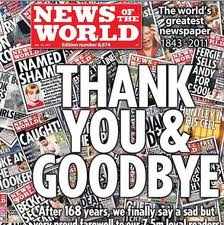
News of the World Final Edition
I was in the U.S. when the News of the World released its final edition, and the ongoing scandal has inspired me to reread some of James Ellroy’s work on tabloid journalism in his historical fiction. In Ellroy’s LA Quartet and Underworld USA trilogy, certain tabloids, specifically Hush-Hush magazine which actually existed and Ellroy read as a child, are intricately involved in criminal conspiracies, disseminating false information often in collusion with organised crime or branches of government. In American Tabloid, the scandal rag Hush-Hush comes to its demise when, fed information by rogue intelligence operatives and organised crime figures, it prematurely prints an article claiming the Bay of Pigs invasion to be a complete success and Castro has been overthrown.
Ellroy writes the Hush-Hush articles in lurid prose using an extreme form of alliteration. I’ve typed out the specific article as it appears in American Tabloid below. If you love (or hate) the tabloids you might appreciate Ellroy’s hyperbolic prose style:
COWARDLY CASTRATO CASTRO OUSTED!
RETREATING REDS WREAK RAT-POISON REVENGE!
His rancorous Red reign ran for a rotten two years. Shout it loud, proud and un-kowtowed: Fidel Castro, the bushy-bearded beatnik bard of bilious bamboozlement, was determinedly and dramatically deposed last week by a heroically homeland-hungering huddle of hopped-up hermanos righteously rankled by the Red Recidividists’s rape of their nation!
Call it D-Day ’61, kats & kittens. Call the Bay of Pigs the Caribbean Carthage; Playa Giron the Patriotic Parthenon. Call Castro debiliated and depilatoried – word has it that he shaved off his beard to dodge the deep and dangerous depths of revenge-seeker recognition!
Fidel Castro: the shabbily-shorn Samson of 1961! His deliriously delighted Delilahs: God-fearing, red, white & blue revering Cuban heroes!!!
Castro and his murderously malignant machinations: trenchantly terminated, 10-4, over-and-out. The Monster’ maliciously maladroit maneuverings: still morally mauling Miami!!!!
Item: Fidel Castro craves cornucopias of cash – getaway gelt to felicitously finance future finaglings!
Item: Fidel Castro has cravenly criticized America’s eminently egalitarian and instantly inclusive racial policies, reproachfully ragging U.S. leaders for their nauseously niggling neglect of Negro citizens.
Item: as previously posited, Fidel Castro and seditious sibling Raul sell homicidally hazardous Heroin in Miami.
Item: as the Bay of Pigs waggled and waxed as Castro’s Waterloo, the mendacious mastiff’s minor miscreant minions mined Miami’s Negro section with rat-poison-riddled Heroin! Scores of Negro drug addicts injected these carcinogenic Commie cocktails and died doomonically draconean deaths!!!
Item: this issue was rushed to press, to insure that Hush-Hush readers would not be left hungrily homesick for our properly protectionist parade of Playa Giron platitudes. Thus we cannot name the aforementioned Negroes or offer specific details on their dastardly deaths. That information will appear in scintillatingly-scheduled subsequent issues, in courageous conjunction with a new ongoing feature: “Banana Republic Boxscore: Who’s Red? Who’s Dead?”
Adios, dear reader – and let’s all meet for a tall Cuba Libre in laceratingly liberated Havana.
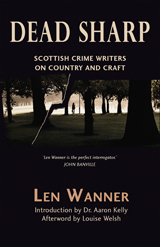 Len Wanner’s book Dead Sharp (Two Ravens Press, 2011) contains nine informative, and entertaining interviews with Scottish crime writers, and a Ten Commandments for successful interviewing. In his Ten Commandments Wanner asks “Am I a good enough interviewer to tell you how to become a better one?” On the evidence of the interviews here, he is. He picks his questions well, is friendly without being gushing, presses his point to get an answer, and manages to bring a lightness and humour even to such glum and serious subjects as gender politics.
It is probably inevitable that the book begins with Ian Rankin, and that his name, and the description “Tartan Noir” should turn up more than once, even in interviews with other writers. Wanner’s interview with Rankin sets the tone for the questioning throughout the book; that is, unexpected, and revealing. The question “If Rebus is an ‘Old Testament sort of guy’, what kind of God are you?” elicits the response from Rankin that “I’m a much more forgiving God than Rebus would accept”, which tells us something about Rankin, and Rebus, but also leads to a discussion about Presbyterianism and guilt in Scottish crime writing that brings in Christopher Brookmyre and Stuart MacBride, both subjects of later interviews.
Wanner’s jokey, and quick-witted style of questioning doesn’t always get him as far as he hopes. Questioning Allan Guthrie on what it was like adapting his novel Two-Way Split as a screenplay, he gets the one word response “Interesting”, while a question about whether he has been tempted to write a series, is rewarded with “No. Never”. Guthrie’s guarded style distinguishes him from the more loquacious subjects here, but later Wanner manages to draw him out on the subject, and we are treated, at some length, to Guthrie’s thoughts on crime and detective fiction, and the “nightmare” which, in his view, is the Police Procedural.
The interviews are revealing about the details of writing methods. Karen Campbell, for example, writes strictly without music playing, and says “I think you write the book you want to read yourself, don’t you?” Alice Thompson is apparently more autocratic. She often writes in noisy cafes, and says “I don’t think about the reader at all”. More interesting is what the writers have to say about genre, Brookmyre taking the position that “what we like in crime fiction is the reassurance our choices would have been vindicated …” while for Rankin it is a “vicarious thrill”. To varying degrees, all address the idea of crime fiction as a genre well suited for exploring political and social issues. Paul Johnston is asked whether crime fiction has “tasked itself with addressing such uncomfortable truths [as heroin addiction]?” he answers: “Well, it should do as far as I am concerned”.
Most of the writers interviewed here are university educated, but their relationship with the academy is sometimes uneasy. Rankin, who began writing his first Rebus novel while he was a postgraduate student, likes the idea of crime fiction being studied in universities, because he thinks it deserves to be taken seriously. Even so, he is scathing in his dismissal of the theoretical turn in literary criticism, describing Deconstruction as “scientism. It was people saying ‘We need to look more scientific. We need to look like we know what we are doing.'” Rankin’s ambivalence is shared by Paul Johnston, who says there is “no reason why there shouldn’t be an academic tradition of studying crime fiction”, but Johnston is strongly aware of the commercial imperatives of crime writing, a point that comes out of many of these interviews. Indeed, it is crime fiction’s ability to transcend itself, to deliver Rankin’s vicarious thrill, and yet still satisfy the more literary interests of character development, social and historical commentary, and complex morality, that makes it so compelling to many readers.
Dead Sharp is fascinating for the details of it’s subjects’ writing lives, but what emerges most strongly from this entertaining book, is Scotland. That may seem an obvious point to make about a book of interviews subtitled “Scottish Crime Writers and their Craft”, where you might expect Scotland to feature quite significantly. But what emerges here is a group of writers who are quite different from each other, both personally, and in terms of the books they write, but who are all exploring ideas of Scottishness, and what Scotland might be like, as a place, and as a nation. Brookmyre comments that Scottish writers seem to be more acceptable to publishers than in the past, and suggests that stories about Scotland are perceived as “more modern, and immediate and raw”.
It’s a debatable point, but judging from the interviews here, Scotland, and in particular Scottish cities, seem to inspire Scottish crime writers. Louise Welsh speaks of being inspired by Glasgow, while MacBride, whose novels are set in Aberdeen, jokes about The “Edinburgh Mafia” in the form of Ian Rankin and his fans, but identifies Rankin’s most famous character, Rebus, as quintessentially Scottish in his refusal to accept that he might be wrong. Scottish crime writing, like this book, and he suggests, perhaps Scots themselves, is irreverent, and often funny, even in the face of hardship and horror. Neil Forsyth sums up the difficulty of the Scottish writer, claiming that writing is essentially quite a cocky thing to do, and that since being cocky doesn’t go down well in Scotland, the only defence is self-deprecating humour. If there is one thread that binds these writers together, self-deprecating humour would be it.
Dead Sharp is a terrific introduction to some of the best contemporary Scottish crime writers, in which they explain their modes of working, and their views on developing the genre, and entertaining readers. The description “Tartan Noir” may be frustrating to writers like Rankin, and those who have no choice but to coexist with his success, but as MacBride explains, the thing about “Tartan Noir” is its diversity, and that there is no one style that defines it. As these excellent interviews show, Scottish crime writing refuses to be pinned down to a snappy marketing description. As Karen Campbell puts it, “We’re more than that, much more”.
Ellroy Opts Out, Goodbye to Facebook and Other Stories
This story must have slipped me by, but it seems James Ellroy closed his FaceBook page back in April and signed off in typically abrasive fashion:
Dear FB Friends,
Fuck Facebook!!!!! — It has proven to be worthless as a book-selling device, and is nothing but a repository for perverts, reparation-seekers, old buddies looking for handouts, syphillitic ex-girlfriends looking for extra-curricular schlong and hack writers begging for blurbs. For those looking for the REAL Ellroy shit, go to my wigged-out website: JamesEllroy.net.
Sayonara, Motherfuckers!!!
Put this alongside the news that the writer of The Social Network, Aaron Sorkin, and the film’s star Jesse Eisenberg have both closed their FaceBook accounts it may be too early too say FaceBook’s days are numbered, as Will Heaven writes at the Telegraph, but it seems that the networking site is beginning its decline.
Very sad news to hear of the passing of actor Peter Falk who has died at the age of 83. Falk had a distinguished career on stage and screen, but he will forever be remembered as the shambling, dishevelled but always underestimated Lieutenant Columbo in the Detective series:
A rather different story, but it was stunning to hear of the arrest of former Boston crime boss and FBI informant James ‘Whitey’ Bulger in Los Angeles. Bulger had been one of the FBI’s most wanted fugitives for fifteen years after going into hiding in December, 1994. Good news for the relatives of Bulger’s victims who will finally get a chance to see justice served. Bulger was memorably the inspiration for the character of Frank Costello, the Mob Boss played so brilliantly by Jack Nicholson in Martin Scorsese’s The Departed:
With the arrest of Bulger and recent assassination of Osama Bin Laden it has been a good year for law enforcement with the top two targets removed from the FBI’s Ten Most Wanted Fugitive list. You can read the list here, it makes for interesting albeit disturbing reading.
My wife and I are going to the US to visit friends and family, and hopefully get some work done! I’ll be blogging again in mid-July.
States of Crime
This week I make my first visit to Belfast, Northern Ireland where I’m giving a paper titled ‘Rogue Cops and Shakedown Artists: Agents of the State in James Ellroy’s American Tabloid‘ at the ‘States of Crime: The State in Crime Fiction’ conference held at Queen’s University. Looking forward to hearing lots of great papers, including a talk by novelists David Peace and Eoin McNamee. Should be fun.


