Anna Chapman and the Eccentricity of Espionage
One of the most facinating aspects to me about the Russian spy ring story is how the whole affair reeks of incompetence. Anna Chapman nee Kushchenko is supposedly a Russian spy, but this is a woman who puts up alluring photos of herself on her Facebook page and obviously craves attention. She hardly seems adept at keeping secrets! Perhaps we should stop regarding espionage as some sort of mythical and idealised world. Look at the sad case of David Shaylor, the former MI5 whistleblower who suffered a breakdown and is now a transvestite squatter who thinks he is Jesus. Spies are not flawless, suave James Bond types. In most cases they are simply ordinary people, or sometimes very weird people.
The novelist John Le Carre has demythologised spying more than anyone. He often says of spying (and this is a paraphrase) ‘If it’s a case of either conspiracy or cockup, it will always be a cockup.’ One of Le Carre’s greatest novels, Tinker Tailor Soldier Spy (1974), examines the heavy emotional toll spying leaves on people. Former British spy George Smiley is called out of retirement to uncover a Soviet mole who has infiltrated British Intelligence. Smiley sets about his investigation by interviewing former employees of British Intelligence who have all been sacked and are now embittered and working in random jobs. We should remember this portrayal the next time another big espionage story is reported by the media, and that Anna Chapman has become a celebrity through her own incompetence rather than for being a good spy.
More on Anna Chapman in the video below:
The Theakston’s Old Peculier Crime Writing Festival is coming up at the Crown Hotel Harrogate from July 22-25th. I’m not going to be able to be there–maybe next year–but as of today the website is still advertising tickets and accommodation packages. In the mean time, here is the shortlist for the Theakston’s Old Peculier Prize, and a chance to vote:
In The Dark – Mark Billingham
The Surrogate – Tania Carver
A Simple Act Of Violence – RJ Ellory
The Crossing Places – Elly Griffiths
Dead Tomorrow – Peter James
Gallows Lane – Brian McGilloway
Doors Open – Ian Rankin
Child 44 – Tom Rob Smith
Vote for the Theakston’s Old Peculier Crime Novel of the Year, 2010.
Critical Consensus, Mad Men and Crime Fiction
Season four of Mad Men premieres July 25th on AMC, and I seem to be the only reviewer with the opinion that it would take a miracle to salvage the show from the disaster of season three. Mad Men is not traditional crime fiction in any sense, but it does share some parallels with the crime genre my thoughts on which you can read here. I thought Mad Men was a great show until season three when it all began to fall apart. Maddeningly, I have found only one review which comes close to sharing my opinion, Peter Hoskin at Coffee House and his review only covers the first two episodes of season three. Has a false critical consensus emerged around the show? One good review follows another, critics repeat other people’s work and pretty soon the show has a reputation as a classic that reviewers are afraid to question. Now I may be wrong, and Mad Men is still a great show which simply isn’t my cup of tea anymore, but a critical consensus does emerge for certain books, films and television shows and they can be misleading and false.
On the subject of critical consensus, I was intrigued to read some of James Ellroy’s comments in a recent Paris Review interview regarding the negative critical reception to his novel The Cold Six Thousand.
Ultimately, I’m impervious to criticism. The ass kicking I got by a lot of critics for the style of The Cold Six Thousand was a real motherfucker, but I stopped reading the reviews. You can’t start thinking that critical consensus is a guarantor of quality. This is something I feel very strongly about. I remember when L.A. Confidential went to the Cannes Film Festival, a critic from The Hollywood Reporter wrote a negative review. He just didn’t think the movie cohered. But by then then all the other critics had loved the film, and this guy at The Hollywood Reporter had to join the club, so he included L.A. Confidential on his list of that year’s best films. The irony is that I think much of what he wrote in his original piece was actually dead-on.
Intriguing words from the Demon Dog of crime fiction. There is an irony here as some critics automatically dismiss crime fiction out of hand but could the film adaptation of L.A. Confidential, despite all the critical praise, really be not that good? Did a false critical consensus emerge? Contrarily, The Cold Six Thousand, is a flawed but stunning novel which in my opinion received an unfair hammering from critics when it was released. Perhaps its reputation will improve with time.
No doubt season four of Mad Men will dazzle the critics once again, and it might prove my instincts wrong and win me back as a Mad Men addict. But a little dissenting opinion might do the show more good than harm.
The Mystery of Jim Thompson

Part of Jim Thompson's House
I’ve just returned to the UK after holidaying in Thailand. One of the many highlights of the trip was a visit to the beautiful Bangkok house of the American silk trader Jim Thompson. Thompson (not to be confused with the crime writer of the same name) was an OSS agent during the Second World War. He was stationed in Thailand at the end of the conflict and quickly fell in love with country. Thompson settled in Thailand permanently in 1946 and focused his efforts on revitalising the then declining silk trade. Thompson’s efforts were highly successful, and he achieved worldwide fame after his silks were used for the costumes in the film version of The King and I (1956). Thompson is a revered figure in Thailand today, and the Thompson brand is still very popular.
On Easter Sunday, 1967, while holidaying in the Cameron Highlands in Malaysia, Thompson left the bungalow he was staying in and went for a walk. He never returned. A large-scale manhunt ensued but no trace of Thompson nor any viable theory as to what happened to him has ever emerged. Six months after his disappearance, Thompson’s sister was murdered in the US in what appears to have been a bungled burglary.
You can read theories regarding Thompson’s disappearance here, here and here.
Raymond Chandler’s Pearl
Over on his blog Tom Williams, who is working on a new biography of Raymond Chandler, has an interesting piece about the early story ‘Pearls are a Nuisance’ in which he makes the intriguing suggestion that the story might include a private joke between Ray and his wife Cissy, whose first name was ‘Pearl’:
‘Pearls Are A Nuisance’ is one of Chandler’s more unusual stories. It appeared in the Dime Detective in 1939 and is narrated by a heavy drinking, 6ft something Anglicized American by the name of Walter Gage who talks ‘the way Jane Austen writes’ despite his size and muscles (he played football in college we are told by his adoring girlfriend, Ellen). When Ellen asks him to track down some stolen pearls without the owner (her employer) knowing Gage is lead to a similarly sized thug and former chauffeur called Henry Eichelberger and, together, to two set out to find the pearls. The story has all the hallmarks of a typical Chandler tale: betrayal, a corrupt but wealthy woman, a beautiful girl. But it sticks out from some of his other stories for several reasons. Firstly there is something of Ray in Walter Gage.
[More]
The Critic Inside Me
I’m going on holiday in a couple of days, so I won’t be blogging for the next few weeks. One of the reasons I’m grateful to get away for a while is that it gives me an excuse not to go see Michael Winterbottom’s film adaptation of The Killer Inside Me. Okay, it’s based on a seminal 1952 Jim Thompson novel, but the extremely graphic violence that is depicted in the movie is enough to persuade me not to go. One reviewer even likened it to Torture Porn. Besides, I’ve never watched a film directed by Michael Winterbottom that has engaged me on any emotional level. They may be cleverly structured and well acted but they are usually joyless affairs (such as 24 Hour Party People (2002)). I doubt he can capture the essence of Jim Thompson’s work.
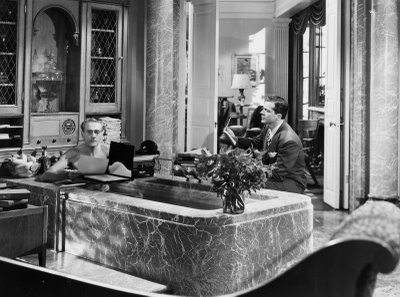
Clifton Webb as the acerbic critic Waldo Lydecker in Laura (1944)
Rereading my last paragraph makes me realise how much I enjoy slating a book or a film rather than praising it — which in turn makes me feel old! I was amused to read that crime writer Philip Kerr has apologised to Allan Massie for writing a scathing review of Massie’s latest book on its Amazon page. I reported last week that Kerr did this as revenge for Massie writing bad reviews of Kerr’s last two books. Perhaps Kerr could find comfort in watching a little known Vincent Price horror movie called Theatre of Blood (1973). The film is every critic’s worst nightmare. Price plays a hammy Shakespearean actor named Edward Lionheart who has spent his life receiving bad notices and being denied a coveted acting award from a group of reviewers known as the Critic’s Circle. Lionheart fakes his own death and then comes back to take his revenge on his critics by murdering them by gruesomely ingenious methods taken from the plays of Shakespeare. The film is on one level a comment on Price’s acting career and is remarkably good fun.
The entire film is available to watch on YouTube. Here’s the opening scene. Enjoy:
Henning Mankell on the Gaza Aid Flotilla
Swedish crime writer Henning Mankell was on board one of the aid ships intercepted by Israeli forces on route to Gaza earlier this week. He has been talking about the ordeal to the Guardian and seems in little doubt that the Israelis arrived with the intention to fight:
“I think the Israeli military went out to commit murder,” Mankell said. “If they had wanted to stop us they could have attacked our rudder and propeller, instead they preferred to send masked commando soldiers to attack us. This was Israel’s choice to do this.
“And it was the most stupid thing they could have done, because look around, Israel has never been so criticised in the world as of today, and if you ask me, this blockade will be over within the next six months.” Via
It has been a busy day for crime fiction bloggers with the dramatic news that Swedish crime writer Henning Mankell was on one of the Gaza-bound aid boats stormed by Israeli forces yesterday. He was not hurt apparently, but he may be in custody.
A slightly more lighthearted story was reported in The Daily Telegraph — crime writer Philip Kerr is an internet troll! Apparently Kerr was so aggrieved by two scathing reviews that historian Allan Massie wrote of Kerr’s last two novels that Kerr got his revenge by slamming Massie’s latest book on its Amazon page. The offensive review must have been taken down as it does not seem to be there any more. A literary feud or an internet imposter?
Also at the Telegraph is the obituary of the actress Carol Marsh. The late Miss Marsh played Rose, the naive young wife of the vicious hood Pinkie Brown, in the film version of Brighton Rock (1947).
Dennis Hopper (1936 – 2010)
It was very saddening to hear the news of the death of Hollywood maverick Dennis Hopper today. Hopper had an illustrious and unconventional career as an actor, director and painter. Crime fiction fans may well remember him best for his excellent, underrated and erotically-charged film The Hot Spot (1990), adapted from Charles Williams’ Hell Hath No Fury (1953). The film is a testament to Hopper’s skill as a filmmaker, and a fine addition to the neo-noir genre.
Below is the original trailer for the film.
The End of the James Bond Film Series?
Those of us who were looking forward to seeing the planned 23rd film in the James Bond series will just have to content ourselves with dipping into our DVD collections and rewatching some of the older films, after it was reported that the pre-production on Daniel Craig’s third outing has been indefinitely postponed. MGM’s well publicised financial problems, the lukewarm critical reception to the last Bond film Quantum of Solace (2008), and the fact that audiences may finally be getting sick of endless revamps, reboots, remakes and reinterpretations of classic films and classic characters have all contributed to the fact that we won’t be seeing James Bond 23 any time soon.
This is worrying news for Bond fans. Some Bond films are better than others and there have been a few real stinkers in the series now and then, but the series only just underwent a major revamp (as Casino Royale (2006) was in essence a prequel to all the previous Bond films as it shows how Bond earned his 007 licence to kill status) and for it to be in trouble so soon afterwards is not a good sign. Every time a new actor plays Bond it is in some ways a revamp, but if the new film is delayed long enough for Craig to lose interest in the part, how will they replace him without once again skewering the continuity and tone of the series? The longest gap yet between Bond films was the six- year hiatus after Licence to Kill in 1989. It took a new Bond in Pierce Brosnan, and a whole new approach to the films in the 1990s, to revitalise the series. As Quantum was released two years ago, and as production on a new film won’t start till at least 2012, we could be looking at an equally long wait. Perhaps too long? I’m being pessimistic, and I hope I’m wrong. Also, a rethink of the Bond series after Craig’s last two outings in the role may be called for. Craig, like Sean Connery and Timothy Dalton before him, has succeeded in portraying the darker side of Ian Fleming’s hard-drinking and womanising spy. But although the Craig films are satisfyingly dark and fast-paced, they lack some of the wit and delightfully British eccentricity that made Roger Moore’s Bond films so enjoyable. Moore had his faults of course, he never took the role too seriously, and he wasn’t particularly interested in challenging himself as an actor. But still he holds the record as the longest serving Bond, starring in seven films over twelve years from 1973 to 1985. The series could do well if it tried to recapture some of the charm and humour he brought to the role.
Moore’s first Bond film was the voodoo-themed Live and Let Die. In the scene below, Bond is trapped in a swamp surrounded by crocodiles and can only escape by jumping on the backs of one crocodile to another! It may not be art, but it’s cinematic gold! Enjoy.


 The Venetian Vase