Dennis Hopper (1936 – 2010)
It was very saddening to hear the news of the death of Hollywood maverick Dennis Hopper today. Hopper had an illustrious and unconventional career as an actor, director and painter. Crime fiction fans may well remember him best for his excellent, underrated and erotically-charged film The Hot Spot (1990), adapted from Charles Williams’ Hell Hath No Fury (1953). The film is a testament to Hopper’s skill as a filmmaker, and a fine addition to the neo-noir genre.
Below is the original trailer for the film.
The End of the James Bond Film Series?
Those of us who were looking forward to seeing the planned 23rd film in the James Bond series will just have to content ourselves with dipping into our DVD collections and rewatching some of the older films, after it was reported that the pre-production on Daniel Craig’s third outing has been indefinitely postponed. MGM’s well publicised financial problems, the lukewarm critical reception to the last Bond film Quantum of Solace (2008), and the fact that audiences may finally be getting sick of endless revamps, reboots, remakes and reinterpretations of classic films and classic characters have all contributed to the fact that we won’t be seeing James Bond 23 any time soon.
This is worrying news for Bond fans. Some Bond films are better than others and there have been a few real stinkers in the series now and then, but the series only just underwent a major revamp (as Casino Royale (2006) was in essence a prequel to all the previous Bond films as it shows how Bond earned his 007 licence to kill status) and for it to be in trouble so soon afterwards is not a good sign. Every time a new actor plays Bond it is in some ways a revamp, but if the new film is delayed long enough for Craig to lose interest in the part, how will they replace him without once again skewering the continuity and tone of the series? The longest gap yet between Bond films was the six- year hiatus after Licence to Kill in 1989. It took a new Bond in Pierce Brosnan, and a whole new approach to the films in the 1990s, to revitalise the series. As Quantum was released two years ago, and as production on a new film won’t start till at least 2012, we could be looking at an equally long wait. Perhaps too long? I’m being pessimistic, and I hope I’m wrong. Also, a rethink of the Bond series after Craig’s last two outings in the role may be called for. Craig, like Sean Connery and Timothy Dalton before him, has succeeded in portraying the darker side of Ian Fleming’s hard-drinking and womanising spy. But although the Craig films are satisfyingly dark and fast-paced, they lack some of the wit and delightfully British eccentricity that made Roger Moore’s Bond films so enjoyable. Moore had his faults of course, he never took the role too seriously, and he wasn’t particularly interested in challenging himself as an actor. But still he holds the record as the longest serving Bond, starring in seven films over twelve years from 1973 to 1985. The series could do well if it tried to recapture some of the charm and humour he brought to the role.
Moore’s first Bond film was the voodoo-themed Live and Let Die. In the scene below, Bond is trapped in a swamp surrounded by crocodiles and can only escape by jumping on the backs of one crocodile to another! It may not be art, but it’s cinematic gold! Enjoy.
When Stieg Larsson died suddenly in 2004, all of his estate automatically defaulted to his father and brother. Larsson’s life partner, Eva Gabrielsson, was left with nothing as Sweden’s inheritance laws do not recognise cohabiting couples. The couple never married, as Larsson was a target of neo-Nazi organisations due to his investigative journalism on the subject, and marriage may have made their address easier to trace. Larsson was working on a fourth book in his Millennium series when he died, and now the manuscript officially belongs to his estranged family, but Miss Gabrielsson has refused to hand it over. Fans of Stieg Larsson’s work have now set up the website, SupportEva.com, to campaign for Miss Gabrielsson to inherit the proceeds and administer the rights of the Millennium series. Miss Gabrielsson claims to have made significant contributions to the Millennium series and this situation is blatantly unfair. SupportEva.com is asking for Larsson fans or anyone who is interested in ending this injustice to make a small donation to help pay for Miss Gabrielsson’s legal fees. Here’s the link to the website.
Jon Ronson on Criminal Profiling
Jon Ronson has a fascinating article in the Guardian titled ‘Whodunnit?’ It charts the rise and fall of criminal profilers, and how certain profilers achieved near celebrity status with their psychological insights, before it all went horribly wrong with the police investigation of the Rachel Nickell murder case. Well worth a read.
Wallander and the British Eye View
 The recent showing on British TV of a second series of the BBC’s Wallander has added to an already growing interest in Scandinavian crime fiction. The success of Henning Mankell’s books, featuring the troubled police detective Kurt Wallander, is easy to explain: Wallander himself is a compelling character of real depth and the plotting is strong. But what stands out for me in both the books and the BBC series is the landscape and the atmosphere. In fact these beautifully made standalone episodes would seem to be more about atmosphere, emotion and feeling than anything else, including detection.
The emptiness and quietness, the unassuming provinciality of Ystad and the surrounding area, mean that the brutal killings Wallander investigates stand out in sharp and vivid contrast. The BBC’s TV adaptation has been described as ‘Norse Morse’, partly because it shared the same Sunday evening slot as the long-running TV series based on Colin Dexter’s novels, partly because Kenneth Branagh’s Wallander seems superficially to be a reworking of John Thaw’s Inspector Morse. But perhaps it’s also because, like sleepy, comfortable old Oxford, rural Sweden, especially beautiful Skåne, just doesn’t seem like the sort of place where bad things might happen.
It’s a common trope in detective fiction of course. Where would Agatha Christie be without her country houses and sleepy villages? But I wonder what this conclusion says about British TV audiences. In reality Oxford is a busy, even overcrowded city, yet it exists at some level in the popular imagination as a semi-rural small town with ‘dreaming spires’ and otherworldly though alarmingly venal Dons. On that basis Ystad seems the perfect location for a Morse for the twenty-first century: it is mostly rural (Brits have a particular fascination for the countryside, despite mostly living in cities and suburbs); it is a paragon (by British standards) of well ordered society and well managed public services; it is far enough away, and expensive enough, for most Brits never to have been there. There is perhaps a hint of schadenfreude here–smug Sweden turns out to be not so great after all–but there is a quiet melancholy in the BBC series, and in the Swedish adaptation also aired in the UK, which is an appealing antidote to some of the more noisy British-based crime series and to the perceived brash grubbiness of Britain itself.
What Henning Mankell himself has done with Wallander is understandably a little different and more pointedly Swedish. At least part of the appeal of the novels is that they unpick Sweden’s idea of its own orderliness and security in the decades since the 1980s, a political point that is watered down almost to homeopathic levels in the British TV series. On the other hand the contemplative, melancholic atmosphere combined with Wallander’s bleak determination seem to say quite a lot about what British audiences think of themselves and where they would rather be, right down to the nostalgic theme tune and the popularity of Wallander’s haunting, ethereal ringtone.
From Mad to Bad: Season Three of Mad Men
(Contains Spoilers)
The reviews for season three of Mad Men have been almost unanimously glowing. I can only assume that I was watching a different programme, as I found all thirteen episodes to be highly disappointing and tedious. Mad Men has garnered many awards, critical praise and ever- increasing ratings since it began in 2007. Like many viewers, I quickly became hooked on the show. Its depiction of 1960s America through the prism of the personal and professional lives of a cast of characters working for a fictional advertising agency based in Madison Avenue, New York City, is both fascinating and bewitching. You become entranced and appalled at the life of Don Draper (played by Jon Hamm), the creative director of Sterling Cooper who oversees million-dollar advertising campaigns in a cut-throat industry, drinks and smokes to excess and regularly cheats on his beautiful wife. Draper’s behaviour is the norm for the characters of this world. This was not only a time of financial boom and increased access to contraception, it was also a time of casual racism, sexism and homophobia. In one of the many subtle ironies of the show, some of the characters appear horrified at the racially motivated violence occuring in the Deep South, whilst being unaware of their own inherent prejudices. But then there so many good things to say about the first two seasons, stylish direction, compelling performances, complex and engrossing storylines and a meticulously researched attention to period detail. The series creator, producer and head writer Matthew Weiner previously worked on The Sopranos, and there are many parallels between the two shows. There is the theme of characters struggling to balance their personal and professional lives. Also, the rules of the advertising world are as fascinating as the rules which govern how the Mafia operates in The Sopranos. Both shows depict a sub-culture which operates very differently to other aspects of American society. Mad Men also has parallels with crime fiction; most strikingly through its elaborate backstory centred around around a criminal act. Don Draper was born Dick Whitman to a desperately poor family, but he faked his death whilst serving in the US Army during the Korean War and assumed the identity of an officer killed in action. Thus, the symbolism of character names– ‘Draper’ shields Dick Whitman’s real identity from the world.
So what went wrong with Season Three? Well, firstly it became apparent from the opening episode that Matthew Weiner and his co-writers had tinkered too much with the format of the show. Season three begins with all of the employees at Sterling Cooper in a rather gloomy mood because of the unpopular policies of the British firm which has bought out the company. The problem with putting new British characters in charge is that it makes many of the existing characters irrelevant. Plus, the Brits seem like pale imitations of the Americans in the firm, albeit they are portrayed as stereotypical upper-class twits. Perhaps an American audience might like this form of portrayal; personally, I found it excruciating to watch. But subtlety was definitely not a factor in how these episodes were written. In episode one, an accounts man is sacked and proceeds to roam around the office yelling obscenities and throwing furniture. This felt like an unpleasant way of grabbing the audiences attention. And there was a lot more of this blunt, shocking tone. The much talked about lawnmower accident felt like a scene from a Quentin Tarantino movie. The storyline concerning Sal’s closeted homosexuality has lost all its nuance and inner drama. It was not convincing that after years of repressing his sexuality, Sal would suddenly jump into bed with a bellhop at a hotel. It was also rather lazy writing to have their tryst interrupted by a fire in the hotel, conveniently sidetracking any dramatic repercussions of events. I could go on, but I suspect I’ve ranted enough. There were other storylines that were stronger and more convincing, yet I finished watching the episodes with a sense that the greatness of the show had been lost, and I doubt it can be regained in the upcoming season four.
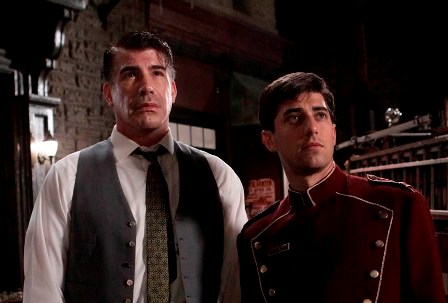
Unconvincing- Sal and the bellhop after the hotel fire
Nancy Drew Turns 80
The first Nancy Drew novel, The Secret of the Old Clock was published 80 years ago in 1930 and naturally Penguin have released a special anniversary edition. The series was one of the earliest successful detective series written specifically for children and is also one of the most famous. Written by a series of ghostwriters under the author name of Carolyn Keene, the Nancy Drew books were produced by the Stratemeyer Syndicate, which was also responsible for the Hardy Boys and the Bobbsey Twins. The history of detective fiction written specifically for children is a curious one in that it did not really emerge as a viable force in publishing until well into the twentieth century. Nancy Drew is an important part of that history; as a product of the brilliant marketing mind of Edward Stratemeyer it could hardly fail. The Star makes the case for the influence of the girl detective:
“One of the raps against Nancy was she was a privileged, upper-class white girl who was perfect,” Rehak says. “But children are willing to look beyond that if they like the character.”
All three women who have served on the Supreme Court—Sandra Day O’Connor, 80, raised on an Arizona ranch; Ruth Bader Ginsburg, 77, who is Jewish, and Sonia Sotomayor, 55, a Puerto Rican, both from New York—cite Nancy Drew as an early influence. [More]
More on Nancy Drew is here and here. My own take on children’s detective fiction is available on my personal blog.
David Fincher’s Zodiac and the True Crime Genre
I’ve just finished watching David Fincher’s Zodiac (2007) for what must be the fourth or fifth time, and I found it as mesmerising as ever. The Zodiac killer was a serial killer who murdered five people in Northern California between December 1968 and October 1969. None of the murders were solved and the identity of the Zodiac is still unknown. In fact very little is known about the killer. He identified himself as the Zodiac in a series of taunting cryptograms and cipher letters that were sent to the Bay Area press at the time of the killings. He claimed to have killed dozens of people but only five murders have been directly linked to him. David Fincher created a brilliant and haunting dramatisation of the Zodiac case. Zodiac is unique amongst crime films for several reasons; firstly, all of the murders which are shown occur within the first thirty minutes of the film, and there is no violence in the remaining two and a half hours. Secondly, the narrative subtly and seamlessly shifts from Detective Dave Toschi’s investigation of the murders to San Fransisco Chronicle cartoonist Robert Graysmith, who conducts his own investigation after becoming obsessed with the case. The film is based on Graysmith’s books Zodiac (1986) and Zodiac Unmasked (2002). Ultimately, both Toschi and Graysmith become convinced that a man named Arthur Leigh Allen is the Zodiac killer. Whether Arthur Leigh Allen was or was not the Zodiac killer is still fiercely debated to this day, but the brilliance of the film is how it portrays the maddening and all-consuming nature of obsession, as both Toschi and Graysmith have to go on with their lives never being able to fully know the truth of the case.
If I had one criticism of the film it would be that Fincher and screenwriter James Vanderbilt are too trusting of Graysmith’s version of events. I have never believed historical fiction should be factually accurate in every detail. Writers and film directors adapt and fictionalise historical accounts to suit their vision of the narrative. Fincher freely admits to doing this in his DVD commentary to the film, which he ends with the line, ‘We’re not saying Arthur Leigh Allen was the guy.’ What makes one historical account more factually valid than another is a matter of debate, and Fincher’s states he wanted the second half of the film to be Graysmith’s story. But what if Graysmith’s account of the Zodiac case contains more than just a few mistakes? On his website, Zodiac Killer Facts and the documentary Graysmith Unmasked, Michael Butterfield has done an excellent job of compiling all the errors, distortions and just plain lies that Graysmith has peddled about the Zodiac over the years. Did Fincher and Vanderbilt fall for Graysmith’s lies? Or does their position as filmmakers justify the dramatic licence they take with the story, even if it means dealing with a charlatan like Graysmith? Well, the amount of research that was conducted for Zodiac is truly astounding. Fincher and Vanderbilt meticulously and painstakingly reproduced the the late 1960s and 1970s period, and many of the details of the case are taken directly from the police reports. In some instances this is taken too absurd levels: for the Lake Berryessa murder scene, Fincher shot it at the exact spot where Bryan Hartnell and Cecilia Shephard were attacked. As there were no longer trees at that spot, and as the Zodiac hid behind trees as he was approaching the couple, Fincher had trees flown in and planted at the spot to make the scene more authentic. A tad excessive?
Zodiac is not a documentary, and it is fully legitimate for Vanderbilt and Fincher to regard the established facts of the case as a malleable first draft in order to create a work of historical fiction. On the other hand, the film does benefit from the enormous amount of research that was conducted. It is just a shame that considering the amount of research, Fincher was not prepared to be a bit more sceptical towards a True Crime Writer who has been so thoroughly discredited.
Below is part one of the excellent documentary Graysmith Unmasked. All of the documentary is available to watch on YouTube and forms an almost complete debunking of Graysmith’s investigation:
Wired on Poe
Wired has a short but to the point article about Edgar Allan Poe and his role in the invention and rise of the detective story. Poe’s place in such a history is well established, but what is interesting about this piece is the way it casually namechecks detectives from Sherlock Holmes to Mike Hammer, Jake Gittes from the film Chinatown, and even Batman, the ‘postmodern equivalent’ of Holmes (presumably referring to the recent, post-Frank Miller Batman, since the Bill Finger/Bob Kane original seems to fit a more modernistic world-view). In a piece this short such connections can’t be explored fully, but still there is a case to be made for the wider influence of Poe and it is perhaps time for a reassessment. A thought-provoking read anyway:
This self-referential circularity extended to the story’s composition, in which readers were slowly clued in to the details of the murders through their literary ciphers. It was a mechanism that evoked Poe’s extensive interest in crytopgraphy, notably outlined in “A Few Words on Secret Writing,” published in Graham’s Magazine three months after “Rue Morgue.”
Poe’s fascination and skill with ingenious detection took serious hold after his death, especially in the work of Doyle, whose Sherlock Holmes first appeared in 1887. Holmes has since come to embody Dupin’s gift for inferential logic and deduction. “Each [of Poe’s detective stories] is a root from which a whole literature has developed,” Doyle once said. “Where was the detective story until Poe breathed the breath of life into it?”
Ray and Cissy: Petition to Reunite the Chandlers
Back in March I wrote about an effort to have the ashes of Cissy Chandler, the wife of Raymond Chandler, moved from their current resting place, on a shelf in a public mausoleum, to the grave of her husband, who adored and idolized her. Loren Latker, of the Shamus Town website, is taking a lot of trouble to bring them together as they wished and the case seems set to be heard by a judge in September in San Diego, near to La Jolla where the Chandlers lived. He has set up a petition which takes only a moment to ‘sign’ and which, if there are enough signatories, should be a huge boost to the chances of the court allowing the move. If you’re a Chandler fan and you have a few seconds spare to pay your respects to the great man, do go over and sign the petition, which you can find here.


