To Wreak Havoc on American History: James Ellroy’s Red Sheet
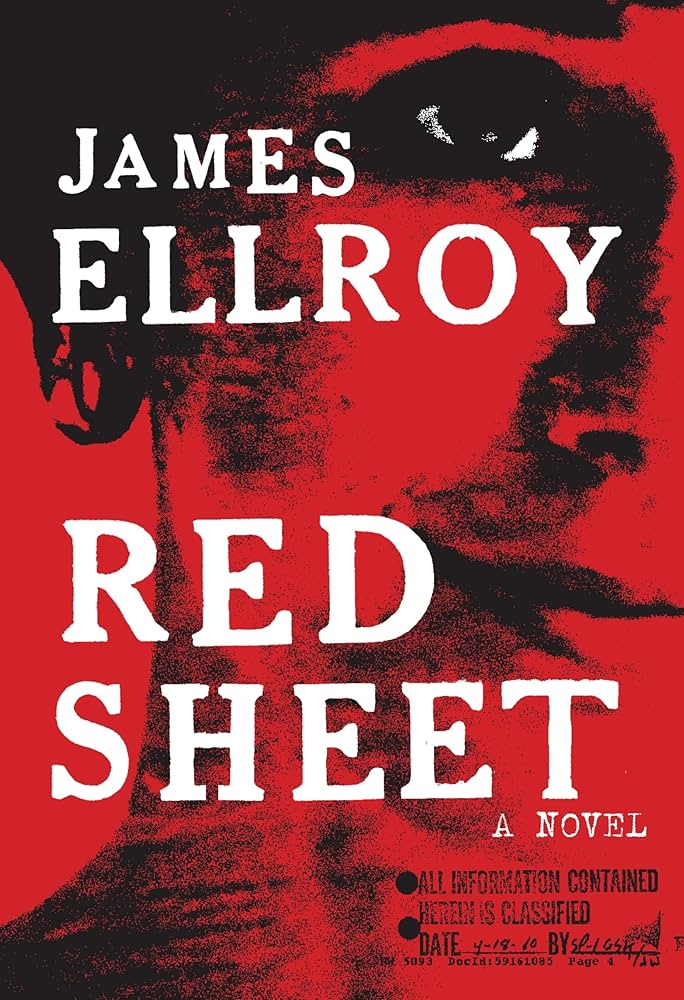
October 1962. Fred Otash is freewheeling around Los Angeles. Once a police officer, latterly ‘Private Eye to the Stars’, Otash finds himself back on the side of the Angels, if you can say that about law enforcement in Ellroy’s work, as he assigned with the LAPD on an investigation into communist influence in the aftermath of the Cuban Missile Crisis. Of course, in Ellroy’s fiction every action has multiple hidden motivations. The Kennedy brothers have ordered the red probe to distract attention away from their complicity in the premature death of Marilyn Monroe. Otash’s involvement in that sordid saga was the basis of Ellroy’s previous novel The Enchanters.
In Red Sheet, Otash finds himself typically overstretched. Richard Nixon’s ill-fated gubernatorial campaign is winding down and Otash is tasked to keep an eye on Tricky Dicky, whose nocturnal wanderings are making his lieutenants – Bob Haldemann and John Ehrlichman – nervous, particularly after he is seen visiting a woman on Halloween night who is shortly thereafter found murdered. On top of that, Otash suspects the death of the woman is tied to the murder of two communist informers, and he begins to unravel a web of intrigue that goes back to the bombing of Guernica during the Spanish Civil War and the Cristero rebellion in Mexico.
This is the convoluted nature of Red Sheet. That I have barely scratched the surface of its labyrinthine narrative in the synopsis above, proves that for an author in his late seventies, Ellroy is not lacking in ambition and scope. Regardless, in recent years a weariness has kicked in when reading Ellroy as it feels that he has said it all before. Novels such as Perfidia and This Storm, part of the prequel Los Angeles Quartet that Ellroy abandoned in favour of his more recent Otash novels, hammered readers with the relentless telegraphic prose style that began to overwhelm characterisation and dialogue.
Any appraisal of a new Ellroy novel must address whether it is a return to form of his classic period (broadly from The Black Dahlia to The Cold Six Thousand) or is it more plodding down the path of idiosyncrasies that have made reading his recent work more of a challenging proposition. As Ellroy’s biographer and someone who has spent a lot of time with him, I can attest to Ellroy’s obsessiveness and the obsession he inspires in his readers. Don’t get me wrong, he can be kind and generous too, but readers and critics are not drawn to him for these qualities. From the writer whose mother was murdered when he was ten years old (the case is still unsolved), and whose father was Rita Hayworth’s business manager (he organised Hayworth’s wedding to Prince Aly Khan), we have come to expect a more visceral intensity in his writing, especially on his dual obsessions of Hollywood and politics and their intersection. The good news is that Red Sheet delivers the goods on that score. In terms of a gripping plot, a well-paced unfolding mystery and sheer page-turning entertainment, Ellroy is a master and it shows here. The novel’s key flaw is a lack of snappy dialogue. The prose is as jazzy as ever, but when characters converse Ellroy falls back into a mode of speechifying that stifles the overall atmosphere. Nevertheless, Red Sheet is an impressive and accomplished addition to the genre, and it’s always good to have Ellroy, through Fred Otash, wreak such havoc on American history.
This review has been cross-posted on Shots Magazine. You can also check out my video review of Red Sheet on YouTube show Ellroy Reads.


 The Venetian Vase