The Art of P. D. James
Editor’s Note: Today, I am happy to welcome to the blog the author and academic Sarah Burton. Sarah has contributed an excellent guest post on ‘The Art of P.D. James’:
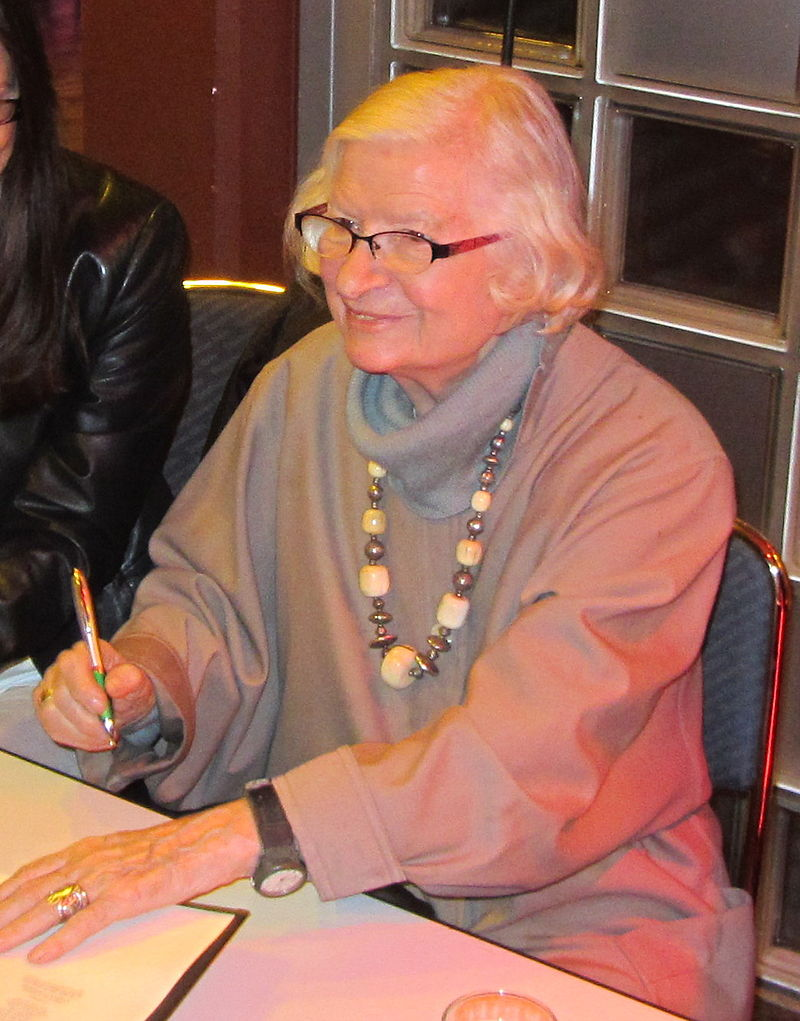
Conveying information to the reader in crime fiction can seem relatively easy. Those investigating the crime have every reason to ask witnesses and suspects pertinent questions; better still, investigators have every reason to discuss the case between them, and turn over various theories – all in full view of the reader. By contrast, in literary fiction a writer can spend an afternoon trying to find a way of conveying a small piece of information to the reader in a way that feels subtle and believable.
That’s not to say, of course, that the crime writer can’t make use of this method too. By the end of the first chapter of P. D. James’s first novel, Cover Her Face (1962), we have a pretty strong sense of the principal location – a country house called Martingale – and this has been achieved by the ‘subtle and believable’ method. These impressions of the house have been gleaned from details picked up incidentally, such as it being the sort of house where dinner parties are often held, at which chicken soufflé, served by a house-parlourmaid, is on the menu; the sort of house that has a drive, and used to have stables, and where weekend guests are not unusual. We pretty much know where we are, and two more chapters pass without us really feeling the absence of an overview of the place.
Then the police arrive.
‘Nice-looking place, sir,’ said Detective-Sergeant Martin as the police car drew up in front of Martingale. ‘Bit of a change from our last job.’ […]
Detective Chief-Inspector Adam Dalgleish did not reply but swung himself out of the car and stood back for a moment to look at the house. It was a typical Elizabethan manor house, simple but strongly formalized in design. The large, two-storeyed bays with their mullioned and transomed windows stood symmetrically on each side of the square central porch…
And so the description continues, until readers could pretty much draw a sketch of Martingale.
By having the reader see the house through Dalgleish’s eyes, James has solved two problems: (a) we now see the house in a way that the viewpoint of any of the characters familiar with the house could not legitimately or believably have provided – they all know the building too well to see what Dalgleish, seeing it for the first time, would naturally notice; (b) we now re-enter the world of the story attached to Dalgleish’s perspective.
Dalgleish and Martin meet the local superintendent in the hall of the house.
Two reporters were sitting just inside the door with the air of dogs who have been promised a bone if they behave and who have resigned themselves to patience. The house was very quiet and smelt faintly of roses.
The reader is now certain that these are Dalgleish’s impressions, not those of a disembodied narrator. (And the presence of the two reporters in the hall is another subtle indicator of the scale of the house – how many of us could accommodate two journalists hanging about in our front hall?) We are with him as he follows the superintendent up ‘the vast square staircase’. Although there is no description of the hall and the corridors as they pass through them, James remedies this when they enter the victim’s bedroom:
The bedroom was white-walled and full of light. After the dimness of the hall and corridors bounded with oak linen-fold panelling, this room struck with the artificial brightness of a stage.
Not only do we get the effect of bursting into the brightness of the room, but where we’ve just been has now been plausibly evoked. Both locations are made remarkable – and so legitimately describable – by contrast.
The account of the dead girl’s room that follows is naturally rich in detail: Dalgleish’s is the kind of mind that hoovers up all particulars, knowing that he can’t yet tell which might or might not be relevant.
So James uses a number of different strategies to help the reader see where we are: some of the time we are almost unconsciously absorbing information about our surroundings as the story moves forward; some of the time Dalgliesh’s consciousness is directing our attention. In both cases James is firmly in control – at no point does anything come from nowhere.

She uses the same technique when delivering backstory; we don’t get told simply that Dalgleish has been in the job at this level for seven years – the information arrives obliquely, as he is considering the victim’s body:
He stood very still looking down at her. He was never conscious of pity at moments like this and not even of anger, although that might come later and would have to be resisted. He liked to fix the sight of the murdered body firmly in his mind. This had been a habit since his first big case seven years ago when he had looked down at the battered corpse of a Soho prostitute in silent resolution and had thought, ‘This is it. This is my job.’
P. D. James has a habit – fairly common now but less so at the time she was first writing – of changing the centre of consciousness of the narration – allowing the reader into the minds of various characters, and to see events as they see them. Leading up to the chapter containing this information about Dalgleish’s career history we have had sections told in the exclusive third person of each of the five main suspects, as well as Dalgleish. The convention James has established means we are only going to get a description of Dalgliesh through one of these viewpoints. In fact, they all see him for the first time at the same time, enabling James to cycle through all these viewpoints:
The door opened and three plain-clothes policemen came in. Superintendent Manning they already knew. Briefly he introduced his companions as Detective Chief-Inspector Adam Dalgleish and Detective-Sergeant George Martin. Five pairs of eyes swung simultaneously to the taller stranger in fear, appraisal or frank curiosity.
Catherine Bowers thought, ‘Tall, dark and handsome. Not what I expected. Quite an interesting face really.’
Stephen Maxie thought, ‘Supercilious-looking devil. He’s taken his time coming. I suppose his idea is to soften us up. Or else he’s been snooping round the house. This is the end of privacy.’
Felix Hearne thought, ‘Well, here it comes. Adam Dalgleish, I’ve heard of him. Ruthless, unorthodox, working always against time. I suppose he has his own private compulsions. At least they’ve though us adversaries worthy of the best.’
Eleanor Maxie thought, ‘Where have I seen that head before? Of course. That Dürer. In Munich was it? Portrait of an Unknown Man. Why does one always expect police officers to wear bowlers and raincoats?’
It’s an unusual strategy, but a hard-working one, these impressions being designed as much to give the reader insight into Catherine, Stephen, Felix and Eleanor as to give us a sense of Dalgleish’s appearance. They are followed by a fifth, much odder impression:
Through the exchange of introductions and courtesies Deborah Riscoe stared at him as if she saw him through a web of red-gold hair.
When he spoke it was in a curiously deep voice, relaxed and unemphatic.
The reader pauses only momentarily over these observations and is soon drawn back into the sweep of the narrative. It is only at the very end of the book, as Dalgleish takes leave of Deborah, that we begin to understand the palpable chemistry between the two:
As he turned his head and saw the lonely figure, outlined momentarily against the light from the hall, he knew with sudden and heart-lifting certainty that they would meet again.
In no hurry to provide the reader with critical information about Dalgleish’s past in this first novel, James waits until the right moment presents itself. This arrives when he is interviewing Eleanor Maxie about the murder of her parlourmaid, Sally Jupp; Sally, an unmarried mother, had announced her engagement to Eleanor’s son hours before her death and Dalgleish is trying to establish how Eleanor felt about the proposed marriage. Eleanor enumerates her reasons, concluding: ‘Of course I disapproved of this so-called engagement.’ She then asks Dalgleish what she doubtless considers to be a rhetorical question: ‘Would you wish for such a marriage for your son?’
For one unbelievable second Dalgleish thought that she knew. It was a commonplace, almost banal argument, which any mother faced with her circumstances might casually have used. She could not possibly have realized its force. He wondered what she would say if he replied, ‘I have no son. My only child and his mother died three hours after he was born. I have no son to marry anyone – suitable or unsuitable.’ He could imagine her frown of well-bred distaste that he should embarrass her at such a time with a private grief at once so old, so intimate, so unrelated to the matter at hand.
As the co-writer of a crime fiction series myself I am well acquainted with the challenge of balancing the needs of the reader who already knows some of the characters from earlier novels and the reader who is meeting these characters for the first time. So I was interested to see how James handled the appearance of both Dalgliesh and Detective-Sergeant George Martin in her second novel, A Mind to Murder (1963). There is no character at the psychiatric clinic where this crime is set who could know enough about either of them for a description to come from their centre of consciousness. So she creates points from which their behaviour might theoretically or historically be witnessed.
Dalgleish and Martin made their last round of the premises together. Watching them at work a casual observer might have been misled into the facile observation that Martin was merely a foil for the younger, more successful man. Those at the Yard who knew them both judged them differently. In appearance they were certainly unalike. Martin was a big man, nearly six feet and broad-shouldered and looking, with his open ruddy face, more like a successful farmer than a detective. Dalgleish was even taller, dark, lean and easy moving. Beside him Martin seemed ponderous. No one watching Dalgleish could fail to recognise his intelligence. With Martin one was less sure.
This is what she does: always resisting the blunt instrument of a single narrative voice that describes everything, she insists all detail could be observed and interpreted by someone (whether it’s ‘a casual observer’, ‘those at the Yard who knew them both’, someone ‘watching’ or the universal individual ‘one’) – again, nothing comes from nowhere; characters are not just described, they are – somehow or other – known.
Even landscape doesn’t exist independently of the story and the characters. Her third book, Unnatural Causes (1967), is situated on the Suffolk coast. Towards the end of the novel a terrific storm is the setting for a thrilling climax ending in death and destruction, Dalgleish being injured but having solved the crime. He wakes up the next morning, aching all over after the exertions of the night before and with his hands bandaged.
He wriggled his arms into his dressing gown and walked across to the window. Outside the morning was calm and bright, bringing an immediate memory of the first day of his holiday. For a moment the fury of the night seemed as remote and legendary as any of the great storms of the past. But the evidence was before him. The tip of the headland visible from his eastward window was ravaged and raw as if an army had clumped across it littering its way with torn boughs and uprooted gorse. And, although the wind had died to a breeze so that the litter of the headland scarcely stirred, the sea was still turbulent, slopping in great sluggish waves to the horizon as if weighted with sand. It was the colour of mud, too turbid and violent to reflect the blue translucence of the sky. Nature was at odds with itself, the sea in the last throes of a private war, the land lying exhausted under a benign sky.
We see this landscape so clearly we feel we are standing at the window with Dalgleish.
My aim in looking carefully at these first three novels in the Dalgleish series was to try to understand what has led to the widespread veneration of P. D. James as an outstanding writer of crime fiction. The appeal of Dalgleish himself is not obvious – quiet and private, his inner life is suggested by the fact that he is also a poet. His methods are not outlandish or remarkable in any way. James confessed to having deliberately killed off his wife and child so that his private life wouldn’t be complicated – an interesting decision when we consider the complexity of many modern fictional detectives’ personal lives – and indeed she doesn’t allow him to be pinned down by a relationship until he marries Emma Lavenham at the end of The Private Patient (2008), the fourteenth and final book in the Adam Dalgleish series.
And like Dalgleish, James plays by the rules; her style isn’t showy and her novels don’t radically rewrite the rule book for crime fiction – in fact some critics find her stories disappointingly traditional. Personally I am not a fan of the characteristic long explanation at the end – in Unnatural Causes in particular the fact that the murderer has recorded a confession detailing every aspect of her crimes seems not only extraordinarily convenient but extremely risky on her part. While this lengthy unravelling is an accepted feature of Golden Age crime fiction I somehow expected more of James. And as a creative writing teacher I would always caution students against introducing readers to a large cast of characters very early on; James expects the reader to take in nine characters on page one of Cover Her Face, and while she slows down a little (twelve characters in the first six pages of the second novel and reducing the number of characters altogether in the third) I still had to revert to the method I haven’t used since attempting to tackle the Russian classics – keeping a list.
So what it is in her writing that raises her – in the opinion of both critics and readers – above so many of her fellow crime writers? I think it is the way she allows, as we have seen, characters to emerge from the text, through their perceptions and the perceptions of those around them, that gives the impression that we are getting to know them, rather than being told who they are. Like most effective literary strategies, we’re not particularly aware, as readers, of how this is being achieved – it’s a subtle and beguiling seduction. And it’s this skill that has made me wonder whether it’s not necessarily the case that P. D. James was simply an outstanding crime writer, but rather that she was an outstanding writer who happened – luckily for us – to specialise in crime fiction.

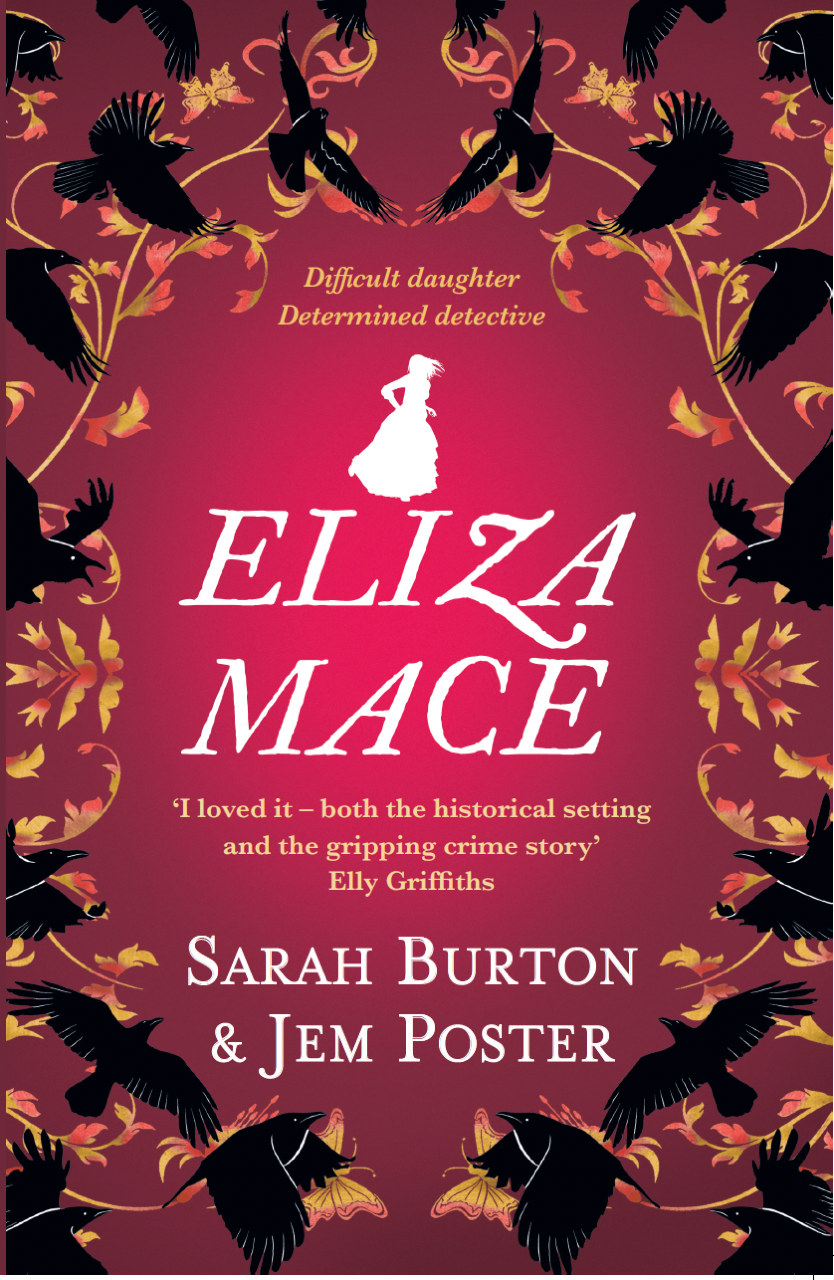
Author Bio: Sarah Burton’s most recent books were co-authored with Jem Poster. Their handbook for writers, The Book You Need to Read to Write the Book You Want to Write is published by Cambridge University Press. Eliza Mace, the first in a historical crime fiction series, published by Duckworth, is out in paperback February 27.


 The Venetian Vase
Thank you, Steve, for this very craft-oriented blog entry. Have ordered Ms. Burton’s book.
Thanks, as always, for reading Bill. Proud to host great writers, such as Sarah.