Days of Smoke by Woody Haut – Review
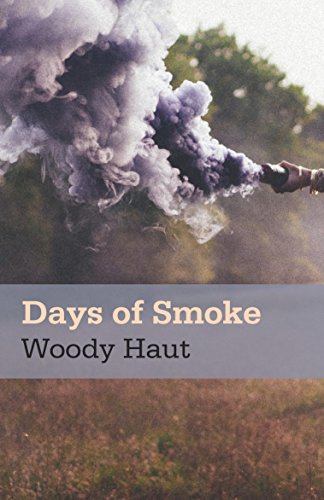 Woody Haut has long traversed the mean streets of noir, first as a distinguished critic and scholar of the subject, and latterly with the publication of his debut novel Cry For a Nickel, Die For a Dime in 2015. As a storyteller, Haut offers a rich sense of atmosphere, period and narrative. His latest novel, Days of Smoke, is a semi-autobiographical tale. Days of Smoke, in many ways maps out how Haut was introduced to the great noir theme of alienation through his personal experiences as a young man in Los Angeles in the 1960s. Cry For a Nickel was set in LA in 1960: a year the noir reader will recognise as classic territory, with the Hat Squad at war with the local Underworld, crime reporters negotiating the blurred lines that separated the LAPD from the Mob, and the glitz and glamour of Hollywood disguising an extremely sordid underbelly. With the quasi-sequel Days of Smoke, the setting is still LA but the time is June 1968. In critical terms, this time-shift marks the transition from film noir to neo-noir where both crime films and hardboiled fiction evolved stylistically to parallel societal changes. Much of the hidden tensions of the 1950s had come boiling over the surface by this point. Hollywood’s power has been denuded. Radical groups are running amok. Civil society is in freefall with race riots at home and an unpopular war abroad.
Connie Myles is a twenty-one-year-old woman working at the draft board. It’s ironic employment for someone who, as the opening line candidly states, ‘hated the fucking war’. One day, accompanied by his father Abe (the main protagonist of Cry For a Nickel), Mike Howard walks in to declare himself a conscientious objector. Mike doesn’t stand a chance against the swaggering chauvinists who are Connie’s colleagues. Men who, upon rejecting Mike’s pacifism, ‘were ebullient, like they were high on something, like they had just done their bit to defeat the enemy, like one more dope-smoking, draft-dodging loser had been beaten down and the country was, for the time being, in safe hands.’ Disgusted by the system, and determined to help Mike through one small act of defiance, Connie steals his file. This sparks a chain reaction of bizarre, gripping and violent events, loosely tied together in the best tradition of Elmore Leonard, which includes the assassination of Bobby Kennedy and a brutal double homicide reminiscent of the Manson Family murders. For much of the novel, Mike can only stand back and watch, such as when Kennedy is shot dead in the Ambassador hotel with a gun that, ironically for a peacenik, had once been in Mike’s possession:
Bobby lay on his back, a pool of blood forming behind his head.
Mike could hear people screaming.
They killed him.
Not again.
They killed him.
Who killed him?
Others had been shot as well.
Who?
How many?
No one knew.
‘They’ seems quite revealing in this instance, suggesting both the chaos in the immediacy of the moment and the paranoia of characters caught in webs of conspiracies. Who killed him? ‘They’ killed Bobby just as They killed Jack. Are ‘They’ the CIA, the Mafia, lone gunmen or is just everyone pitted against each in this world as Nixon cultivates his Silent Majority.
Having recently worked with Woody Haut on a book about James Ellroy I was informed by the author to expect an Ellrovian influence in Days of Smoke, and it’s visible when Mike meets right-wing nut, or agent provocateur if you prefer, Jonathan, who goes by the name of Juan as he thinks masquerading as a Cuban right-winger would be the fastest way to make people hate him. Juan developed anti-social tendencies after his mother was murdered. He describes dressing up as a Nazi to agitate Jewish students at the school he attends, Fairfax High, which readers might recognise as being based on Ellroy’s own deranged behaviour when he attended Fairfax. Ellroy’s actions led to the future Demon Dog of American Literature being expelled, and it must be a notorious chapter of the school’s history as Fairfax do not list Ellroy as one of their alumni, even though they do list other notable students who dropped out such as Demi Moore. But while Haut is covering similar territory to Ellroy, both thematically and from memory and experience, Haut views conspiracies as less coordinated than the crimes committed by Ellroy’s unholy trinity of Mob/Intelligence Services/Cuban exiles. Ellroy created a secret history in which everything connects, partly through J. Edgar Hoover’s massive archive of classified files. Haut’s approach is less structuralist, not as grandiose and perhaps less contrived than Ellroy’s. There are some very satisfying plot twists in Days of Smoke, but the characters are caught as much in noir fatalism as they are in the military-industrial complex. This to me was the biggest achievement of the novel, to merge Ellroy’s institutional corruption with the individual despair of David Goodis. As Ron Slate identifies in his review of the novel, the central premise of Days of Smoke is rooted in autobiography: ‘In 1968, Woody Haut appeared at the office of the Pasadena draft board to reestablish his status as a conscientious objector.’ In comparing Haut’s experiences of the Sixties with Ellroy’s it is possible to read them as opposite poles of thought – one left-wing the other right-leaning – and yet more drawn to each other in their critique of authoritarianism than at first apparent. Ellroy had his first brush with the military in 1965. He volunteered for the US Army, his father having forbidden him to join the Marine Corps as Ellroy ‘might have gone to Vietnam and got my ass shot’. After taking an instant dislike to army life, Ellroy faked a nervous breakdown in order to be discharged, thus permanently avoiding the Vietnam War. By the time Haut was registering as a conscientious objector, a path that would take him to London which would become his home from where he would write his seminal studies of the genre, Ellroy was drifting between homelessness, crime and several stints in the LA County Jail. Both authors’ different paths would lead them into becoming expert noir practitioners, as Mike says of Juan, ‘(he) had more than his share of misfortunes, which had turned him into the person he now was, that this right-wing thing was just a guise, a way of separating himself from others, allowing him to become someone different, that the death of his mother was the beginning of a process that simply allowed him to shed one skin for another, though what he was today might not necessarily be who he would become tomorrow.’
Days of Smoke is a crime novel set in a decade teetering on the brink of revolution. The reader knows how the history will play out, but there are still plenty of surprises in the narrative and, not to mention, some insightful parallels with the current fractious political climate. In forging a new noir style out of political history, personal experience and his encyclopedic knowledge of noir, Woody Haut has crafted a modern classic in the genre. Not to be missed.
The Great Bravura by Jill Dearman – Review
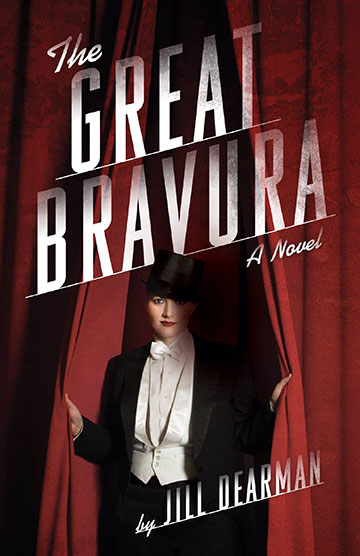 The Great Bravura is a novel which weaves together illusion and film noir, philosophy and art and sexuality and a missing woman case. It is a mystery whodunnit that asks ‘Is the central event a crime or an illusion?’
Bravura and Susie have a magic act in 1940s New York, plus a friendship and on/off romance which has served them well. But when the seductive Lena joins their act, like the uninvited guest in a Harold Pinter play, she begins to tear them apart with her belief in real magic. When Susie vanishes during their ‘Disappearing Box’ act, Bravura is at a loss. Has Lena used the dark arts to get rid of Susie, making it a case of murder by illusion?
Dearman presents a noir world where people are drawn to the colour of magic, but the real magic act of this novel is how the post-war period setting is an alternative history where gay marriage and lesbian parents are as commonplace and accepted as they are in liberal societies today. Any noir aficionado is drawn to the romanticism of the 1940s/50s era with its mean streets, smoky bars and hardboiled attitude, but looking back at this time, readers of traditional noirs will recognise homophobic attitudes that rankle today. Dearman could have made this a narrative about prejudice. Instead, it reads as a celebration of sexuality and noir, with musings on surrealism and metaphysics woven into the text as effortlessly as the references to classic film noirs: ‘Build My Gallows High’, ‘Leave Her to Heaven’, ‘Nightmare Alley’ and more seminal noir titles are all used as chapter headings. The story alternates between the three first-person viewpoints: Bravura’s, Lena’s and Susie’s. This gives the reader insight into the minds of Dearman’s three illusionists and heightens the sense of difficulty Bravura increasingly faces in separating reality from fiction. Is the titular character controlling these illusory images or is she subservient to a dream-like reality?:
The moment before you awaken is usually the most glorious. You are awash in the world of dreams. When you open your eyes, that’s when reality starts to sink in. You’re not a rich gentleman farmer living the quiet life. You’re not a household name, worshipped by millions of adoring fans. But for me, that morning, whatever I was dreaming about – dancing with Dietrich? Playing poker with Orson? – none of it could compare to what I had right beside me in real life.
Where was she?
The moment between sleep and waking, between the missing and the deceptively apparent, infuses Dearman’s vision of noir. In an interview for The Brooklyn Rail, she compares noir to the ‘missing letter’ of the Hebrew alphabet:
It’s impossible-to-name sound that fills the void in the universe. The breath of life in other cultures. I think of it as the pause that we “hear” yet don’t hear in music. Noir contains a lot of that silent invisible presence. Noir is impossible to define in an absolute way, yet oftentimes it is the musicality of it—the jazzy American riffing, mixed with the wild id-driven and idiosyncratic exploration of the irrationality of human nature that the French existentialists wrote about so eloquently—that makes us recognize a work of fiction or film as truly “noir.”
While critical arguments persist about which works classify as noir and which do not, this reader is left in no doubt that with this novel Dearman has captured the musicality of the genre, and with it she has crafted a darkly romantic and thrilling noir tale. But even if you’re not a fan of the genre, like a sceptic at a magic show, you’ll find yourself surprised, deceived and won-over by The Great Bravura.
This Storm: James Ellroy’s New LA Quartet Novel
The title of James Ellroy’s next Los Angeles Quartet novel is This Storm. The news leaked on the internet a couple of years ago, but was swiftly removed from most websites, as at the time, Ellroy was apparently displeased with the leak. However, now you can pre-order copies of This Storm on Amazon and Waterstones so it’s fair to assume that This Storm is officially the novel’s title. Inevitably, the symbolism behind the title will be the source of some speculation for hardcore Ellrovians (and there are a few of us about!). I did some digging and the phrase ‘This Storm’ is used in the prologue to Ellroy’s most recent novel Perfidia:
Reminiscenza.
I wandered off in a prairie blizzard 85 years ago. The cold rendered me spellbound, then to now. I have outlived the decree and find myself afraid to die. I cannot will cloudbursts the way I once did. I must recollect with yet greater fury.
It was a fever then. It remains a fever now. I will not die as long as I live this story. I run to Then to buy myself moments Now.
Twenty-three days.
Blood libel.
A policeman knocks on a young woman’s door. Murderers’ flags, aswirl.
Twenty-three days.
This Storm.
Reminiscenza.
This is Kay Lake’s first-person narration which opens and draws to a close a few pages before the novels coda, when the phrase is repeated ‘War. Blood libel. Twenty-three days, this storm, reminiscenza’. The twenty-three days refers to the narrative timespan of the novel, beginning on the day before the Japanese attack on Pearl Harbour and concluding on the last days of 1941. Given this setting and context, ‘the storm’ Ellroy is portraying in his fictional LA is the anti-Japanese hysteria, Internment and flagrant war profiteering that followed the Day of Infamy. In the second volume of the Quartet, the storm will continue ‘murderers flags, aswirl’ as the US is plunged inexorably into total war. Of course, we shouldn’t speculate too much about the plot when not even a synopsis for the novel has appeared yet. But it’s worth remembering that, just as Ellroy used the phrase ‘This Storm’ in the opening of Perfidia, he has also used as titles other phrases or words that have appeared in his novels. For instance, ‘Perfidia’ is the song that Bucky Bleichert and Kay Lake dance to in The Black Dahlia. Ellroy used the Black Dahlia case as backstory in his second novel Clandestine, but also gave it fleeting references in Brown’s Requiem and Blood on the Moon before writing his seventh novel ‘titled thrillingly and ironically The Black Dahlia‘ he once joked in the documentary Feast of Death.
A good title can make the difference between a reader buying your book or not, and Ellroy has butted heads with publishers before about naming his novels. Killer on the Road was originally released as Silent Terror (at publisher Avon’s insistence), before subsequent reprints bore Ellroy’s preferred title. Correspondence I examined at the James Ellroy archive at the University of South Carolina indicated there was disagreement between Ellroy and his editors over Blood’s a Rover, which was Ellroy’s title choice, but we now know that Ellroy won that argument. Perhaps my favourite example, though, of Ellroy’s colourful history of title choices was from an unpublished novel. By the mid-1980s, Ellroy had completed three novels featuring his brilliant but unhinged Detective Lloyd Hopkins. He planned a fourth Hopkins novel and wrote the outline before abandoning it to write The Black Dahlia, the book that made his name. And the title of this unpublished fourth Lloyd Hopkins novel? – The Cold Six Thousand. A title he would return to around fifteen years later, like an itch he just had to scratch.
If you’re excited about This Storm but can’t wait for the projected April 2019 release date, then you may be interested to hear about another Ellroy forthcoming release. The Big Somewhere: Essays on James Ellroy’s Noir World is an anthology of critical essays I have edited featuring contributions from some of the best Ellrovian scholars working today. It is to be published by Bloomsbury in July, but you can pre-order a copy here. Check it out.

Noir City comes to Denver
For the following post on Noir City Denver we welcome back to the blog James Ellroy aficionado and all-round good guy Jason Carter…
What is film noir?
Is it merely about conventional crime? Is it bad people doing bad things, blinded by their own obsessions? Is it a beautiful yet duplicitous woman driving lust-crazed men to destruction? Is it the illusion of the American Dream rudely juxtaposed with the simultaneous urge to disrobe this fatuously disingenuous fantasy? Noir gives you a front row seat to this slow burning chaos and shows you an America light years from its founding ideals, rife with corruption and darkness, and abounding with alienation, anxiety, moral ambiguity and disillusionment.
James Ellroy has a curt, concise and yet dynamic phrase to sum up all this dark distortion: “You’re FUCKED!” The Demon Dog often explains it this way: “You have just met a woman… You are coming in for the very first kiss, and what you know will be the veritable Mount Everest of sexual delight… BUT, it’s film noir, and the common term of transit in film noir is: First kiss to your death in the gas chamber in the Green Room at San Quentin Prison—six and a half months! WHY?! Because it’s film noir, AND YOU’RE FUCKED!”
Film Noir Foundation Founder and President Eddie Muller, whom Ellroy has reverently dubbed the “Czar of Noir” defines this characteristically un-definable genre in a manner more accessible, but no less haunting: “If a private eye is hired by an old geezer to prove his wife’s cheating on him and the shamus discovers long-buried family secrets and solves a couple of murders before returning to his lonely office – that’s detective fiction. If the same private eye gets seduced by the geezer’s wife, kills the old coot for her, gets double-crossed by his lover and ends up shot to death by his old partner from the police force – I can say with complete assurance: you are wallowing in NOIR.”
The Film Noir Foundation is a non-profit public benefit corporation established to preserve the cultural, historical, and artistic significance of film noir as an original American cinematic movement. The Foundation preserves films in danger of being lost or irreparably damaged, thus ensuring high quality prints of these classic films remain in circulation for future generations. The centerpiece of the Foundation’s public awareness campaign is the annual Noir City film festival, established in 2003 in Muller’s native San Francisco.
Fifteen years after Noir City’s inception, Muller brought his venerable cinematic carnival to Denver for the very first time. And there was no better locale in the Mile High City than “Ellroy’s House” (Muller’s name for the Alamo Drafthouse).
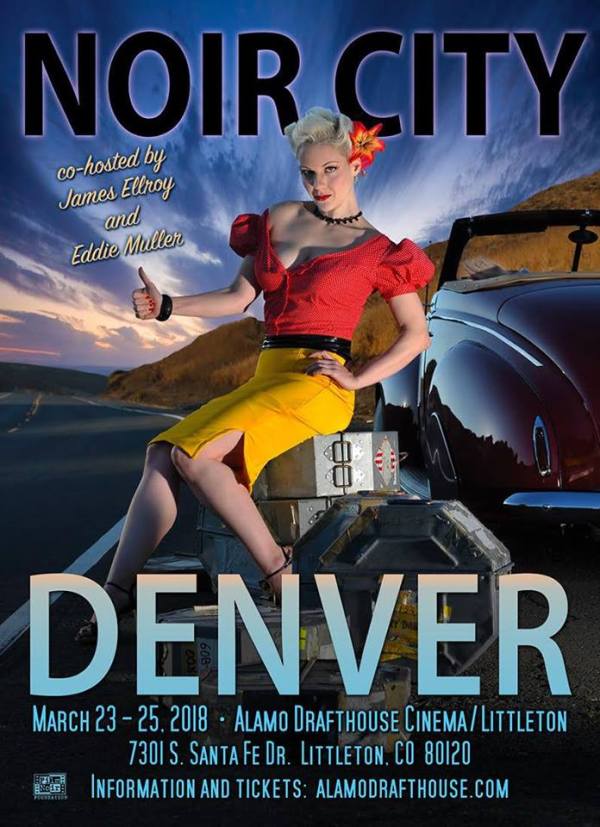
Despite Noir City being Muller’s creation, the event’s Denver stop could also have been called “Ellroyfest”: Dig a roomful of krazy kool kats playing dress up in old school fedoras, and a Pachuco-era Zoot Suit or two… Dig Helen Knode, and LAPD Museum Executive Director Glynn Martin—Ellroy’s co-author on the 2015 book LAPD 53—and there’s Jello Biafra, former lead singer of the Dead Kennedys…
Say what?!
“Oh boy—old punk rockers connected with noir, where did it start?” the Boulder-bred Biafra mused. “Well, the movies were cool obviously, and some of them had a certain sleaze and degenerate vibe that appealed.”
The Prowler (1951)
Noir City Denver’s first film, Joseph Losey’s The Prowler, offered an abundance of sleaze and degenerates. “It’s a film we both think very highly of,” Muller began. Ellroy agreed: “It’s a crackerjack motion picture. It’s about cops as voyeurs, and Van [Heflin] is the single, creepiest cop in film noir”.
After being frightened by a peeping Tom at her mansion in the suburbs, the beautiful Susan Gilvray (Evelyn Keyes) calls the police for help. Responding officer Webb Garwood (Van Heflin) becomes infatuated with Susan, and the two engage in an affair. Susan soon terminates their relationship though, choosing to remain with her husband, John (Sherry Hall). However, Webb’s obsession with her continues to grow, until he ultimately kills John, marries Susan and buys a motel with the proceeds from John’s life insurance policy. After Susan reveals that she’s pregnant, the couple relocates to a deserted ghost town, because Webb fears the baby will be incriminating evidence that he killed the sterile John. Preparing to deliver the baby himself, Webb is forced to fetch a doctor, a move that precipitates Webb’s climactic demise.
“Noir helps us empathize with why this character is doing these things, why they are acting in a certain way” Muller told me in our post-film conversation. “In the case of The Prowler, Susan’s motivation was that she wanted a baby, and Webb had no business being a cop… he was much more of a used car salesman, only doing things for material short term gain.”
Working in conjunction with Ellroy, Muller’s Film Noir Foundation recently gave The Prowler a comprehensive digital restoration.

James Ellroy and Eddie Muller holding court at the Alamo Drafthouse
The Lineup (1958)
“The Lineup was originally a TV show from 1950-1953… It was good like a pitbull… It was goooood like a motherfucker! Women wore hats. Men wore hats. Women wore little white gloves… I miss those days,” Ellroy mused.
Muller fleshed out the Demon Dog’s nostalgic description, referencing Director Don Siegel’s exceptional camera work that deftly and historically captured many iconic San Francisco locations that no longer exist: “This is the San Francisco that I grew up in,” Muller said. “I was there, and I remember all that stuff. This whole movie follows the two hitmen and drops the cops.” Led by the pathological hitman Dancer (a superbly sinister Eli Wallach), the perps Muller mentioned systematically eliminate the unwitting carriers of planted heroin with the quietly hilarious exception of a little girl who used the Big H to powder her doll.
“This film also features the best car chase shot before [Peter Yates’ 1968 Steve McQueen romp] Bullitt,” Muller said, regarding the film’s frenetic finish that races across the entire city as the police investigators close in.
Wicked As They Come (1956)
“There are many sub-categories of film noir. Wicked is ‘evil woman noir’,” Ellroy began. “There are two decent novels in the noir canon: Double Indemnity, and [Wicked’s source material] Portrait in Smoke.” The 1956 film, directed by Ken Hughes stars Arlene Dahl as a beautiful and cunning poor girl from the slums named Katherine. In moves reminiscent of Ellroy’s uber-manipulative Celeste from The Big Nowhere, Katherine uses and abuses men to get what she wants. Near the end of the film, as Katharine’s misdeeds finally catch up to her, it is finally revealed that the source of Katharine’s evil is a brutal childhood assault (and supposed gang rape) by a group of thugs. Like Ellroy’s own childhood trauma, Katharine’s ordeal obsessively dictates and directs her life.
711 Ocean Drive (1950)
In 1950, the public was fascinated with national coverage of congressional hearings on organized crime. This fascination gave birth to yet another noir sub-genre, the expose film. “[Joseph M. Newman’s 711 Ocean Drive] revealed so much about the inner-workings of organized crime, it had to be filmed under police protection,” Muller said, shortly before the film. Amid constant threats of sabotage, Columbia Pictures actually purchased insurance policies with Lloyd’s of London to prevent the kidnapping of stars Edmund O’Brien and Joanne Dru.
Drive focuses on diligent and ingenious telephone repair-man Mal Granger. Granger fuses his love of horse racing and electronics when he expands the illegal racing wire of Gangster Vince Walters. After Walters is murdered, Granger assumes command of the operation, and soon finds himself the target of both an east coast gangster who wants Granger out of the way, and a lieutenant who’s after Granger for murder. In a rather ironic tribute to Granger’s genius and the power of electricity, the chase concludes at the top of the Hoover Dam (a major source of electricity), where Granger is shot, and plunges to his death.
The film’s final frames concern a public service announcement warning viewers that their participation in bookmaking operations are also an indirect participation in murder, not too different from PSAs linking drugs to terrorism (“if you buy drugs, YOU could be supporting terror”) in the early 2000s.
On a lighter note, I was pleased to see Ellroy’s litigious nemesis Albert Teitelbaum listed among the credits as the film’s fur supplier. I thought about bringing it up to Ellroy, but chose to leave that mess on the court docket where it belongs.
I Walk Alone (1947)
“As head of the Film Noir Foundation, I can actually lean on studios like Paramount, and tell them what they have in their vault,” Muller began. “Paramount has an edict that they will not print film anymore. Thankfully, I impressed them enough with Noir City that Paramount made a digital print of [I Walk Alone].” Eddie passed the microphone to Ellroy, who broke down the film’s cast with typical Ellrovian antics: “This movie stars the holy troika Kirk Douglas—still alive at 101 years old—Burt Lancaster and LEZ-abeth Scott.”
Byron Haskin’s I Walk Alone shows the transition of American crime, from shadowy rum-running bootleggers to ensconced corporate kingpins. The film opens on bootleggers Frankie Madison and Noll Turner, who make a pact dictating that if either was caught and imprisoned, the other would save half of any profits made for the captured partner to collect upon release. Madison becomes the unlucky one, and upon his release fourteen years later, finds Turner a successful club owner and unwilling to split the profits as previously agreed. Turner uses his club as a money laundering operation while also ordering murders and beatings to protect his empire. Madison eventually derails Turner’s operations and does indeed collect what’s owed to him, all while evoking a slow-simmering bitterness over his old friend’s betrayal.
He Walked by Night (1949)
The festival’s final film was Alfred Werker and the uncredited Anthony Mann’s He Walked By Night. “This is a landmark film,” Muller declared. Ellroy concurred: “It’s an important motion picture in the hard boiled canon…It’s based on the Irwin “Machine Gun” Walker case… The film spices it up, sexifies it, and makes it goooooooooood!” Walker was a former Glendale, California police department employee and WWII vet who was responsible for an audacious L.A. crime spree of burglaries, robberies and shootouts from 1945-1946. A schizophrenia rap—and ironically, a failed suicide attempt—helped Walker “beat the green room,” as Ellroy put it, and live out his days until 2008.
In the film, Roy Morgan (Richard Basehart) is a burglar who listens in to radio police calls, allowing him to continually avoid the cops. After Morgan kills a police officer, Sergeants Brennan (Scott Brady) and Jones (James Cardwell) struggle to piece the case together. But when Jones is wounded in a shoot-out with Morgan, Brennan employs all facets of detective work, including forensics and informants, to find the elusive and clever criminal.
Jack Webb appears in the film as a forensics specialist who helps connect several crimes to one person. He Walked by Night, and its police technical adviser Marty Wynn, would later inspire Webb’s popular Dragnet radio and television shows—which in turn paved the way for the glut of contemporary crime shows (CSI, Law & Order, etc.) we see today. Webb would also go on to pen a 1958 book called The Badge that would later stun an eleven-year-old El Monte, California boy named Lee Earle Ellroy.
Ellroy, Muller and your columnist Jason Carter
The Mystery of the Missing Crime Novelist
The final (and unexpected) act of this festival of shadows, darkness, mystery and intrigue happened when we exited the theater following the conclusion of He Walked By Night. You could call it The Mystery of the Missing Crime Novelist… Eddie Muller was alone in the lobby and looking lost. “Anybody seen James?” he asked. For the first time in this three day festival, the natural and abundant confidence of the Turner Classic Movies host had seemed to vanish. For the next 25 minutes, we made nervous chatter with him, while we all wondered what had become of the Demon Dog. After sitting through six films of deception and debauchery, we naturally had to entertain the possibility that Ellroy had been subdued by a shadowy attacker. If this was true, I personally hoped the Demon Dog’s lifetime commitment to physical fitness would pay off, allowing him to escape. Like a noir-esque eleventh-hour twist, Ellroy suddenly thundered through the front doors, startling all of us, “Sorry… I fell asleep in my car!”
As Ellroy and Eddie sauntered off into the darkness, Jello Biafra asked me which Ellroy novel he should start with. “Ellroy will tell you to read Perfidia first, because it’s the earliest-set book he’s written, and the chronological beginning to his life’s work… I often tell people to begin with either The Black Dahlia or his autobiography My Dark Places, but in your case, because of who you are, maybe you should start with his Underworld USA Trilogy”, I said.
“Why’s that?”
“It’s full of dead Kennedys.”
Jason Carter
THIEF – Michael Mann’s Classic Back on the Big Screen
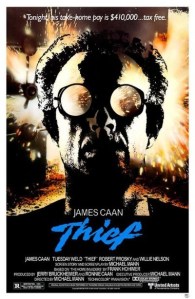 Yesterday, I introduced a special screening of Thief at Picturehouse at Fact cinema Liverpool. Set in Chicago in the early 1980s, Thief is one of the greatest crime films of modern times, and we were able to bring it back to the big screen in Liverpool via Ourscreen, which is also how I arranged a screening of Sorcerer last December (and my friend Dan Slattery organised a Christmas screening of Die Hard).
For such an esteemed noir tale, the plot of Thief is relatively straightforward. James Caan plays professional jewel thief Frank. When the fence from one of his heists dies in suspicious circumstances, Frank finds himself in the crosshairs of the Mafia. Mob Boss Leo offers to make him ‘a millionaire in four months’ if he will do heists for him. Frank’s plan is to do one or two really big scores and then go straight, but will his violent new employer let him? The narrative takes second place to the character study of Frank and the people around him: his beautiful girlfriend Jessie (Tuesday Weld), his likeable and trusted accomplice Barry (James Belushi), and his jailhouse mentor Okla (Willie Nelson). Frank is the archetypal sympathetic criminal that often populates Michael Mann films (think Larry Murphy in The Jericho Mile or Neil McCauley in Heat). He wants to raise a child and lead a normal life with Jessie, and he wants to arrange parole for Okla before a heart condition dooms him to die in prison. But to do all that he has to take down scores, and the people he loves the most will suffer for his sins.
Thief is based on Frank Hohimer’s memoir The Home Invaders: Confessions of a Cat Burglar. Hohimer was the pseudonym of professional thief John Seybold who wrote the book in his jail cell after turning informant and vowing never to go back to a life of crime. Seybold narrates his criminal career in a hypnotic street-wise prose, and is not an entirely unsympathetic criminal, but is a much meaner and rougher character than Frank his movie counterpart. Seybold specialised in home invasions, but Frank tells Leo in Thief that he will only rob from department stores and businesses. Also, Seybold was a suspect in the unsolved murder of Valerie Percy. Miss Percy was found beaten and stabbed to death in her bed on September 18, 1966. Seybold came under suspicion, alongside numerous burglars, as the Percy family lived in a plush Kenilworth mansion (Valerie’s father Charles was elected to the United States Senate) and it was assumed to be a case of a burglary gone wrong. Seybold denied any involvement, but admits in his book that he lied to the police about the case. He refrains from discussing the murder until the brief final chapter of the book, but, strangely, the photographs printed in the centre of the memoir certainly dwell on the case. Seybold spends much of the text ranting about the corruption of Chicago’s Criminal Intelligence Unit and how they were determined to frame him, but I can’t help feeling that he may have been fitted up for the Valerie Percy murder by his own book editor. This may have been for commercial reasons. The book sold well on its initial release (possibly due to interest in the Percy murder), but is almost entirely forgotten today and its fiendishly difficult to get a hold of a copy. I had to borrow my copy from the British Library who, I suspect, have the only copy available in the UK. In recent years Mann has tried to distance Thief from the book on which it was based, although in some respects the film is a fairly literal adaptation. Okla’s prison letter to Frank, for instance, is almost word-for-word identical in book and film. In an essay for the Blu-Ray edition of the film, Brad Stevens claims the film is based on the criminal exploits of John Santucci (stage name of John Schiavone), who acted as a technical consultant on the film and played the corrupt detective Urizzi. In another one of life’s little ironies former Chicago cop Dennis Farina makes his acting debut in the film as one of Leo’s hitmen. Farina had once arrested Santucci on burglary charges. Seybold himself is said to have been a technical consultant on the film, despite there being an outstanding FBI arrest warrant out on him at the time. Seybold would wind back in prison. Another problematic ‘technical consultant’ on the film was former CIU Chief William Hanhardt. He would later be convicted of running a jewellery theft ring and sentenced to prison.

Yours truly introducing Thief at Picturehouse at Fact in Liverpool
Thief is one of the best films for portraying the thin line between cops and criminals, and it is significant that it was one of the first films produced in Chicago after Mayor Richard Daley left office. Daley had made it difficult for studios to get filming permits for Chicago (there was a de facto 20 year hiatus) during his tenure as Mayor of the Windy City. Daley was apparently angered at the portrayal of Chicago as a haven for crime and corruption, and while Chicago native Michael Mann doesn’t shy away from the grit and grime of the city, it is clear he still loves its colourful and characterful bars and nighthawk diners. Fans of Heat and its famous diner scene with Pacino and De Niro will recognise a precursor to that scene in Thief. In many ways Thief is a stronger film than Heat. Upon revisiting Heat I found there to be far too much windswept hair, sunglasses and Armani suits. Thief is a far more realistic portrayal of criminals and the day-to-day drudgery of the criminal life, and yet Tangerine Dream’s pulsating score and Mann’s now trademark neon cinematography imbue the film with a haunting beauty.
It’s still a classic 37 years after its original release, and it was a privilege to bring it back to the big screen.
Postscript: As The Home Invaders is such a rare book today I felt it would be worthwhile sharing one of the anecdotes from its pages with you. Hohimer/Seybold describes burglarising an Indianapolis home and waking a ‘really beautiful blonde’ woman. He finds her unexpectedly chatty considering she has just surprised a burglar.
She said, “Could I talk with you a few minutes first?”
I said, “Sure why not it’s your home.”
Now I was mentally alert for any type of trick. She pointblank asked me how much I would charge to kill her husband (like I am an authority on murder and it has a set price). I said, “What would it be worth to you?”
She said, “Well I have never done this before so I don’t know, would ten thousand be correct?”
I said, “What about more like thirty thousand?”
“All right”
“Fine, we are in business. Do you have the money here in the house?”
“No.”
“Well how about a down-payment.”
“I have no money here, I can go to the bank tomorrow and get it.”
If she had the money in the house I would have taken it anyway and done nothing. I said, “Honey that would really be a smart move for me. I come to meet you and the police are waiting.”
“Oh no I wouldn’t do that.”
I was glancing at a phone book. I opened the first page and saw the FBI number and closed it. I said, “Honey I’ll tell you how we are going to work this so we can both be safe. Do you have a pencil handy?” She started to open a drawer, I said, “Don’t open that drawer, I’ll get it for you.” I was not about to take my eyes off that bitch for one second or let her stick her hand in no drawer. She was one cold blooded mother-fucker. We had just gotten through discussing the terms for murder and it meant no more to her than you discussing the latest book you read.
I gave her the pencil and the phone number. I said, “Now you call this number three days from now. When I answer the phone I’ll say FBI and that way you can be sure you’re talking to me, and you tell me what you want and I’ll be sure it’s you.” She wrote it down. I said, “Now I have to tie you up to make this robbery look good.” She said she understood, the maid would untie her in the morning.
When we got back to our car, I told Barry what the broad said, he wouldn’t believe me. To this day he thinks I am bullshitting. I been in a lot of homes and I never had that request before or after. I wonder if she made that phone call.

Each chapter of The Home Invaders begins with an illustration of an item from Hohimer’s burglary kit
In Dog Years: Ellroy at 70
Today is James Ellroy’s 70th birthday, and to mark the special occasion, we welcome back to the blog James Ellroy aficionado and all-round good guy Jason Carter…
A popular myth says that dogs age 7 years for every one year a human advances. Today, March 4, 2018 James Ellroy, the Demon Dog of American Literature, and our closest approximation to a human-dog hybrid, turns 70. With people living well past that today (70 is the new 20!) it’s no longer a number as daunting as it once seemed… until you actually get there yourself.
According to the dog to human ratio, Ellroy the dog at 70 is the canine equivalent of Ellroy the human at 10… As the Demon Dog himself often says, “Grok the groin-grabbing gravity” here!
Ellroy’s 70th trip around the sun is a seminal occasion in this old dog’s momentous life. At 10 years old, the central event of Ellroy’s existence arrived—the horrid and brutal murder of his mother. Ellroy has spent every waking moment since then reminding us all that he is still, and forever, that 10-year-old boy, beset with an ambiguous bereavement.
Ellroy’s L.A. Quartet begins and ends the exact same way… an old man looks back to a chaotic and beautiful time. As Ellroy completes his Second L.A. Quartet—an expansive immersion into the era immediately preceding the action of the original Quartet—the Demon Dog joins Bucky Bleichert and Dave ‘The Enforcer’ Klein in doing the exact same thing—looking back, and like so many of Ellroy’s bad men, coming to terms with his mortality.
When I suggested to Ellroy once that he introduce and screen one of the numerous documentaries about him at the Alamo Drafthouse as part of his now-iconic monthly Denver film series, the Demon Dog declined, replying in a manner even I wasn’t prepared for: “My ego’s not as big as it used to be…” For a man who has spent a lifetime making a brashly outsized ego an indelible component of his public shtick—indeed the flagship product of the Ellroy brand—this is a stunning admission.
Yet, Ellroy’s introspection—and its implicit capitulation—is at odds with the Demon Dog’s determined personal challenge to make every successive novel more complex and engrossing than anything that preceded it, an action which clearly invokes Dylan Thomas. And while Ellroy is famous for concluding his book readings with Thomas’ 1946 poem “In My Craft or Sullen Art,” it is another Thomas work—perhaps the Welsh poet’s most notorious—written just a year before Ellroy was born, that the Demon Dog is emulating most fervently: This devoted dog is rage, rage, raging against the dying of the light.
In a 2009 interview conducted by his then-girlfriend Erica Schiekel, Ellroy said “I don’t wanna be one of these older guys that write skinnier, and skinnier, and skinnier, and more and more solipsistic books… I wanna write big motherfuckers full of density, history, and I want to change.”
Perfidia, Ellroy’s first novel following that interview, certainly upheld that commitment, as the book—701 pages in hardcover—was the Demon Dog’s longest ever… Ironically while also being a comprehensive micro history—its story unfolding over just 23 sin-sational days in 1941.
In a January, 2015 appearance on PBS’ Overheard with Evan Smith, Ellroy sounded like a more cantankerous incarnation of Cormac McCarthy’s Sheriff Ed Tom Bell as the Demon Dog used Perfidia to denigrate the disingenuous distinctions of a classless era. “[Perfidia] is a broadside against minimalism, irony, and all things picayune in the [contemporary] culture… Everywhere you go [today], there’s a gigantic ad with blood sucking vampires, dystopian end-of-the-world hoo haw, poor people transported to the planet Jupiter, so rich people can inhabit planets closer; a quasi-Marxist vision made by movie studios looking to reap half-billion dollar profits… this is a good culture to deny. This is a good culture to time travel back to another era.”
A disdain for popular culture has remained an Ellrovian hallmark since the Demon Dog’s first novel Brown’s Requiem, a work in which the narrator and title character, Fritz Brown (Ellroy himself in all but name), rails against American “optimism, boosterism, and yahooism that [opts] for sentiment over truth every time”. Interestingly enough, in an introductory essay for a 1994 hardcover reprint of Requiem, the Demon Dog seems to chide the youthful naiveté of this quote when Ellroy says “It takes a while to learn to imply rather than preach.”
While Ellroy spurns popular culture, which ostensibly includes the goofy excesses of astrology, he is quick to tell you that 1948, the year of his birth, was the Year of the Rat in Chinese Astrology.
Criticisms of popular culture aside, it is worth noting that 2018 and 1958 are both Year of the Dog.
A typical Ellroy introduction at either a book reading or film screening will often include the Demon Dog’s recitation of “Little Gidding.” It’s a 1942 poem that stands as the last of T.S. Eliot’s Four Quartets, and explores the connections of the personal, historical, past, present, spiritual renewal, and the burden of experience, ultimately espousing Eliot’s belief that humanity’s gross mismanagement of life leads to severe imbalance and war. However, this turmoil can be overcome, Eliot assures us, by recognizing the lessons of the past—a softer way of saying “accept responsibility for your actions or inertia”—this is a prime educational tenet of Ellroy’s cannon also. The past, present and future are unified, “Little Gidding” tells us (or, as Ellroy often phrases it, “then is now.”), and understanding said unity is inescapably essential for salvation and growth.
Ellroy has said for decades that he believes his murdered mother mounted a valiant—though ultimately unsuccessful—fight for her life in her last moments, violently scratching and clawing at her attacker. It seems Jean Hilliker Ellroy’s only child is doing the same as he defiantly stares down the sunset. Rage, rage, rage.
Look at this bittersweet, elegiac moment as a neon-lit, kaleidoscopic fever dream panoply with a white noise soundtrack of TV fuzz:
Ellroy at 70.
Ellroy at 10.
2018.
THEN is NOW.
Closure is bullshit.
Ramification without end.
The Contained Apocalypse.
These mental machinations can drive a person insane.
The “Contained Apocalypse” is an Ellrovian construct that utilizes past violence, particularly that of the 1940s and 1950s, to allegorically explicate contemporary violence… a notion that also echoes the Demon Dog’s lifetime quest to obliterate the fatuous myth of “closure”. Ellroy discussed the concept at length shortly after the 1992 publication of White Jazz:
“[My books] reflect the 1990s. I’m just juxtaposing 90s violence in a more contained fashion, back to the 40s and 50s… And I think people want to know why… And I think I give them some answers… I think that The Big Nowhere was set in 1950—but 1950 is now… I think that the same things that were going on then, are going on today—only now everything has a name… Back then, everything was hidden… It was the more contained apocalypse…”
Twenty six years later, these words—originally spoken amid the chaos of the 1992 L.A. Riots—have lost no relevance. Ellroy is an elder statesman and a battle-weary warrior whose words injure as much as they instruct. The lesson this ninth grade dropout teaches is lingering, painful, and sparing of no one; something the Demon Dog alludes to when he says “If you find my books difficult to read, imagine how difficult they are to write.”
The years of struggle have certainly left their mark: Ellroy’s squamosal, coronal and lambdoidea skull sutures are clearly showing, and I can only imagine the ferociously obsessive and endless mental firestorms that pushed them to the surface, the same way that subterranean magma gradually sculpts the land above.
Still, the inevitabilities of age aren’t all doom and gloom… Ellroy has made his complete lack of hair a humorous refrain; something he often references when he encounters another bald patron (“Hey brother—LOVE your haircut!”), or—more frequently—when he sees an enviously full head of hair (“Can I get a hair transplant?!”). As my hair has always grown thick, full, and fast, I am often the subject of Ellroy’s tragically optimistic request. (In fact, Ellroy often introduces me at the Alamo Drafthouse as “This is Jason Carter… wouldn’t all of you like to have hair like Jason?” I often respond with “Anytime you want that hair transplant, Dog…”)
Ellroy loves pitbulls. When he signs books, he’ll frequently draw a likeness of one of his two pitbulls, Dudley, or the dearly departed Barko, on the page. They’re clearly his favorite dog breed, although Ellroy professes a passion for all animal life (something that compelled the Demon Dog to adopt a vegetarian diet for a time several years ago). When speaking about pitbulls, Ellroy frequently cites the dog’s legendary intelligence and loyalty as some of his favorite canine traits.
As a dog lover myself, I’ve always seen Ellroy as a German Shepherd, recognizing in the Demon Dog the shepherd’s strength, work ethic, athleticism, fierce intelligence and unsurpassed loyalty… It’s no wonder those dogs are the preferred breed for the military and police agencies.
 Ellroy’s energy is ecstatic and infectious. I’ve spent enough time with Ellroy the past two years to say with absolute certainty that the Demon Dog at 70 years old, has more energy—mental and physical—than many people one third his age. He’ll attribute his boundless stamina to his constant coffee consumption (“Can’t make the scene without caffeine!”), but I believe Ellroy’s spark originates from a deeply intrinsic need to outrun the squalid and feckless years of his youth (Ellroy’s 1996 memoir My Dark Places provides a raw and rapaciously readable account of this downward spiral).
With three more volumes to go in the Second L.A. Quartet, and Ellroy’s ruminations about a possible post-war trilogy after that, the Demon Dog’s final sprint is looking more and more like an ultra-marathon with no finish line, or at least an unwanted one…
Fuck closure.
Happy Birthday, Dog.
Jason Carter
McMafia – Gangsters in the Age of Globalisation
 The final episode of McMafia was broadcast last night, and while it may not have been the monster hit the BBC were hoping for, I would still rate it as one of the best dramas produced for television in recent years.
The story followed the fortunes of City of London banker Alex Godman (James Norton). The scion of a wealthy Russian family exiled in London, Godman at first comes across as your typical stiff upper lip English gentleman who wants nothing to with his father’s alleged involvement with organised crime. But when Godman’s uncle Boris makes the mistake of trying and failing to assassinate rival Mob Boss Vadim Kalyagin, Godman soon finds himself dragged into his family’s dangerous world by association. After Boris pays the ultimate price for crossing Vadim, Godman (whose legitimate business is failing) is courted by the shady Israeli politician/gangster Semiyon Kleiman (David Strathairn) who wants to continue the covert war against Vadim but can only do it with Godman’s help. There are strong parallels here with The Godfather, in which the good son (Godman/Michael Corleone) rejects the family business only to be sucked in regardless and, to his surprise, quietly enjoys the role of gangster. The deterioration in Godman’s relationship with his fiancee and the lost opportunity of fatherhood is also reminiscent of Michael and Kay in The Godfather. Even the reference to Veniamin (an ill-fated Russian crook whose grisly demise is used as a verbal warning) allusively reminded me of ‘Luca Brasi sleeps with the fishes.’ Does Godman’s name echo The Godfather as well? As the series progresses, it becomes clear he is certainly not the good man he thought he was, and he seems to have a God-like imperviousness to human emotions.
 The influence of fictional gangsters from popular culture on the drama is unusual as McMafia is based on non-fiction. Misha Glenny delivered an outstanding piece of investigative journalism in his book McMafia. He recounts in astonishing detail how the fall of communism led to ex-members of the Security Services in Eastern Bloc countries to launch their own mafias once they found themselves out of work. Spin the globe and Glenny examines how the Yakuza played an unusual role in rebuilding Japan (for a healthy slice of the profits) after the Second World War. In another chapter he focuses on how some of the most notorious internet email scams began in Nigeria. But how does this relate to the TV series? Show creators Hossein Amini and James Watkins have taken Glenny’s work as a font of inspiration for the series but did not have a strict linear narrative from the book to follow. I found this quite liberating as I could read the book without it having any spoilers for the TV series. Other non-fiction works such as Fast Food Nation and The Men Who Stare at Goats have been adapted this way. Certain parts of the text did feel like they were directly inspired by the book. For instance, Lyudmilla the Russian beautician who arrives in Cairo expecting to find legitimate work only to be kidnapped and trafficked into the sex industry in Tel Aviv is very closely modelled on a harrowing story from the book of Ludmilla, a Moldovan woman who was forced into the sex trade during what should have been an exciting adventure abroad. As a powerful drama with an epic scale, McMafia astounded me. Watch a gangster film like Goodfellas and you’re often seeing thugs with baseball bats beating people up over unpaid loans or petty insults. McMafia, by contrast, portrays a world in which drugs manufactured in India are sold in Africa, the profits are laundered in the Cayman Islands and wind up in London or Moscow bank accounts. Organised crime has become a global business.
McMafia has substantial flaws which led many viewers to switch off and stopped it from generating the ‘water cooler talk’ buzz that accompanied other BBC hits such as The Night Manager. It pains me to say this but James Norton is just too wooden as Godman. I understand he may have wanted to avoid comparisons with Bryan Cranston’s manic portrayal of chemistry teacher Walter White in Breaking Bad, and opted for a quieter introspective approach, but Godman felt too much like a blank slate. If anything, I felt more sympathy for Vadim the lifelong gangster who slowly finds his empire crumbling around him. Vadim knows his kind are not fated to die peacefully in their dotage, but his visible shock at the price his family pays for his misdeeds made me empathise with him. Also, the series was dogged with allegations of anti-Russian sentiment and anti-Semitism. I don’t think its controversial or wrong necessarily to portray gangsters of different nationalities. As Glenny writes in the book, almost every country on earth has produced gangsters, and the few countries that appear not to have an organised crime presence tend to have ultra-authoritarian governments such as in North Korea where the ‘state budget is decisvely dependent on the trading of narcotics to criminal syndicates in neighbouring countries’. However, in the show, Semiyon is not only a gangster he is a member of the Knesset, being assisted in a human-trafficking scheme by a Mossad agent. This was certainly one of the more over the top plotlines, and the forthcoming adaptation of John le Carre’s controversial The Little Drummer Girl, given the subject matter, will likely add to allegations of anti-Semitism at the BBC.
But if you can overcome these problems, and they are significant, then McMafia is still an astonishing feat of storytelling. In many ways it is a grittier, more realistic portrayal of organised crime than The Night Manager which had descended into a colourful caper by its final episode. McMafia is already making an impact on the real world as it seems to be influencing government policy. It may have lacked popular appeal, but McMafia still has many distinctions to recommend it.
Michael Mann’s Thief at FACT Liverpool
I’ve arranged a Ourscreen showing of Thief at FACT Liverpool on Saturday, March 10th at 12 noon. Thief is one of my favourite films, and I would argue one of the greatest crime films of the 1980s. The story behind the production of the film is fascinating, but I’ll talk more about that on the day as I’m introducing the film. You can book tickets through the Ourscreen website. Please note the screening only goes ahead if we sell enough tickets. Ourscreen kindly added Thief to their catalogue (as they did with William Friedkin’s Sorcerer last December) so I could arrange the screening. I’ll post a copy of my talk about the film after the screening, but why not come along so you can see it in person? Hope to see you there.

The Play That Goes Wrong – Review
I first came across the phenomenon that is the Cornley Polytechnic Drama Society when I saw the Christmas TV specials Peter Pan Goes Wrong and A Christmas Carol Goes Wrong. Those two productions were probably the funniest thing I’d seen on television for years. So, when I heard that the original The Play That Goes Wrong was touring in the UK I eagerly snapped up a ticket. The premise of each play is that the fictional Cornley Polytechnic mount productions which through a combination of incompetence, bad luck, raging theatrical egos and bizarre coincidences invariably go wrong. The fun for the audience is to watch these very amateur actors try and keep it together.
I’m glad to say that this material is as funny, if not more so, onstage as it is on the telly. While audiences members were still taking their seats, the cast engaged in some breaking of the fourth wall. One member of the ‘technical crew’ walks round asking if anyone has seen her dog, while cast and crew members fiddle with a door on the set that just won’t stay shut (this is a set-up for two gags that pay off in spades once the play begins). Then we get an introduction from Chris, director of Cornley Polytechnic and lead actor in The Murder at Haversham Manor (a spoof of Agatha Christie’s The Mousetrap). This play within a play has a classic Golden Age Mystery set-up. A dead body is discovered at the eponymous Haversham Manor. An Inspector arrives and everyone at the house (gardener, butler, fiancee to the victim etc.) are murder suspects. This ‘plot’ acts as the springboard for a non-stop series of gags, including slapstick, double entendres and sex farce (one rather fetching member of the cast spends almost the entire second act clad only in her negligee). The amateur thesps struggle to keep the play going as the set quite literally falls apart around them. The Play That Goes Wrong is so gleefully funny and joyfully entertaining that to attempt any critical analysis might take away from its charm, but I will say that the laughs come thick and fast and even moments that don’t seem amusing at first are often just the build-up for big punchlines later on. It features physical comedy which is up there with the best of Chaplin or Buster Keaton, and also nicely sends-up the traditions of the English country house murder mystery. All that remains to be said is go see it. You’ll laugh yourself silly.
I saw The Play That Goes Wrong at Chester’s impressive, and still relatively new Storyhouse theatre. You can find details of the nationwide tour here.

Need to Know by Karen Cleveland – Review
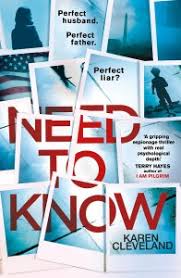 Need to Know is one of the most anticipated thrillers I’ve come across in years. Almost a year before publication date, it was reported that the movie rights had been sold and Charlize Theron will produce and star in the film adaptation. With such hype you might think any reading of the novel is bound to be a disappointment, but my initial reaction was one of surprise. Surprise that such a slow-burning intelligent spy novel could still be such a massive hit in an age of repetitive and action-driven vacuous franchises.
In Need to Know, Vivian Miller is a CIA counter-Intelligence analyst who seems like she has it all: a high-powered career tracking Russian sleeper cells in the US and a nice house perfect for raising her four kids with her loving, handsome husband Matt. But it’s not long before things start to unravel. A secret dossier at work reveals her husband is a Russian spy. She buries the evidence while she decides what to do. Cleveland gives us flashbacks to Vivian’s early relationship with Matt and how it developed. Suddenly, the mysteries of his character are beginning to make sense. Why did he always cancel planned visits for them to meet his parents at the last minute? Where did all of his money come from? The idea that you can never really know your partner is hardly new to the genre, and just when I thought this was going to be Gone Girl at Langley the story takes another turn. Vivian’s efforts to conceal her husband Matt’s true identity from her employers get increasingly dangerous, and the reader is left wondering if she choose between loyalty to her country or her love for her husband.
Cleveland spent eight years working as a CIA analyst, and she joins the growing ranks of retired spooks writing spy novels. Thankfully, she brings her knowledge of real-life espionage to add realism to this tale. This is a world wherein spies sit in front of computers and pore over financial statements and social media messages looking for threats to national security. And yet, even if the spy trade isn’t glamorous, Cleveland makes sure its never dull. Need to Know kept me guessing right to the end as the characters are involving and sympathetic. Vivian and Matt are not lazy caricatures of spies, they have the same problems as other couples, and the reader identifies with them as a consequence.
Just before Christmas, publishers traditionally rush out ghost-written, shallow memoirs by celebrities you’ve never heard of. So, this January, I needed to know that well-written and engaging novels are still hugely popular. Karen Cleveland did that for me.
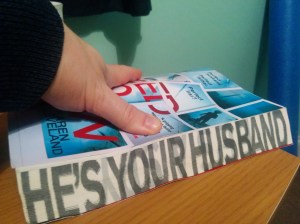
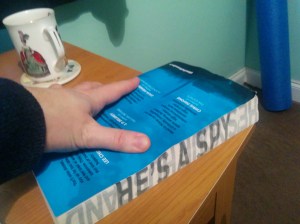
The proof copy of Need to Know had a hidden message for budding spies


 The Venetian Vase