Should Crime Novels Be More Political?
John le Carré’s latest novel A Delicate Truth has just been published, and from the extracts I have read serialised in the Telegraph, it looks set to be one of his best works in years. Part of the criticism of le Carré’s recent novels is that they have been too preachy and angrily left-wing. There are not many writers producing work at the age of 81 who can produce as much buzz as le Carré, but with A Delicate Truth continuing his general leftward trend – the plot involves a cover-up of a disastrous counter-terrorism operation which left an innocent mother and child dead on that last outpost of Empire, Gibraltar – has le Carré made the right choice in giving his work a more partisan edge?
To a degree every narrative will be political. Some crime writers are well known for their political beliefs: Sara Paretsky and David Peace are broadly leftist, PD James and James Ellroy are conservatives. John le Carré is one of the most interesting writers to read through the prism of his politics. I like to think of him as a sceptical patriot.
His most famous creation is the aging spymaster George Smiley. In the trilogy of novels Tinker Tailor Soldier Spy (1974), The Honourable Schoolboy (1977) and Smiley’s People (1979), Smiley is jaded, understated, underestimated and often humiliated: his promiscuous wife cheats on him, and yet through the application of his intellect, intuition and dogged perseverance, he always triumphs, albeit at a heavy price. Part of Smiley’s appeal is his pragmatic patriotism. He knows the West has to win the Cold War because communism is an evil force, but yet he sees on his own side abuses of power which are (almost) as bad. By contrast, the traitor in Tinker Tailor Soldier Spy, codenamed ‘Gerald’, who was based on Kim Philby is much more brashly English. Yet behind the mask of his patriotism, Gerald is sending British agents to their death.
le Carré was in his late forties when he completed the Smiley vs Karla trilogy, and it is often presumed that people who start on the political left become gradually more conservative with age. Yet right at the age when you would expect le Carré’s values to start corresponding more closely with Smiley’s. the author suddenly turned against him:
My impatience with George Smiley is that I am no longer able to resolve his excuses. There is something specious to me now about his moral posture. The notion of Smiley’s was that he sacrificed his moral conscience so that decent, ignorant people could sleep at night. He goes through life saying, “I give up all moral judgments; I take upon myself the lash of my own guilt.” We Empire babies were brought up thinking that we messed with things so that others could have clean hands. But I believe that someone who delivers up the responsibility for his moral conscience is actually someone who hasn’t got one.
With his follow-up novel The Little Drummer Girl (1983), le Carré found what he regarded as a radical cause, to portray the Palestinian people sympathetically in a work about the Middle East. In the novel, a radically left-wing English actress ‘Charlie’ is used by Israeli Intelligence in an elaborate scheme to penetrate a breakaway Palestinian terrorist group. le Carré conducted a huge amount of research for the novel, interviewing members of Mossad and meeting then PLO leader Yasser Arafat in Beirut. In writing the book le Carré, in his own words, ‘fell in love with the Palestinians’:
(I) became astonished really with one very simple perception that seems to me to have made no headway in the West at all: that one can, indeed as I am, be greatly in favour of the state of Israel and wish for its survival but that in the making of Israel a great crime was committed, not numerically commensurate with the crime that was committed against the Jews, but appalling all the same. Millions of people displaced, others subjugated with total alien types of rules, turned into second-class citizens. The image of the Palestinians, largely invented, as crazies carrying guns and so on was so far removed from the reality of the majority of the Palestinian people that it needed saying, it needed demonstrating – and not by some maverick Trotskyist, or something, but somebody like myself who has written extensively, with great passion I like to think, about Jews in the past but found in this situation an injustice which needs reporting.
I’m not sure that portraying the Palestinians sympathetically would be seen as radical today. It seems to be the broad view of people in the arts, but perhaps in 1983 the issue was perceived differently. The irony is that le Carré said he didn’t want the novel to be the work of ‘some maverick Trotskyist’, but Charlie in the novel is on the Far Left. Charlie was partly based on le Carré’s sister, the actress Charlotte Cornwell, and partly, it is believed, on the well known left-wing firebrand,Vanessa Redgrave.
le Carré would then turn to a radical examination of his own life story. His most autobiographical novel, and for many his greatest, A Perfect Spy (1986), is not particularly political (in examining the nature of betrayal here le Carré seems uninterested in ideology). The end of the Cold War was to prove challenging for many spy writers, but le Carré was ahead of his contemporaries with The Russia House (1987), an examination of how glasnost and perestroika was changing the Soviet Union. Since the fall of the USSR, le Carré has examined a wide array of espionage subjects, with mixed results. The 9/11 attacks and the resulting War on Terrorism seemed to fire his passion again as a writer. Absolute Friends (2003) was a scathing critique of the ‘Special Relationship’. le Carré, like Smiley, had previously held the view that Britain needed to be the junior partner of the US after the war in order to defeat communism, but now the Coalition angered him. Reviewing the novel in the Telegraph, George Walden wrote ‘a once entertaining writer is subsiding into ranting moralism […] All it says is that the Americans are making a cock-up of everything, and that they, not the terrorists, are the greatest danger to civilisation.’ Highly critical of the 2003 invasion of Iraq, le Carré wrote an article for the Times titled simply ‘The United States of America Gone Mad’.
Ultimately, like Walden, I have reservations about crime writers using novels to preach their political views, even if they are distinguished as le Carré. The danger is that they will alienate the readers who will disagree with them and bore the readers who don’t. Of course, they could convert a reader or alert them to issues which are not widely discussed elsewhere, that is, however, a formidable task.
Should crime novels be more political? Probably not.
Here’s the trailer for A Delicate Truth:
The two interviews quoted in this article are ‘The Little Drummer Girl: An Interview with John le Carre’ by Melvyn Bragg from The Quest for le Carre (London: Vision Press, 1988) and ‘John le Carre on Perfect Spies and Other Characters’ by Thom Schwartz from Writer’s Digest, 67 (February 1987), pp.20-21
Moby Dick on the Mersey
From May 4th to May 6th there will be a marathon reading of Moby Dick at Merseyside Maritime Museum. The event has been organised by fellow VV founder Chris Routledge as part of his continuing research into the connection Herman Melville had with Liverpool. My wife and I will both be reading chapters alongside many other readers. You can volunteer to read here if you are interested. This promises to be a wonderful, epic event. Do come along if you can. More details here.

Lunchtime Classics
I’m delighted to be giving another talk at Waterstones Liverpool One as part of the Lunchtime Classics series. The series was started by Glyn Morgan last year and consists of readings and discussions of classic stories and authors by ‘literary experts’ (or me depending on which talk you attend). Last year I spoke on James Ellroy’s L.A. Confidential, this year I’m discussing John Le Carre and the George Smiley novels. The full list of speakers confirmed so far is pasted below, and the speaker booked for the week after me is rather fetching I can tell you.
All readings are 1-2pm in the Illy Café at Waterstones Liverpool One.
Wednesday 24th April: Glyn Morgan (Ph.D Researcher, University of Liverpool) on H.G. Wells’ The
War of the Worlds.
Wednesday 1st May: Michelle Yost (Ph.D Researcher, University of Liverpool) on E.M. Forster’s
‘The Machine Stops’.
Tuesday 7th May: Dr Deaglàn Ó Donghaile (John Moore’s University) on Joseph Conrad’s The
Secret Agent.
Wednesday 15th May: Dr Greg Lynall (University of Liverpool) on Jonathan Swift’s Gulliver’s
Travels.
Tuesday 21st May: Lee Rooney (University of Liverpool) on Cormac McCarthy’s The Road.
Wednesday 29th May: Dr Danny O’Connor (University of Liverpool) on T.S. Eliot’s The Waste Land.
Thursday 6th June: Dr Ben Brabon (Edge Hill University) on Bram Stoker’s Dracula.
Tuesday 11th June: Maria Shmygol (University of Liverpool) on Solzhenitsyn’s One Day in the Life
of Ivan Denisovich.
Wednesday 19th June: Dr Matthew Bradley (University of Liverpool) on Oscar Wilde’s The Picture
of Dorian Gray.
Wednesday 26th June: Dr Chris Pak (University of Liverpool) on Stanislaw Lem.
Wednesday 3rd July: Steve Powell (University of Liverpool) on John Le Carre’s Smiley Trilogy.
Wednesday 10th July: Dr Diana Powell (University of Liverpool) on Walter Scott’s The Bride of
Lammermoor.
Tuesday 16th July: Andy Sawyer (University of Liverpool) on the work of Saki (H.H. Monroe).
Monday 22nd July: Dr David Hering (University of Liverpool) on David Foster Wallace’s The Pale
King.
Waterstones Liverpool One, 12 College Lane, L1 3DL. Tel: (0151) 7099820
And speaking of Waterstones Liverpool One, Harlan Coben will be in the store on April 25th at 12:30 PM signing copies of his new novel Six Years, which is already in development to be adapted into a film starring Hugh Jackman. I’m disappointed that work commitments means I can’t attend this one, but do go if you can.
Finally, on the topic of crime fiction superstars visiting North-West England, did Richard Roundtree a.k.a Shaft visit my home city of Chester back in 2000? These photographs seem to suggest that he did. Lovely to see he went walking on our famous Roman Walls.
Back in January I gave a talk at St Barts Pathology Museum on the sixty-sixth anniversary of the discovery of Elizabeth Short’s corpse on 39th and Norton, an abandoned lot in the Leimert Park residential neighbourhood in Los Angeles, by local resident Betty Bersinger. Bersinger’s discovery was the beginning of the Black Dahlia murder case, one of the most enduring mysteries in LA history.
The lecture was filmed, and I had planned to embed the video on this site, but I was recently informed that there was a problem with the recording. I have therefore decided to publish an edited version of the transcript here. For the sake of brevity, I have cut out information about Miss Short’s life and the murder investigation and references to true-crime books which attempt to solve the case, so that I could focus solely on the cultural depictions of the Black Dahlia that followed. You might enjoy this essay more if you already know a fair bit about the Dahlia case, if you don’t know much about it, there is a huge amount of material online, see here, here and here.
I had a wonderful time at St Barts and met some lovely people. I hope you enjoy this version of the lecture:
I never knew her in life. She exists for me through others, in evidence of the ways her death drove them. Working backward, seeking only facts, I reconstructed her as a sad little girl and a whore, at best a could-have-been – a tag that might equally apply to me. I wish I could have granted her an anonymous end, relegated her to a few terse words on a homicide dick’s summary report, carbon to the coroner’s office, more paperwork to take her to potter’s field. The only thing wrong with the wish is that she wouldn’t have wanted it that way. As brutal as the facts were, she would have wanted all of them known. And since I owe her a great deal, and am the only one who does know the entire story, I have undertaken the writing of this memoir.
James Ellroy’s novel The Black Dahlia begins with this first-person narration by Bucky Bleichert. Bleichert’s view of Elizabeth Short, the Black Dahlia murder victim, broadly conforms to how cultural depictions of the case have reflected the prejudices and obsessions of their creators. Elizabeth Short’s brief life and violent death have been much scrutinised, and in cultural terms she has become a blank canvas to which authors and their characters create an identity which fits their own obsessions.
One of the first films to even loosely approach the Black Dahlia murder as a subject was the 1953 film noir The Blue Gardenia. Directed by Fritz Lang from a story by crime writer Vera Caspary, The Blue Gardenia concerns a young switchboard operator (played by Anne Baxter) who is engaged to a serviceman stationed in Japan. On the night of her birthday, she sets two places at the dinner table, one for her and one for the photo of her fiancee. She then sits down to read a letter from him, which she has saved for the occasion, only to discover that he has fallen in love with a nurse and has written to say goodbye. Depressed, she decides to throw caution to the wind and go on a date with the caddish Harry Prebble, a man who hangs around her office trying to pick up vulnerable women. He takes her to the nightclub The Blue Gardenia where she starts to drink too much and is quickly intoxicated. She finds herself back at his apartment, but when he comes on to her too strong, she defends herself from his unwelcome advances with a poker before falling into a drunken unconsciousness. She awakes the next day in her apartment only to discover in the newspaper that Prebble is dead and the police are looking for the woman he was seen with in the nightclub, who is now the prime suspect. An ambitious journalist labels the missing woman as ‘The Blue Gardenia’ and the case quickly becomes a press sensation. Unfortunately, The Blue Gardenia is one of the more routine film noir’s of the period. Some critics believe that the influence of the Dahlia case does not extend beyond the title. Although the Dahlia influence may be only minor and allusive, it is interesting nonetheless: there is the near-fantasy relationship with a serviceman, a possible sex crime which escalates into a murder and an intense public interest in the case which develops after a journalist gives the murderess an intriguing nickname. As the story is told mostly from Baxter’s point of view and portrays her sympathetically, the viewer sees the ‘Gardenia’ woman as both victim and murderess, although the final twist deconstructs this merging of identities (but I won’t reveal it to you as I don’t want to give the game away).
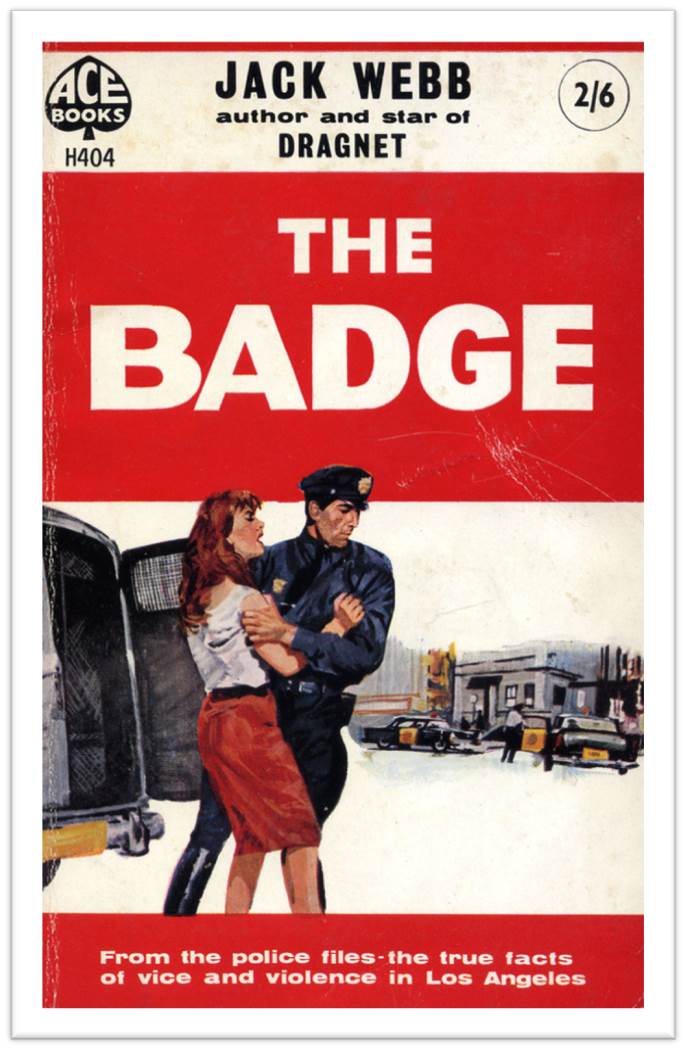 The next chapter in the cultural history of the Dahlia case comes from Jack Webb, creator, producer and star of the hit television police show Dragnet. Webb starred as Sergeant Joe Friday in Dragnet. The show was a phenomenal success when it first aired from 1951 to 1959 and was considered ground-breaking in its realistic depiction of police work. According to Webb’s opening narration, many of the episodes were based on actual LAPD cases making the show an early example of the police procedural sub-genre. Although much of this realism would seem horribly contrived to a modern audience (as the show was partly conceived to be LAPD propaganda). A point further made by the fact that LAPD Chief William H. Parker was credited as a consultant to the original radio show. Joe Friday is less a man than a machine: he speaks almost entirely in monotone and carries a black and white moral system, black being any infringement of the law. The Black Dahlia case was too graphic for television, which at the time was under heavy censorship. Publishing was more liberal and so as a companion piece to Dragnet, Jack Webb authored The Badge. First published in 1958, The Badge featured ‘True and terrifying crime stories that could not be presented on TV’. In the opening chapter, there is a ten page synopsis of the Black Dahlia murder. It differs in tone from the rest of the book in that it freely admits the LAPD were never close to cracking the case, and it even expresses a cynical dark humour in mocking the frustrations of Detective Finis Brown’s inability to make any progress in the investigation:
But with the monster who slowly, delectably tortured The Black Dahlia to death, they have never felt that they were anywhere near close. They have never known the motive, nor whether the slayer was man or woman, nor where the agony was perpetrated.
Was the killer The Dahlia’s lover or husband who felt he had been betrayed? But what betrayal, even unfaithfulness or a mocking laugh, merited revenge like this?
Was it perhaps a woman who had taken The Dahlia as wife in Lesbian marriage? Was that why the body had to be bisected, so that she could carry out the parts to her car?
Was the killer, man or woman, a sadist with a blood fetish who slashed for no comprehensible reason at all?
All LAPD can say is that its detectives have exonerated every man and woman whom they’ve talked to, including the scores who insist to this day that they are guilty.
Beyond that, you are free to speculate. But do him a favour – don’t press your deductions on Finis Brown.
Jack Webb had relatively few roles outside of Dragnet, although he did have a small and memorable role in Billy Wilder’s Sunset Boulevard. In one scene he jokingly introduces William Holden’s character at a party with the line ‘Fans, you all know Joe Gillis, the well-known screenwriter, uranium smuggler, and Black Dahlia suspect’. I wonder if he ad-libbed the line.
The Badge was a treasured birthday gift for the eleven-year-old James Ellroy, or as he was known at the time Lee Earle Ellroy. Ellroy’s mother, Geneva Hilliker Ellroy, had been murdered the year before. She had been seen on a date with an unidentified man near their home in El Monte and was found strangled to death the next morning outside of the nearby Arroyo High School. The case had gone unsolved, and the young Ellroy, who had been at odds with his mother for some time, went to live with his father without seemingly any emotional trauma. After reading The Badge, however, Ellroy would link the Dahlia case with his mother’s murder in his mind and sow the seeds of one of his greatest works as a novelist some twenty-eight years later. Ellroy was to describe the discovery in his autobiography:
Betty Short became my obsession.
And my symbiotic stand-in for Geneva Hilliker Ellroy.
Betty was running and hiding. My mother ran to El Monte and forged a secret weekend life there. Betty and my mother were body-dump victims. Jack Webb said Betty was a loose girl. My father said my mother was a drunk and a whore.
My Dahlia obsession was explicitly pornographic. My imagination supplied the details that Jack Webb omitted. The murder was an epigram on transient lives and impacted sex as death. The unsolved status was a wall I tried to break down with a child’s curiosity.
I applied my mind to the task. My explication efforts were entirely unconscious. I simply told myself mental stories.

Theodora Keogh
There would be many turbulent years ahead for Ellroy before he would reinvent himself as a novelist, yet before his version of the case, there would be two major Dahlia depictions in popular culture. The first would come from a woman who was one of the most promising novelists of her generation. Her contribution to Dahlia mythology was her ninth novel, The Other Girl. The novel was published in 1962. When Theodora Keogh died in 2008, the Daily Telegraph was the only major newspaper to run an obituary. I, like many other readers, was for the first time given insight into the life of an extraordinary woman who in her later years spurned the public eye for a life of obscurity. Theodora Keogh was born Theodora Roosevelt in New York in 1919, granddaughter to President Theodore Roosevelt, and was educated at the Chapin School in Manhattan, and later in Munich by the pro-Nazi Countess Montgelas. She formed a ballet company with Alexander Iolas and joined a musical revue at the Copacabana in Rio. She was known to dance in the street, wear boyish clothes and carry a knife for protection. After the war she worked in costume design on several Hollywood films before she began writing novels. Keogh’s novels were popular and acclaimed: the composer Ned Rorem described her as ‘our best American writer, certainly our best female writer’. Broadly categorised as lesbian pulp fiction, alongside such novelists as Ann Bannon and Marijane Meaker, Theodora Keogh’s novels are sinister, darkly sexual tales. The Other Girl is no exception. The novel’s main focus is on Marge Vulawski, the daughter of immigrant workers who has grown up on a farm just outside of L.A. Marge came to the City of Angels with high hopes but has become bitter and cynical, as her practical know-how with farm machinery and her broad build have led her to an unexciting job as a garage mechanic. Around Marge, Keogh creates an eccentric collection of oddball characters including a woman named Zoe who refers to herself simply as ‘the Duchess’ and the sleazy Hollywood agent Herman Lee. Then, of course, there is the girl, Betty, whom the reader will recognise as Elizabeth Short. Betty is an aspiring actress who becomes the focus of Marge’s sexual desire, a desire merged with an increasing anger. During an orgy with some French sailors, Betty and Marge have their first sexual contact:
But her [Betty’s] breasts themselves were surprisingly small; fresh and round and shiny like a peeled twig with dark, insulting nipples. The fresh, tender lower curves of these breasts entered into Marge’s memory for ever. They merged with childhood dreams, with infancy. They became the salty, threaded stuff of her generation.
Was what followed called an orgy? The French sailors hadn’t treated it as such. To them it appeared natural, neither odd nor perverse.
The novel ends with Betty’s murder, and it would be the end of Theodora Keogh’s literary career. According to an expert on Keogh, Robert Nedelkoff, she wrote one more novel, ‘The Love Life of Sometime Malone’ which was rejected by her publisher and practically disappeared from public life. Nedelkoff also speculates that The Badge may have reminded Keogh of the Dahlia case, as she had been working in LA as a costume designer at the time of the murder. She ended her days living on a farm in North Carolina, although since her death there has been a renewed scholarly interest in her work.
In 1975 came the television film Who is the Black Dahlia? The film jumps between the investigation of her murder and flashbacks of key moments of her life. The film broadly follows the facts of the case, although there are a few jarring changes, for instance Elizabeth’s hometown is said to be Portland, Maine, and she is raised by her grandmother when in reality she was raised by her mother in Medford, Massachusetts. The film is not particularly distinctive, hampered by a low budget and confusion as to what it wants to achieve; however, it does feature a moving portrayal of Elizabeth Short by Arnaz and is available to watch in its entirety on YouTube.
 Then, in 1977 came one of the key Dahlia works. John Gregory Dunne’s True Confessions tells the story of two brothers working in post-war Los Angeles: Tom and Des Spellacy. Tom is a detective and Des is a priest. Both are cynical and corrupt in their own way. Des is in line for a bishopric but is increasingly uncomfortable with the archdiocese’s links to the crooked businessman Jack Amsterdam. The Black Dahlia case is a loose but important influence on the novel. Tom Spellacy is investigating the murder of a woman found naked, chopped in half and dumped on an abandoned lot. Here Elizabeth Short is renamed Lois Fazenda, and the tone is more than a little misogynistic. When Spellacy and his partner Frank Crotty are trying to fend off an eager journalist by coining a nickname for the victim, they come up with ‘the Magic Pussy Murder’, ‘the Sliced-up Slit Case’, and ‘the Missing Clit Caper’ before finally settling on ‘the Virgin Tramp’. Tramp in American slang, more so than in the UK at least, refers to promiscuity which makes the sobriquet oddly contradictory, like the flower that cannot be black, it cancels itself out while exuding a mysterious aura. It may also be a reference to Dunne’s lapsed Catholicism. Dunne’s family originated in the Irish immigrant communities of Frog Hollow, Hartford, Connecticut. Dunne transposes the deeply Irish areas of New England, particularly Hartford and Boston, onto post-war LA, a city which was not as ethnically Irish as his portrayal. The novel is laced with raucous black humour and heavy cynicism in its depiction of the inner politics of police work and the Catholic church: priests have heart attacks in bed with young hookers and an ambitious policeman chokes to death on his steak dinner on the day he becomes chief. Despite this, there is a degree of humorous affection in the portrayal of the Church. Also, the Virgin Tramp evokes the Virgin Mary, or, on another level, the severed body of Christ, as although the resolution of the murder mystery is somewhat banal, anyone who had any contact with the Virgin Tramp finds their careers destroyed by the scandal. But through his unhappy association with the victim, Des Spellacy returns to a humble parish church with a renewed faith, her blood having paid for his sins.
True Confessions was an immediate bestseller when it was released and lead to a faithful film adaptation in 1981 with Robert Duvall and Robert De Niro in the roles of Tom and Des Spellacy. Despite this, the novel seems to have disappeared from popular consciousness in recent years, overshadowed perhaps by the definitive cultural depiction of the Dahlia case.
James Ellroy was recovering from alcoholism and drug addiction when True Confessions was released, and the book had a profound effect on him. The success of True Confessions deterred him from making the Black Dahlia case the subject of his first novel, despite having a burning ambition to write about it. Ellroy briefly touched upon the Dahlia case as back story to his second novel Clandestine. Clandestine was a fictional retelling of his mother’s murder and the case is solved in the book.
The novel contains a scene where the Irish-American cop Dudley Smith, who would later become one of Ellroy’s most notable characters in his LA Quartet novels, describes rounding up a series of psychopaths who are natural suspects in the Dahlia murder. Smith encourages them to disfigure the corpse of an Elizabeth Short lookalike in an attempt to identify the killer. Ellroy would return to this voyeuristic reenactment scene in his Dahlia novel. Knowing that Dunne had only adhered to the facts of the case in regards to some of the torture details, Ellroy’s ambition was to replicate the details of the case as much as possible into a narrative and then create a fictional solution. Ellroy began his formal research into the case by taking three, triple-reinforced pillow cases filled with quarters into a New York City library and ordering through inter-library loan the original LA newspaper articles covering the Dahlia case.
It is in the fictional aspects of the story that Ellroy recreates the emotional relationship he formed between himself and the Dahlia and his mother. One of the most striking aspects of the novel is the emergence of unstable trinities. At the centre you have the two police officers Bucky Bleichert and Lee Blanchard. The relationship is complicated by Blanchard’s girlfriend Kay Lake, whom Bucky is deeply attracted to, complicating matters for all three of them. As the narrative evolves, the trinity reinvents itself. Bucky and Blanchard become obsessed with the Dahlia, Blanchard to the extent that his relationship with Kay crumbles and he disappears. Bucky then starts a relationship with Kay, but he too is obsessed with Elizabeth Short and starts seeing living women as proxies for his emotional love for a dead woman. This is further complicated when Bucky has a fling with Madeleine Sprague, a femme fatale who bears an uncanny physical resemblance to Elizabeth Short. The dedication to the novel reads:
‘To Geneva Hilliker Ellroy 1915-1958 Mother: Twenty-nine Years Later, This Valediction in Blood’
And in his memoir My Dark Places Ellroy goes into some depth as to how his mother’s murder fuelled the narrative:
I was burning a lifelong torch with three flames […] My mother. The Dahlia. The woman I knew God would give me. […] I locked myself up for a year and wrote The Black Dahlia.
The year flew by. I lived with one dead woman and a dozen bad men. Betty Short ruled me. I built her character from diverse strains of male desire and tried to portray the male world that sanctioned her death. I wrote the last page and wept. I dedicated the book to my mother. I knew I could link Jean and Betty and strike 24-karat gold. I financed my own book tour. I took the link public. I made The Black Dahlia a national bestseller.
I told the Jean Ellroy – Dahlia story ten dozen times. I reduced it to sound bites and vulgarized it in the name of accessibility. I went at it with precise dispassion. I portrayed myself as a man formed by two murdered women and a man who now lived on a plane above such matters. My media performances were commanding at first glance and glib upon reappraisal. They exploited my mother’s desecration and allowed me to cut her memory down to manageable proportions.
A film adaptation of The Black Dahlia appeared in 2006 directed by Brian De Palma. The film divided critical opinion. Some people hate it. I take a more charitable view of the film. In fact, I like it. One aspect which the critics seemed to agree upon was Mia Kirshner’s hauntingly beautiful performance as Elizabeth Short. Here’s a clip:
The examples I have given her are what I consider to be the main fictional works on the Black Dahlia, although it has been referenced or alluded to in many other works. The case has proved fertile ground for each author’s creative vision. Public fascination with the Black Dahlia case is likely to grow in the years to come, and we can probably expect to see many more cultural depictions of one of the most gruesome and fascinating murder cases in American history.
Crime Fiction and Censorship
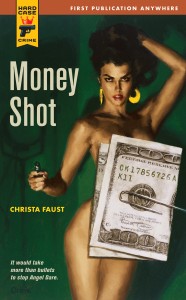 Christa Faust is one of the hottest crime writers around today. A former fetish model and professional dominatrix, Faust’s acclaimed novels such as Chokehold and Money Shot feature indefatigable former porn star Angel Dare. Why do I mention this? Well, partly to recommend Faust’s novels but also to alert you to legislation which in a few years may make it illegal to buy her work and other works of crime fiction in the UK. Tomorrow the European Parliament will vote on a resolution to ban all forms of pornography in the 27 European Union member states. Iceland, which is not in the EU, is considering similar proposals. I don’t consider Faust’s work porn– that’s not the point I’m trying to make. Pornography in its more extreme forms is already outlawed, but as Tom Chivers says at the Telegraph, to ban porn we must necessarily define it and that’s where you can see the EU casting its net into huge swathes of our culture. Chivers gives this example:
An old friend of mine who did art at university did a whole exhibition of, basically, photos of body parts and rubber models of other body parts and, really, just lots of body parts. Is that art? Is it pornography? Whether you like it or not we’ve got a decision to make, and if the EU is banning porn, then presumably it’ll be the EU that decides what’s too porny for the Tate Modern.
The nature of bans is they get extended with follow up legislation, and it’s easy to imagine some puritanical bureaucrat taking exception to Faust, or to say Raunchy paperback cover art like this example, or this one, or this one, or this one. It may be porn to them, but its art to us (or at least part of the genre we love). The European Parliament also wants to ‘eliminate gender stereotypes in the EU’ so we can kiss goodbye to the femme fatale and the sexist PI as well. In the US, this costly, impractical (especially in the Internet age) and illiberal legislation wouldn’t be seriously considered due to the First Amendment.
Would we really want to silence our authors in this way?
To illustrate, here’s a funny (NSFW) scene from James Ellroy’s Destination Morgue where Detective ‘Rhino’ Rick Jensen and actress Donna Donohue (based on Dana Delaney) go into a porno bookstore (where incidentally Ellroy himself once worked) looking for evidence on a murder case:
Donna Donahue – right by the bookstore – a bliss blast in LAPD blue.
I double-parked and jumped out. Donna said, “I didn’t have time to change, but it bought us some time here.”
“Say what?”
“I impersonated a cop. The bookstore guy’s cueing up his surveillance film from two days before the robbery. We can stand in a stall in back and watch.”
I walked in first. The clerk ignored me. The clerk salaciously salaamed to Donna. He pointed us down “Dildo Drive” – a mobile-mounted, salami-slung corridor. Packaged porno reposed on racks and shimmied off shelves. It was a donkey-dick demimonde and Beaver Boulevard.
We ducked dildos. We made the booth. Donna doused the lights. I tapped a projector switch. Black-and-white film rolled.
We saw pan shots. We saw ID numbers. We saw Sad-Sack Sidneys slap sandals in slime.
Donna said, “I already checked the credit-card receipts. Nothing from Randall J. Kirst.”
I nodded. “Nobody – not even turd burglars – want credit-card receipts from the fucking Porno Vista.”
Donna said, “Right. We’re looking for two men making purchases together – the victim and the killer I saw.”
Police smarts in forty-eight hours – add breeding and brains. I said, “What kind of work does your family do?”
Donna laffed. “They manufacture toilet seats.”
I yukked. My gut distended. I hyper-humped it back in.
Film rolled. We saw dykes buy dildos. We saw college kids buy Beaverrama, Beaveroo, Beaver Den, Beaver Bash, Beaverooski, and Beaver Bitches. We saw flits flip through The Greek Way, Greg Goes Greek, Greek Freaks, More Is More, The Hard and the Hung, and The Hungest Among Us. I laffed. Donna laffed. We bumped hips for kicks. Donna’s gunbelt clattered.
Moby Dick’s Greek Deelite, Moby Dick’s Athens Adventure, Moby Dick Meets Vaseline Vic. We yukked. We howled.
Parsifal Found!
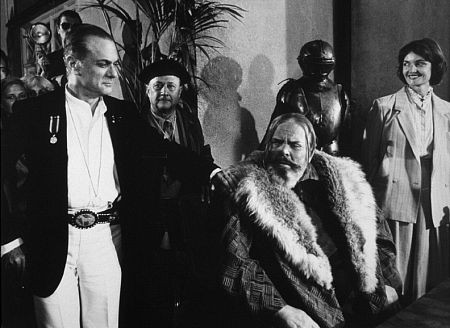 Last June I wrote a post about the obscure film Where is Parsifal? ,which the BFI had listed as one of their 75 missing films. Directed by Henri Holman, the film was screened at the 1984 Cannes film festival and featured a stellar cast including Orson Welles, Peter Lawford, Tony Curtis, Donald Pleasance and Vladek Sheybal, but it was savaged by the few critics that saw it, probably due to its bizarre plot (something to do with the titular character (Curtis) inventing a laser skywriter and trying to sell the patent). My interest in the film stemmed from the involvement of Terence Young as executive producer. Young had been a promising film director at the start of his career and played a significant role in the success of the James Bond film franchise. Young was a friend of Bond creator Ian Fleming and directed three of the first four films in the series. He also groomed Sean Connery for the role as Bond. Sadly, the latter half of Young’s career is tainted by his involvement with bizarre and disastrous projects, such as Inchon (a Korean War movie financed by Unification Church founder Sun Myong Moon which is regarded as one of the worst films ever made) and allegedly The Long Days (1980), a propaganda film about Saddam Hussein which Young is said to have directed and edited for the Iraqi dictator. Young’s involvement with Where is Parsifal? may have also been dubious. In an article for Psychotronic magazine, which examined the life and career of Vladek Sheybal, David Del Valle alleged that Welles only agreed to appear in the film as the producers had (falsely) promised to back his planned film adaptation of King Lear. Whether Young was party to this deception is not known.
Anyway, I received a number of positive responses to the original post which made me wonder just how ‘lost’ the film was. One reader alerted me to this French news film available on YouTube which shows a clip from the film and Young and Curtis together at Cannes promoting it. My post was linked on the Italian Wikipedia page about the film which stated it was released on DVD in Italy in 2010 under the title There is Something Strange in the Family. Strange indeed! An Australian reader contacted me to say he had a VHS copy of the film. It was released on VHS in Australia in the 1980s apparently. Sure enough, I found this essay on the BFI website from November last year stating that they have removed Where is Parsifal? from their missing film list after Henri Holman donated his personal 35mm print. It’s wonderful news that they’ve finally tracked down a copy of this strange and elusive film for their archive, but as I discovered, there were quite a lot of copies in circulation for a missing film. It’s going to be a lot more difficult for the BFI to discover other older missing films such as The Mountain Eagle (1926): Alfred Hitchcok’s second film and the only film by Hitch regarded as lost. Still, anything’s possible. Thanks to all the readers who contacted me about the original post.
Looking Back on Theakston’s: The Strange Case of Stephen Leather
 My wife and I attended Theakston’s Old Peculier Crime Writing Festival in Harrogate last year. We had a wonderful time and blogged about it here, here and here. One panel discussion we decided to skip was ‘Wanted for Murder: The Ebook’ partly because I’m sick of hearing that print is dead, but by skipping the session, I missed some comments by thriller writer Stephen Leather that would snowball into a scandal that has rocked the publishing world. Regarding publicising his own books on social media Leather said:
As soon as my book is out I’m on Facebook and Twitter several times a day talking about it. I’ll go on to several forums, the well-known forums, and post there under my name and under various other names and various other characters. You build up this whole network of characters who talk about your books and sometimes have conversations with yourself
What’s most surprising is the brazen way Leather boasted about this. The odd thing about Theakston’s was that the subject the panels were supposed to be discussing was often not interesting enough to sustain the session, so writers drifted off onto other subjects. Perhaps Leather made the admission as he was stuck for something to say and thought it wouldn’t amount to a big deal. He was wrong. Leather’s comments were picked up on by, amongst others, spy writer Jeremy Duns. Duns has made something of a name for himself exposing internet frauds. It was Duns who unmasked RJ Ellory as having written fake reviews praising his own novels online. Ellory made an ass of himself but at least he had the good grace to apologise, unlike Stephen Leather. Through dogged research Duns began to identify the ‘sock puppet’ accounts on Facebook, Amazon and Twitter that Leather set up to plug his own work and engage in cyberbullying. By the way, take a look at Leather’s author website. Skim through the pages and you’ll see photos of him with George W Bush, Tony Blair, Chuck Norris, Michael Schumacher etc. They’re obvious parodies, and all harmless fun you might say, but I can’t help thinking they tell us something about Leather’s delusions of grandeur. Nick Cohen, who had a hand in exposing Johann Hari’s articles as full of fabrications, wrote about Leather in his column for the Observer. Cohen’s argument is that American writers who engage in this sort of fraud and plagiarism find they can never get published again, whereas in Britain their careers go on relatively unhindered as with Leather and Hari. Leather reported Cohen to the Press Complaint’s Commission, not for saying that Leather had set up sock puppet accounts, he had already admitted to that, but for Cohen’s write up of Duns findings regarding the cyberbullying of Steve Roach:
When he wanted to fake an identity, Leather picked on Steve Roach, a minor writer who had made disobliging remarks about one of his books. Leather created Twitter “sockpuppet” accounts in the names of @Writerroach and @TheSteveRoach. Roach described on an Amazon forum how one account had “16,000 followers all reading ‘my’ tweets about how much ‘I’ loved SL’s books”. He was nervous. He told Duns in a taped conversation that Leather was “very powerful” and not a man to be crossed. Roach emailed Leather and begged to be left alone. Pleased that his cyber bullying campaign had worked, Leather graciously gave Roach control of the @Writerroach account he had created, to Roach’s “great relief”.
The PCC adjudication was in Cohen’s favour. As Cohen says there is a difference between promoting your own work, which is legitimate, and deceit, which is not. I use this blog to promote my own work quite regularly, whether people choose to buy my books or not is up to them, but I’m not out to deceive anyone. Incidentally, I have come across a rather intriguing authorship question in my research pertaining to James Ellroy. But I don’t regard anything in that example to be fraudulent or malicious, rather it is just a common creative technique employed by novelists. Judge for yourself. Anyway, Duns has reason to believe that there may be many other authors engaged in internet fraud:
I have also heard from authors about private web forums and Facebook groups where authors, some of them extremely successful, hang out, and that they trade positive reviews and also post negative reviews to sabotage authors who they dislike or whose success they feel threatens theirs. I guess we’re looking at the tip of the iceberg here.
I think we owe a great deal to Cohen and Duns for their exhaustive efforts to expose these frauds and not back down when they receive an onslaught of abuse for doing so. If you are a writer and don’t believe this issue is important then I suggest you read these words of Duns:
Please don’t say this is all a car crash, or getting silly now, or it takes two to tango, or aren’t we equally to blame for talking about this while these frauds just carry on merrily deceiving people. Especially if you are more famous than Leather. Get off the pot. Speak out: share, retweet, blog.
Take a stand.
I take it Stephen Leather will not be invited to speak at Harrogate again this year, as Val McDermid is chairing the programming committee this time and as she is one of the signatories of a letter to the Telegraph condemning fake reviews I doubt he will be, but it would be nice if Jeremy Duns was, perhaps in a panel titled ‘Wanted for Fraud: Unmasking the authors who write fake reviews of their own work online’. Now that would be worth going to see.
A student’s take on Vera Caspary’s Laura
 This semester I’m teaching two courses for the University of Liverpool’s Continuing Education: The Female Dick: Women in Crime Fiction and Star-Crossed Lovers in Literature. But instead of having my students write traditional essays, I’ve asked them to write blog posts. Why? There are two reasons: first, I think the blog is a great platform to discuss, debate, inform and analyse (if they simply wrote it as an essay for their tutor, it wouldn’t reach as wide an audience), and second, most of my students are entirely new to blogging. Many of them are retired, and they bring a wealth of professional and practical insights to the text.
I’ve posted the first, a review of Vera Caspary’s Laura, on Prevailing Westerlies. If you have time to leave a comment, word of encouragement or question, I’m sure it would be appreciated.
Unpublished James Ellroy Interview
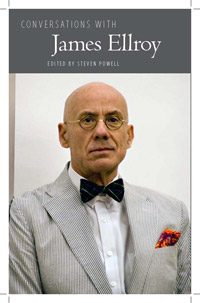 I’ve had the pleasure of interviewing James Ellroy four times: on three occasions by telephone and once in his apartment in LA. Three of these interviews are included in the collection Conversations with James Ellroy which I edited for University Press of Mississippi. The interview I excluded from the volume was the third telephone interview which took place in November 2008. After giving the matter some thought, I decided that the interview wasn’t up to the high standard of my other interviews with Ellroy. You have to make some very difficult decisions when you’re editing an anthology of this kind, and I wanted to ensure there was space in the book for some of the outstanding interviews Ellroy has given throughout his career to such figures as Duane Tucker, Paul Duncan and Craig McDonald. However, I came across the interview again recently when searching through an old thumb drive, and I thought there were enough interesting moments to share it with you here, published for the very first time. I’ve edited it down quite significantly to the highlights:
INTERVIEWER: I watched Zodiac last night. My wife and I watched it with the director’s commentary, and I was thinking you’ve been involved in a lot of documentaries, factual shows, well Murder and Mayhem, Bazaar Bizarre, the Zodiac DVD commentary. Why the change…
ELLROY: Bazaar Bizarre is just a horrible movie and a horrible performance on my part. I was coming off a crackup and taking some bad medication and my weight was up. I didn’t look good. It’s a bad, vile movie. Why mince words?
INTERVIEWER: I was wondering, you moved from your early fiction where there were lots of motifs about serial killers and murderers, psycho-sexual murderers, but then you moved into more factual explorations of serial killers. Why the move from fiction to factual interpretations?
ELLROY: Well… It started out with the bridge between those two types of works The Black Dahlia, which has the psycho-sexual aspect and the historical aspect in the King of psycho-sexual Los Angeles crimes, and the King of LA crimes period. And it was at that time that I determined to write the LA Quartet. And hence first LA history and then American history, and I have been synchronous ever since. And there may be some psycho-sexual aspects to individual crimes within a larger set of crimes in a given book of mine, but I will never write exclusively in that vein. I determined that I had taken it as far as it would go.
INTERVIEWER: Yes, I’ve been reading Scene of the Crime: Photographs from the LAPD Archive, and it has very haunting photos. Very strange experience to look over those photos of Elizabeth Short, which are of course shocking. Your explanation as to the treatment, well, the torture of her body, and what happened to her hinges a lot on a kind of art, aestheticism, the Victor Hugo novel The Man Who Laughs and the painting. Is that something out of your research on the case or are you interested in any links between art, aestheticism and murder?
ELLROY: I made it up and what happened. And then subsequently, oddly, the writer named Steve Hodel who wrote the book Black Dahlia Avenger— he’s a former LAPD homicide detective– where he posits that his physician surgeon father did the job to imitate the art of Man Ray. It’s a quasi-factual book: it purports to be real, but it’s entirely theoretical and suppositional. But Black Dahlia Avenger made that connection. What a man [Ed Beitiks]. He’s a journalist. He’s dead now, may he rest in peace, Ed Beitiks told me. It was a very fine but still inadequate explanation of the horror visited upon Elizabeth Short that we’re trying to contain within some kind of reference, cultural reference, artistic reference of the horror inflicted upon her, and no level of detail can do that horror justice. And so the Victor Hugo The Man Who Laughs painting, which doesn’t exist, just came to me out of the blue. Someone told me about the painting as I was preparing the text to the book.
INTERVIEWER: One of the things that was interesting about Zodiac (the film) was the Zodiac case is still officially unsolved, whereas a lot of the issues of crime fiction is the theory that everything connects or everything should connect. How do you explore that question of how everything connects or does everything still connect in things like historical fiction and real life?
ELLROY: It certainly does in real life, and the genius of Zodiac, which I think is one of the greatest American crime films, is that nothing ever quite fits and the three men, the three obsessive men, you know the Ruffalo, Gyllenhaal and Downey characters, simply go on and endure in not knowing. And when they know to whatever extent that they know, I’m talking about the scene with Ruffalo and Gyllenhaal in the diner at the end. So what? The guy’s not killing anyone else, and he’s still out on the loose working in a hardware store. And I was haunted by the movie. It influenced a TV pilot that I’m working on now about, although it’s not about the serial killers at all it’s about the cops and the Hillside Strangler task force, and I give Zodiac in the composure and the stillness and the quietude of that movie every credit.
INTERVIEWER: Yes, yes it’s a great movie. I very much enjoyed it.
ELLROY: Very slow isn’t it? It’s just boom.
INTERVIEWER: Yes, it takes its time– and just great performances. I guess on the theory that everything connects, there’s now that quite famous line in your first novel Brown’s Requiem which, I’m gonna have to paraphrase because I don’t have the book right in front of me, when Brown is in Mexico and spots a suspect presumably by chance, he said ‘This was odd. It’s proof of the existence of God.’ With the other references to God in your books, they’re rather ambiguous: Lloyd Hopkins very often prays to a God he admits that he doesn’t believe in. Do you think there is a presence of God in your literature?
ELLROY: Yeah I do. I do and I’m a Christian. I’m not an Evangelical Christian, but God and religious spiritual feelings always guided me during the worst moments of my life, and I don’t for a moment doubt it. Blood’s A Rover is the fullest expression of people from 1968 to 1972 including a woman who’s a Quaker activist pondering the existence or non-existence of God and talking about the nature of belief. And I always like getting in asides and putting it out there and stopping just short of preaching.
INTERVIEWER: There’s been a lot of criticism of your work, in my eyes completely unjustified, but you know people like Mike Davis in his book City of Quartz, a kind of unusual history of Los Angeles, he seems to think the racism of the characters by extension makes the author or the text racist. How would you respond to criticism like that?
ELLROY: Well the racism of protagonists in my book, the actual men that you’re supposed to dig, is a casual attribute, it’s not a defining characteristic. And most people who decry racism, most PCers want racism distilled in that manner. It’s defining, thus it’s indicted, and so casual racist asides from Jack Vincennes or Bud White or Buzz Meeks or Danny Upshaw or Pete Bondurant or, you know, Dwight Holly or any of these guys flummoxes people. And I don’t write from grievance. I’m not out to change the world. I would hope that my being would serve to influence them in some minor way, but I got no beef. And I write stories that are contained within plot boundaries, circumscribed arcs of time. People can think what they like. And I don’t engage in criticism of other writers for a couple of reasons: one, I’m too competitive and I don’t go on panels for the same reason. I’m out to take over the show rather than have a collegial chitchat. And so criticism like the criticism Mike Davis levied at me just, while it bugged me in the moment, goes in one ear and out the other. There are people out there they live on grievance, and I can understand why, and I’ve just gotta say ‘God bless em.’
INTERVIEWER: Your portrayals of LA in the forties and fifties of course the narrative relies not just on either third person or first person but FBI transcripts, newspaper articles, sleazy Hush-Hush tabloids. Why the use of these, you know, other means of communication or telling the story?
ELLROY: To update the actions of the characters outside of their limited viewpoint. Entirely to further the story from a different viewpoint. In the case of White Jazz, to alleviate the burden of the extreme language and update the reader simply from the slant that the protagonists have not seen.
INTERVIEWER: Another thing that may be linked to communication is the portrayal of institutions: the FBI, the CIA, the Mafia. Some illegal, some governmental institutions, and in the Underworld USA, their interests often overlap. How do you render concisely, and where do you get this inspiration for these incredibly complex and convoluted institutions?
ELLROY: Part of it’s just having lived through the era and having soaked up a good deal of doublespeak. A lot of it’s instinct. I’ve never had the instinct to do a great deal of research. I want coherent facts in front of me as I like to extrapolate. A lot of this overlap of agency and obfuscatory talk and the jockeying of men, I’m talking about the political books, aligned with various bogus male authority derive from my reading of Libra.
INTERVIEWER: Yes Libra is a fascinating novel, and I just recently read Don DeLillo’s Underworld. Would it be an inspiration on The Cold Six Thousand?
ELLROY: No, I actually read it after I wrote The Cold Six Thousand. I also think it’s very, very pretentious and flawed. I think it’s a great, great novel, at times I thought this is the greatest novel I ever read. But God does he go on! Did you find that, he just goes on?
INTERVIEWER: Yes, definitely. It’s rather unusual some segments like the nuns and the…
ELLROY: The nuns go nowhere don’t they? I wanted it to stay with the baseball. Yeah and the baseball changing hands, and then it just kept going here, here, here and here and felt more and more undisciplined.
INTERVIEWER: I quite liked Lenny Bruce, the comic monologues which link the story. Would you say that Lenny Bruce and his kind of insult comedy, his highly and wildly adrenalised, neurotic schtick. Was that an inspiration for Lenny Sands?
ELLROY: No, I just liked the idea of Lenny as a name with no dignity. And I also think that Lenny Bruce was nowhere near as good as the monologues that Don DeLillo wrote for him. I mean DeLillo wrote those monologues. He didn’t say that shit. I guarantee you he did not say that shit. I guarantee you he was not that smart and omnivorously gifted. I mean he was a dope fiend who was entirely hit and miss.
INTERVIEWER: I guess a lot of what makes the monologues so fascinating in Underworld is that they’re caught in the moment, particularly around abut the Cuban missile crisis everyone thought they were gonna die in a nuclear holocaust and in the monologues he plays off that fear
ELLROY: The story American Tabloid is entirely inspired by Libra and DeLillo’s tripartite theory: Mob, renegade CIA, crazy Cuban exiles. It’s the line in the prologue ‘Only a reckless verisimilitude can set that line straight.’ And it’s so diligently about the inner lives of the assassins that it creates empathy. YOU WANT JACK DEAD. You want Jack dead because you dig these guys and you’re in their head. It’s only after the fact that I think most people, most people who liked the book think, Oh shit. Why do I feel such great empathy with those who killed John F. Kennedy?
INTERVIEWER: Yes, yes, that is unusual and the ending with the cancer victim Heshie. His death creates this empathy with the death of JFK as well.
ELLROY: ‘Don’t nod out Hesh. You don’t get a show like this every day.’ Pete tells him, yeah.
INTERVIEWER: The history of Los Angeles, it’s your birthplace it’s intensely romantic to you. You’ve lived in a fair few places in in the US: New York, Connecticut, Kansas City. Do any of those settings particularly inform or inspire your writing?
ELLROY: I’m from LA, and it’s a life sentence. As a fount of inspiration, I can write about LA wherever I find myself. LA was what I first saw and I’ll take it. I’ll take it. I have an instinct in this stage of my life to get to places that are a little bit more peaceful and we shall see.
Conversations with James Ellroy is available to buy on Amazon.com and Amazon.co.uk.


 The Venetian Vase

