Blogs of the Year 2012
I’m delighted that J. Kingston Pierce of The Rap Sheet has selected the Venetian Vase as one of the best blogs of 2012. It was only last year that David Mattichak (check out his blog here) nominated me for the Very Inspiring Blogger Award and now this! The Blog of the Year 2012 award was started by The Thought Palette and the rules are as follows:
1. Select the blogs you think deserve the “Blog of the Year 2012” Award.
2. Write a blog post and tell us about the blogs you have chosen–there’s no minimum or maximum number of blogs required–and “present” them with their award.
3. Please include a link back to this page, “Blog of the Year 2012” award at The Thought Palette, and include these “rules” in your post.
4. Let the blogs you have chosen know that you have given them this award and share the “rules” with them.
5. You can now also join the Facebook group–click “like” on this page, “Blog of the Year 2012 Award” Facebook group, and then you can share your blog with an even wider audience.
6. As a winner of the award, please add a link back to the blog that presented you with the award–and then proudly display the award on your blog and sidebar.
Chris Routledge and I started VV back in 2009 and it’s been a joy to do. I tend to blog about what research I’m doing at the moment, what I’m reading or just to plug my own books! It can be hard work coming up with enough material to keep people coming back to the site, but when they leave positive comments, subscribe, link back to my work or select VV for awards like this one, it makes the whole thing worthwhile. Sometimes I’m stuck for something to write about and then an idea starts to grow and the urge to write about it is too hard to resist. Another pleasure of blogging is that WordPress gives you excellent porn (stat porn that is). Most visitors to this site come from, unsurprisingly, English speaking countries, but VV also gets plenty of hits from France, Germany, Sweden, Spain etc. It’s nice to know that people from far afield visit the site. I also occasionally get hits from random countries like Saudi Arabia where, I imagine, crime and detective fiction is probably illegal.
I enjoy blogging, and as long as people find the site entertaining, I’ll continue to do it. No blogger will get very far unless he reads other blogs to keep up with what’s going on: it’s both a source of inspiration and a means of learning the craft. Below is a list of blogs which have delighted me that I’d like to name as ‘Blogs of the Year 2012’ (I’ve limited my selection to genre fiction/true crime related blogs, oh, and some of these blogs have already been named as Blog of 2012 but I’m sure they won’t mind winning twice!):
James Ellroy’s 1984 Interview for Armchair Detective
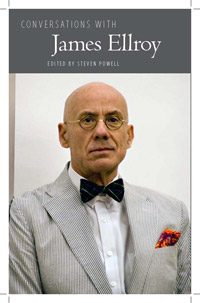 Regular readers will know that last year saw the release of Conversations with James Ellroy, a collection of interviews with the Demon Dog of American crime fiction which I edited for University Press of Mississippi. When I was editing the anthology one of my tasks was to contact writers and publications to obtain the copyright for interviews I wanted to go in the book. Many fans of James Ellroy admire his 1984 interview with Duane Tucker for Armchair Detective. It shows a young, ambitious crime writer with just a few novels to his name but with a clear vision and talent that in the years to come would make him one of America’s greatest crime writers. Here’s an excerpt in which the young Ellroy talks about his future writing plans:
Ellroy: I’m going to write three more present-day L.A. police novels, none of which will feature psychopathic killers. After that, I plan on greatly broadening my scope. How’s this for diversity: a long police procedural set in Sioux City, South Dakota, in 1946; a long novel of political intrigue and mass murder in Berlin around the time of Hitler’s Beer Hall Putsch; the first complete novelization of L.A.’s 1947 “Black Dahlia” murder case; and the reworking, rethinking, and rewriting of my one unpublished manuscript—“The Confessions of Bugsy Siegel,” an epic novel about the Jewish gangsters circa 1924–45.
As it happens Ellroy wrote two more ‘present-day L.A. police novels’ and only one of the other novels he mentioned came to fruition, but it would be one of his most powerful works of fiction – The Black Dahlia. Naturally I wanted this interview to be included in the book, and I contacted Duane Tucker to obtain copyright permission. However, Mr Tucker informed me that he had no recollection of conducting the interview and suggested Ellroy may have written it himself and used his name. Intrigued, I contacted Ellroy about this and received a reply from his assistant that ‘like his friend Duane Tucker, James has no recollection of the interview’. Ellroy and Tucker are close friends, and Ellroy dedicated his novel Killer on the Road to him. Armchair Detective is out of print now, but its editor in 1984 was the legendary Otto Penzler. I contacted Mr Penzler about the interview, and he was very adamant that a ‘fake’ interview would not have been published. His explanation was that Mr Tucker simply forgot about the interview as it has been nearly three decades. In the end I obtained the copyright without any difficulties, the interview was published in the collection, and I addressed the authorship question regarding the Tucker interview in the introduction.
It’s not an unusual practice for authors to write their own interviews: Norman Mailer wrote one as a conversation between himself and a Prosecutor in court and the Guardian did a whole series on the subject back in 2010. However, in both those cases, the author is well established and the reader is on the joke. Could Ellroy have written the Tucker interview as a way of announcing himself to the crime fiction world in the early 1980s? As I say in Conversations with James Ellroy, there is no definitive proof that he did, but circumstantially there is enough to suggest that he may have done. For instance, throughout the interview the word icon is consistently misspelled with a k, ikon. This spelling has appeared in several Ellroy novels. Also, the introduction to the interview describes Blood on the Moon as ‘contrapunctually-structured’. This unusual term was coined by Ellroy to define how Blood on the Moon switches from the perspective of the detective to the serial killer and back again. Now if Tucker transcribed and wrote the interview, then why does it feature these conspicuous spellings which are so quintessentially Ellrovian? The more I read the interview, the more I found the interaction between Tucker and Ellroy to appear staged. However, I make no definite claims. It’s every researcher’s worst nightmare to be caught out, AN Wilson style, and there could just be a reasonable explanation for all this.
Still, it’s a fascinating interview, and perhaps it gives us even better access into Ellroy’s mind as a writer than we previously thought. So, if you didn’t get the Christmas present you wanted last month why not pop over to Amazon.com or Amazon.co.uk and treat yourself to a copy?
Skull and Bones
I had a wonderful time on Tuesday night speaking at St Bart’s Pathology Museum. I hope to post a video of the event when it becomes available. I particularly enjoyed meeting so many lovely people including, for the first time in person, crime writer, critic and social butterfly Mike Ripley:
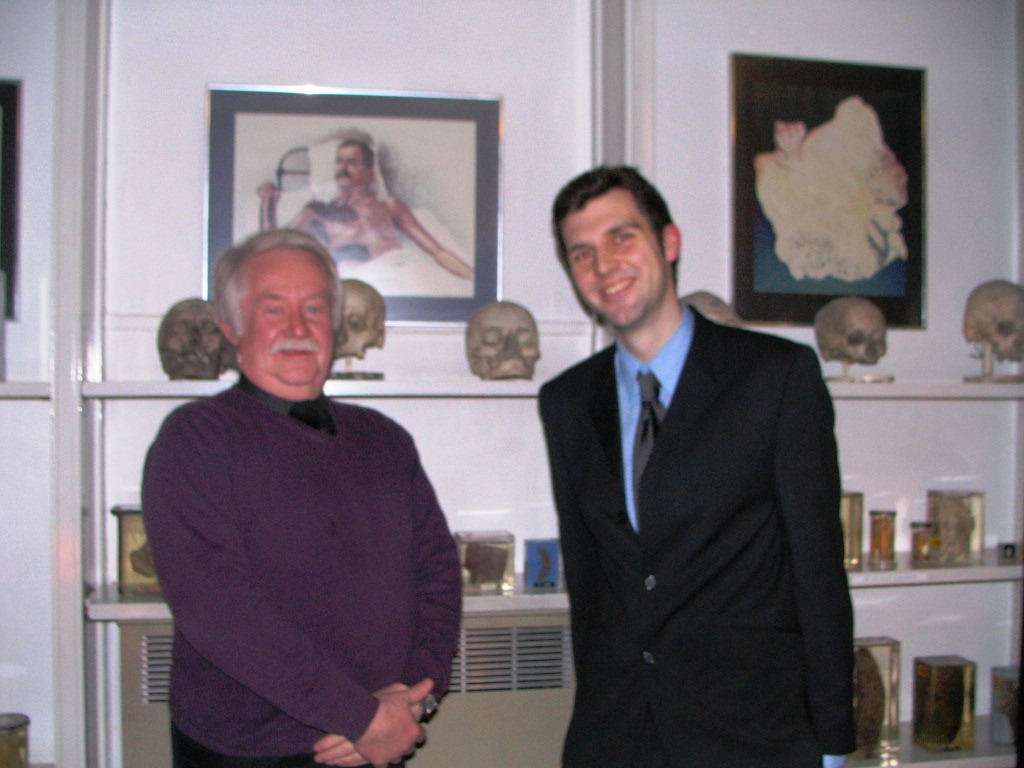
Mike and I.
Johnny Stompanato and James Bond
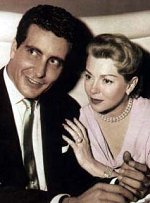
Johnny Stompanato and Lana Turner
In his review of Sir Sean Connery’s book Being a Scot, Euan Ferguson laments that Connery’s decision to write a book on the subject of Scottish identity, rather than a straight autobiography, means we will never hear his account of ‘the impossibly other-age story of his on-set headbutting of feared Mafia hitman Johnny ‘Stompy’ Stompanato’. Before he shot to fame as James Bond, Connery was making the film Another Time, Another Place (1958) with Lana Turner in London. Stompanato, an enforcer for Los Angeles’ Mob Kingpin Mickey Cohen, was Turner’s boyfriend at the time, and when rumours began to circulate of Connery and Turner having an affair, Stompanato flew to London and, so the story goes, threatened Turner and Connery with a gun, only to have Connery wrestle the gun from him and beat him up. A few months later, Stompanato was killed by Turner’s fourteen-year-old daughter Cheryl Crane. Crane stabbed him to death, so it is believed, in a heated moment when he was threatening her mother. Connery was in LA at the time filming Darby O’Gill and the Little People and had to go into hiding as Cohen suspected he was involved in the luckless Stompanato’s death.
As Ferguson suggests, the whole fascinating, sordid little story sheds light on a bygone Hollywood era. But it was only when I was reading the memoir of another onscreen James Bond, Sir Roger Moore’s My Word is my Bond, that I discovered Moore had his own frightening encounter with Stompanato around the same time as Connery. Moore had been friends with Lana Turner ever since they starred together in the historical drama Diane (1956). While she was in London filming Another Time, Another Place, Turner invited Moore to a party where the confrontation happened:
As the guests arrived, Lana pinned a label on them, mine read ‘Roger Boy Knight’, in reference to Ivanhoe of course. One of the other guests was a rather swarthy individual who carried the label ‘Johnny Dago’. I actually saw very little of him during the evening, which progressed from drinks to food to more drinks and music to dance…
At some point, as the other guests started to thin out, Lana asked me to dance – not one of my talents I must admit. As I shuffled around the floor with her in my arms, probably standing on her toes several times, I felt a cold breeze on the back of my neck. I glanced over my shoulder to find ‘Johnny Dago’ leaning against the doorjamb and staring, unsmilingly, at Lana and me.
A little voice in my head said, ‘Roger it is time you went home!’ I didn’t need a second prompt. I excused myself and made for the door.
A few weeks later I read that ‘Johnny Dago’ – better known as gangster Johnny Stompanato, with whom Lana was romantically involved, having recently divorced Lex Barker – had been deported by Scotland Yard for having physically abused Lana, and for having entered the UK illegally using a passport in the name of John Steele. He had, I read further, also turned up on the set of Lana’s film and threatened Sean Connery with a gun. Sean wrestled the gun from him and decked him with a right hook: all very Bondian. Johnny was convinced that Sean was having an affair with Lana, also very Bondian.

Roger Moore and Lana Turner
Moore’s encounter with Stompanato was not quite as heroic as Connery’s, but it is interesting to surmise how Stompanato’s rage must have been building step by step, first in his encounter with Moore and later Connery. Both men would achieve massive success as cinema’s greatest hero – James Bond. As Moore said, the whole affair was ‘all very Bondian’. Moore also had another interesting encounter with a gangster, this time Mickey Cohen:
I once met Cohen at a nightclub where I had gone to see the great Don Rickles, a fantastic comedian who became known as the ‘master of the insult’. Gary Cooper was also there that night, and Rickles, having made a few cracks at Cooper and then dismissing me for being a pretty boy at Warner Brothers, turned his attention to Cohen. He called him a dirty hood, then – obviously thinking better of it – dropped on his knees and held his hands together in a prayer towards the gangster, saying that he was only joking and he loved MISTER Cohen SIR!
If you thought Connery was brave taking on Stompanato, then you’ve got to admit Rickles was pretty damn brave calling Cohen a ‘dirty hood’ to his face!
I’ve never read Being a Scot: it struck me as an acquired taste, but I would highly recommend My Word is my Bond as a fascinating insight into a life well lived. The only false note is Moore’s constant dismissal of his talents. Sir Roger’s self-deprecating sense of humour is part of his charm of course, but it does get a little wearing for those of us who enjoy his work.
Black Dahlia Lecture at St Bartholomew’s Pathology Museum
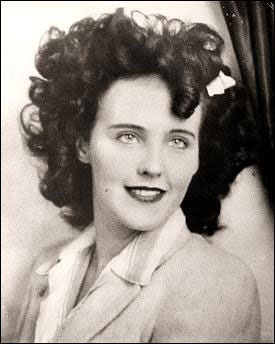
Elizabeth Short
January 15th, 2013 is the 66th anniversary of the discovery of Elizabeth Short’s corpse in Los Angeles, which was the genesis for the most enduring mystery in LA’s history – the Black Dahlia murder. To mark the anniversary, I’ll be giving a talk titled ‘I Never Knew Her in Life: Cultural Depictions of the Black Dahlia Case‘ at St Bartholomew’s Pathology Museum. I’m delighted that Carla Connolly has invited me to speak in such a beautiful, Grade II listed building, and I’m thrilled to be sharing a stage with Professor Peter Vanezis OBE who will be giving a talk titled ‘The Investigation of Dismembered Remains’.
Do come along if you have the chance. You can book tickets for the event here.
England, His England: The Sceptical Patriotism of John le Carre
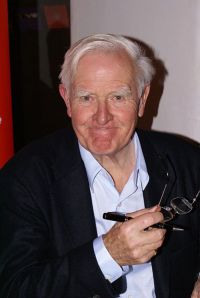
John le Carré at the “Zeit Forum Kultur” in Hamburg on November 10th 2008.
By Krimidoedel
In his long career John le Carré’s (the pen name of David Cornwell) greatest achievement would probably be merging genre fiction with the literary novel. This is no mean feat. Most authors tend to be great at one but awful at the other, although to be fair le Carré’s one non-spy novel The Naive and Sentimental Lover was scathingly reviewed and probably deserved it. I have just finished reading The Tailor of Panama and found it to be one of le Carré’s best, and perhaps the best of his post-Cold War work. The plot concerns ex-con Harry Pendel, who has built himself a comfortable life as the owner of Pendel and Braithwaite, Panama’s most successful tailoring business. Pendel caters to a rich and powerful clientele, which includes His Excellency, the Panamanian President. One day Pendel receives an unwelcome visit from a young Foreign Office employee Andy Osnard. Osnard knows all about Pendel’s criminal past and wants him to spy for British Intelligence in the build-up to the American handover of the Panama Canal. But what plausibly can Pendel tell Osnard? Soon, he lets his imagination run away with him and events spiral wildly out of control.
This is le Carré’s most unique novel, as instead of the dour Cold War world of espionage, the tone is openly satirical and at times farcical, being heavily indebted to Graham Greene’s Our Man in Havana. It is a joy to read le Carré’s acerbic descriptions of the great and good English institutions. He seems both scathing of their failings and, nonetheless, strangely fond of them. This leads to some glorious comedy when the habitually lazy Osnard, an old Etonian, is trying to decide on a career:
The question was how. He had no craft or qualification, no proven skills outside the golf course and the bedroom. What he understood best was English rot, and what he need was a decaying English institution that would restore to him what other decaying institutions had taken away. His first thought was Fleet Street. He was semi-literate and unfettered by principle. He had scores to settle. On the face of it he was perfectly cut out to join the new rich media class. But after two promising years as a cub reporter with the Loughborough Evening Messenger his career ended with a snap when a steamy article entitled ‘Sex Antics of our City Elders’ turned out to be based on the pillowtalk of the managing editor’s wife.
A great animal charity had him and for a while he believed he had found his true vocation. In splendid premises handy for theatres and restaurants the needs of Britain’s animals were thrashed out with passionate commitment. No gala premiere, white-tie banquet or foreign journey to observe the animals of other nations was too onerous for the charity’s highly paid officers to undertake. And everything might have come too fruition. The Instant Response Donkey Fund (Organiser: A. Osnard), the Veteran Greyhound Country Holiday Scheme (Finance Officer: A. Osnard) had been widely applauded when two of his superiors were invited to account for themselves to the Serious Fraud Office.
After that, for a giddy week he contemplated the Anglican Church, which traditionally offered swift promotion to glib, sexually active agnostics on the make. His piety evaporated when his researches revealed to him that catastrophic investment had reduced the Church to unwelcome Christian poverty. Desperate, he embarked on a succession of ill-planned adventures in life’s fast lane. Each was shortlived, each ended in failure. More than ever, he needed a profession.
‘How about the BBC?’ he asked the Secretary, back at his university appointments board for the fifth or fifteenth occasion.
The Secretary, who was grey-haired and old before his time, flinched.
‘That one’s over,’ he said.
Osnard proposed the National Trust.
‘Do you like old buildings?’ the Secretary asked, as if he feared that Osnard might blow them up.
‘Adore them. Total addict.’
‘Quite so.’
With trembling fingertips the Secretary lifted a corner of a file and peered inside.
‘I suppose they might just take you. You’re disreputable. Charm of a sort. Bilingual, if they like Spanish. Nothing lost by giving them a try, I dare say.’
‘The National Trust?’
‘No, no. The spies. Here. Take this to a dark corner and fill it in with invisible ink.’
Le Carré’s Cold War novels were partly constructed as a defense of British, or more broadly Western, values. He has never been the flag-waving type; indeed, as a man of the left he is critical of the English class system. Perhaps this dates back to his early life when his criminal father could swindle enough money together to have him educated at the Sherborne School and Oxford, but he was never, understandably, respectable enough to be truly part of this privileged world. And yet there is a real humour and fondness in his Englishness: in The Honourable Schoolboy a sex scene between Peter Guillam and Molly Meakin is described simply as ‘She surprised him with a refined and joyous carnality’. In an excellent profile of the author Peter Love, goes as far as describing le Carré as a ‘Radical Tory’. I think le Carré would probably shudder at the label. After all, in The Tailor of Panama Tories are described as ‘Empire-dreamers, Euro-haters, nigger-haters, pan-xenophobes and lost, uneducated children.’
Subtle.
Nevertheless, I think le Carré would comfortably describe himself as a patriot, and his more recent work has conveyed an aging man’s anxiety at the future direction of the country. In works such as Absolute Friends, it is clear le Carré does not regard the War on Terrorism as justified a cause as the Cold War and has become increasingly bitter about Britain’s ‘Special Relationship’ with the US. Now, anti-Americanism aside, perhaps this sceptical patriotism, combined with an affectionate and disarming portrayal of the flaws in our national character, is the best type to have.
British Politics Review
 The British Politics Review is a Norwegian publication whose goal is to raise the interest and knowledge of British politics in Norway (although more people in Britain should read it too!). I was delighted to contribute an article to the latest edition, the theme of which is the connections between politics and literature. The issue includes a touching piece by Kaja Schjerven Mollerin on George Orwell, Charles Ferrell on British writers’ response to the General Strike in 1926, Juan Christian Pellicer on the politics of Milton’s Paradise Lost, Howard J. Booth on Rudyard Kipling and Imperialism and Alexander Beaumont on politics in contemporary British fiction. My piece is called ‘Tony Blair, Robert Harris and the ghost of a literary feud’.
You can read the whole issue here.
PD James’ The Private Patient

NHS Hospital Ward in 1973
Sometimes we start reading the works of authors for unexpected reasons. I decided to read some of PD James’ novels after coming across a rather grubby letter a certain writer wrote to the Society of Authors claiming Baroness James should step down as the President of that organisation as she voted for the government’s controversial Health and Social Care Bill when it was brought before the House of Lords (perhaps he thought she had “unsuitable views for a woman”?)
Interestingly, from 1949 to 1968 James worked as an administrator in the National Health Service and she has drawn upon this experience for several novels such as Shroud for a Nightingale, The Black Tower, and A Mind to Murder. Although Philip Roth has just announced his retirement, stating that he has no more books left in him at the age of 79, it did cross my mind that Baroness James, now 92, published her most recent novel just last year and that her writing remains as sharp as ever.
The Private Patient (2008) explores the rather murky world of plastic surgery. It has a wonderfully grotesque and Dickensian cast of  characters whom James spends more than the first hundred pages introducing before the appearance of her legendary detective and poet Adam Dalgliesh. Rhoda Gradwyn is a successful and unscrupulous tabloid journalist (the sort showcased recently by the Leveson inquiry). She checks into the fictional Cheverell Manor in Dorset, a magnificent country house transformed into a private clinic run by the arrogant and ambitious Dr George Chandler-Powell who is having an affair with the voluptuous Sister Flavia Holland, a nurse with a heart of stone. Gradwyn wants a scar, which she received from her abusive father during childhood, removed from her face: ‘Because I no longer have need of it’. Some of the staff are weary of a woman of Gradwyn’s reputation coming to the clinic, and, indirectly, Gradwyn contributes to the destruction of the clinic’s reputation when she is murdered within twenty-four hours of her successful operation. The newly engaged Commander Dalgliesh travels to Cheverell Manor to solve the murder case of a woman who was herself an enigma, thus the title carries a double meaning referring both to private healthcare (always a controversial subject in the UK as we have seen) and the mystery of the individual victim.
There are shades of Golden Age detective fiction in the novel as the characters are isolated in a remote setting and all possess plausible
motives for wanting to see the ruthless Gradwyn dead. The downside of this is that some of the characters’ portraits border on caricatures to the modern reader, such as the superstitious kitchen worker Sharon Bateman who is obsessed with the seventeenth-century burning of a supposed witch on the grounds of the Manor. Bateman was a bit too parochial for my tastes. However, this is more than offset by the eloquent and often moving prose which, used as I am to a more hard-boiled American style, never failed to impress. As evidenced in the scene where Dalgliesh first set eyes on Gradwyn’s corpse:
Dalgliesh knew that speculative gazes fixed on a corpse – his own among them – were different from the gazes fixed on living flesh. Even for a professional inured to the sight of violent death there would always be a vestige of pity, anger or horror. The best pathologists and police officers, standing where they stood now, never lost respect for the dead, a respect born of shared emotions, however temporary, the unspoken recognition of a common humanity, a common end. But all humanity, all personality was extinguished with the last breath. The body, already subject to the inexorable process of decay, had been demoted to an exhibit, to be treated with a serious professional concern, a focus for emotions it could no longer share, no more troubled by. Now the only physical communication was with gloved exploring hands, probes, thermometers, scalpels, wielded on a body laid open like the carcase of an animal. This was not the most horrific corpse he had seen in his years as a detective, but now it seemed to hold a career’s accumulation of pity, anger and impotence.
Dalgliesh finally puts all of the pieces together, but with the solving of the case there always remains a void, as though the deeper mysteries of human existence can never be solved, not even by the most celebrated of detectives. And yet the final note is one of optimism, decent values have triumphed and life is worth living.
A superb novel.
Finley Light – To Be James Bond
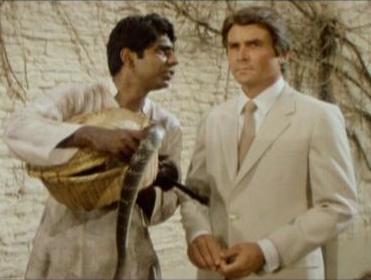
This is James Brolin in one of his screen tests as James Bond but whatever happened to Finley Light?
Although my feelings about Skyfall were lukewarm I’ve still been enjoying much of the Bond memorabilia which has appeared on the web recently. Only six actors have played James Bond in the official Eon series, but many more have been considered for the part. Somehow I just can’t imagine Burt Reynolds, Mel Gibson or John Gavin, all of whom were considered – Gavin even signed a contract which was subsequently bought out, saying those immortal lines “The name’s Bond, James Bond.” Then again, the actors who did play Bond had time to establish themselves in the role, and I guess we just accept them in the established Bond history. I wouldn’t have pictured American actor James Brolin as Bond either, but he did a fantastic screen test (now on YouTube), re-enacting a scene from From Russia With Love with Maud Adams, when the producers were considering him for the role for Octopussy.
There is an excellent essay on Alternative007 about the actors who were in the frame at one time or another to be Bond. Michael Billington appears to have come closer to the role than any of the other contenders, and I think he would have made a wonderful Bond. He has a brief but important role in The Spy Who Loved Me as the Russian spy Sergei Barsov. One named I have heard repeated a few times regarding potential James Bonds is the rather distinctive sounding ‘Finley Light’. Light was apparently considered after Roger Moore stood down in 1985 but on Alternative007 Light is only briefly mentioned with the rather intriguing line, ‘Australian model called Finlay Light was strongly linked to the role but to this day no one is sure if such a person exists!’ I was puzzled by this and began pondering whether Finley Light might have been some elaborate ploy by the producers to hoodwink the press and Bond fans at the time. Light just seems too reminiscent of George Lazenby, another Australian who was plucked from obscurity for what turned out to be a brief tenure as James Bond, and I certainly couldn’t recall coming across Light in any other films. Apparently, the Mail on Sunday ran a world exclusive breaking the story that Light had signed a ten year contract to be Bond. However, before I let my conspiracy-theory-inclined-mind run away with me a little bit of internet searching seemed to confirm there is such a person as Finley Light (some sources spell it Finlay with an a). Light has an imdb page which lists him as having one screen acting credit for a single episode of an Australian television series titled Case for the Defence, broadcast in 1978 and there appears to be some information on Light at the National Library of Australia although unfortunately its not digitised, and I can’t find any photos of Mr Light. I’ve also found a Finlay Light who played drums in the British Heavy Metal band Necrosanct who were active in the late 1980s and early 90s, although I’ve no idea if this is the same person as the enigmatic would be spy.
I guess I’m intrigued. If any readers, particularly Australian ones, remember Finley Light I’d like to hear from you.
UPDATE: I’ve finally come across some images of Finley Light and they’re quite striking. Here’s the link to some photos of Light that were taken in 1986 around the time he was being considered for Bond (scroll down to the bottom of the page to see him). Light has a distinctive look which makes me think he could have suited the role of Bond.
Does this blog post from 2010 show an older Finley Light?
Skyfall: Bond has been Better
 I went to see Skyfall this week. I had not read any of the reviews so as not to sway my opinion, (plus I think nine out of ten critics will say whatever the producers tell them to) but the hype has been impossible to avoid. Everyone from the Guardian to the Vatican has been singing Bond’s praises. So is the film any good? Yes, but it’s far from Bond at his best.
Daniel Craig’s third outing as Bond begins with 007 in Turkey, accompanied by the beautiful fellow agent Eve (Naomie Harris) and hunting down a hired killer (Ola Rapace) who has stolen a hard drive containing the identities of undercover NATO agents. Bond is left for dead on this mission but returns to the fold after a bomb attack on MI6 headquarters and the publication of NATO agents’ names on the internet. Bond is sent by M to track down ex-MI6 agent Raoul Silva who is responsible for the attacks on his old employer. Silva bears a bitter grudge against M from the days he worked for her in Hong Kong. Bond travels first to Shanghai and then to Macao on the hunt for Silva where he encounters the sexy and mysterious Severine (Berenice Marlohe).
There’s a lot to like about Skyfall. Judi Dench turns in a brilliant performance as M, and Javier Bardem must rank as one of the best Bond villains of the series. Daniel Craig is as strong as ever as Bond. Every Bond film is in a sense tailored to the actor playing Bond, and the areas where Craig is less comfortable in the role fuel some of the film’s weaknesses. The lack of humour is one point. Craig is an intense actor, which is good for exploring Bond’s back-story but falls flat when you consider this secret agent is also supposed to be witty and charming. Bond has become so obstreperous that he seems to be in a constant state of contention with everyone he works with. Another problem is that a distinctive romance seems to be missing for Bond in this film. Bond has always been a bit of chauvinist, but at least in the older Bond films there was always a woman he would share the adventure with. In Skyfall the women flash through the story so quickly that we never truly get to know any of them or understand the attraction. Craig is very much a modern Bond for our times, but when you greatly reduce the romance and humour it becomes less a case of reinventing the formula and more just a lack of confidence in storytelling. No Bond film is perfect, and with so many elements of the formula to include, gun barrel shot, pre-credit sequence, theme song etc., this film felt divided between set pieces that worked and set pieces that didn’t. Quantum of Solace, by comparison, was vastly underrated.
None of the flaws of Skyfall are too big to overcome in future installments (although making Bond black won’t necessarily improve things). Bond has been better before and will be better again.


 The Venetian Vase