Bibliography
Looking through my bookshelves not so long ago I was shocked to discover that I could remember very little about the books that I’ve read, even the ones I really liked. I love reading, and I’m fortunate that in a sense it’s part of my job, but how do you remember characters, plots or historical facts accurately when the list of what you’ve read starts to build up? After giving the matter some thought, I decided to try my hand at maintaining an annotated bibliography. The researching and publishing that I’ve done so far has required that I create bibliographies, but this one would be different. I started with basic publishing information and then gave a short account of what the book is about and what I thought of it. These would not be reviews as such, but my general thoughts on the book which I could revisit from time to time and hopefully relive a little of the book itself. I’ve pasted two entries below which reflect my reading interests of crime fiction and history.
This is a fairly new thing for me so if there are any bibliophiles out there, or people who have better methods of memory recall when it comes to books, I’d be interested in hearing what you’ve got to say:
Camilla Läckberg The Hidden Child (London: Harper, 2011)
 Having seen Camilla Läckberg speak at Theakston’s Old Peculier Crime Writing Festival at Harrogate, I rushed out to buy one of her novels. The Hidden Child was the first one to hand. Upon reading it I was impressed by her skillful crafting of a good thriller. There is a gritty realism in her writing which is missing in the more overblown work of fellow Scandinavian greats Stieg Larsson and Jo Nesbø, but the downside is her writing lacks the visceral excitement of either of these contemporaries.
Erica Falck is writing a true crime book when she discovers her mother’s diary, a Nazi medal and a baby’s clothing stained with blood. Läckberg alternates the story between Falck’s investigation into the meaning behind the items and flashbacks to 1940s war-ravaged Europe. The mystery unravels slowly in both settings with the hardships of war contrasted with Falck stumbling into a case which involves Neo-Nazi groups and murder. So far so good plot-wise, but no Scandi crime novel would be complete without an exploration of the leading characters complicated domestic lives, and here Läckberg goes into overdrive. Falck has a new-born baby: her husband Patrik is a detective on paternity leave but is proving fairly hopeless at it. Patrik is also visiting his ex-wife and helping her look after her young son while her husband’s away. Erica’s sister Anna is struggling in a new relationship because of an exceptionally stroppy teenage stepdaughter, oh and did I mention Melberg, the curmudgeonly Police Chief who reluctantly inherits a stray dog, strikes up a romance with a fellow dog lover and takes up salsa classes? Now there is nothing particularly wrong with any of this, but there does seem to be an awful lot of it and it was beginning to distract from the mystery storyline towards the end. Still, The Hidden Child is a strong mystery novel by a writer who is in Barry Forshaw’s words, ‘The hottest female crime writer in Sweden at the moment.’
Andrew Mango Atatürk (London: Murray; 1999)
 Mustafa Kemal Atatürk is one of the most enigmatic figures in twentieth- century history. He might plausibly be described as a benevolent dictator. Andrew Mango sets himself the gargantuan task of telling Atatürk’s life story, and his massive role in founding and shaping the modern Turkish State, but also unravelling the deeper mystery of who Atatürk really was. He succeeds at the first task but falls short on the second. Born into the Ottoman Empire (now Thessaloniki) in the late nineteenth century, the details of Atatürk’s (or Mustafa Kemal as he was known then) are understandably sketchy. Mango spends this early part of the book chronicling the decline of the Ottoman Empire, a process which had started years before the calamitous decision to enter The Great War on Germany’s side. Although it was a dying state, there is something Romantic about the pure Ruritania of the Ottoman empire with the monarchy sustained by Islam through the Caliphate. Atatürk was a staunch secularist and was sketching out his vision for a Republic of Turkey while bravely fighting for his country, famously defeating the allies at Gallipoli. The chapter on Gallipoli falls a bit flat, but Mango does well at deconstructing some of the myths surrounding Atatürk. For instance, his famous order, ‘I don’t order you to attack. I order you to die. By the time we are dead, other units and commanders will have come up to take our place.’ Is more likely to have been ‘I do not expect that any of us would not rather die than repeat the shameful story of the Balkan war. But if there are such men among us, we should at once lay hands upon them and set them up in line to be shot!’
Atatürk was a cunning strategist, outwitting rivals to become the leader of the Turkish Nationalists and foiling the Allies attempt to carve Turkey up into a Hellenic empire. By the time the Sultan tried to side with the Nationalists, Atatürk sidelined him, so that he couldn’t take any credit in their victory. After winning independence, he set about secularising an almost entirely Muslim country. The Fez was banned under the 1925 Hat Law. A new constitution separated Church and State. Atatürk is regarded as the great emancipator of women. His adopted daughter became a fighter pilot. Inevitably, people who resisted his vision were dealt with harshly, but the Cultural Revolution Atatürk set in motion is remarkable for the relatively small loss of life in comparison with other revolutions. By the time of his death, many Turks still lived in extreme poverty, but his regime had laid the foundation for prosperity, liberty and democracy. Or had it? Mango offers a spirited defence of Atatürk noting some of the contradictions of his character. He did not treat women in his private life with the emancipated role he gave them in Turkish society. His atheism seemed at odds with his penchant for bizarre pseudo-intellectual ideas such as the Sun-Language theory, and posthumously, a cult has been built around his personality. It is illegal to criticise him. Statues and portraits of him are everywhere, and ‘Atatürk’ translates as ‘Father Turk’, the surname he chose which was forbidden to any other Turk, which partially makes him appear more of a monarch than the first President of Turkey. During his rule, the Turkish parliament had no greater role than simply rubber-stamping his reforms. The first free Turkish elections were not held until 1950, and since then, there have been a series of bloodless military coups. But Mango leaves the reader with no doubt that Atatürk transformed Turkey for the better: if his reforms amounted to ‘Measured Terror’ and might seem precarious, bear in mind Turkey’s unique position as the meeting point between East and West, and the condition today of neighbouring states such as Iran and Syria.
Ellroy at the Movies
News reached the blogosphere recently of potential movie adaptations of James Ellroy’s The Big Nowhere and Blood’a A Rover. These are brilliant novels and could possibly make excellent films. I think The Big Nowhere would be easier to film as the plot is fairly self-encapsulated. By contrast Blood’s A Rover is set over five years and takes many plot threads from the previous two films in the Underworld USA trilogy. Still, just because these films are ‘in development’ does not mean we are going to be seeing them at the cinema any time soon, if at all. As Ellroy has said on numerous occasions, movie production is a dysfunctional business. So in the meantime, we Ellroy fans will have to content ourselves with the adaptations of Ellroy’s movies which have already been made and the films he has scripted.
Here’s a run through, with video clips embedded of the Ellroy films which have been made so far:
Cop (1988):
James B. Harris’s Cop is an adaptation of Ellroy’s novel Blood on the Moon, the first book of the Lloyd Hopkins trilogy. James Woods turns in a powerful performance as the intellectually brilliant but manic and unstable Detective Hopkins, here on the hunt for a serial killer preying on single women. Cop received mixed reviews upon its release, but it has held up well as a taut, suspenseful thriller. The story may be fairly conventional, but there are still recognisable Ellrovian touches here and there, such as Hopkins’ unusual parenting methods. See video below.
LA Confidential (1997):
Curtis Hanson’s magisterial LA Confidential set the standard for Ellroy adaptations which no one has come close to since. You have to admire Hanson and screenwriter Brian Helgeland for pulling off the near impossible task of compressing Ellroy’s epic fictional history of 1950s LA into a two hour and twenty minute movie. As an example of how perfectly Ellroy’s prose comes alive onscreen, here’s a scene from the novel where Bud White rescues Inez Soto from her kidnapper Sylvester Fitch:
A nude woman spread-eagled on a mattress – bound with neckties, a necktie in her mouth. Bud hit the next room loud.
A fat mulatto at a table – naked, wolfing Kellogg’s Rice Krispies. He put down his spoon, raised his hands. ‘Nossir, don’t want no trouble.’
Bud shot him in the face, pulled a spare piece – bang, bang from the coon’s line of fire. The man hit the floor dead spread – a prime entry wound oozing blood. Bud put the spare in his hand; the front door crashed in. He dumped Rice Krispies on the stiff, called an ambulance.
And here’s the same scene in the film:
Brown’s Requiem (1998):
Adapting Ellroy’s debut novel into film was never going to be an easy task, and Jason Freeland’s Brown’s Requiem fails in almost very way. The story veers uncomfortably between mystery and comedy and Freeland doesn’t know how to handle actors. Will Sasso is appalling as the psychopathic Freddy ‘Fat Dog’ Baker, Selma Blair hardly sizzles as Jane Baker and even the late great Brion James fails to be menacing as the villainous Cathcart. On the plus side, Michael Rooker puts in a strong performance in the lead role of private eye and repo-man Fritz Brown:
Dark Blue (2003):
Ellroy got a ‘story by’ credit for Dark Blue as the final film was partially based on a screenplay he wrote titled ‘The Plague Season’. Set in early 90s LA, Dark Blue is an intelligent, if never quite compelling, drama following corrupt Sergeant Eldon Perry in the days leading up to the Rodney King verdict and riots:
The Black Dahlia (2006):
Another film which split the critics, Brian DePalma was always a risky choice to direct Ellroy’s most personal novel as his lurid horror style is too dependent on gratuitous violence in telling the story of the unsolved murder of Elizabeth ‘Betty’ Short, LA’s most enduring mystery. Despite this, there are still moments of suspense and even a few touching scenes as in Betty’s audition tapes:
Street Kings (2008):
Another by-the-numbers cop thriller which Ellroy could probably write in his sleep. Ellroy has a co-writing credit on Street Kings with three other writers, and while it’s an entertaining watch, it lacks a compelling lead character in Keanu Reeves’ Tom Ludlow and the story is riddled with cliches.
(Spoiler alert) Video below is the ‘killcount’, which edits together all of the film’s death scenes. Enjoy:
Rampart (2011):
Officer Dave ‘Date Rape’ Brown (Woody Harrelson) has a complicated personal life and falls foul of his superiors in the LAPD after he is caught viciously beating a man who crashed into his patrol car. That’s about it plot wise. Rampart is a film, which like its title character, is boorish, pretentious and violent. In Hollywood the screenwriter will always come second to the vision of the director, and it’s hard to believe Ellroy wrote the film that Rampart became. Director Oren Moverman tries and fails to mix two fundamentally different genres – art movie and violent cop drama – and the results are risible. Avoid:
Extract from 100 American Crime Writers
 Below is an extract from the introduction of 100 American Crime Writers which describes the emergence and development of crime fiction in American literature. You can download the entire introduction on Palgrave’s website, or you can buy the book on amazon.co.uk or amazon.com.
Any attempt to trace the genesis of American crime fiction is hampered by the need or desire to locate a source and date, which is inevitably open to revision and dispute. The oldest author to appear in this volume is Edgar Allan Poe (b.1809) whose “The Murders in the Rue Morgue” (1841) is widely credited as the first detective story. Poe’s ‘tales of ratiocination’ featuring C. Auguste Dupin were a significant influence on the Golden Age of detective fiction, and his influence can still be seen in the work of contemporary crime writers. Although Poe and his successors laid much of the foundations of the crime fiction genre that a modern-day reader would identify, American crime fiction, however, can be said to have pre-dated Poe. Sara Crosby argues that some of the earliest American crime writing is to be found in the popular execution sermons of seventeenth- century New England which were written to pass judgment on condemned men. The decline in church influence and advances in publishing caused these ‘sermons’ to evolve into different forms, and Crosby identifies ‘crime writers’ amongst the first generation of American novelists, including William Hill Brown, Susanna Rowson, Hannah Webster Foster and Charles Brockden Brown, all of whom were particularly fascinated with the subject of crime and the criminal (Crosby 2010).
To understand the historical developments and trends in American crime fiction, it is necessary to examine similar trends in British crime fiction in regards to late nineteenth and early twentieth century writing. This was a period when trends in British and American crime writing often paralleled but sometimes moved in opposition to one another. Julian Symons argued that there were essentially two Golden Ages in the crime fiction field: the Golden Age of the Short Story and the Golden Age of Detective Fiction. Even within these two ages, opposition to the dominant trend was emerging in the form of a more realist style (Symons 1972). During the Golden Age of the Short Story, which was exemplified by the works of Poe in America and Arthur Conan Doyle’s Sherlock Holmes stories in Britain, the Dime Novels, including the long-running Nick Carter series beginning in 1891, were also flourishing. The successor to the first Golden Age, the Golden Age of Detective Fiction, is generally regarded as the period between the two World Wars, and is often identified as an idiosyncratically British form, if only because the settings of country houses and rigid class structures did not apply so easily to American society. However, Americans also succeed in this form, and among the American Golden Age writers, John Dickson Carr and Jacques Futrelle achieved popularity on both continents. Just as the Dime Novels were popular during the era of the classic detective short story, so too did another more radical form of crime fiction emerge during the second Golden Age. In the 1930s, the pulp magazines Black Mask and Dime Detective began to publish detective short stories by a new breed of crime writers including Carroll John Daly, Raymond Chandler and Dashiell Hammett. The magazines were dubbed ‘pulps’ as they took their name from a new wood-pulping procedure whereby the trademark slick covers could be produced quickly. Black Mask introduced tough, urban private detectives, such as Philip Marlowe and Sam Spade, who were far removed from the aloof, eccentric intellectual ‘detective’ developed by the Golden Age writers. Violence, sexuality and instinct were brought closer to the reader, stripping away the sanitising veil of scientific and intellectual crime solving. The prose style was shortened to reflect the immediacy of this new genre and the cynical thought processes of the world-weary protagonists, although Chandler himself was fond of using elaborate similes. Many Black Mask writers transitioned successfully to novel writing, often expanding the material of their short stories into novel-length narratives. The hardboiled style continued to thrive with the rise of the paperback industry in the 1940s, which allowed the reading public greater access to crime fiction, and led to the reprinting of Chandler and Hammett’s 1930s hardcovers.
Meyer Levin’s Compulsion
 Meyer Levin described Compulsion (1956), his fictionalisation of the Leopold and Loeb murder trial, as a ‘contemporary historical novel or a documentary novel’. Today, the novel reads more like what Truman Capote dubbed, and by his own account invented with In Cold Blood (1966), a non-fiction novel. Although largely forgotten by literary critics, Compulsion is a superior book to In Cold Blood and to the many imitators in the true crime genre which followed Capote’s celebrated work.
Compulsion is based on the murder of Robert ‘Bobby’ Franks by Nathan Leopold and Richard Loeb. Leopold and Loeb were two University of Chicago law students from wealthy families. In May 1924 the two students kidnapped and murdered Franks in an attempt to prove their intellectual superiority by committing the perfect crime. If such a thing as the perfect crime does exist, this was not it. Within a week the two men were arrested and charged: their elaborate plan fell apart when Leopold’s eyeglasses were found near the corpse. The subsequent trial gripped the nation. Although it was an open and shut case, there was a deeper mystery to events: why had two such privileged and intelligent young men committed such a barbaric crime and would they be executed for it? Famed attorney Clarence Darrow defended Leopold and Loeb at the trial, which ultimately resulted in both men escaping capital punishment but being sentenced to life imprisonment. Loeb was killed by fellow prisoner James E. Day in 1936. Day alleged that Loeb was attempting to rape him, although this claim seems dubious. Leopold was eventually paroled in 1958 and spent his remaining days doing medical research in Puerto Rico.
Meyer Levin was also a University of Chicago student when the story of Leopold and Loeb first broke and was well-placed to factually recreate the case in novel form. In Compulsion, Leopold and Loeb are portrayed as Judd Steiner and Artie Straus. Clarence Darrow is renamed Jonathan Wilk. The name changes are important as in this detail the novel differs from later non-fiction novels. The novel is narrated in the first person by a ‘cub’ reporter Sid Silver who covers the case. The novel begins with the murder itself, and then Levin shows the immediate aftermath: the widespread fear of a serial killer being on the loose is supplanted by disbelief as suspicion slowly falls on Straus and Steiner who in their arrogant belief that they can outwit the police inadvertently reveal their guilt. Much of the novel reads as a discourse on philosophy and psychology. Straus and Steiner are fascinated by the philosophy of Friedrich Nietzsche and model themselves on the Nietzschean Ubermensch, ‘Supermen’ who create their own values and live above conventional morality. Despite, or perhaps because of, their formidable intellect, the two killers have practically no emotional intelligence. They are easily outwitted by investigators who are even able to demonstrate how they have misunderstood Nietzsche’s philosophy. Psychology is the other key theme of the novel, and much effort is given to explaining the crime in terms of Freudian theories which were just beginning to have an impact in the U.S. in the mid-1920s. On both these themes, Levin artfully displays the fallibility of knowledge. At the time of the novel’s publication, Freud still held great sway in academe, but his influence has become more cultural than scientific, and the Freudian analysis of Straus and Steiner seems particularly contrived. The 1924 setting is skilfully evoked. This was an age when people were still recovering from the horrors of the Great War. There is a degree of optimism regarding humanity’s future and the pursuit of knowledge, but as Silver is narrating the novel after the Second World War, both reader and narrator know that even more unspeakable horrors await mankind. Thus, a single murder motivated by Nietzschean philosophy acts as a microcosm of the crimes against humanity perpetrated by a Nazi ideology which was itself inspired by Nietzsche.
Compulsion is divided into two parts: Book One is titled ‘The Crime of Our Century’ and deals with the murder and aftermath. Straus and Steiner’s trial is covered in Book Two: ‘The Trial of the Century’. Note the difference between ‘Our’ and ‘The’. For Levin, the murder of Bobby Franks represented the murder of a little part of humanity. In an age when religion had lost its authority and empires were crumbling, new humanist ideals were emerging, but these had been corrupted to the extent that Straus and Steiner regard murder not as a moral abomination but as an abstract concept. Sid Silver ruminates on their motive in prose which is both moving and thrilling to read:
We could, in that night, only grasp their claim of an experiment, an intellectual experiment, as Judd put it, in creating a perfect crime. They would avow no other motive: their act sought to isolate the pure essence of murder
Before, we had thought the boys could only have committed the murder under some sudden dreadful impulse. But now we learned how the deed had been marked by a long design developed in full detail. What was new to us was this entry in the dark, vast area of death as an abstraction. Much later, we were to seek the deeper cause that compelled these two individuals to commit this particular murder under the guise, even the illusion, that it was an experiment.
Just as there is no absolute vacuum, there is no absolute abstraction. But one approaches a vacuum by removing atmosphere, and so, in the pretentious excuse offered by Judd, it seemed that by removing the common atmospheres of lust, hatred, greed, one could approach the perfect essence of crime.
Thus one might come down to an isolated killing impulse in humanity. To kill, as we put it in the headlines, for a thrill! For an excitation that had no emotional base. I think the boys themselves believed that this was what they had done.
At first their recital sounded much like an account of daydreams that all could recognize. They had been playing with the idea of the “perfect murder.” Is not the whole of detective-story literature built on the common fantasy? True, in such stories we always supply a conventional motive. We accept that a man may kill for a legacy or for jealously or for revenge, though inwardly we may make the reservation – that’s foolish, the butler wouldn’t go so far. We accept that a dictator may unleash a war out of “economic needs” or “lust for power” but inwardly we keep saying, “Why? Why? Why?”
Sadly, Meyer Levin never got the recognition he deserved. He will be remembered perhaps as one of American literature’s great nearly men. He undertook exhausting research to adapting Anne Frank’s diary into a Broadway play, but his version was never produced as he was replaced with other writers. It was a loss that was to haunt him for the rest of his life. Compulsion is now often overlooked in the True Crime field for Capote’s In Cold Blood, but the Leopold and Loeb case was a more complex and significant event in American history than the Clutter family murders which Capote novelised. In Cold Blood is remembered less for being a great book than it is for the ethical issues raised by Capote’s relationship with the two killers Richard Hickock and Perry Smith and the tragedy which befall Capote due to the books phenomenal success.
My advice – read Compulsion, it’s a better book.
The Project of a Lifetime
I have a piece on The Rap Sheet in which I discuss the challenges of editing my new book 100 American Crime Writers. Here’s an extract:
I began working on 100 American Crime Writers as a contributor. Chris Routledge, the editor of the book at the time, asked me to write three biographical entries: James Ellroy, James M. Cain, and Mickey Spillane. I considered this to be an exciting and daunting task in itself, between uncovering new biographical details through researching and re-reading each man’s considerable collection. Despite this, when Chris asked me to take over as editor so that he could focus on other projects, I didn’t hesitate to say “yes.” As although it required researching and writing many more entries, communicating with 14 contributors, and dealing with the details of proofreading, bibliographies, editing proofs, and what-not, I was enthusiastic about the great wealth of interesting and engaging material and the opportunity to ensure it reached a broad audience.
You can read the whole thing here.
100 American Crime Writers
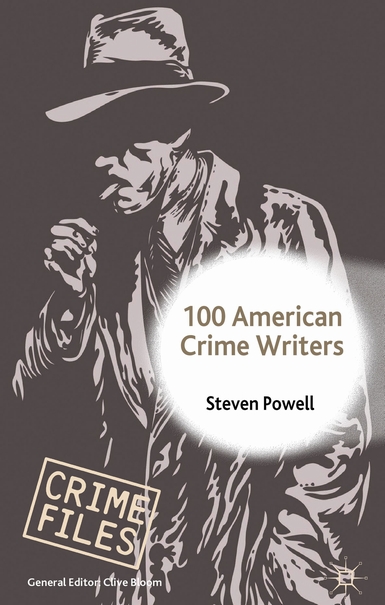 I am now settled in to my new apartment. I have a room with a view which is very conducive to writing. This is good because my latest book, 100 American Crime Writers, has just been published by Palgrave Macmillan, and over the next few weeks, I’m going to write several posts on this site to publicise it. As editor of this anthology, I had several wonderful contributors who wrote the biographical entries which comprise the volume. Editing the book was an often arduous, sometimes glorious and ultimately rewarding experience. I often felt like a crime writer, or better still a private detective, piecing together the mystery of these great crime writers’ lives. Several of the contributors have made similar comments to me about the experience. The lives of American crime writers are as fascinating, if not more so, than the work they produced, and the entries balance the discussion between their life and work. If you are a student, scholar of just fan of crime fiction then this is a book for you.
Here is the jacket cover, description and list of entries:
From Edgar Allan Poe to James Ellroy, crime writers have provided some of the most popular, controversial, acclaimed and disturbing works in American literature. 100 American Crime Writers provides critical biographies of some of the greatest and most important crime writers in American history. Both an important scholarly work and an enjoyable read accessible to a wider audience, this addition in Palgrave’s Crime Files series includes discussion of the lives of key crime writers, as well as analysis of the full breadth and scope of the genre – from John Dickson Carr’s Golden Age detective stories to Raymond Chandler’s hardboiled Philip Marlowe novels, Ed McBain’s 87th Precinct police procedurals to Megan Abbott’s modern day reimagining of the femme fatale. Drawing on some of the best and most recent scholarship in the field, all of the key writers and themes of the genre are discussed in this comprehensive study of one of the most fascinating and popular of literary genres.
‘Out of the Venetian Vase’: From Golden Age to Hard-boiled
‘After These Mean Streets’: Crime Fiction and the Chandler Inheritance
Megan Abbott
Paul Auster
W.T. Ballard
Ann Bannon
Robert Bloch
Lawrence Block
Leigh Brackett
Gil Brewer
Fredric Brown
Howard Browne
Edward Bunker
James Lee Burke
W.R. Burnett
James M. Cain
Paul Cain
Truman Capote
John Dickson Carr
Vera Caspary
Raymond Chandler
Harlan Coben
Max Allan Collins
Richard Condon
Michael Connelly
Patricia Cornwell
Robert Crais
James Crumley
Carroll John Daly
Norbert Davis
Mignon G. Eberhart
James Ellroy
Janet Evanovich
William Faulkner
Kenneth Fearing
Rudolph Fisher
Kinky Friedman
Jacques Futrelle
Erle Stanley Gardner
William Campbell Gault
David Goodis
Sue Grafton
Davis Grubb
Frank Gruber
Dashiell Hammett
Thomas Harris
Carl Hiaasen
Patricia Highsmith
George V. Higgins
Tony Hillerman
Chester Himes
Dorothy B. Hughes
Roy Huggins
Day Keene
Jonathan Kellerman
C. Daly King
Jonathan Latimer
Dennis Lehane
Elmore Leonard
Ira Levin
Elizabeth Linington
Eleazar Lipsky
John Lutz
Ed McBain
Horace McCoy
William P. McGivern
John D. MacDonald
Ross Macdonald
Dan J. Marlowe
Margaret Millar
Walter Mosley
Marcia Muller
Frederick Nebel
Barbara Neely
William F. Nolan
Sara Paretsky
Robert B. Parker
George Pelecanos
Edgar Allan Poe
Melville Davisson Post
Richard S. Prather
Bill Pronzini
Ellery Queen (aka Dannay and Lee)
Arthur B. Reeve
Mary Roberts Rinehart
James Sallis
George S. Schuyler
Viola Brothers Shore
Iceberg Slim
Mickey Spillane
Rex Stout
Jim Thompson
Ernest Tidyman
Lawrence Treat
S.S. Van Dine (Willard Huntington Wright)
Joseph Wambaugh
Carolyn Wells
Donald E Westlake
Raoul Whitfield
Charles Willeford
Charles Williams
Cornell Woolrich
Here’s the page on the publisher’s website, and here is the link for Amazon.
Radio Silence
Apologies for the lack of posts recently. I’m moving apartments this weekend and it’s proving to be every bit as stressful as I feared. Normal service will resume shortly.
Jo Nesbo at Theakston’s
Mark Billingham introduced the closing event at Theakston’s, and what an event to go out on– Jo Nesbo being interviewed by Mark Lawson. When Billingham mentioned Nesbo’s achievements in life thus far, it was hard not to feel a slight twinge of jealously. A freelance journalist, rock star, stockbroker, footballer and extreme sports enthusiast, it’s difficult to believe when you see him that this man is 52. He looks in great shape, but in his own words he is ‘slowly falling to bits’. Nesbo revealed how he came to novel writing quite late. On a trip to Sydney he started sketching out a story at the airport and was thoroughly hooked on writing it by the time he finally arrived at his hotel. The setting provided the story, with Nesbo writing of how his now legendary Norwegian detective Harry Hole is sent to Sydney to investigate the murder of a Norwegian celebrity, his investigation leads him to explore the Aboriginal myth of The Bat-Man. When he finished the manuscript, Nesbo expected it to be politely rejected by publishers, but he had hoped they would have some words of encouragement for him to continue writing. To his surprise, The Bat (as it is known in the UK) was published, and Harry Hole is now one of the most famous fictional detectives of our time. Interestingly, Nesbo now regards airports as one of his favourite places to do some writing. Although he claimed to be quite a formal writer, working from a synopsis, writing in airports sometimes gives him the energy and productivity that every writer craves. He also mentioned how Headhunters had been a work in which he felt completely unemcumbered by convention, and he was determined to push the lead character to the limits of human endurance. If you have read the novel or seen the film of Headhunters, you will be left feeling exhilarated by its style.

Jo Nesbo at Theakston’s
Nesbo talked more about his life, divulging lots of fascinating information which I had not known before. His mother’s family had fought with the Norwegian Resistance during the Second World War, but it was only when he was 15 that Nesbo discovered his father had fought with the Germans on the Eastern Front and had spent two years in prison upon returning to Norway at the end of the war. Nesbo spoke movingly of how as a child he had always thought of the German soldier as evil-looking in their imposing black uniforms and steel helmets, a view that was perpetuated in post-war Norwegian culture. Now he had to come to terms with the fact that his father had fought with them. But he grew to love his father again when he explained to Jo why he had done it: his father had grown up in the US in a staunchly anti-communist family. Thus, when the Germans invaded and occupied Norway, he leapt at the chance to fight the Russians. His experiences on the front, particularly during the Siege of Leningrad were horrific, and he admitted that his time in prison was a fairly light punishment for the crime of betraying his country. Nesbo worked this material into his Harry Hole novel The Redbreast. His father had planned to write a novel about his wartime experiences but died of cancer the year he retired.
The Theakston’s festival closed on the first year anniversary of the Oslo bombing and Utoya massacre. Nesbo discussed the effect that this tragedy had left on his country. He had noted previously that as a young country, (Norway became independent in 1905) Norwegian culture had looked for heroes, firstly in the Arctic explorers and then in Resistance fighters, while overlooking the level of collaboration with the Germans that had taken place. Utoya was as shocking to the national psyche as the assassination of the Swedish Prime Minister Olof Palme was to Sweden in 1986. Lawson asked if the massacre was like a Kennedy moment, will everyone remember where they were when it happened? Nesbo said that the explosion was felt quite far throughout Oslo, and he was dangling from a rope inside a local gym when it happened. However, he played down the Kennedy comparison. Norway is still a peaceful and prosperous country, and people want to continue their lives in much the same way as they always have. He talked of the concerted effort by Norwegians not to give mass murderer Anders Breivik more attention than he deserves.
All in all, this was a thrilling and engaging interview that was the perfect event to close what has been a brilliant Theakston’s crime writing festival. For more information on this interview, Mrs Peabody Investigates has an excellent write-up on her blog.
Camilla Lackberg and Deon Meyer
As the author of Death in a Cold Climate: A Guide to Scandinavian Crime Fiction, Barry Forshaw was the perfect moderator for a panel on translation which featured two of the most successful Swedish crime writers working today, Camilla Läckberg and Liza Marklund, and also the South African crime writer Deon Meyer and Spain’s Antonio Hill. Actually, very little of the conversation focused on translation. Läckberg and Marklund both stated they were very happy with the job translators and editors do with their work. Antonio Hill said he has barely been consulted with the translation into English of his debut novel El Verano de los Juguetes Muertos, aka The Summer of Dead Toys. Meyer’s work has been translated into twenty languages, but as he writes his crime novels in Afrikaans, he lamented that some things are just impossible to translate as they are specific to the language. However, he stated that Britain’s long held fascination with South Africa mitigated this problem to an extent, where more social explanation was needed when he transitioned to other markets. Marklund discussed how different social attitudes can be the most difficult to convey through translation, but when done successfully, the results are personally satisfying. In socially conservative Italy, her liberated Annika Bengtzon character is very popular with Italian women, who are fascinated by the idea of a man staying at home to take care of the children. Both Läckberg and Marklund noted that since their novels are not published in chronological order, it leads to contention with German publishers who prefer a more straightforward rendering, a comment which led to a rather tetchy response from a German member of the audience.
Liza Marklund
The conversation broadened into other crime fiction related topics. Marklund argued that the best crime fiction is produced in Scandinavia, the United Kingdom and the United States because crime writing can only thrive in established democracies. People want to read about ‘the black spots on the white canvas’. She stated that on a visit to Kenya, people were baffled that she wrote crime fiction. In a country with quite a few problems, it is just not part of their culture. Hill and Meyer commented that crime fiction only emerged in their countries after the end of the Franco regime and apartheid respectively. The creative expression and dissident thinking necessary for writing crime novels is not possible in dictatorships. Forshaw commented that the success of writers like Läckberg and Marklund had robbed us of the belief that Scandinavia was a social democratic paradise. Marklund said that where she was born in northern Sweden people can be quite insular in their beliefs. She joked that Scandinavians believed that the problem with other nationalities is that ‘there not Scandinavians’. Hill said there were still lingering problems leftover from the Franco regime, and the ongoing Eurozone crisis is particularly harsh in Spain. Forshaw tried to conjure a dystopic reverse scenario; in light of recent scandals, has freedom of the press gone too far in Britain? Has it spawned a whole new level of corruption? Meyer responded that this overlooked the fact that Britain still produced some of the best journalism in the world. Läckberg said that sleazy tabloid journalism does not exist to the same extent in Sweden. She herself had been the subject of some unwanted media scrutiny in her home country, but the tabloids were nowhere near as intrusive as their British counterparts. The German woman, who I mentioned earlier, made a eloquent comment during the Q and A session. She said she lives in the US where the social problems should not be underestimated, and in Germany where democracy is still a relatively recent introduction, crime fiction had become a phenomenon. She finished by saying we needed to look at each societies fascination, or lack thereof, with crime fiction on a case by case basis. Meyer had the last word: poverty and corruption exists everywhere, only in different areas of life and society from one country to the next.
Judging from this insightful comment, and the fascinating topics all four writers discussed, it seems that crime writers will not be running out of material any time soon.

America’s Got Talent: Four US Crime Writers
Friday at Theakston’s Old Peculiar Crime Festival, John Connolly artfully guided a discussion titled ‘America’s Got Talent’ with four writers outwardly tied by nationality; however, as was discovered in the discussion, they share more than a home country as similar influences, methods and interests in the genre emerged.
Megan Abbott’s very early yet enduring love of film noir (she wanted to marry James Cagney as a child) was complimented by stories from Gillian Flynn, whose film professor father took her to watch Alien and Bonnie and Clyde at the tender age of seven. Chris Mooney spoke of his ‘cool grandmother’ who allowed him to watch the Creature Double Features and The Shining, while Ryan David Jahn, who worked as a screen writer after leaving the Army, explained that he wrote visually, preferring to show a character through his actions rather than through internal monologue or dialogue.
As I usually attend academic conferences, one of the most refreshing moments was when the authors were candid about their struggles. Gillian Flynn called herself a ‘slow writer’ who doesn’t know where the book’s going when she begins and who spend a lot of time editing and redrafting. Megan Abbott said that she did not have a ‘logical mind’ and that puzzles, or the traditional whodunnit form, did not suit her. Ryan David Jahn admitted to missing deadlines and slacking off eight months of the year, only to be driven to finishing a book in four months, sometimes writing 12,000 words a day. Chris Mooney, who came across as a great guy to have a drink with as he always had a funny line, explained that he used to be a perfectionist with his work, but now he forces himself to give a rough edit to his publisher and do the editing afterward.

Megan Abbott
I was surprised by a few things. One was the importance Megan Abbott placed on true crime, and how the idea of what people do when they’re backed into a corner fascinates her. Secondly was how difficult the editing process is for Gillian Flynn: she spoke of writing the story then having to write backwards, as her final product led to different emphases being needed in the body of the work. Her complexity came off as a laborious layering of ideas. Ryan David Jahn talked of his novel The Dispatcher (which he’s currently writing the screenplay for), and its likeness to Jim Thompson’s The Getaway, and Chris Mooney explained where he got the basis for Sacred Ash, a concept in his novels that has to do with the storing of cremated ashes. Apparently, he based it on an actual company, Holy Smoke, which makes ammunition out of people’s ashes, so that, as Chris noted, loved ones can fire their dearly departed into a Thanksgiving turkey.
Only in America… the country from which these four talented and compelling writers hail.


 The Venetian Vase