Call Me Dog
I have two speaking engagements coming up which may interest readers in the Merseyside area. The first is titled, ‘”Call me Dog”: My Interviews with James Ellroy’ in which I will talk about interviewing Ellroy and editing Conversations with James Ellroy. This will take place at the Centre for Lifelong Learning, University of Liverpool, 2 May, 1pm-2pm. Details on booking for this event can be found here.
Then, as part of Waterstones ‘Lunchtime Classics’ series I shall be reading from Ellroy’s L.A. Confidential and talking about the novel. This will be at Waterstones Liverpool One store on 18 July at 12 noon.
All welcome.
Ring Twice for Laura: Vera Caspary’s novel and film Laura
I imagine that I am like many people who, once they have seen the film based on a novel, struggle to return to the book and ‘picture’ the character the way the author had originally intended— a compelling dramatic performance has the downside of limiting our imagination through memory. This I found to be very true when reading Vera Caspary’s Laura (originally serialised as Ring Twice for Laura )(1942).
The novel and the film both begin with Detective Mark McPherson visiting renowned columnist Waldo Lydecker to question him about the murder of Laura Hunt. The backstory introduces us to a woman adored by the men around her. The proofs of Laura’s attractiveness, which give the men in her life motive and make them suspects, are made plain to the detective, who in turn, develops morally dubious and unprofessional feelings for Laura.

Clifton Webb as Waldo Lydecker and Dana Andrews as Detective McPherson
It was not the eponymous heroine, nor Detective Mark McPherson, that I had trouble revising when I began Caspary’s novel, (perhaps because in the film McPherson is a close-lipped, hard-boiled type, and Laura seems ephemeral, and changeful, a point emphasized by her adapting to each man she is with). Instead, it was the cultured essayist Waldo Lydecker that proved too difficult to break from Clifton Webb’s 1944 performance. In the film, Webb sparkles with the acerbic wit of Oscar Wilde or Noel Coward. He is at once loathsome and entertaining, pathetic and controlling. The audience’s own interest in him absolves Laura for not seeing his faults more clearly. In the novel, Waldo is fat from his indulgence in fine cuisine, and his physique is compared to McPherson and Shelby Carpenter, Laura’s intended, in a way that makes his inferiority seem too great a hurdle to overcome even in the duality between riches/poverty and brains/brawn that Waldo and Shelby represent as competing forces. Webb’s confidence in the film, however, is ebullient. That is not to say he’s unaware of his age, and his relative frailty, but that he thoroughly believes his intelligence will eventually win out.
Yet in the novel, Waldo, and Laura’s fiancé the impoverished Southern gentleman Shelby, are given the additional flaw of being of the wrong era. Caspary creates an unfavourable comparison between Victorian and Modern ages that aligns Laura with McPherson. I don’t think I’m spoiling the ending by saying that one-third of the way through the novel it is revealed that Laura is not dead. Diane Redfern, a love rival of Laura’s, has been killed and her corpse initially mistaken for Laura, who becomes a suspect once she turns up alive. In a fight between the newly resurrected Laura and Shelby, the characters make explicit references to ‘Victorian’ and ‘hardboiled’, creating tension between the Golden Age detective fiction and the hardboiled style:
Shelby: ‘He [McPherson] ought to be hardboiled. You’d expect him to be tougher. I don’t like him trying to act like a gentleman.’
‘Oh, pooh!’ I said.
‘You don’t see it. The man’s trying to make you like him so you’ll break down and confess. That’s what he’s been working for all along, a confession. Damned caddish, I’d say.’
I sat down on the sofa and pounded my fists against a pillow. ‘I hate that word. Caddish! I’ve begged out a million times to quit using it.’
Shelby said, ‘It’s a good English word.’
‘It’s old-fashioned. It’s out of date. People don’t talk about cads any more. It’s Victorian.’
‘A cad is a cad, whether the word is obsolete or not.’
‘Quit being so Southern. Quit being so righteous. You and your damn gallantry.’ I was crying. The tears ran down my cheeks and dripped off my jaws. My tan dress was all wet with tears.
McPherson’s thoughtfulness crosses the class divisions important to the tropes of the Golden Age, but his character is not typical either of the hardboiled style, i.e. he is interested in reading and high culture. Shelby fights against such subversion. Waldo, likewise, uses class and his education of Laura as a means to defeat his opposition. Yet in the novel, Laura is a gutsier, more defiant woman, who will not be bound by past structures; however, her cinematic counterpart is more malleable, and she almost remains a creation of the men around her even after her reappearance.
In Caspary’s novel, the narrative is out of Waldo’s control, an important point to her ‘defeat’ of the Golden Age/Victoriana through him. Caspary’s unique and unsettling approach breaks from a tradition of trusted narrators to rotate between the main protagonists, with Waldo offering a part of the story. By contrast, in the film Waldo is the only narrator, a shift created and fought for by the director Otto Preminger. Although the other characters reveal their feelings through conversation and interrogation, the story remains his, even in his downfall.
Very Inspiring Blogger Award
I am delighted to have been nominated for the Very Inspiring Blogger Award by David Mattichak Jr. David has his own fine blog which you can read here, and was actually one of this site’s first followers, subscribing shortly after Chris Routledge and I started the blog. The Venetian Vase has had several contributors over the past few years, and we hope to have more in the future, so I would like to take this opportunity to thank everyone who has contributed and made the site informative and entertaining for crime fiction fans.
Anyone who is nominated for the Inspiring Blogger award is required to say a few things about themselves and nominate some bloggers who have inspired them. Here goes:
I was born in Chester, UK, and I have spent many a pleasant day walking on Chester’s famed Roman Walls and Tudor Rows. I now live in Liverpool, which is a mere twenty miles away, but, as any Liverpudlian or Cestrian will tell you, worlds apart in terms of culture. I enjoy the busy, vibrant lifestyle in Liverpool, but I still like to escape every now and then to quaint old Chester.
Crime fiction is my main passion in life, but I did once harbour ambitions of becoming an actor. Although I was nowhere near good enough to become a professional, I was fortunate to act in many amateur theatre productions in Chester and several at the University of Liverpool. One of my friends and fellow thespians from those days is now on the brink of movie stardom.
If I ever decide to emigrate, it will probably be to Thailand (where my wife lived for five years) as it is the most beautiful country I have yet visited. I have written some thoughts on one of Thailand’s most enduring mysteries which you can read here.
Regular readers will be aware that my first book, Conversations with James Ellroy, was released in February and my next book, 100 American Crime Writers, will be released later this year.
Of the blogs I follow here are a few which I find to be inspiring:
J. Kingston Pierce’s The Rap Sheet is essential reading for any crime fiction researcher or fan. Pierce posts almost daily updates of crime fiction news, promotes the work of many of his fellow bloggers, and has an encyclopedic knowledge of the genre.
Steve Hodel is a former LAPD homicide detective who wrote one of the most extraordinary true crime books I have ever read, Black Dahlia Avenger. He blogs about the Black Dahlia case and many other LA based cases at his Squad Room Blog.
I began following The Great Balancing Act when its author, Susan, started chronicling her struggle with Hodgkin’s Lymphoma. After six months of chemotherapy she has now made a full recovery.
Dickens’ Nocturnal Wanderings:Walking and Obsession
As this is the 200th anniversary of Charles Dickens’ birth, a few months ago I read Claire Tomalin’s clear, extensive and insightful biography of Charles Dickens. In relation to crime-fiction, Dickens is thought by many to be the author of the first detective story with his novel Bleak House (1852-3), wherein the villainous lawyer Mr Tulkinghorn patiently works out Lady Deadlock’s scandalous secret and the story reaches its height, as Tomalin puts it, with ‘a three-suspect murder at the climax’ featuring one of the first police detectives in fiction, Inspector Bucket. Aside from expanding my understanding of the relentless energy with which Dickens pursued his craft, the stage, his charitable works and his mistress Nelly Ternan, as well as the unforgivable way he patronised, dismissed, and falsely blackened the reputation of his long-suffering wife (he did not go as far as his friend and fellow novelist Bulwer-Lytton and have his wife committed against her will to an insane asylum) one of the things that stood out to me was his compulsion for walking–sometimes 20 miles at a time and often in London or Paris at night.
Dickens’ walks seemed to have initially been taken out of necessity but grew into a form of voyeurism, an outlet for frustrations, a means of escaping family, and a way to spend time with his male friends. He began wandering the streets of London as a ten-year-old boy when his parents were unable to fund his schooling, and his independence grew when his father was imprisoned for debt, and twelve-year-old Dickens lived and worked apart from his family. Dickens observed the glories and trappings of late-Georgian and early Victorian London, and his writing reveals his fascination with all levels of society including the criminal underworld, jails and prostitution. Although some of his walks as a married man were idyllic rambles through his boyhood county of Kent, in Paris, he visited the morgue at sundown and walked the streets all night.
I am a great fan of walking, rambling, and generally viewing a city by foot, but the time and length of Dickens’ walks, seemed to go beyond enjoyment to compulsion or obsession. Parenthetically, Robert Frost’s poem, ‘Acquainted with the Night’ states that ‘time was neither wrong nor right’, but the idea that the night walker is largely apart from society (or good society) and in a largely voyeuristic role, seems to indicate something brooding and forbidden. Dickens taps into these ideas himself in his last completed novel, Our Mutual Friend (1864-5). The novel is divided into two love stories, although many prefer the John/Bella plot that harkens back to medieval or Shakespearean drama of disguise, I have always preferred the love triangle of the bored gentleman-barrister Eugene Wrayburn (who always puts me in mind of a fin de siècle Oscar Wilde character), the severely passionate schoolmaster Bradley Headstone, and the self-sacrificial boatman’s daughter Lizzie Hexam. Obsession is key to the story, and Lizzie becomes the object at which the two men’s separate meannesses unfold. Although they both ‘watch’ Lizzie, and try to cast it as watching over her, they become more and more entangled with each other. When Lizzie escapes London following Headstone’s forceful proposal and Wrayburn’s pursuit of what would result in her becoming his mistress, Wrayburn takes to walking the streets at night, taunting Headstone, whom he knows follows him in the absence of Lizzie. Below is a clip of the BBC’s version of the night walk from their 1998 adaptation of Our Mutual Friend.
It is another night walk that will drive Headstone, in his passion-for-Lizzie-cum-hatred- for-Wrayburn to attempt a murder.
Overrated / Underrated
More and more I find myself disagreeing with film and television critics. Usually because I think they have completely overrated a production and watching it has subsequently proved to be a letdown. However, there have been a number of times when it seems that the critics haven’t done justice to a good film or television drama. I think there are a number of reasons why a potentially misleading critical consensus might grow around a work. Firstly, if several critics write one thing about a film, then another critic with a different opinion might feel obliged to give the same opinions out of fear that his opinions must be wrong. Secondly, critics might be more interested in trends rather than quality, which leads to a wave of initial enthusiasm (as with the Twilight and Girl Who films), followed by a backlash in which several critics take their revenge. To be fair, a balanced review should identify the strengths and weaknesses of any production, as lavish praise or unremitting criticism can be boorish to read (although the latter often leads to some wickedly funny reviews such as Peter Bradshaw’s take on Disney flop John Carter).
In this post I will discuss briefly a television production which I found to overrated by critics and also a film which I consider to be underappreciated. This is just my opinion and it would be hypocritical of me to try to force it on you so please feel free to disagree and give some of your own overrated / underrated examples in the comment thread.
Overrated – The Wire
The Wire was given ‘the best television series ever made’ label some years ago, but I resisted watching it for the longest time as I thought to myself that another cop drama with ghetto gangsters couldn’t possibly be original and exciting. Then I finally saw the first season and realised what all the fuss was about. Creator and writer David Simon brilliantly brings to life Baltimore’s crime-ridden streets with finely-realised characters– from drug addicts to dope pushers, violent enforcers, drug kingpins, the police who chase them and the innocent families who get caught up in the crossfire. Another eye-opener was the complex relationship between the local politicians and the Baltimore police department which more often than not leads to bureaucratic nightmares and miscarriages of justice.
However, being labelled ‘the best television show ever made’ is bound to make The Wire seem overrated, and, like all shows, it suffers from several structural problems. One is an overdependence on montages, with all five seasons ending with a montage it feels like a repetitive, crude way of telling the story. Also, ironically for a show with such a high mortality rate, the writers seemed to have a sentimental attachment for characters who have outlived their dramatic usefulness. Finally, despite its reputation for realism, there are several scenes which depict police procedure and the court system which are unrealistic and would never happen in real life, such as in season five when a lawyer, who is the live-in partner of a judge, tries a case in her court. Sometimes this can be dramatically justified, but I wonder if any other police drama would have been allowed to get away with this so easily. I would recommend Season one and four as the best seasons, with season two easily being the worst and plain boring, and three and four well worth watching.
Below is a clip from one of my favourite scenes is Season one, where the Major Crimes Unit are closing in on the Drug Kingpin Avon Barksdale:
Underrated – U-Turn
Sean Penn plays Bobby, a drifter who gets stranded in the small town of Superior, Arizona, after his car breaks down. He is on his way to Vegas to pay off a gambling debt to a mobster who has already cut off two of his fingers. But then the money he’s carrying to pay off the debt gets shredded when Bobby is caught in the middle of drugstore heist cum shootout, and he finds himself caught in the strange town with no money, no car and no way out. Directed by Oliver Stone, U-Turn received mixed reviews and was even nominated for two Golden Raspberry awards, but to me it’s one of Stone’s greatest films. It’s a film of great storytelling as Stone has no political axe to grind. He deftly mixes several genres, displays real technical flair and evokes an atmosphere which is simultaneously claustrophic and ironically sprawling, as there are a multitude of strange characters in Superior. The film is a good twenty minutes too long and it is far from flawless. However, as U-Turn has several noir elements, perhaps this is the reason I like the film so much. In film noir an evocative milieu is arguably more important than the story itself, and U-Turn, with its many memorable and bizarre moments, lingers in the memory long after viewing.
One such moment below:
The Undershaw Alliance

As many readers will know, Arthur Conan Doyle’s former home, Undershaw, is in a state of disrepair, and under threat of being converted into apartments by its owner, Fosseway, a Virgin Islands registered property company. The Undershaw Alliance brings together two groups, Academics for Undershaw, and Crime Writers for Undershaw to campaign to save the house for the nation in its current form, and establish a Conan Doyle Museum and centre for British crime writing. The planning permission granted to Fossway is going to the High Court on 23 May, 2012. There is an alternative:
But what better or more appropriate place could there be for a Conan Doyle Museum and Centre for British and Irish Crime Writing, thus affirming its cultural value and Conan Doyle’s place in the literary heritage of Great Britain and Ireland, and beyond, open and accessible to the public all year round (including school visits), with a library, conference facilities, crime writing courses and a writer in residence?
Join the campaign here: Undershaw Alliance.
On Editing
I have a piece on The Rap Sheet in which I describe the aims and structure of Conversations with James Ellroy, as well as discuss what went in to putting the book together. Lots of people, myself included, want to write a novel; rather less I suspect want to edit an anthology. But if you are a writer or researcher interested in the process, or just a fan of James Ellroy, I hope you will find the piece interesting. You can it read it here.
I’ve been blogging a lot about James Ellroy recently. This has been to publicise Conversations with James Ellroy which I enjoyed writing about. However, next week I’m going to return to blogging about other crime fiction topics.
Lee Earle Ellroy – The Early Life of James Ellroy
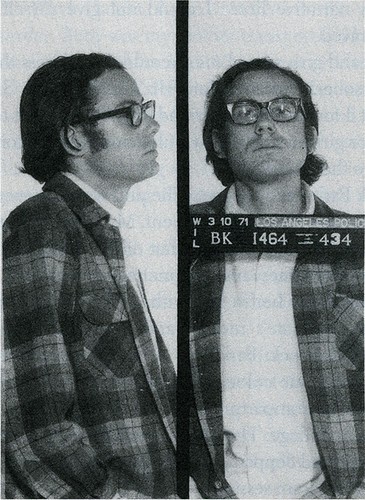
Lee Earle Ellroy Mug Shot
Conversations with James Ellroy begins with a chronology which sets out the key dates and events in Ellroy’s life. It was my task as editor to compile this chronology. At first glance it did not seem particularly daunting as Ellroy has written two memoirs, several autobiographical essays and has discussed his life in hundreds, if not thousands of interviews. But the abundance of sources creates its own problems: there are contradictions regarding dates and places, making it apparent that some sources must contain inaccuracies that as an editor you don’t want to repeat. I also had to take into consideration that as a memoirist Ellroy tended to be vague regarding dates. I see two main reasons for this: firstly, in his early life Ellroy dropped out of high school, seldom held a job, went through periods of homelessness, struggled with alcohol and drug addictions, committed several crimes including burglary and shoplifting, and served short sentences at the Los Angeles County Jail. Given these circumstances, it is perhaps not surprising that there is a lack of documentation regarding Ellroy’s early life, and his own recollections are written in a fluid, stream of consciousness style. Secondly, Ellroy once conveyed to me that he was purposefully vague about dates, as he wanted to keep some things private. For an author who has bared so much of his soul over the course of his career it would be hard not to sympathise with his desire not to keep some elements of his life out of the public eye.
Many readers may not be aware that James Ellroy was not born with that name, but was named Lee Earle Ellroy after his father. It was a name he would come to despise feeling it sounded too much like Leroy, and this hatred of his own name typified the luckless, self-loathing man he was for much of his early life. The purpose of this article is to look at the first thirty-three years of Ellroy’s life, although I skip some events due to the constraints of limited space, my aim is to set out as accurately as possible a historical record of the often frightening and disturbing life of Lee Earle Ellroy.
Lee Earle Ellroy was born on March 4, 1948, in Los Angeles, California, the only son of Geneva “Jean” Odelia Ellroy (nee Hilliker) and Armand Lee Ellroy. Ellroy was born just over a year after the discovery of the mutilated corpse of Elizabeth Short on a vacant lot at 39th and Norton, Los Angeles, on January 15, 1947. Miss Short was dubbed ‘the Black Dahlia’ by the press, and her unsolved homicide would become one of the most enduring mysteries in Los Angeles history and a lifelong obsession for Ellroy, being the subject of perhaps his greatest work of fiction.
Ellroy’s memories of his parent’s marriage suggest a very unhappy union: they fought, drank too much and had affairs. In an interview with Nathaniel Rich, Ellroy said, ‘I don’t remember a single amicable moment between my parents other than this: my mother passing steaks out the kitchen window to my father so that he could put them on a barbecue.’ Ellroy’s parents divorced in 1954, and Jean retained primary custody of her son. The relationship between his parents would continue to be hostile, and young Ellroy often found himself caught in the middle of their disputes. In 1958 Jean and her son moved to a new home in El Monte, just outside Los Angeles. Although his mother had promised him a bigger, nicer house, young Ellroy was shocked at how small and dilapidated their new accommodation was. On June 22, 1958, the body of Geneva Hilliker Ellroy was found in the shrubs outside of Arroyo High School. She had been strangled to death. The police began a murder investigation, but the case was never solved. Young Ellroy had been with his father the weekend of his mother’s death. They had been to the cinema to watch The Vikings starring Kirk Douglas and Tony Curtis. When he arrived back at his mother’s house, he saw several police cars, and as he describes in his memoir My Dark Places, ‘A man took me aside and kneeled down to my level. He said, “Son, your mother’s been killed.”’
For his eleventh birthday on March 4, 1959, Ellroy’s father gave him two books, an anthology The Complete Sherlock Holmes and Jack Webb’s The Badge. The Badge contained a ten page synopsis on the Elizabeth Short murder case and Ellroy was immediately fascinated. He saw the parallels between the Elizabeth Short case and his mother’s unsolved murder, and grew a greater understanding of his mother as a result. Although he could not know it at the time, the unsolved homicide would become the subject of his seventh and arguably greatest novel The Black Dahlia (1987).
Ellroy’s formal education was hindered by his increasingly erratic behaviour. He attended John Burroughs Junior High School from 1959 to 1962 and then Fairfax High School from 1962. Fairfax High was predominantly Jewish and regardless of what his real views may have been, Ellroy would say and do almost anything to get attention. In his interview/article ‘Doctor Noir’ Martin Kihn records that ‘he [Ellroy] wrote a song criticizing American Nazi Party leader George Lincoln Rockwell to impress a girl.’ However, he also engaged in outrageous acts of anti-semitism, joining the American Nazi Party, buying Nazi paraphernalia and singing the Horst Wessel song. In 1965, Ellroy was expelled from Fairfax High for fighting and truancy. Armand Ellroy’s health had been deteriorating for some time. On November 1, 1963, he suffered the first of several strokes. The young Ellroy became his father’s caregiver. Despite this, when he was expelled from school, Ellroy asked his father for permission to join the US Marines. Armand Ellroy refused, but he did allow Ellroy to join the regular army. Thus, in May 1965 Lee Earle Ellroy had a very brief period in the US Army stationed in Fort Polk, Louisiana, assigned to Company A, 2nd Battalion, 5th Training Unit. Ellroy was particularly unsuited to army life, Kihn describes his arrival:
While taking the Army oath, Ellroy realized he was making a big mistake. He started faking a nervous breakdown by stuttering, then tearing his clothes off and running naked through the Fort Polk, Louisiana, reception station.
Ellroy’s outrageous behaviour managed to convince an army psychiatrist to recommend an immediate discharge. Ellroy’s army career lasted less than a month; his father suffered another stroke and Ellroy flew back to LA to visit him in hospital. He died on June 4, 1965. Armand Ellroy’s last words to his son were ‘Try to pick up every waitress who serves about you.’ After his father’s death Ellroy’s life steadily fell apart. He seldom worked or had money. He cashed his father’s last three social security checks, and also received money from his mother’s insurance policy administered by his aunt in Wisconsin. He worked briefly for a psychic passing out handbills, and also found work in a pornographic bookstore, but was fired for stealing money from the till. 1966 to 1969 were some of the darkest years of Ellroy’s life; he went through periods of homelessness, sometimes sleeping in the parks in LA. He became an alcoholic, drinking copious amounts of scotch and Romilar CF cough syrup, and a substance abuser of amphetamines and Benzedrix inhalers. Voyeurism was Ellroy’s other all-consuming addiction. He would break into to the houses of young women who lived in the wealthy Hancock Park area of LA. His overriding purpose was sexual voyeurism, not burglary for money. He would search through the clothes drawers and sniff women’s panties. He would make himself a sandwich and pour a drink, before leaving the house and carefully covering his tracks. The Manson family murders in 1969 led to a paranoid atmosphere in LA and the arrival of several private security firms which patrolled Bel-Air and Hancock Park. The increased risk led Ellroy to stop breaking into houses. However, his list of petty crimes continued and led to a series of arrests and short term stints in the Los Angeles County Jail. Although he has given differing accounts as to the number of times he was arrested, Ellroy’s police record lists fourteen arrests between 1968 and 1973 for offences such as shoplifting and driving under the influence. Martin Kihn describes Ellroy’s first arrest as being quite dramatic, ‘someone reported having seen Ellroy sneaking into a deserted house, and a team of L.A. cops barged in with shotguns and arrested him.’
Between 1975 and 1977 Ellroy’s health was in a dangerously poor condition; he suffered two bouts of pneumonia and almost died of a lung abscess. He also had a nervous breakdown and was diagnosed with the rare condition post-alcoholic brain syndrome. These health scares persuaded Ellroy to clean up for good. He entered Alcoholics Anonymous and quit drinking. In 1977 he began working as a caddy at the Hillcrest Country Club but was quickly sacked after fighting with a fellow caddy. He then began a slightly longer tenure at the Bel-Air Country Club, and it would be caddying that provided the inspiration for his first novel. One of the less dramatic features of the life of Lee Earle Ellroy was his growing love of crime fiction, which began as a child. He started off reading the Hardy Boys and Nero Wolfe novels, later graduating to Raymond Chandler, Dashiell Hammett, Mickey Spillane, Ross Macdonald and Joseph Wambaugh. Even during his periods of homelessness, Ellroy devoured crime fiction, often sitting in a library for hours reading through detective novels and drinking scotch. Crime fiction would be the subject of his first novel, Brown’s Requiem, (Ellroy’s preferred title was ‘Concerto for Orchestra’ but this was later changed at his publisher’s insistence). In the novel, the protagonist Fritz Brown is an ex-cop, repo-man and low-rent private eye. Ellroy has described the novel as autobiographical:
Here’s a guy who looks exactly like me, has a German-American background, likes classical music, came from my old neighborhood, gets involved with a bunch of caddies. All that’s me.
Writing the novel was a challenge, as Ellroy described in an interview with Fleming Meeks, it began with a prayer on the grounds of the Bel-Air Country Club on January 26, 1979,
‘God,’ I said, ‘would you please let me start this fucking book tonight?’ And I’ve been at it ever since.”
Ellroy did not own a typewriter and the novel was handwritten. His writing sessions were often conducted on a bench at the Bel-Air, or in the caddyshack while the other caddies were sat around playing card games. Once the novel was completed, Ellroy quickly found an agent who sold the manuscript to Avon for $3,500. Brown’s Requiem was published in 1981, and upon publication Ellroy changed his first name and moved across country to Eastchester, New York, where he continued his writing career while working as a caddy at the Wykagl Country Club. As Ellroy explained in an interview with Craig McDonald, when changing his name he chose the name James from the pseudonym ‘James Brady’ which his father had used. ‘It’s just a simple name that goes well with “Ellroy.”’
Lee Earle Ellroy officially ceased to exist. James Ellroy would become one of the greatest American crime writers.
Conversations with James Ellroy is available to buy on Amazon.co.uk and Amazon.com.
James Ellroy on the Rodney King Scandal
Conversations with James Ellroy features three previously unpublished interviews that I have conducted with Ellroy. In my first interview with Ellroy, I quickly found him to be gentlemanly and very pleasant, occasionally displaying flashes of the eccentricity readers have come to associate with his Demon Dog persona. Ellroy is an eloquent speaker, but he shocks his listener by inserting or interrupting his intellectual assessments with idiosyncratic, sometimes foul-mouthed urban speech patterns. Ellroy can be combative in conversations, and he is not afraid to express controversial opinions. When I asked him if there was any contradiction between his portrayal of corruption in the LAPD of the 1940s and 1950s in his LA Quartet novels, and his present amicable relationship and high regard for the LAPD, to my surprise, he came out with a vigorous and convincing defence of the LAPD Officers involved in the Rodney King beating.
On March 2, 1991, Rodney King was driving on the Foothill Freeway in the Greater Los Angeles area. He had been drinking and was over the legal limit, two police officers spotted the car speeding and gave chase. When King finally stopped the vehicle there were five police officers at the scene. The two passengers in King’s car were taken into custody without incident, but King resisted arrest. In their efforts to restrain him, the officers shot King with a taser, hit him with their batons and kicked him. The incident was caught on tape by a citizen who just happened to be in the area, and when the video was seen by the public it caused outrage at the apparent police brutality. None of the police were found guilty of using excessive force at the subsequent trial, and news of their acquittal sparked the 1992 Los Angeles riots in which 53 people were killed.
You can read Ellroy comments from the interview which pertain to Rodney King below:
Interviewer: Would you say that current, or moderately current LAPD scandals like Rodney King or O.J. Simpson are more beyond the pale compared to the good work the LAPD does in the majority?
Ellroy: Well a couple of things. First of all, I wouldn’t call O.J. Simpson a scandal, it’s just, it’s not even a botched murder case—it’s a bad acquittal. And the second thing, Rampart wasn’t much of a scandal when truly dissected. Same thing with Rodney King if you see the entire three-minute tape. The fifty-six hammer blows that put Rodney on the ground, and the contact slash don’t look good, but moment to moment the entire three minute tape leads me to say, and I realize this is revolutionary, I don’t think they did anything wrong. There’s a moment when one of the policeman, and it might have been interestingly enough a man named Powell, kicked Rodney King in the head, which was the only out-of-line and out of policy thing that they did. Yeah he attacked Stacy Koon. The other people in the car were led to safety. He kept attacking: he took a taser, he kept getting up, getting up, getting up. He’s six foot five, two hundred and fifty pounds, and on angeldust, and you don’t engage people like that in one-on-one fights. And I think it was an aesthetic call that people made: they could either see this in the context of white racism and police corruption or overall police misconduct, or they could see it in a more localized context, which in this case, I think, is also a more broader context—that these are the exigent factors of police work, ad hoc, day to day. And you can’t let angeldust-addled shitbergs drive around at one hundred and ten miles an hour on the freeway, where they will kill people: interdict and suppress them. It doesn’t look good, the footage a million people have seen, many millions of people have seen. In a larger context, it reveals itself to be something entirely different, and so pointing to these things, and Rampart’s a crock of shit, and accepting them as historical fact is very dangerous and specious. And so what I’m morally obligated to do with interviewers is try to give them a different view of these speciously alleged facts.
Reading Ellroy’s comments I am struck by how cogently he argues his position, but it does not shake my belief that the police involved used excessive, even criminal force. Still, Ellroy has studied the case in far more detail than I have, and I grew up with a cultural understanding of the events which is in danger of seeing things out of context. For instance, I first saw the beating on video during the opening credits of Spike Lee’s Malcolm X (1992), a highly manipulative piece of filmmaking considering Malcolm X died nearly thirty years before the incident took place. However, I’ve pasted the video below and watching it again it is undeniably brutal and harrowing.
Conversations with James Ellroy is available to buy on Amazon.co.uk and Amazon.com.
Conversations with James Ellroy
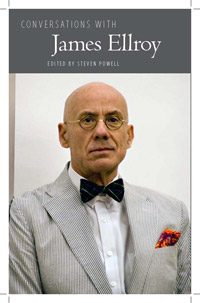 Conversations with James Ellroy, which I have edited for University of Mississippi Press’ Literary Conversations series, is released this month. The book is a collection of interviews which James Ellroy has given over the course of his literary career. I am very proud of the book, which I think will be of great interest to James Ellroy and crime fiction fans everywhere, and over the coming weeks I shall be posting on this blog some articles about the book. Conversations with James Ellroy is available to buy on Amazon.com and Amazon.co.uk. In the meantime here is the jacket cover and synopsis of the book:
“Morality in literature is largely the expositing of moral acts and their consequences, the karmic price of the perpetrators of the immoral acts, for having committed them.”
As a novelist who has spent years crafting and refining his intense and oft outrageous “Demon Dog of American Crime Fiction” persona, James Ellroy has used interviews as a means of shaping narratives outside of his novels. Conversations with James Ellroy covers a series of interviews given by Ellroy from 1984 to 2010, in which Ellroy discusses his literary contribution and his public and private image.
Born Lee Earle Ellroy in 1948, James Ellroy is one of the most critically acclaimed and controversial contemporary writers of crime and historical fiction. Ellroy’s complex narratives, which merge history and fiction, have pushed the boundaries of the crime fiction genre: American Tabloid, a revisionist look at the Kennedy era, was Time magazine’s Novel of the Year 1995, and his novels L.A. Confidential and The Black Dahlia were adapted into films. Much of Ellroy’s remarkable life story has served as the template for the personal obsessions that dominate his writing. From the brutal, unsolved murder of his mother, to his descent into alcohol and drug abuse, his sexual voyeurism, and his stints at the Los Angeles County Jail, Ellroy has lived through a series of hellish experiences that few other writers could claim.
In Conversations with James Ellroy, Ellroy talks extensively about his life, his literary influences, his persona, and his attitudes towards politics and religion. In interviews with fellow crime writers Craig McDonald, David Peace, and others, including several previously unpublished interviews, Ellroy is at turns charismatic and eloquent, combative and enigmatic.


 The Venetian Vase