Strange Bedfellows: Politicians and their Favourite Crime Novels

Houses of Parliament
A recent article in the Telegraph listed some of the books President Barack Obama is said to have read. His reading list includes several high brow titles, but I was pleased to discover the President also appears to be a fan of crime fiction. Obama has read both The Way Home (2009) by George Pelecanos and The Bayou Trilogy (2011) by Daniel Woodrell. If Obama can be considered as a fan of crime fiction then he is following in the footsteps of President Bill Clinton who named Walter Mosley as one of his favourite writers. Clinton was also photographed on Air Force One holding a copy of Dennis Lehane’s Prayers for Rain (1999), a relatively minor incident which led to a huge increase in sales of Lehane’s work. President Kennedy regarded Ian Fleming’s From Russia With Love (1957) as one of his favourite novels, and also appears to have admired Richard Condon’s The Manchurian Candidate (1959). When Frank Sinatra informed JFK his next film was an adaptation of Condon’s novel, the President replied “Great, who plays the mother?”
If any readers can think of any other politicians who love crime (fiction that is!), please share them in the comment thread.
Bond Actors at their Best
This year marks the fiftieth anniversary of the beginning of the James Bond films. There have already been several enjoyable tributes, with doubtless more to come throughout the year, as well as the release of the twenty-third Bond film Skyfall. As a self-confessed Bond addict I have compiled together a little tribute to showcase some of the best moments of the six actors who have played James Bond (in the official series). All of the videos have been uploaded by Bond fans onto YouTube and some will only partially embed, but if you click on the link it will take you straight to the site where the videos can be watched. Enjoy!
By 1962 when the first Bond film was released, the character of James Bond had already become iconic, due to the success of Ian Fleming’s novels, so it was important the producers found the right actor for the part. Sean Connery must have seemed like a risky choice as he was at that time relatively unknown. However, Connery soon dispelled any doubts with his portrayal of Bond as a fearless, ruthless and darkly charming secret agent. Connery’s success set the standard by which all other actors in the role have been judged. Bond’s introduction in the first film Dr No was vital to establishing the right tone for the character, and Connery pulls it off with aplomb. The clip below shows Connery’s first scene as Bond, playing Baccarat with the alluring Sylvia Trench:
George Lazenby’s stint as James Bond was limited to one film and has been much maligned. Replacing Connery was always going to be a difficult task and the producers decided on another unknown, but unlike Connery, Lazenby had no real acting experience and it shows. However, On Her Majesty’s Secret Service will be remembered as the film which showed Bond’s human side when after years of womanising the spy finally falls in love and marries, only for it to end in tragedy:
Roger Moore’s tenure as Bond seems to divide fans and critics alike. Personally, I’ve always liked Moore who holds the record as the longest serving Bond playing the character in seven films over twelve years. Below is a clip of one of the most inventive and thrilling scenes in the series taken from Live and Let Die. It’s not just super-villains Bond has had to deal with over the years, it’s also their pet sharks, snakes or in this case crocodiles! Just spare a thought for the stunt man who had to do this scene five times!
Timothy Dalton was perhaps the most distinguished actor to play Bond. He researched the role carefully, immersing himself in Fleming’s novels and giving a darker and grittier portrayal of the spy in his two films. Sometimes criticised for being stiff and humourless, this airplane fight scene from The Living Daylights proves the Bond films could still be tough without compromising on the ingenuity and inventiveness:
Pierce Brosnan deserves credit for rescuing the series after a six-year hiatus. He was the first actor to play Bond after the end of the Cold War and the films successfully modernised Bond’s image. In the scene below, taken from Goldeneye, Bond spars with the first female M, played brilliantly by Judi Dench:
After the disastrous Die Another Day, Daniel Craig was the first actor to play Bond in a reboot of the series. Before Craig’s debut in Casino Royale, there had been occasional attempts at continuity in several of the films, such as references to Bond’s brief marriage, which suggested that all of the actors were playing the same Bond. Casino Royale dispenses with this concept to be essentially an ‘origin story’ of how Bond earned his licence to kill double 00 status. Craig plays Bond appropriately as a young, cocky and obstreperous spy who gradually learns his craft the hard way and falls for the enigmatic Vesper Lynd along the way. This clip is from the conclusion of the card game at the titular Casino Royale:
Raymond Chandler on the Albert Anastasia Murder
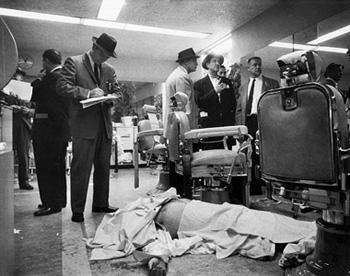
Albert Anastasia Murder
Dick Dedrick’s excellent audio documentary Private Eyes: Chandler & Marlowe ends with a recording of Raymond Chandler’s July 1958 interview with Ian Fleming. At this late stage of his life, Chandler was widowed, depressed and drunk, but consented to the interview out of his respect for Fleming who held him in equally high regard. It is a sometimes difficult interview to listen to, with Chandler slurring his words and Fleming struggling to keep him focused. However, there are several moments when he shines, such as when Fleming asks Chandler about the recent murder in New York of Albert Anastasia, Boss of the Gambino Crime Family. Anastasia was sitting in the barber chair in the barber shop of the Park Sheraton Hotel when two men rushed in and shot him to death. The motive, it is believed, was an internal power struggle and tensions with the other New York Crime Families. The case was never solved. The photo of Anastasia dead on the barber shop floor became one of the most iconic images in Mafia history.
Below is a transcription of Chandler and Fleming discussing how a Mob murder would be arranged:
Fleming: I see they had another killing last week in New York, one of these men connected with that dock union man, what was his name…
Chandler: Albert Anastasia
Fleming: Anastasia yes. How is a killing like that arranged?
Chandler: Very simply. Do you want me to describe how it’s done?
Fleming: Yes, yes.
Chandler: Well, first of all the Syndicate decides it– has to decide– he must be killed. They don’t want to kill people, it’s bad business nowadays. Then when they make the decision, they telephone to a couple of chaps, say in Minneapolis, who own hardware stores or something or other and have a respectable business front. And these chaps come along to New York, and they’re given their instructions. They are told– they are given a photograph of the man and told what’s known about him, and when they get on a plane, if they have to get on a plane…
Fleming: In Minneapolis?
Chandler: …they’re given guns. No, not in Minneapolis. After they get their instructions they’re given guns. Now these guns are not defaced in any way, but they are guns which have passed through so many hands that the present owners could never be traced. The company could say the first purchaser. So they go to where the man lives, they get an apartment across the street from him or a room, and they study him for days and days and days until they know just exactly when he goes out, when he comes home, what he does, and when they’re ready they simply walk up to him and shoot him. They have to have a crash car: Bugsy Siegel was a great man for a crash car. The crash car is in case a police car should come down the street and accidentally on purpose smashes the police car so the other fellows get away, get back to the plane, go home that’s all there is to it.
Fleming: So they drop their guns at the spot do they?
Chandler: They always drop the guns yes.
Fleming: And wear gloves?
Chandler: How many fingerprints have ever been taken off guns?
Fleming: Yes quite.
Chandler: They hold them by the butt.
Fleming: Yes, quite true. Of course they always appear to take them off in books, but I suspect that because by filing the material on the butt and scratching it well of course you make a rough surface that won’t take any prints at all.
Chandler: No, butts aren’t made that way. They’re made to be rough.
Fleming: How much would they get paid for that each?
Chandler: Ten thousand.
Fleming: Ten thousand each?
Chandler: If it’s an important man. It’s small money to the Syndicate.
Fleming: And then they go back to their jobs in hardware stores in Minneapolis.
Chandler: Yes, it’s quite impersonal. They don’t care anything about the man; they don’t care about his general life. It’s just a job to them. Of course they have to be a certain sort of people or they wouldn’t do it. I mean they’re not like us; we wouldn’t do it.
Fleming: No, it’s a difficult thing to imagine doing.
Chandler: Well, I’ve known people I’d like to shoot.
Fleming: For instance? Anybody in England?
Chandler: No, not in England.
Fleming: What did you want to shoot them for?
Chandler: I just thought they were better dead.
Sadly, Chandler died less than a year after giving this interview. It is apparently the only audio recording that exists of his voice, and although his poor health is all too obvious, I particularly like this part of the interview as showing Chandler at his best. His comments seem insightful yet playful, easily commanding the listener’s attention and ending with a piece of wickedly dry humour.
I have also found the entire interview on YouTube. It will appeal to Chandler and Fleming fans alike. Here’s the link.
Terence Young – The Man Who Would Be Bond

Sean Connery, Terence Young and actress Claudine Auger during the filming of Thunderball
Terence Young is remembered today as the director of three of the first four James Bond films: Dr No (1962), From Russia With Love (1963), and Thunderball (1965). The rest of his directing career was mixed: some genuinely good films, Wait Until Dark (1967) and Mayerling (1968), and many other films that were mediocre at best. Young himself is fascinating figure, but no biography has ever been written of him (although there is one Italian monograph which is a study of his films). However, he seems to pop up as a colourful character in the biographies of several famous figures. It was not until I read Ben Macintyre’s excellent Agent Zigzag (2007), about the extraordinary life of MI5’s wartime double agent and criminal Eddie Chapman, that I learned that Young worked with British Intelligence during the Second World War. Young was an intelligence officer attached to the Field Security Section of the Guards Armoured Division which saw heavy fighting at Normandy and Arnhem.
Young counted Eddie Chapman as a friend before the war. Young had a reputation as a sophisticated gentleman with a taste for fine wine, expensive clothes and beautiful women. Chapman, on the other hand, was involved with criminal gangs and was an expert safecracker. The two men’s paths crossed in London where the division between high society and the criminal underworld was not always distinct at the time. Macintyre describes the remarkable series of events that followed: Chapman was serving a prison sentence on the Channel Islands when it came under Nazi occupation. He was transferred to a prison in Paris when he offered his services to the Abwehr, German Intelligence. After being parachuted into England as a German spy, he immediately contacted MI5 in the hope of working for them as a double agent. Young was contacted by Intelligence agent Laurie Marshall to meet with his old friend Chapman and ‘build up his morale’. Young was glad to do this, and he also provided a character reference for Chapman saying he would make a perfect spy:
Young went on to describe the glamourous, roué world Chapman had inhabited before the war, the people he knew from ‘the film, theatrical, literary, and semi-political and diplomatic worlds’, and his popularity, ‘especially among women’. Could Chapman be trusted with intelligence work, Marshall inquired? Young was adamant: ‘One could give him the most difficult of missions knowing that he would carry it out and that he would never betray the official who sent him, but that it was highly probable that he would, incidentally, rob the official who sent him out… He would then carry out his [mission] and return to the official whom he had robbed to report.’ In short, he could be relied on to do whatever was asked of him, while being utterly untrustworthy in almost every other respect.
Young’s assessment of Chapman proved to be highly accurate. Young’s insight and experience into the real world of espionage must have surely influenced his contribution to the success of the James Bond films, just as Ian Fleming’s experiences in Naval Intelligence influenced his creation of Bond, even though the character inhabits a fantasy version of the world of a spy. Young also gave the cinematic James Bond facets of his own character. In an essay written for Her Majesty’s Secret Servant, Robert Cotton examines how Young schooled Sean Connery on how to be Bond:
When Connery arrived, far before filming began, Young saw his best opportunity to mold the actor in his own image. As Lois Maxwell related in one of Connery´s many biographies, “Terence took Sean under his wing. He took him to dinner, showed him how to walk, how to talk, even how to eat.’ Some cast members remarked that Connery was simply doing a Terence Young impression, but Young and Connery knew they were on the right track. Then, late in pre-production, when Connery was almost ready to make his debut, Young took Connery on a lunchtime trip into downtown London, to his own tailor on Saville Row. It was time for Connery to “put on the suit’ as it were. It was time for Connery to become James Bond.
By the time Connery showed up for his first days filming, Young had changed everything about him. Connery no longer talked with his hands, one of Young´s most infamous pet peeves. He still moved perfectly, but Young had coached him on WHEN to move. Connery was already far from being a hack actor when he came to the series, but Young knew how to make Connery shine, and he did. Young had taken elements of his own personality and passed them on to Connery. He had turned Connery into a gentleman, and then he turned that gentleman into James Bond.
It’s a shame that having played such a big part in the success of the Bond films that the rest of Young’s work would not be so distinguished. He directed a highly fictionalised and rather disappointing film about Eddie Chapman’s wartime adventures, Triple Cross (1967), and has the dubious distinction of directing what is generally regarded as one of the worst films of all time Inchon (1982). An epic retelling of the Korean War battle, Inchon was partly financed by Unification Church founder Sun Myung Moon and starred, in a terrible piece of miscasting, Sir Laurence Olivier as General Douglas MacArthur.
Terence Young died in 1994, and because his reputation had steadily declined with each poorly received film, it is perhaps not surprising that he is largely forgotten today. But several years ago an intriguing rumour began to circulate on the internet. In the run-up to the 2003 invasion of Iraq by Coalition forces an article written by Mark Bowden titled ‘Tales of the Tyrant’ appeared in The Atlantic. Bowden presented a rather distasteful, fawning portrayal of Saddam Hussein and briefly stated that Terence Young had edited the film The Long Days (1980), a propaganda piece about Saddam’s early life. The claim was later repeated in the play It Felt Like a Kiss (2009), and is examined in this online essay, but on Young’s imdb page, his involvement is listed ‘uncredited’ and ‘unconfirmed’. Even so, its remarkable to think that Young may have still been involved in a murky world of intrigue at that late stage of his life and career. If the rumour is true, it is a stain on Young’s reputation, especially considering that Young often appeared to be a patriot with a social conscience, having directed the anti-drugs trade film The Poppy is Also a Flower (1966), financed by the United Nations. The film may have been made before the Iran-Iraq War and the Gulf War, but the brutality of Saddam’s regime would have still been clearly evident. In the film, Saddam was played by his cousin Saddam Kamel, who was later killed on the dictator’s orders.
Regardless of this rumour, Young will be best remembered for shaping the cinematic character of one of our best loved spies.
Update: I’ve discovered new information on Young which I’ve put in a follow-up post ‘Where is Parsifal and the Continued Enigma of Terence Young’.
The Elusive Centre: Megan Abbott and The End of Everything

Abbott's novel is loosely based on her upbringing in Grosse Pointe, Michigan.
Megan Abbott’s dreamy and compelling The End of Everything explores the strivings for an elusive centre: the central place, the definite reason, the moral certainty of childhood. Abbott’s narrator, thirteen-year-old Lizzie, begins the narrative almost without an individual identity: Lizzie’s personhood is bound up in Evie, her next door neighbour and best friend, whom Lizzie has known since infancy. Until Evie’s hair darkened and Lizzie’s body began to become more womanly, they were hard to tell apart. Their knowledge of one another has become instinctual, or so Lizzie believes, until Evie’s disappearance makes her reexamine her friend and thus herself.
Before Evie disappears, Lizzie and Evie seem on the periphery of things, marginalised by the relationships around them. Lizzie’s parents are divorced and have little time for her (as does her grunting teenage brother), whereas Evie’s home is dominated by Evie’s mysterious, sexual sister, Dusty, whose close relationship with her father is the envy of both girls. The Dusty/Mr Verver relationship upsets the household dynamic, excluding Evie’s and Dusty’s mother to a cipher-like existence.
When Evie disappears, the balance shifts dramatically, and Lizzie is both disturbed and guiltily excited to shift into the centre. Evie’s kidnap heightens Lizzie’s mother’s maternal instincts, and Mr Verver craves her companionship as Dusty becomes reclusive. But just as this seems a redressing of the balance, it is also another version of a distorted world, as Lizzie’s unspoken sexual feelings for Mr Verver and the fear of Evie’s molestation, rape, torture and even murder at the hands of her captor come to the front.
Abbott’s description of Lizzie’s physical and visual impressions, float before the reader like dreams, yet these powerful evocations are part of the fabric of reassessing and becoming as made evident by Lizzie’s attempts to find words, to find the truth, in these fleeting impressions and to describe what happened to her friend:
I’m watching through the kitchen window, the coffee pot chugging.
Sometimes, at night, he’s out there.
That’s what Evie had said.
When she said it, it was just a cold-spiny feeling, a bit of nighttime spookiness. But later, it snuck back into my thoughts, and I wondered about all the boys who trailed Dusty, who swarmed her in the school corridors, who wedged notes into her locker and buzzed about her. So many of them might flit around at night […]
Mr Verver walks into the kitchen, his whole body jumping with energy. “They think it could be something, ” he says. “They don’t know, but they think it could be.”
I feel a tingle on my tongue. I feel it because I think, Doesn’t he see what this means? Isn’t this scarier, a hundred times, the idea that wherever Evie is she might be with someone who watched her, for nights on end, from the dark sweep of a backyard tree, who watched, unhurried, unbothered, puffing and breathing and watching and–
Something clicks and shutters in my head, and there it is, there it is, tumbling from my half-opened mouth:
“The car. Twice. I saw a car go by twice.”
Abbott’s power lies in her descriptions, but also in what remains elusive to the reader, the tantilizing spaces which we are compelled to fill and adjust and reassess along with her characters. Although The End of Everything is a departure from her noir settings, Abbott retains her powerful style. My only reservation is having taught middle school myself, Abbott’s perceptions may exceed the capabilities of her narrator, although the wonder, the cruelty, and the uncertain striving of that age is powerfully present.
Whose Line is it Anyway? – Film Noir Spoof
Every Christmas I like to post a crime fiction spoof to celebrate the season of good cheer. Below is a clip of Colin Mochrie and Ryan Stiles imporvising a film noir spoof on Whose Line is it Anyway?
Happy Holidays everyone! See you in the new year.
Jim Thompson, Crime Fiction, and the American West
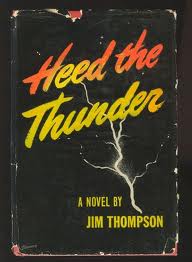 I have just finished reading Jim Thompson’s second novel Heed the Thunder (1946), a western set in early twentieth-century Nesbraska. When I first came across the book I initially thought it must have been a departure from Thompson’s celebrated hardboiled crime fiction, but it was actually published before Thompson started writing crime fiction. Like John D. MacDonald and Chester Himes, Thompson began his writing career with more respectable ‘literary’ aspirations. But like many of his contemporaries, he found his greatest acclaim in crime fiction, although in Thompson’s case much of that acclaim has been posthumous. Heed the Thunder is a loosely plotted series of episodes set around the wealthy Fargo family: much of the focus is centred on the patriarch Lincoln Fargo, a Civil War veteran who served in the Union Army but held secret Southern sympathies. The book often reads as an overly self-conscious attempt to write a ‘Great American Novel’, but it’s possible to see why Thompson would later excel in the hardboiled genre. There is a pervasive sense of secrets and conspiracies forming between families, friends and communities. The narrative also moves inexorably towards violently horrific conclusions as the repercussions are felt from immoral actions, such as a longstanding incestuous affair between first-cousins. It is the younger generation of characters who seem to meet the most macabre of fates. The older characters tend to cling on living with their sorrow. Although not everyone seems to be ill-fated, a venal and incompetent politician is steadily promoted and even manages to do something charitable. One of the most notable qualities of the novel is Thompson’s skill for eliciting pathos through his sharp ear for regional dialects. The deathbed thoughts of one leading character are particularly moving:
I know now, maybe, what the Bible means when it talks about a sparrer falling – I mean, every time there’s a death, the whole world dies a little. There ain’t no death, no deed, no o-mission or co-mission that don’t leave its mark…
“We burn off a forest, an’ all we see is the cleared land, an’ the profit. We burn the forest because we say it’s ours to burn, an’ we can do what we want with what’s ours. We burn it, an’ the birds leave, an’ the grubs come, and the grain don’t grow so good. And there’s hot winds and dust.
“We plow up the prairie because it’s ours to plow, and we dam up the cricks because they’re ours to dam. We grab everything we can while the grabbin’s good, because it’s ours an’ because some other fellow will do it if we don’t. … And, hell, there ain’t nothin that’s really ours, and we don’t know what’s in the other fellow’s mind. …
Other crime writers would excel in the western genre, such as Elmore Leonard, Robert B. Parker and Frank Gruber. But perhaps Thompson’s greatness in this field came from his experiences living a wild and eccentric life. The son of a corrupt Texas Sheriff, Thompson understood the mentality of western towns where power is concentrated in the hands of a few and the ideals of the American dream are drowned in a sea of blood and lawlessness, themes he appropriated so successfully in western-themed crime novels such as The Killer Inside Me (1952) and Pop 1280 (1964). Heed the Thunder (which was also released under the the more pulp sounding title Sins of the Fathers) ends with an intriguing author’s note:
I was about to pronounce this book the first of a trilogy when the ghost of a hawk-faced old man prodded me with an ethereal cane, “How the hell you know it will be?” he jeered, “Goddam if you ain’t a good one!”
And upon the taunt, there came another, in choked explosive tones, “Maybe I had ought to cut his ears off, seein’ he don’t plan to use ’em.”
So I will say this:
This may be the first volume of a trilogy; there may be a sequel to it – if, in the present book, I seem to have interested or amused sufficent readers to warrant such.
Sure enough the two sequels to Heed the Thunder never came. Thompson’s literary greatness lay elsewhere, in another genre.
On My Reading List

Megan Abbott
Megan Abbott’s latest novel The End of Everything was released earlier this year and has been sitting on my shelf just waiting be hungrily devoured. A new Abbott novel is a crime fiction event, and this one, set in an affluent 1980s Midwest suburb and focused on the disappearance of a young girl named Evie and the affect it has on her closest friend Lizzie, promises to be as gripping and powerful as Aboott’s previous novels Die a Little (2005) and The Song is You (2008).
This one is actually a reread but always worth a visit; Meyer Levin’s Compulsion (1956) is a epic novelisation of the infamous Leopold and Loeb murder case. A precursor to the non-fiction novel which some critics claim began with Truman Capote’s In Cold Blood (1965), Levin thrillingly explores the psychology of the young killers (here renamed Strauss and Steiner), in the process giving a fascinating insight into upper middle-class Jewish life in 1920s Chicago. The subsequent murder trial where the killers were represented by Clarence Darrow (renamed Jonathan Wilk in the novel) includes some of the most dramatic courtroom scenes in crime fiction. Highly recommended.
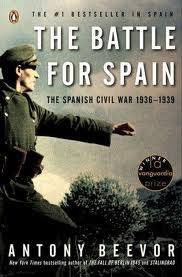 As much as I love reading crime fiction, it is in some respects my job, so I like to read other types of books as well. In order to diversify my reading I’m trying to read more history books. I’ve just checked out from the library Antony Beevor’s The Battle for Spain: The Spanish Civil War (1936-1939). This appealed to me as Beevor appears to be one of those historians who can write to a wide audience and not get too bogged down in excessive details. I know very little about the conflict other than it was a forerunner to the Second World War. I’m looking forward to this one.
Sabbatical
I have a publishing deadline for early December, so I’m taking a short break from blogging. Most of the work is completed, but there is still the checking, double checking and triple checking to be done. I’ll be blogging again in mid-December. See you then.
Beebo Brinker and Lisbeth Salander
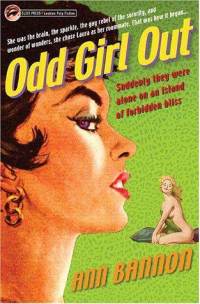
Ann Bannon's Odd Girl Out
I’ve been reading several novels in Ann Bannon’s excellent ‘Beebo Brinker Chronicles’ series, and I was struck by how much the stories reminded me of Stieg Larsson’s ‘Girl Who’ novels. On the surface the two series appear to be very different; Ann Bannon is the pseudonym of Ann Weldy who wrote five novels, Odd Girl Out (1957), I Am A Woman (1959), Women in the Shadows (1959), Journey to a Woman (1960) and Beebo Brinker (1962), which are now considered groundbreaking works of lesbian pulp fiction and form the Beebo Brinker Chronicles. Bannon’s only other novel, The Marriage (1960) is generally not considered part of the series, although it does feature several series characters. The series centres around the characters Beebo, Laura, Beth and Jack as they come to terms with their sexuality in late 1950s and early 1960s America. Beebo is sometimes considered the archetype of the stereotypical butch lesbian, but this is a somewhat unfair assessment as Bannon is highly skilled at subtle and plausible characterisations. Beebo does not even appear in the first novel, Odd Girl Out, which is set in a fictional midwestern university where Laura and Beth first meet and begin a friendship which develops into a romance. Unlike others novels belonging to the lesbian pulp fiction genre, such as Theodora Keogh’s The Other Girl (1962), the Beebo Brinker series contains little in the way of actual crimes. Instead, Bannon explores the emotional violence that entails from relationships complicated by feelings of misogyny and sexual jealously. Indeed, the sexuality of the characters is the crime to their society. Occasionally in the novels, the turbulent emotions of the characters does manifest itself in physical and sexual violence, such as rape. But for the most part, the Beebo Brinker chronicles have a literary feel which some critics would argue transcends crime fiction.

Noomi Rapace as Lisbeth Salander
So how does this connect to Stieg Larsson’s Girl Who novels? After all, Larsson’s series fully embraces all manner of crime fiction elements such as locked room mysteries, private detectives, corporate intrigue, espionage, international conspiracies and serial killers to name just a few. Well, in the character of Lisbeth Salander, Larsson created a protagonist who was socially ostracised in a manner not unlike Beebo Brinker and Bannon’s other characters. Lesbianism no longer carries the stigma it once did in 1950s America and elsewhere, but Salander’s bisexuality is by no means universally accepted nor is her Goth identity. Indeed, sinister bureaucratic figures often consider Salander criminal or mentally deficient partly because of her tattoos and body piercings. Another connection between the two series is that they destroy the facade of idealised societies by taking the perspective of characters who are not accepted by that society. The Beebo Brinker Chronicles are set in an America that had become the most prosperous and powerful nation in the world following the Allied victory in the Second World War. But her characters do not find happiness in these economic boom times, as they are either marginalised or have to live with deceit to protect their sexuality. By the time the last novel in the series was published in 1962, America was on the cusp of massive social change and painful upheaval with race riots and anti-Vietnam war protests in what would be a fractious period for the nation. Larsson, and fellow Swedish crime writers who came before him such as Henning Mankell, have thrillingly dramatised Sweden’s social and political ills. This has been culturally significant, as many readers in the UK and elsewhere had somewhat naively regarded Sweden as an ideal European state, almost entirely devoid of poverty, crime and political corruption. This is not to say that either Sweden or the United States are wholly dysfunctional societies masquerading as utopias, far from it. But it is noteworthy that both the Beebo Brinker Chronicles and the Girl Who novels created a certain revisionism as to how we have come to view these societies.


 The Venetian Vase