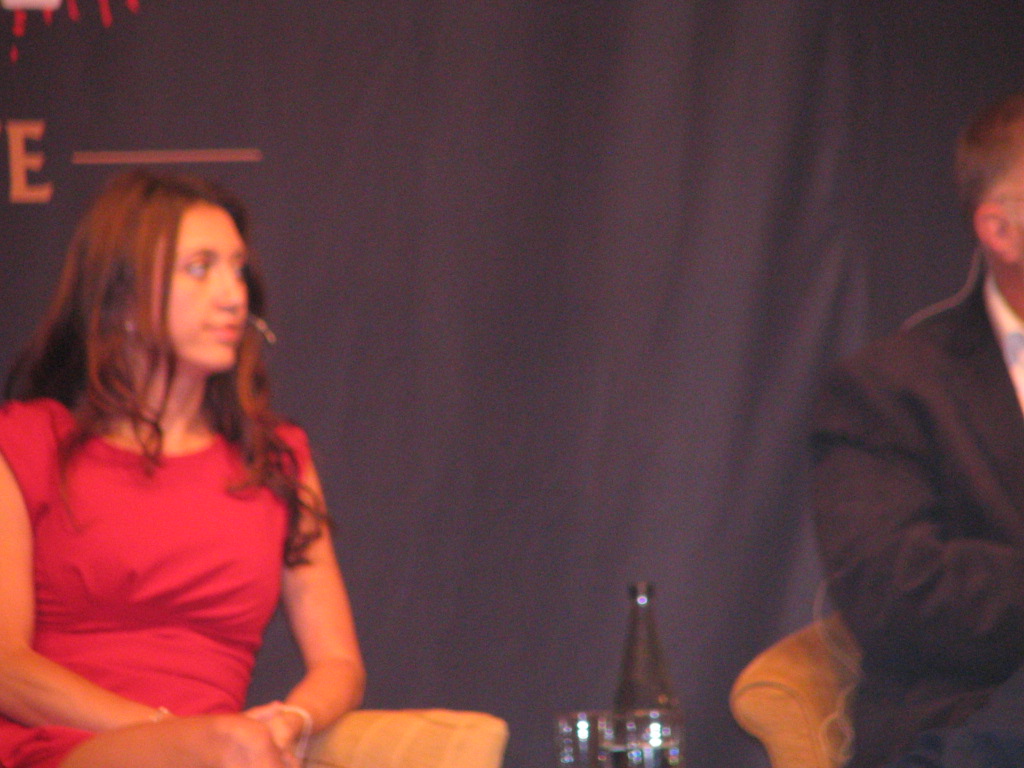
Camilla Lackberg and Deon Meyer
As the author of Death in a Cold Climate: A Guide to Scandinavian Crime Fiction, Barry Forshaw was the perfect moderator for a panel on translation which featured two of the most successful Swedish crime writers working today, Camilla Läckberg and Liza Marklund, and also the South African crime writer Deon Meyer and Spain’s Antonio Hill. Actually, very little of the conversation focused on translation. Läckberg and Marklund both stated they were very happy with the job translators and editors do with their work. Antonio Hill said he has barely been consulted with the translation into English of his debut novel El Verano de los Juguetes Muertos, aka The Summer of Dead Toys. Meyer’s work has been translated into twenty languages, but as he writes his crime novels in Afrikaans, he lamented that some things are just impossible to translate as they are specific to the language. However, he stated that Britain’s long held fascination with South Africa mitigated this problem to an extent, where more social explanation was needed when he transitioned to other markets. Marklund discussed how different social attitudes can be the most difficult to convey through translation, but when done successfully, the results are personally satisfying. In socially conservative Italy, her liberated Annika Bengtzon character is very popular with Italian women, who are fascinated by the idea of a man staying at home to take care of the children. Both Läckberg and Marklund noted that since their novels are not published in chronological order, it leads to contention with German publishers who prefer a more straightforward rendering, a comment which led to a rather tetchy response from a German member of the audience.
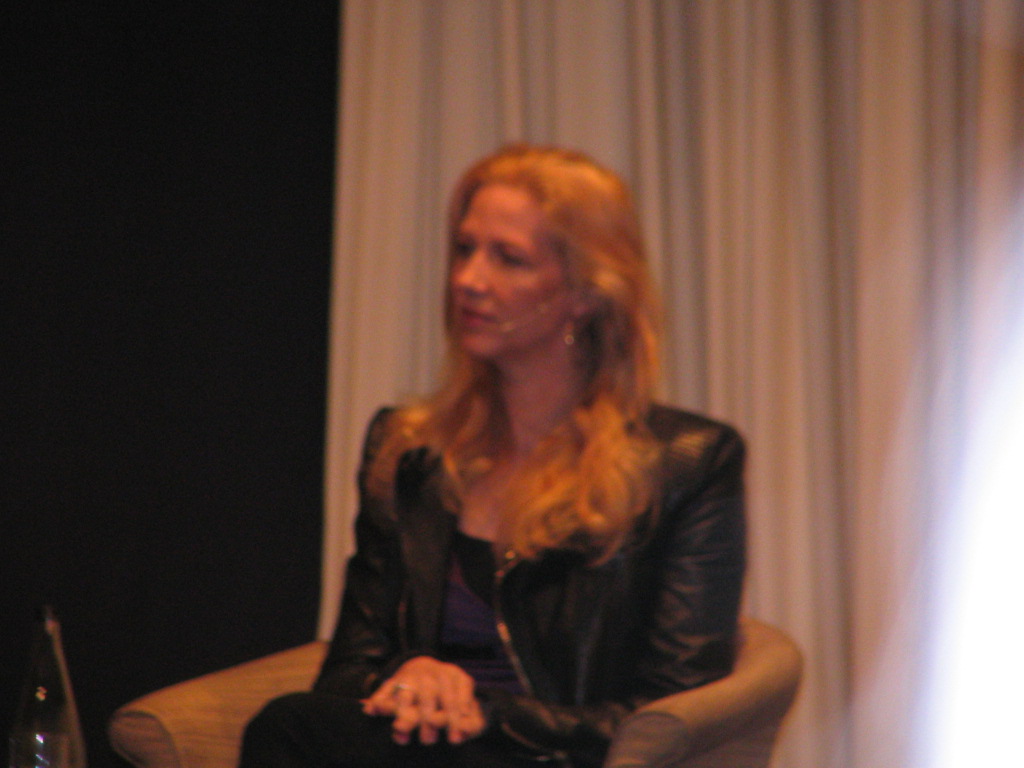
Liza Marklund
The conversation broadened into other crime fiction related topics. Marklund argued that the best crime fiction is produced in Scandinavia, the United Kingdom and the United States because crime writing can only thrive in established democracies. People want to read about ‘the black spots on the white canvas’. She stated that on a visit to Kenya, people were baffled that she wrote crime fiction. In a country with quite a few problems, it is just not part of their culture. Hill and Meyer commented that crime fiction only emerged in their countries after the end of the Franco regime and apartheid respectively. The creative expression and dissident thinking necessary for writing crime novels is not possible in dictatorships. Forshaw commented that the success of writers like Läckberg and Marklund had robbed us of the belief that Scandinavia was a social democratic paradise. Marklund said that where she was born in northern Sweden people can be quite insular in their beliefs. She joked that Scandinavians believed that the problem with other nationalities is that ‘there not Scandinavians’. Hill said there were still lingering problems leftover from the Franco regime, and the ongoing Eurozone crisis is particularly harsh in Spain. Forshaw tried to conjure a dystopic reverse scenario; in light of recent scandals, has freedom of the press gone too far in Britain? Has it spawned a whole new level of corruption? Meyer responded that this overlooked the fact that Britain still produced some of the best journalism in the world. Läckberg said that sleazy tabloid journalism does not exist to the same extent in Sweden. She herself had been the subject of some unwanted media scrutiny in her home country, but the tabloids were nowhere near as intrusive as their British counterparts. The German woman, who I mentioned earlier, made a eloquent comment during the Q and A session. She said she lives in the US where the social problems should not be underestimated, and in Germany where democracy is still a relatively recent introduction, crime fiction had become a phenomenon. She finished by saying we needed to look at each societies fascination, or lack thereof, with crime fiction on a case by case basis. Meyer had the last word: poverty and corruption exists everywhere, only in different areas of life and society from one country to the next.
Judging from this insightful comment, and the fascinating topics all four writers discussed, it seems that crime writers will not be running out of material any time soon.

America’s Got Talent: Four US Crime Writers
Friday at Theakston’s Old Peculiar Crime Festival, John Connolly artfully guided a discussion titled ‘America’s Got Talent’ with four writers outwardly tied by nationality; however, as was discovered in the discussion, they share more than a home country as similar influences, methods and interests in the genre emerged.
Megan Abbott’s very early yet enduring love of film noir (she wanted to marry James Cagney as a child) was complimented by stories from Gillian Flynn, whose film professor father took her to watch Alien and Bonnie and Clyde at the tender age of seven. Chris Mooney spoke of his ‘cool grandmother’ who allowed him to watch the Creature Double Features and The Shining, while Ryan David Jahn, who worked as a screen writer after leaving the Army, explained that he wrote visually, preferring to show a character through his actions rather than through internal monologue or dialogue.
As I usually attend academic conferences, one of the most refreshing moments was when the authors were candid about their struggles. Gillian Flynn called herself a ‘slow writer’ who doesn’t know where the book’s going when she begins and who spend a lot of time editing and redrafting. Megan Abbott said that she did not have a ‘logical mind’ and that puzzles, or the traditional whodunnit form, did not suit her. Ryan David Jahn admitted to missing deadlines and slacking off eight months of the year, only to be driven to finishing a book in four months, sometimes writing 12,000 words a day. Chris Mooney, who came across as a great guy to have a drink with as he always had a funny line, explained that he used to be a perfectionist with his work, but now he forces himself to give a rough edit to his publisher and do the editing afterward.

Megan Abbott
I was surprised by a few things. One was the importance Megan Abbott placed on true crime, and how the idea of what people do when they’re backed into a corner fascinates her. Secondly was how difficult the editing process is for Gillian Flynn: she spoke of writing the story then having to write backwards, as her final product led to different emphases being needed in the body of the work. Her complexity came off as a laborious layering of ideas. Ryan David Jahn talked of his novel The Dispatcher (which he’s currently writing the screenplay for), and its likeness to Jim Thompson’s The Getaway, and Chris Mooney explained where he got the basis for Sacred Ash, a concept in his novels that has to do with the storing of cremated ashes. Apparently, he based it on an actual company, Holy Smoke, which makes ammunition out of people’s ashes, so that, as Chris noted, loved ones can fire their dearly departed into a Thanksgiving turkey.
Only in America… the country from which these four talented and compelling writers hail.
Dare Me: Megan Abbott’s Indirect Challenge?
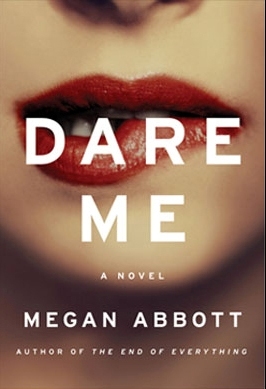 I read Megan Abbott’s new novel Dare Me with considerable apprehension. First, it’s about cheerleaders, and secondly, unlike her previous novels it’s set in the unromantic, technological present world of Facebook, texting and tweeting. To me, that seemed a vacuous combination.
Abbott, however, does not give us dumb cheerleaders, and Dare Me owes a debt to other examinations of the dark side of High School such as Heathers. The story opens with the cheerleading squad anticipating the arrival of their new coach. Beth, the captain of the squad, expects to rule over her in the same way she controlled the last coach. But this new coach is hardly a push-over, and her training regimen is both modern (smoothies and yoga) and incredibly tough. Addy, Beth’s best friend and the protagonist of the story, is drawn to the new coach, whilst Beth schemes to bring her down.
Yet what Abbott does so thrillingly in The End of Everything, namely believably maintain her protagonist’s sometimes-wonder-sometimes-surprise-sometimes-facination with the situation wherein she finds herself, seems forced in Dare Me. This flaw led to a lack of sympathy for Addy, who although more naive than Beth, seems complicitly involved in a hard-boiled world. Strangely, it is the mostly absent, almost-a-cipher, work-a-holic husband of the coach that I felt closest to. Like Nick Papadakis in James M.Cain’s The Postman Always Rings Twice, he is the hardworking man who has done little wrong besides make the mistake of marrying a woman who is selfish and self-obsessed. When Coach embarks on an affair with an Army recruiter, she tries to explain her relationship to her ingenue Addy, who has earlier with Beth witnessed them in flagrante. But Coach’s explaination feels as hollow and self-obsessed as the cheerleaders she coaches:
People will always try to scare you into things. Scare you away from things. Scare you into wanting things you can’t help wanting. You can’t be afraid.
Just as frustrating was the almost pure evilness of Beth, Addy’s best friend and the captain of the team. Perhaps this is because I was an athlete: I played elementary, middle, high school and even university sports, but I never heard a woman talk like Beth nor scheme like Beth. Aside from being a prime manipulator, Beth talks to her squad like the expletive-laden Drill Instructor Gunnery Sergeant Hartman from Full Metal Jacket:
Let’s get started, kitties, Beth says. The Celts wait for no sad-ass chicken hearts […]
Whip your heads, she says, and we do.
Make your clasps sharp, she says and we do.
Make your faces like you’re wired for pleasure, she says and we gleam ecstatic.
Give ’em the best blow-job smiles you got.
And
Hella bitches, she bellows, rocking her feet on the bench so that is shudders. Our scout, I can feel her out there, waiting. And, bitches, she is so ready to be f****d.
All this to say that I found the social vision too bleak and too unbelievable. In comparison, the TV show The Wire, whose troubling yet superbly executed season 4 confronts the harsh realities of inner-city Baltimore’s school system, still retains amidst its bleakness the hope of compassion, of justice, even of morality, that Dare Me lacks. Dare Me presents a dystopic society, wherein Coach corrupts her charges with wine and boys whilst hypocritically claiming the upper moral hand to their own fumbling high school experiments with the same. Even deaths or near-deaths, which James M. Cain used as a kind of reckoning, mean very little in this confused world, and relationships, forged out of feelings of possession, self-hatred or selfish desires are difficult to find sympathy with.
Abbott’s impressive back catalogue, her skill and her vision all ‘dared me’ not to like this book. But I will, in this one instance, prove her wrong.
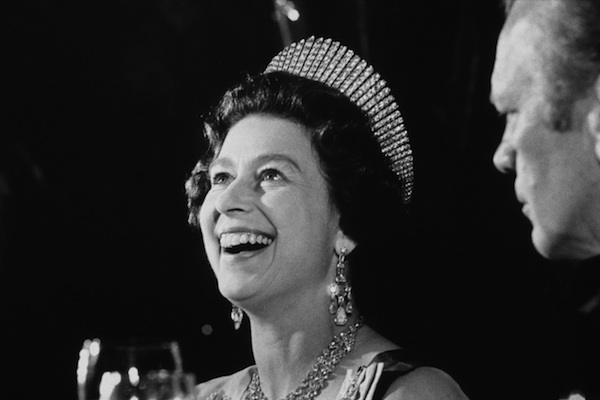 As it is Jubilee year, I thought I might share with you a charming anecdote by the American comedian Dan Rowan about his meeting with Queen Elizabeth II in 1972. I only discovered who Dan Rowan was when I was doing some research on the American crime writer John D. MacDonald and found that the two men were friends and a book of their correspondence, A Friendship: The Letters of Dan Rowan and John D. MacDonald 1967-1974, was published in 1986. I acquired a copy, and it quickly became one of my favourite books. I’ve blogged about it before here and here. Dan Rowan was a nightclub comedian who with his friend and professional partner, Dick Martin, hit the big time with the success of their television sketch show Rowan and Martin’s Laugh-In. At the advice of mutual friend Virginia Caldwell (wife of writer Erskine Caldwell) Rowan and MacDonald became pen pals, despite having never met before. The two men quickly become close friends, and their letters are thrilling, funny and moving to read. In some ways their friendship is unequal, with MacDonald being the more senior figure, and Rowan is somewhat deferential to the writer whose Travis McGee novels he had admired for years. They discuss many subjects, but the bulk of the correspondence concerns the pressures Rowan experiences of being involved at every level in a hugely successful television show. At the height of their fame in 1972, Rowan and Dick Martin were invited to host the Royal Gala Variety Performance. After the show, when Rowan met the Queen and Prince Philip he was surprised at how much they seemed to know about him.
Now there was pandemonium backstage as we were all lined up according to someone’s sense of importance. Well, not all, since the acrobats and several others were on the back line craning necks, to be introduced to ER II. Until then I was not nervous but all of a sudden noticed a certain clamminess in the palms. Dick and I were first in line and he was standing on the wrong side of me so that when Sir Lew Grade, who had arranged the entire affair, came along just ahead of H.M. he mistakenly introduced Dick as “Dan Martin” and I am astounded to report that H.M. smiled at Dick, looked at me as she took my hand and said to Sir Lew, “No, this is Dan. That’s Dick Martin.” She held my hand for a time, released it and instead of moving on as I expected, stopped and stared at me for a moment and then said, “And you have come all this way to do this for Us?” “A pleasure, Ma’am,” I gallantly replied. “Do you do this sort of thing often?” “No, Ma’am.” She waited. “We are usually too busy.” I waited. “All this way,” she murmured. “It certainly was very kind of you.” She hesitated and then moved down the line and shook hands with others, stopping again further down when she spoke to Richard Attenborough. A fine actor. He had made a cameo appearance with the Comedians.
Next was Prince Philip who also held my hand a long time, and then clapped his other hand over it and said, “What is this hideous nonsense I hear your show is going off the air?” I was again very surprised and stumbled in answering, “Not at all, Your Highness. We start again this year for the sixth season.” He dropped my hand and said, “Jolly good. That show keeps me home.” And from all I heard rumored around London, the Queen would be glad of anything which kept this playboy home. Well, there’s more but it just occurred to me that you’re both commoners and couldn’t understand it. Ho hum, must buzz off now and polish my tiara. More later if you’re good.
Dan
This story seems to capture everything that still fascinates us about monarchy forty years later. The Queen is disarming, Prince Philip unguarded in his remarks, and Dan Rowan’s fascinated but irreverent tone seems to be just right. MacDonald wrote back:
You know, that was one fine letter too about the Queen and all. […] I want to hear more about the dandy little Queen. When are you coming to tell us. We wait impatiently here (we commoners). I hope you haven’t been such a fool as to wash your hand.
Three months after the Gala Performance, Rowan and Martin were a guest of President Nixon at his La Casa Pacifica home ‘the Western White House’ in San Clemente. Nixon had guest starred on Laugh-In during the 1968 presidential campaign. Nixon must have held the two comedians in high regard as they performed a sketch for him as part of his private birthday celebrations in 1973. In fact, it was only when I began researching this post that I discovered that the Royal Gala Variety Performance that Rowan writes about is different from the annual Royal Variety Performance. The distinction is that in a Gala performance the artists are picked at the specific invitation of the Monarch, thus explaining why the Queen and Prince Philip knew so much about Rowan. Sadly, Dan Rowan’s career went into decline after Laugh-In ended in 1973, but it is remarkable to discover that while the show was still on the air, just how many fans in high places Rowan had.
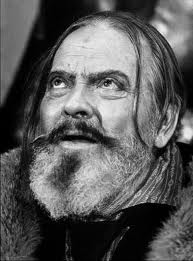
Orson Welles as Klingsor in Where is Parsifal?
At the beginning of the year I wrote a piece for this blog titled Terence Young: The Man Who Would be Bond. Young was a British film director best known for directing three of the first four James Bond films. He served his country with distinction in the Second World War and later went on to direct some impressive films. After the 1960s his career declined, and he had the dubious distinction of directing what is generally regarded as one of the worst films ever made – Inchon (1981). This critically panned film portrayed the titular Korean War battle and was financed by Unification Church founder Sun Myong Moon. Odd, dubious sounding projects marred Young in his last years. He is rumoured to have directed or edited a propaganda film for Saddam Hussein titled The Long Days (1980). The rumour has never been proven, but I explored the possibility of it being true in the original post.
Recently, quite by chance, I came across Young’s name again. I was on the British Film Institute’s website reading about their list of 75 most wanted lost films. The most recent film on the list is Where is Parsifal? (1984). This bizarre film was screened at the Cannes film festival and then seems to have disappeared. It features a stellar cast including Orson Welles, Tony Curtis, Peter Lawford and Donald Pleasance but was savaged by the few critics who saw it. From what I can discover of the plot, it appears that Tony Curtis plays Parsifal, an eccentric hyponchrondriac who has invented a laser skywriter and is trying to sell the patent. A cast of oddballs descends on Parsifal’s castle, and a series of frenetic comic episodes ensue. The BFI has scanned an original programme of the film screening which lists the production team, and when I saw it one named jumped out at me. The executive producer of Where is Parsifal? was one Terence Young. There is no mention of the film on Young’s imdb page, but the BFI site indicates the film was produced by Young and Slenderline productions, who only appear to have one credit, so I assume it was Young’s own shortlived production company. Intriguingly, one of the cast members of Where is Parsifal? was the wonderfully intense Polish character actor Vladek Sheybal. Sheybal appeared in many spy films including, most memorably, From Russia With Love (1963) directed by Young himself. In an article about Sheybal, David Del Valle claims the producers of Where is Parsifal? lied to the then morbidly obese and dying Orson Welles about his role in the film:
It was the second feature with Sheybal and Orson Welles, who was, by then, huge and still trying to raise money to direct again. Welles had taken the role because the (lying) producers had promised to back his planned version of King Lear.
It’s sad to think that Welles was exploited in the making of this film and Young may have been complicit in it. The BFI webpage on Where is Parsifal? appears to be down right now so I can’t link to it, but needless to say if you happen to know about a copy of the film the BFI would like you to get in touch.
UPDATE: A copy of the film has now been found! Read more here.
Black Dahlia Avenger II
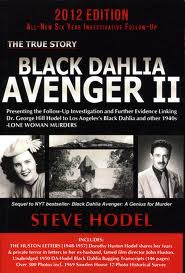
Black Dahlia Avenger II
I have just finished reading Steve Hodel’s Black Dahlia Avenger II. For those of you unfamiliar with Hodel’s research and writing on the Black Dahlia case, let me give you a little background. Steve Hodel is a retired LAPD Homicide Detective. Hodel’s father, Dr George Hill Hodel, died in 1999 at the age of 91, and Steve Hodel subsequently found two photographs amongst his father’s possession which he believed at the time to be of Elizabeth Short, aka the Black Dahlia, the victim of the most brutal and notorious unsolved murder in Los Angeles history. Hodel started an investigation which examined the potential connections between his father and Elizabeth Short. Ultimately, he came to the conclusion that his father murdered Elizabeth Short after being inspired by the Surrealist art work of Man Ray. Hodel puts his thesis forward convincingly, and thrillingly, in the original Black Dahlia Avenger (2003). I first came across the Black Dahlia case after reading James Ellroy’s celebrated novel The Black Dahlia (1987). I would heartily recommend Hodel’s book as compelling in its vivid portrayal of LA and the LAPD in the 1940s and 50s. Hodel maps out connections between the Surrealist art movement, Hollywood, organised crime and the LAPD. His research has become influential, inspiring more books on the topic, such as the excellent Exquisite Corpse: Surrealism and the Black Dahlia Murder by Mark Nelson and Sarah Hudson Bayliss. In Black Dahlia Avenger II, Hodel presents a follow-up to his original investigation. It is not as groundbreaking as the original, but it is full of interesting research and a must-have for anyone who is fascinated by the Black Dahlia case.
Lunchtime Classics
Readers in the Merseyside area might be interested in this. I’m giving a talk on James Ellroy’s L.A. Confidential and a reading from the novel at Waterstones, Liverpool One, in July as part of their Lunchtime Classics series. I’ve posted the details below, including other talks in the same series:
Tuesday 19th June, 12pm: Dr Angie Macmillan (The Reader Organisation, editor of the A Little Aloud, anthologies) on Tove Jansson’s ‘The Invisible Child’.
Tuesday 10th July, 12pm: Andy Sawyer (Director of MA in Science Fiction Studies at University of Liverpool, Science Fiction Foundation Collection librarian) on John Wyndham’s The Day of the Triffids.
Wednesday 18th July, 12pm: Steven Powell (Ph.D researcher, University of Liverpool, editor of Conversations with James Ellroy) on James Ellroy’s L.A. Confidential.
All events will be held at Waterstones, Liverpool One, 12 College Lane, Liverpool, L1 3DL.
All welcome!
Killer on the Road
 I’ve written a piece on James Ellroy’s overlooked novel Killer on the Road for the blog LaeLand. The editor of LaeLand, Lae Monie, has also kindly published an author spotlight piece on me. You can read it here.
On a different subject, fellow VV contributor Chris Routledge has republished Simon Nash’s Dead of a Counterplot (1962). Nash was the pseudonym of Raymond Chapman, and Dead of a Counterplot was the first of five novels featuring academic and amateur detective Adam Ludlow. I read Dead of a Counterplot this weekend and found it to be a thoroughly entertaining combination of mystery and good humour. I can’t wait to read the next four in the series. You can find out more details of this project on Chris’ blog.
What Do Crime Fiction Fans Do on Vacation/Holiday?
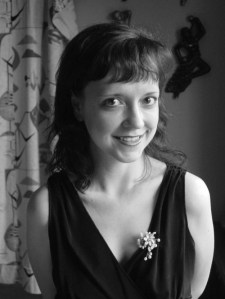
I like this photo of Megan Abbott looking retro
It was my husband that brought me back to crime fiction after childhood dabblings in Nancy Drew and Sherlock Holmes, and our mutual interest has spurred some unusual holiday choices. When his research took us to the US in 2009 to meet James Ellroy in LA, we included a day of visiting famous murder scenes (my father’s SAT NAV and Ellroy’s My Dark Places came in handy here). But this year, in the spirit of austerity, our ‘staycation’ will also involve crime fiction. Most notably, we’re on our way to Theakston’s Old Peculier Crime Festival in Harrogate from July 19-22nd. We’ve booked tickets to see my favourite Crime Fiction author (and fellow former suburban Detroiter) Megan Abbott, whose novel Die a Little will be part of the reading list on my Women in Crime Fiction course next year. If you can’t make it to the festival, but are looking for a great summer read, Abbott’s intense, almost poetic prose can’t be beat. Here are some reviews I’ve done on her novels: Die a Little, The End of Everything and The Song is You. Although the courses for 2012-2013 Continuing Education at the University of Liverpool aren’t listed yet, you can keep an eye on what’s coming through this link.
Cross-posted from The Prevailing Westerlies.
Crime Fiction: A Testimony
I recently came across a piece by J. Kingston Pierce for the Kirkus Reviews in which he describes how his interest in crime fiction began in his teenage years and grew to become the focus of his writing career. It’s an excellent piece, here’s the link, and it made me wonder about my own discovery of the genre.
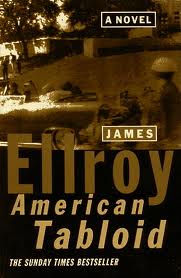
This cover of American Tabloid caught my attention in a Bournemouth bookshop, if it hadn’t my life might have been very different
At school I struggled with maths and sciences. I enjoyed subjects such as history, religious education and sociology, where ideas could be debated and nuance and conflict shown. No subject combined all of the ‘big ideas’ of life more thrillingly than English Literature. But, as in most English literature curriculums, the focus of my high school literature course was almost exclusively on authors in the literary canon. Genre is, or at least was, a dirty word. So I had little concept of modern popular fiction until I started reading my father’s collection which included Ian Fleming’s James Bond novels, Clive Cussler’s Dirk Pitt adventure series and Bernard Cromwell’s Sharpe novels set during the Napoleonic Wars. These novels liberated my sense of reading. For the first time I began to experience the excitement and danger of the narrative as though I were a character in the story. I learned that great stories could be told through action, rather than just thought and dialogue, and still possess the potential for leaving a profound emotional impact on the reader. But I was soon to read a novel which kickstarted my fascination with the one genre that brought together my favourite character-types of genre fiction: spies, adventurers and detectives.
At some point in my mid-teens I was holidaying with my parents in Bournemouth in South West England. In a bookshop I noticed a book on the shelves and recognised the front cover as being an artist’s impression of the Mary Moorman photograph depicting President Kennedy’s assassination. The book was titled American Tabloid and was written by James Ellroy, who I knew very little about. A novel about the Kennedy assassination seemed interesting, so I bought it and started reading straight away. I was immediately hooked. The portrayal of intrigue and corruption in the Kennedy era was riveting. Ellroy told the story from the perspective of protagonists on the very fringes of society: Mob hitmen, rogue intelligence agents, Cuban exiles. The men who, in his fictional version of events, eventually conspire to kill Kennedy. It was from reading this novel that my obsession with and knowledge of crime fiction began to develop. Reading the novel felt like being plunged into a secret world where different rules apply. To understand these rules I needed to go back and read earlier crime novels. After reading all of Ellroy’s novels, short stories and articles, I read Raymond Chandler and Dashiell Hammett to trace the development of the hard-boiled private detective, and how these stories were a reaction to the quaint style of the predominantly British Golden Age of Detective Fiction. I came to appreciate how Ed McBain discarded the private eye and developed the police procedural sub-genre with his 87th Precinct series. I was floored by the works of Elmore Leonard and George V. Higgins, and how they moved the genre away from mystery plotlines towards dialogue-driven storytelling with an emphasis on humour and sudden, unpredictable outbreaks of violence. I began reading contemporary Scandinavian crime fiction and British espionage thrillers.
That being said, I maintained my interest in canonical literature and studied for an MA in Victorian Literature. However, upon completion of my MA, I returned again to the writer who had first introduced me to the world of crime fiction, James Ellroy. So I’m now in my final year of PhD studying the life and work of James Ellroy. I’ve edited a book about Ellroy, details here, and have edited an anthology about American crime writers released later this year. My obsession with crime fiction has gradually transformed into my profession, and I can’t think of anything else I’d rather do.
If anyone else remembers fondly how they first discovered crime fiction, please share your story in the comment thread.


