A friend recently tipped me off to a series of videos posted on YouTube under the title Marble Hornets. Marble Hornets is a form of internet vérité horror similar in style and perhaps inspired by the Louise Paxton videos. The plot is not easy to explain but here goes: our main protagonist is Jay who begins this story somewhere in the middle of events explaining to the viewer how he volunteered on a student film, titled ‘Marble Hornets’, directed by his friend Alex Kralie, and how Alex began to behave very oddly during the production– abruptly abandoning the project and disappearing off the scene. Jay slowly goes through the footage of the film, trying to piece together what was happening to Alex, and by extension he begins to experience the same frightening journey himself. What follows is a gripping and suspenseful examination of the supernatural, the metaphysical and of human paranoia, and by telling the story through short episodic YouTube videos, Marble Hornets is part of a new form of internet horror genre. Here is the link to Marble Hornets Youtube page where you can view all of the videos released thus far.

Marble Hornets is not quite as good as the Louise Paxton hoax, it is a tad too pretentious for a start. The Louise Paxton videos benefitted from a certain simplicity in the storyline and a stunning central performance from Zoe Richards. But Marble Hornets is a sprawling ambitious horror saga (with more videos still to come), lovingly made with real creativity and imagination. To appreciate Marble Hornets to its fullest extent I would recommend watching two or three videos at a time over the course of several days. Once you have familiarised yourself with the story, these links might prove helpful: a wiki page with lots of information and theories on the story, and the YouTube page of the mysterious Totheark.
Absurdism in the Works of Joseph Wambaugh

Joseph Wambaugh
James Ellroy once described police officer turned novelist Joseph Wambaugh as ‘a right-wing absurdist and how many right-wing absurdists have you run into?’ Wambaugh’s novels may not be as overtly absurd (or as critically acclaimed) as the work of Paul Auster or James Sallis, but his stories certainly contain many bizarre moments. Wambaugh was in the Marine Corps from 1954 to 1957 and joined the LAPD in 1960, so from personal experience he learned how rigidly structured, discipline-driven state institutions work. Wambaugh had ten years experience in the LAPD when his debut novel The New Centurions (1970) was released. The novel charts the first five years in the careers of three very different policemen and contains faint elements of what would later make Wambaugh’s work so controversial and gripping, such as the portrayal of police work being encumbered by the suspicion that judges, lawyers, social workers and citizen activists had of the police. While some would view suspicion as vital for maintaining police accountability, in The New Centurions it is portrayed merely as farcical. But Wambaugh is not wholly uncritical of the LAPD: the novel aroused controversy when LAPD Police Chief Ed Davis tried to get alterations made to the manuscript as it detailed the ‘Policeman’s Discount’, wherein police officers could get free meals, cigarettes and liquor at local stops throughout the city. Both Wambaugh and the publishers refused to back down and the manuscript went unchanged. Perhaps this was the beginning of the end of Wambaugh’s police career, as he would resign from the LAPD four years later on account that his literary celebrity was interfering with his police work. With his resignation, however, his portrayal of police work became increasingly cynical. Whereas The New Centurions displayed a certain degree of police idealism that gradually declined as individuals became hardened over the years, in Wambaugh’s most famous novel The Choirboys (1975) all idealism seems to have disappeared from the outset and policemen are more concerned with pursuing hedonistic pleasures than upholding the law. Gradually Wambaugh blurred the line between the police station being symbolic of a disciplined state institution and the society it is meant to oversee, which had suffered a complete collapse of laws and values. But if critics thought they would be able to pin down Wambaugh merely as a police or crime writer, he would continue to defy them. In the late 1980’s Wambaugh moved from LA to San Diego, and his novel settings also shifted locations. From that point Wambaugh’s police did not have to contend with the hellish urban problems of LA but with their own boredom in the suburban bliss of San Diego and uber-rich Palm Springs. Later works moved away from black comedy to more outre farce, and the main text was often preceded by quirky character synopses, such as this one from The Secrets of Harry Bright (1985):
SGT. SIDNEY “BLACK SID” BLACKPOOL – an L.A.P.D. homicide detective with a staggering Johnny Walker habit. Involved in a dead-end murder investigation that strikes closer to home than he can bear.
Aside from the abrupt changes in writing style, Wambaugh has also mastered seamless transitions between fiction and factual work and back again. Inspired by Truman Capote’s In Cold Blood (1965), Wambaugh became if not the most distinguished practitioner of the non-fiction novel then certainly the most prolific and diverse. Wambaugh knew Capote personally, and In Cold Blood was a significant influence on Wambaugh’s first non-fiction work The Onion Field (1973), an account of the kidnapping and murder of LAPD officer Ian James Campbell by two criminals. The Onion Field plays to Wambaugh’s greatest strengths as a writer: it is heart-poundingly tense when fellow policeman Karl Hettinger is escaping from the two killers who have just murdered his partner, and it is also scathingly critical of the absurdities of the legal system which prolonged the subsequent trial for several years. In the true crime genre, controversy is never far behind, and Wambaugh’s career is no exception. Wambaugh’s Echoes in the Darkness (1987) deals with the murder of Susan Reinert and her two children and the subsequent trial and conviction for the crimes of Jay C. Smith who was Principal of Upper Merion Area High School in Pennsylvania where Ms. Reinert worked as an English teacher. Wambaugh allegedly paid police investigators on the case $50,000 on the condition that Smith be arrested. Without an arrest and a conviction in the case they are portraying, true crime authors are often denied a contract by publishers and Wambaugh later admitted, ‘I didn’t think the book would work until something happened to Smith’ (Capote was faced with a similar problem waiting for the two killers to be executed when he was writing In Cold Blood). Smith was found guilty and sentenced to death. After spending six years on Death Row, his conviction was overturned by the Pennsylvania Supreme Court for prosecutorial misconduct. The controversy surrounding Echoes in the Darkness is a murky affair from which Wambaugh emerges with little credit.
Wambaugh had previously handled another true crime case with sound judgement. In the late 1970’s Wambaugh was contacted by convicted killer Jeffrey MacDonald. MacDonald was a former Army medical doctor convicted of murdering his pregnant wife and two daughters. MacDonald protested his innocence (and still does to this day) and wanted Wambaugh to write his story. Wambaugh declined MacDonald’s offer and wrote back to him:
You should understand that I would not think of writing your story. It would be my story. Just as The Onion Field was my story and In Cold Blood is Capote’s story.
True crime authors have their own concept of narrative which may not always conform to how things actually happened or how the subjects of the books see things. MacDonald was almost certainly not innocent as his defence was flimsy (although some commentators have their doubts that he’s the killer), and Wambaugh didn’t want to be put in a position of defending him in print. This refusal proved especially prophetic as the writer Joe McGuinness, who eventually agreed to write MacDonald’s story, depicted MacDonald unfavourably as a lurid and pitiful psychopath in the bestselling true crime book Fatal Vision (1984). Subsequently, when MacDonald sued McGuinness, it was found that the author had feigned deep sympathy with the convicted killer during research for the book, even writing letters saying his conviction was unjust and condoning his adultery.
When Wambaugh returned to fiction with his Hollywood Station series of novels, it might have seemed at first like he was looking to avoid controversy, but he used the novel format to once again to defend his conservative views on law and order, as the series is highly critical of restrictions placed upon the LAPD in the aftermath of the Rampart scandal. Now in his seventh decade with almost two dozen books to his name, Wambaugh has still not achieved the critical distinction which has been bestowed upon some of his fellow crime writers, but his books stands as unique, and at turns surreal and bizarre, portrayals of police work. And although Wambaugh is cynical about many aspects of the justice system, his moving depiction of weary policemen forced to operate in a fallen, absurdist world has always struck me as making them appear more heroic and admirable than a more idealised portrayal ever would.
Edward Bunker on Poker
Day after day, ten hours of each of them, I watched the game through the bars. D’Arcy sat to Sampsell’s left, right by the corner of my cell, and he began to flash his cards to me. He showed me if he bluffed (not often) and got away with it. The bluff, he told me, was really an advertisement to promote getting called when he had a powerhouse hand. It was nice to bluff successfully, but getting caught was also useful. If you never bluffed, you never got called when you had a good hand. More than any other poker game, how one plays a hand depends on their position relative to the dealer. Raised bets and re-raises are frequent before the draw, and although there is a wager after the draw, and sometimes it is raised, an axiom of lowball is that all the action is before the draw. D’Arcy gave me another axiom: be easy to bluff, for it is far cheaper to make a mistake and throw a hand away, than to “keep someone honest” and call.
Bunker also expounds on how to cheat at poker, but adds the caveat that this should not be practised:
An old dope fiend confidence man taught me how to hand muck (palm cards) and deal from the bottom of the deck. Over the years I found that when I could cheat, I didn’t need to because I was a better poker player than that. When the other players were so good that cheating would have helped, they were also so good that they, too, knew the moves. Nothing illegal is seen, but there are telltale ways of holding one’s hand, or framing the deck. The primary thing was being able to spot a card mechanic. When I did I would give him the signal known to con men around the world, a clenched fist on the table. It signals he must play it on the up and up. A flat palm means go ahead and work. There are also standard signals for con men who play the match and strap, and for boosters and till tappers and other members of the vanishing breed of professional thieves who go back at least as far as Elizabethan England.
Tom Wolfe and James M. Cain
For many crime fiction fans James M. Cain will always be remembered for four seminal crime novels: The Postman Always Rings Twice, Serenade, Mildred Pierce and Double Indemnity. The story of his career after these works is a sad one of bad reviews, works going out of print, historical research which led to nothing and publishers turning their back on him. Then, in 1965, help came from an unlikely source. In a review of Norman Mailer’s An American Dream, Tom Wolfe, the distinguished novelist and founder of the New Journalism, compared Mailer’s writing unfavourably to Cain’s:
Of course, Mailer cannot match Cain in writing dialogue, creating characters, setting up scenes or carrying characters through a long story. But he is keener than Cain in summoning up smells, especially effluvia. I think Norman Mailer can climb into the same ring as James M. Cain. He’s got to learn some fundamentals, such as how to come out of the corner faster. But that can be picked up. A good solid Cain-style opener goes like this:
“They threw me off the hay truck about noon….”
Although Wolfe’s praise did not lead to any significant reversal of fortune for Cain, it did contribute to the emergence of scholarly studies of Cain, who gradually has become recognised as one of the greatest and most important American Hardboiled crime writers. Ironically, Cain hated this genre label, and it was his attempt to break free of it that led to his career decline. By suggesting that an all-but-forgotten crime novelist is a better writer than a fashionable but (let’s face it) tedious and verbose literary figure, Wolfe implied that a genre writer can transcend the limitations of his genre whilst still being naturally recognised as a crime writer. To make this point, Wolfe quoted the now famous opening of The Postman Always Rings Twice, a novel which was an influence on Albert Camus’ The Stranger and on many film noirs of the 1940s and 50s. It might be tempting to write off Wolfe’s words as merely part of the endless and entertaining series of literary feuds that regularly occurred between authors such as Wolfe, Mailer, Gore Vidal, Truman Capote and John Updike, but Wolfe showed genuine appreciaton for Cain as his 1969 introduction to the Cain omnibus Cain x3 clearly shows. In it, Wolfe sincerely captures the joy of reading Cain and his power as a novelist:
Cain was one of those writers who first amazed me and delighted me when I was old enough to start looking around and seeing what was being done in American literature… I can see how complex Cain’s famous ‘fast-paced’ ‘hard-boiled’ technique really is.
HRF Keating 1926-2011
H.R.F. Keating, one of the grand old men of the British crime and detective fiction community, and a notable detective novelist in his own right, died today. What follows is the piece I wrote about him for the forthcoming 100 British Crime Writers book. He’s a sad loss to the crime and detective fiction community.
Author of over 50 books, including the popular and acclaimed Inspector Ghote series of detective novels, formerly a journalist, and crime fiction reviewer for the The Times newspaper (London). Although a British-based writer, Keating is notable for having set his most successful work in India, Inspector Ghote being an officer of the Bombay (Mumbai) Police. Along with Julian Symons, Keating was an important crime and detective fiction book reviewer in the 1960s and 1970s; he was the author of books about Sherlock Holmes, Agatha Christie, and How To Write Crime Fiction (1986).
H.R.F. Keating—known as Harry—was born on October 31, 1926, in St. Leonards on Sea, East Sussex and attended Merchant Taylor’s School, London, before reading Modern Languages at Trinity College, Dublin. In 1953 he married Sheila Mitchell, with whom he had four children. In 1956 the couple moved to London, where Keating became a journalist with the Daily Telegraph. He later moved to The Times, where he was the crime fiction reviewer for 15 years. Keating was encouraged to write and publish his stories by his wife, and his first published novel, the surreal Death and the Visiting Firemen, appeared in 1959.
Inspector Ganesh Ghote
Inspector Ghote first appeared in the 1964 novel The Perfect Murder, which won the Crime Writers’ Association’s (CWA) prestigious Gold Dagger Award in Britain and the Edgar Allan Poe Award in the United States. It was Keating’s sixth published novel and those that came before were successful in Britain. In their Good Reading Guide to Murder (1990), Kenneth and Valerie MacLeish describe books like Death and the Visiting Fireman (set in a firefighting conference) and Zen There Was Murder (set on a retreat for Zen Buddhists) as “brilliant spoofs.” But these books did not translate well to American audiences and were never published in the United States.
Keating began working on the Inspector Ghote books partly as a response to this sense of being ‘too English.’ In search of somewhere exotic as a setting for his next story Keating reported sitting down with an Atlas and picking India almost on a whim. The Perfect Murder was an almost immediate success on both sides of the Atlantic, and Ghote featured in a series of books published more or less annually for the next 15 years.
Ghote’s bankability as a character is evident in the titles published in the 1960s and early 1970s: Inspector Ghote’s Good Crusade (1966), Inspector Ghote Caught in Meshes (1967), Inspector Ghote Hunts the Peacock (1968), and so on. Keating’s novels were also popular in India, but it is worth noting that he did not visit the country for the first time until ten years after the publication of the first Ghote novel. Until then his only experience of India was from research; after his visit he claimed to have found writing the books more difficult.
Julian Symons, who categorised Keating, in Bloody Murder (1985), as an ‘entertainer’ nevertheless thought highly of him as a writer, and believed he had been ‘hampered’ by Ghote, and prevented from developing in more interesting directions. Symons gives The Murder of the Maharajah (1980), a non-Ghote mystery which earned Keating his second Golden Dagger, as an example, and says that it ‘shows what Keating can do when free of Ghote’ (Symons, 1985: 190).
From the late 1970s Keating wrote Ghote novels more intermittently, in between standalone novels and other series. In 1978 he published an apocalyptic science fiction novel, A Long Walk to Wimbledon, and between 1984 and 1986 he published three novels as Evelyn Hervey. From 2000 he pursued his Harriett Martens series about a female Detective Inspector in the British police force, and in 2008 returned to Inspector Ghote, with a prequel, Inspector Ghote’s First Case, and, in 2009, A Small Case for Inspector Ghote?
Nonfiction
Keating’s non-fiction has been similarly influential. In 1977 his book Agatha Christie: First Lady of Crime was the first book about Christie to appear after her death, while Writing Crime Fiction (1986) remains a perceptive and important guide to writing in the genre. In 1987 Keating published Crime and Mystery: The 100 Best Books, containing short critical pieces on the 100 books Keating thought were the best in the genre up to that point. In terms of influence Keating’s list was equivalent to that drawn up by Symons for the Times thirty years earlier. Yet despite his success, Keating’s work never made the transition from book to television or film in a significant way. Of Keating’s more than 50 novels, only one, The Perfect Murder, has so far been adapted for film (by Ismail Merchant, in 1998).
Besides his writing Keating was an active member of the crime and detective writing community. A Fellow of the Royal Society of Literature, he was Chairman of the Crime Writers’ Association (1970-1971), The Society of Authors (1983-1984), and was President of the Detection Club (1985-2000). In 1996 he received the CWA Cartier Diamond Dagger in honour of his remarkable lifetime service to crime writing.
Keating died on March 27, 2011.
Further Reading
H.R.F. Keating website. http://hrfkeating.com (accessed 24 August 2010).
Ripley, Mike. Obituary in The Guardian, March 28, 2011. Online: http://www.guardian.co.uk/books/2011/mar/28/hrf-keating-obituary
Tamaya, Meera. H.R.F. Keating: Post-Colonial Detection (A Critical Study) Bowling Green (OH): Bowling Green State University Popular Press, 1993.
By Chris Routledge
From the Archive
It’s coming up to nearly two years since Chris and I started Venetian Vase. It has been a very rewarding experience, and I’d like to thank all of our readers and contributors. Should you be interested, I’ve pasted some links below to some of my favourite posts that Chris and I wrote when we first began the site:
This is a review of Francis Russell’s wonderful biography of Warren G. Harding, The Shadow of Blooming Grove. This book was a big influence on James Ellroy, who had planned to write a novel about Harding before abandoning the project.
Detroit in the Fiction of Elmore Leonard
Elmore Leonard is one of my favourite crime writers, but does his work portray Detroit as compelling as city as say Raymond Chandler’s Los Angeles?
Why does James Ellroy often appear to be completely crazy? This post explores Ellroy’s ‘Demon Dog’ persona and its manifestation in ‘Dog Humour’.
Bazaar Bizarre and the Demon Dogs
In 2004, James Ellroy was at a low ebb after suffering a nervous breakdown during the book tour for The Cold Six Thousand and struggling with an addiction to painkillers. He agreed to star in and narrate the documentary, Bazaar Bizarre, about Kansas City serial killer Bob Berdella. It may have been the worst decision of his career.
Louis Menand on Pynchon’s ‘Inherent Vice’
Chris takes a look at some of the lazy, tired criticisms of crime fiction. In particular, how Louis Menand’s review of Inherent Vice betrays his reductive understanding of the genre.
Lawrence Block on Donald Westlake
This one looks at the professional partnership and friendship between Block and Westlake.
Worth Going to Hell For
Following on from Diana’s piece about Film Noir, I came across an article in Obit Magazine about the femme fatale, with an interesting take on the character type. Author Kevin Nance argues that while the femme fatale disappeared from cinema in the the 1950s, her legacy can be found in “empowered ass-kickers” on TV, and in film, ever since:
She’s in trouble, she says, and needs his help. He hesitates a second while his brain tries to work. Whatever her problem is — something about her husband working her over, the sick bastard — she can take care of herself, from the looks of her. But hello, the looks of her: those long legs, those tremulous lips, those wounded eyes. This dame isn’t in trouble, she is trouble, his brain shouts — but those eyes, those eyes. He’s way past listening to his brain. The only sound he can hear is her voice, whispering that she needs him, wants him, can’t live without him. And if his brain turns out to be right, if she ends up dragging him down into depravity, madness and murder, well, tough. If there was ever a thing worth going straight to hell for, she’s it.
The Film Noir Academy Awards
Film noir is a cinematic genre which has been largely overlooked by the Oscars. To join in the fun of Sunday’s ceremony, I’d like to suggest some retrospective winners drawn from the genre of film noir. These things are always a matter of opinion, but I hope you enjoy some of the suggestions:
Best Film Noir Picture:
Touch of Evil (1958). This gripping and experimental noir is set in the fictional US/Mexico border town of Los Robles. Welles adeptly uses music and camera angles in a film more gripping than Citizen Kane and wider and more nuanced in character development. The complex meeting ground between America and Mexico is examined through an upright Mexican law enforcement officer (Charlton Heston), who is respected in his own country but made powerless on American soil, and is thwarted and framed by a corrupt sheriff on the other side (played by Welles himself). Heston’s perilous situation is parallelled with his beautiful American wife’s sexually menacing ordeal in a hotel room at the hands of a Mexican gang.
Best Film Noir Director:
Billy Wilder
Wilder was nominated for Sunset Boulevard (1950) and Double Indemnity (1944) but lost out to Joseph Mankiewicz for All About Eve and Leo McCary for Going My Way, a largely forgotten musical. Wilder was such a great film noir director because he could implicitly portray the essence of a Los Angeles, the spiritual home of American film noir, in all its quirkiness and superficiality. Two distinct directorial touches stand out: the image of William Holden’s corpse floating face down in the swimming pool in Sunset Boulevard, and from Double Indemnity an unflinching close-up shot of Barbara Stanwyck’s character while her husband is being bludgeoned to death in the seat next to her. Special mention should also go to his cult classic Ace in the Hole (1951).
Best Film Noir Actor:
Robert Mitchum
Night of the Hunter. By 1955 Mitchum had already secured his image as the cool and laconic tough guy, often as a criminal, but he never appeared so amoral so as to be unsympathetic. His role as the itinerant and criminal preacher Harry Powell was inspired casting against type. Mitchum effortlessly portrays a man who is the embodiment of pure evil, preying on people’s superstitions in the backwoods of West Virginia, invoking fear of damnation in others whilst simultaneously committing crimes such as murder. His psychopathic charismatic preacher is manipulative, emotionally overwhelming but not altogether unattractive, and perhaps just deluded enough to believe his merciless theology. Mitchum’s aging Philip Marlowe in Farewell My Lovely (1975) was another outstanding noir performance and worth a mention here.
Best Film Noir Actress:
Joan Crawford
Crawford actually won the Academy Award for the title role in Mildred Pierce (1945), but it is worth mentioning again as one of the best film noir performances by an actress. Yet this was a difficult choice for me, as Gloria Grahame in In a Lonely Place (1952)deserves special mention for her complex portrayal of Laurel Grey, a woman who first provides the alibi for, but then later doubts her neighbour-turned-lover’s innocence. Crawford in Pierce is compelling as a woman whose self-sacrificial desire to give her daughter everything results in the ultimate betrayal of her affections. This is a noir more in the realist mode with the criminal elements played down for the drama of domesticity and normal life. Such material might seem unpromising but Crawford’s performance makes it compelling.
Best Film Noir Supporting Actor:
Edward G.Robinson
For his portrayal of insurance investigator Barton Keyes in Double Indemnity (1944), Robinson turns what should be the good guy of the piece into a menacing and calculating figure (as opposed to Fred MacMurray’s likable and charismatic murderer). But Robinson is more than just a threatening figure close to exposing MacMurray and Barbara Stanwyck’s murderous scheme, his brilliant mind, ready wit and machine-like rhetorical delivery can be both exhilirating and funny. And in the denouement the character expresses a heretofore hidden empathy. Magic.
Best Film Noir Supporting Actress:
Thelma Ritter
Pick Up on South Street (1953). Ritter’s character’s take on ‘honour amongst thieves’, allows her to snitch on other pickpockets as a purely capitalist enterprise. But when Richard Widmark’s petty thief is sought by a coldhearted killer working for the Communists, Ritter defiantly returns to a protective position, knowing it will result in her death. Ritter was actually nominated for the role, but lost out to Donna Reed for From Here to Eternity.
Arthur Conan Doyle and the Arctic
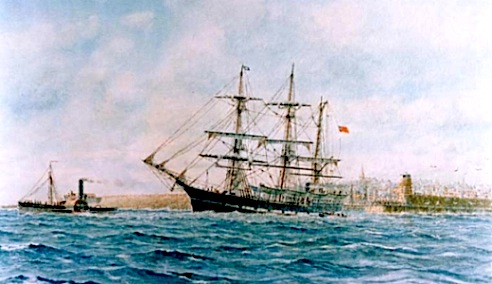 In the Spring of 1880 Arthur Conan Doyle, then a 21 year-old medical student, sailed as ship’s surgeon on board the Hope, an Arctic whaler, out of Peterhead. The Hope was a modern vessel with an auxiliary steam engine to go with its three masts, and in his brief reminiscence about the voyage, “Whaling in the Arctic Ocean” Conan Doyle says: “What surprised me most about the Arctic regions was the rapidity with which you reach them. I had never realised that they lie at our very door. I think that we were only four days out of Shetland when we were among the drift ice.”
Doyle’s role on board ship was primarily as medical officer or surgeon, but in reality there was little for him to do but observe the scenery (and on several occasions fall into it), and to act as a companion for the ship’s captain, Captain Gray. It was customary, on board Greenland whalers, for the crew and captain to remain almost entirely separate, other than in the giving and receiving of orders, and in the captain’s briefings of harpooners and senior ship’s officers, so they often took along a companion for the seven month voyage.
Doyle concludes his short essay with the reflection that while he had stagnated intellectually during the voyage, the purity of the Arctic air had worked wonders for his physical health. But it seems to me that Doyle’s Arctic voyage, after which he completed his studies and qualified as a doctor, tells us quite a lot about his intellectual development. In particular it gives a context for the habit of observation and reflection that characterises his great literary creation, Sherlock Holmes.
By 1880 Arctic whaling was in decline. Doyle himself comments on the scarcity of “commercial” whales, notably the Bowhead whale, then known as the Greenland Right Whale, though he also mentions the relatively large numbers of Fin and Humpback whales, which were not pursued, being considered fit only for tallow. Sixty years earlier, when the whale fishery was at its peak, it was relatively common for scientists and adventurers to sail on whale ships in order to carry out experiments, or test theories. This was the tradition from which Doyle emerged, in his twenties, and it was in this spirit that he made his voyage north. Here, for instance, is his record of catching and killing seals, his rationalism overriding the horror of the slaughter, and expressing itself in terms of social criticism, for which he is not well known:
It is brutal work, though not more brutal than that which goes on to supply every dinner table in the country. And yet those glaring crimson pools upon the dazzling white of the icefields, under the peaceful silence of the Arctic sky, did seem a horrible intrusion. But an inexorable demand creates an inexorable supply, and the seals, by their death, help to give a living to the long line of seamen, dockers, tanners, curers, triers, chandlers, leather merchants and oil sellers who stand between this annual butchery on the one hand, and the exquisite, with his soft leather boots, or the savant, using a delicate oil for his philosophical instruments on the other.
But of course Doyle was also one for sensation, and there was plenty of that in the seas off Spitzbergen. On one occasion, in a boat alongside a whale in its death throes, the crew watched as the whale raised its fin high above them: “each of us held one hand up to stave off that great, threatening fin–as if any strength of ours could have availed if the whale had meant it to descend. But it was spent with loss of blood, and instead of coming down the fin rolled over the other way, and we knew that it was dead. Who would swap that moment for any other triumph that sport can give?”
Thankfully we do not speak of whaling as sport any more, but in this moment of peril, faced with the certain destruction of boat and crew, Doyle extracts a moment of thrilling terror worthy of Holmes himself. Doyle celebrated his twenty first birthday at 80 degrees north, but his claim to have come of age there had as much to do with experience as chronology. It is an intriguing thought that the death throes of a whale came close to depriving detection fiction of one of its cornerstones.
Romantic Reunion: Raymond and Cissy Chandler
Yesterday, February 14th 2011, in San Diego, California, Raymond Chandler and his wife were reunited after 57 years. When Cissy died in 1954, Chandler was too distraught to make arrangements for his wife of 30 years, who, according to Judith Freeman, was his ‘anchor, his shrine of worship, his raison d’être’. Although he was buried in Mt Hope cemetary after his death in 1959, Cissy’s cremated remains lay in storage when, in 2010, Loren Latker and others sought to reunite the pair. Yesterday’s ceremony was a celebration of their love for each other. After a jazz-enfused funeral procession, there was a grave-side ceremony, followed by a gimlet reception (Chandler’s favourite drink) at the Hilton and a celebratory dinner. Although we couldn’t attend, all of us at Venetian Vase would like to thank Latker and the others who completed and honoured their love story by reuniting the pair.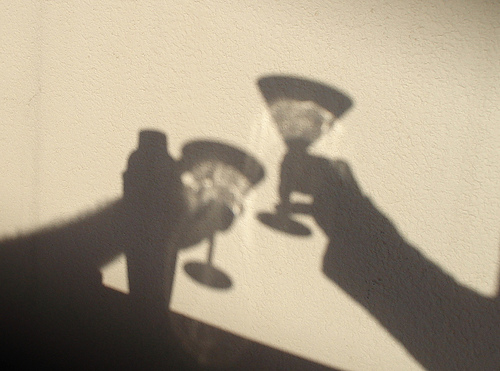


 The Venetian Vase