New Novel in Stieg Larsson’s Millennium Series
Well this comes as a very pleasant surprise. The Guardian is reporting that readers can expect the return of Lisbeth Salander in a fourth book of the Millennium series:
A sequel to late Swedish author Stieg Larsson’s bestselling Millennium crime trilogy will go on sale in at least 35 countries from August, the book’s publishers said on Tuesday.
That Which Does Not Kill was completed in November by David Lagercrantz, known for co-authoring Swedish football star Zlatan Ibrahimovic’s autobiography. He stands in for Larsson, who died of a heart attack in 2004 aged 50.
The book will continue the story of the troubled but resourceful heroine Lisbeth Salander first made famous in Larsson’s The Girl with the Dragon Tattoo.
But the author remained tight-lipped about the meaning of the title or what direction the action-packed political thriller – 500 pages long in Swedish – will take.
“Lisbeth Salander’s not just any superhero. She’s not only great because of her talents but also because of her context and background.”
At the time of his death Stieg Larsson reportedly had plans to write at least another seven novels.
I’d heard the rumours of a fourth manuscript, but I had no idea how close it was to publication. I’m looking forward to this one immensely. It raises a lot of questions. Will it revive the Swedish and American film franchises I wonder? Will Larsson’s former partner Eva Gabrielson receive a fair share of the royalties?
Henry VII: Winter King and the Shadow of the Tower
 If you’re currently enjoying the television adaptation of Hilary Mantel’s Wolf Hall, I have two recommendations which should be essential for anyone interested in the Tudor age. One is a TV drama, The Shadow of the Tower, and the other is a historical biography, Winter King: The Dawn of Tudor England (2011) by Thomas Penn. Both deal with the founder of the Tudor Dynasty, Henry VII. The Shadow of the Tower was the final series in the BBC’s acclaimed Tudor trilogy produced in the 1970s. It followed the The Six Wives of Henry VIII (1970) and Elizabeth R (1971), both of which have come to be regarded as the best historical dramas of their kind, and came at the start of what would be a Golden Age of British television drama. The Shadow of the Tower is the prequel to these two dramas, beginning on the day of The Battle of Bosworth Field when Henry Tudor seized the crown from Richard III.
James Maxwell is superb in the leading role, and his performance as Henry is strong enough to recommend the series alone. An American-born actor, who achieved some of his greatest successes at Manchester’s Royal Exchange Theatre, Maxwell perfectly captures the cunning, manipulative, and quietly authoritative nature of Henry in every word and mannerism. Characteristics of the monarch Penn describes as:
A sallow young man, with dark hair curled in the shoulder length fashion of the time and a penchant for expensively dyed black clothes, whose steady gaze was made more disconcerting by a cast in his left eye – such that while one eye looked at you, the other searched for you. […] The soft politesse concealed a sharp observer, a gleaner of information, cool under pressure and used to having to think several steps ahead: a leader.
As soon as you think you understand Henry, Maxwell seems to effortlessly change in character and motivation. His purely political marriage to Elizabeth of York (played by Norma West), uniting the Houses of York and Lancaster in the new House of Tudor, becomes one of genuine love and affection. History still provides the basis for the best thrillers, and the threats posed by Yorkist pretenders Lambert Simnel and Perkin Warbeck, the latter claiming to be Richard of Shrewsbury, one of the princes Richard III imprisoned in the Tower, provide the overarching narrative of the series. Even if you’re knowledgeable about this era of history, you’re still likely to find it suspenseful as the Lambert Simnel rebellion marches south to meet Henry’s forces at the Battle of Stoke Field. It is also quite funny, as the teenage Simnel, who is little more than a pawn of the Yorkists in the final battle of the Wars of the Roses, slowly starts to drive his own commanders crazy with his stroppy behaviour. Everyone knows he is a fraud and does not possess a drop of royal blood, but they are forced to pretend he is their king while support seeps away and certain death awaits them. Other episodes are pretty much standalone dramas. There is an episode which deals with John Cabot’s efforts to secure a commission for his expedition to North America (Henry barely appears in this one).
One of the best episodes is titled ‘The Serpent and the Comforter’. In it, Peter Jeffrey plays a preacher who has been imprisoned in the tower, tortured and sentenced to death for heresy; having used scripture to challenge the authority of the Church. Word reaches Henry about the prisoner and, intrigued, Henry summons him. The two men debate the meaning of the Bible and the role of the Church. Henry, for all his malevolence, is sincere in his faith and concerned for the soul of the prisoner, even going so far as praying for him. He wants the preacher to recant before his execution so that, in Henry’s view, his soul will not burn in hell for eternity. However, he is also psychologically cruel, using sophistry to best the preacher and make him doubt his faith. You’ll be left in no doubt that these opposing facets of Henry’s personality can coexist.The performances of Jeffrey and Maxwell as prisoner and king, each determined to convince the other of the rightness of their faith, are outstanding. The episode is very theatrical and, intriguingly, none of the characters are named. Instead they are credited as ‘the prisoner’, ‘the king’, ‘the guard’ etc. We see in the prisoner’s struggle with his conscience a microcosm of an impending conflict that will reverberate through British history for centuries with Henry VIII’s break with Rome and the dissolution of the monasteries, the English Civil War, the Glorious Revolution, and even events that have happened in my lifetime, such as the Troubles in Northern Ireland.
Alas, The Shadow of the Tower did not achieve the same level of success as the two Tudor dramas that preceded it. This is partly due to the fact that Henry VII has never had the same grip on the public’s imagination as other monarchs. Penn wrote ‘the most telling verdict of all is that Shakespeare, who omits Henry VII altogether from his sequence of history plays – and not for want of material but, one suspects, because the reign was too uncomfortable to deal with.’ In his review of Winter King, Toby Clements wrote that ‘Henry VII’s reign comes as a pivot on which the story turns – from the medieval to the modern, the dark to the light, the Plantagenets to the Tudors’, and even the Horrible Histories song about Henry jokes about his relative anonymity compared to other historical figures.
There are also some structural problems with the series. The Six Wives of Henry VIII and Elizabeth R had both followed a six, ninety-minute episode format. The Shadow of the Tower unfolds over thirteen episodes, and even though each episode comes in at a pacy fifty minutes it still feels rather drawn out at times. For instance, there is one completely superfluous episode which deals with Warbeck, after his final defeat and capture, having a series of fantasies/delusions about reigning as King of England. After Warbeck’s execution the series moves at breakneck pace climaxing with the sudden deaths of Prince Arthur and Queen Elizabeth. Rather than ending with the death of Henry, it shows an aging monarch whose meticulous plans for the succession lie in ruins. Henry has lost none of his 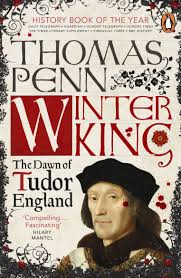 intelligence, but his passion for life has died with the passing of his first-born son and wife. As a consequence, a tyranny is about to be unleashed, and where the series ends, purely by coincidence, Penn’s narrative in Winter King begins, and this is why the book is such a joy to read after watching The Shadow of the Tower. Penn deals with almost all of the events that feature in The Shadow of the Tower within the first chapter of Winter King. Bosworth Field receives only a few pages of text: the Battle of Stoke Field is afforded even less space. Penn is much more interested in Henry’s plans for the succession of Prince Arthur, and his regime’s descent into rapacious pilfering. There are a number of events of Henry’s later reign that Penn focuses on that I would have loved to have seen dramatized in The Shadow of the Tower. Henry’s longstanding duel with Yorkist heir Edmund de la Pole, and the downfall of two of Henry’s most cruel and unpopular advisers, Empson and Dudley, both of whom were executed when Henry VIII succeeded to the throne, giving the new king a massive popularity boost and propaganda coup. The athletic and dashing Henry VIII was a very different character from his calculating and paranoid father, and Penn argues convincingly that his reign would have seemed like a new golden age for England after the excesses of Henry VII’s last years: ‘This [Henry VIII] was a monarch for whom gold and jewels were nothing compared with virtue and eternal renown.’ Eventually, it became just a different form of tyranny.
Neither The Shadow of the Tower as a drama nor The Winter King as history can fully answer the question as to whether Henry was a good king. It entirely depends on how you define the term and office, and it is akin to asking whether Napoleon Bonaparte was a good dictator. Henry was a deeply complicated man living in turbulent times, and it’s this that makes him a compelling figure for narrative. If we take the contrived Whig approach and judge Henry by the moral standards of later generations then he comes across badly. This was the age of the Star Chamber and crippling taxation. In his defence he did unite the kingdom after years of civil war, created a stable dynasty and avoided expensive foreign wars. Truly, he is one of the most fascinating and neglected figures of British history.
Postscript: I was delighted to spot James Laurenson playing the Earl of Shrewsbury in the first episode of Wolf Hall. I have somewhat encyclopaedic fascination with character actors, and I was sure Laurenson had appeared in the BBC’s original Tudor trilogy. I went straight on imdb.com to see if my memory was correct, and sure enough, Laurenson played Simier in Elizabeth R and the Earl of Lincoln in The Shadow of the Tower. Are there any other direct connections between Wolf Hall and the seventies productions I wonder?
Perfidia – A Web of Connections
 In Exquisite Corpse: Surrealism and the Black Dahlia Murder (2006) Mark Nelson and Sarah Hudson Bayliss created a highly impressive chart they titled ‘Los Angeles 1935-1950: A Web of Connections’ which ‘situates Black Dahlia murder suspect George Hodel within the culturally elite circles of Los Angeles at the time of the murder and illustrates the close geographical proximity of the central characters in our book.’
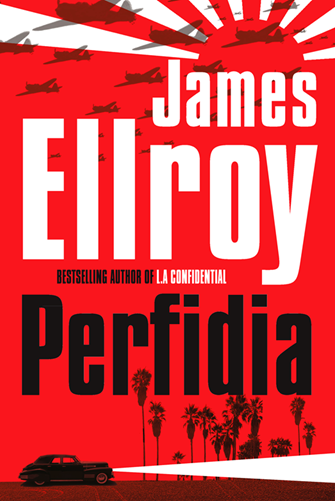
After completing my second reading of James Ellroy’s Perfidia, I’m beginning to see more clearly how Ellroy has devised his own web of connections within his body of work as a crime novelist. Nelson and Bayliss explored the potential connections of figures such as Man Ray and John Huston to the Black Dahlia case, building upon the work of former LAPD detective Steve Hodel. With Perfidia, Ellroy has embarked upon a second LA Quartet, preceding the first Quartet chronologically, which, in its myriad plotting, forges fictional links between Bette Davis and the Black Dahlia herself, Elizabeth Short. Many of Ellroy’s old and new characters will be linked in the new Quartet which will spur readers and critics to reexamine Ellroy’s previous work in light of these narrative developments. Here are some of the specific connections:
Ellroy’s decision to make Elizabeth Short the illegitimate daughter of Dudley Smith was for me one of the biggest surprises of the novel. In Clandestine (1982), Ellroy’s second novel, Dudley Smith describes how while investigating the Black Dahlia murder he arranged for a cadaver of a young woman to be presented before a group of known lunatics and violent criminals. He dyes the corpse’s hair black to make her look more like Miss Short in the hope of provoking a reaction from one of the men, who would then inadvertently reveal himself to be the murderer ‘I was looking for a reaction so vile, so unspeakable, that I would know that this was the scum that killed Beth Short’. In The Black Dahlia the same scene appears but without Dudley Smith. Smith is not a character in The Black Dahlia because Ellroy feared Smith’s outwardly Irish persona would draw parallels with John Gregory Dunne’s Dahlia novel True Confessions (1977), which is in part an examination of Irish-American culture. But this leaves Ellroy in a tricky situation for the upcoming Quartet novels if he wants to be consistent with the fictional universe of The Black Dahlia. How can a character as demonic, relentless and compelling as Dudley Smith not be involved in the investigation of the murder of his illegitimate daughter?
Perfidia links to Ellroy’s Underworld USA trilogy through such characters as J. Edgar Hoover, Ward Littell and Scotty Bennett. There is also the wider issue of Ellroy’s fascination with archives. Hoover’s death in 1972 and the fate of his archive of files is the climax of Blood’s a Rover (2009). Kay Lake’s first diary entry in Perfidia is preceded with the line ‘COMPILED AND CHRONOLOGICALLY INSERTED BY THE LOS ANGELES POLICE MUSEUM‘. If this is the beginning of a link to Hoover’s archive of files we can see Ellroy’s intention for the two Quartet series and the Underworld USA trilogy to be read as one long, continuous secret history. Essentially, a fictional archive of sources.
Ellroy originally planned for Dudley Smith to fall in love with Ellroy’s mother Geneva Hilliker. That would have linked the Quartet to Ellroy the author, outside of his fiction, and potentially, if he wanted the plotline to question Ellroy’s parentage, triggered a rereading of his memoirs My Dark Places (1996) and The Hilliker Curse (2010). Ellroy revised his plans. However, in this interview with Chris Wallace, Ellroy claims that he originally planned for William H. Parker to have an affair with his Geneva Hilliker in the novel:
My original plan was to base Joan Conville, the navy nurse in Perfidia, on my mother, Jean Hilliker—righteous Jean Hilliker. And she and Parker [Los Angeles chief of police from 1950 to 1966, William H. Parker, a central character in Perfidia] have an affair the next book. But, do you really want to have Whiskey Bill Parker fucking your mother? Haven’t we had enough of this woman?
Conville is an enigmatic, haunting character, a ‘ghostly redhead’ as Ellroy calls her, who is referenced by Parker throughout the novel but never seen. The name Conville struck a distant chord and I reached for my dogeared copy of The Black Dahlia. The resolution to the mystery in the novel lies in the skewered bloodlines of the grotesque Sprague family. There is the patriarch Emmett Sprague who has two daughters, Madeleine and Martha. Madeleine is actually the illegitimate daughter of Emmett’s wife Ramona Cathcart Sprague and Georgie Tilden (Emmett’s former business associate). Martha is Emmett’s natural daughter, and her full name is Martha McConville Sprague.
Martha McConville/Joan Conville. It could be overreading or coincidence but I wonder if there is a connection between the characters which will be developed in later novels. According to this surname database Conville has quite an interesting genesis, ‘this unusual surname is of Irish origin, and is an Anglicized form of the Gaelic “MacConmhaoil”, the prefix “mac” denoting son of, plus the personal name “Conmhaoil”, composed of the elements “cu” meaning hound.’
In short, Son of the Hound, or perhaps Demon Dog?
Octopussy is chiefly remembered as the film that went head to head with Never Say Never Again in the summer of 1983 as part of the famous ‘Battle of the Bonds’. It considerably outperformed Never Say Never Again at the box office, and the reviews broadly agreed that Octopussy held together better than Sean Connery’s ill-judged return as Bond. However, thirty years after their original release, neither film is well regarded critically.
After watching Octopussy again recently, I felt it a very strong addition to the Bond film series, helped in no small part by the screenplay by George MacDonald Fraser. I’m a huge fan of the Flashman novels and have read most of Fraser’s other books. In his memoir The Light’s on at Signpost (2002), Fraser devotes a chapter to the making of Octopussy. It’s a fascinating insight into how the author who gave the world the greatest literary coward ended up writing the screenplay for the cinema’s greatest hero.
Octopussy begins with a dying British secret agent arriving at the British embassy in East Berlin clutching a fake Fabergé egg. Bond is sent to investigate, and at an auction in Sotheby’s, he observes the exiled Afghan prince Kamal Khan (Louis Jourdan) buy the real egg, or so Khan thinks, for an astronomical price. Tracking Khan to his palace in India, Bond discovers Khan has connections with the belligerent Soviet General Orlov (Steven Berkoff), and the beautiful, enigmatic Octopussy (Maud Adams). Octopussy is running a jewellery smuggling operation which, unbeknownst to her, is a front for Orlov’s plans to smuggle a nuclear bomb into a US air force base in Berlin. That’s about all I’ll say here about the plot. As you can probably tell from that summation, Octopussy has a convoluted narrative, but the plot threads come together nicely, and its makes a plausible and welcome break from earlier fantastical Bond films such as Moonraker.
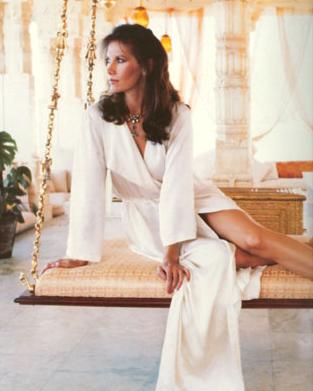
Maud Adams as the titular Octopussy
Aside from the storyline, what I really admire about Octopussy is its exotic setting, lush photography and seductive evocation of India at its most magical. One critic derided the film as anachronistic. That really seems to be missing the point as the film is deliberately imbued with a sense of Kiplingesque adventure. George MacDonald Fraser’s love of India, his defence of the British Empire and his detailed knowledge of Victorian and Edwardian Britain made him, in many respects, a latter day Rudyard Kipling. In Flashman and the Mountain of Light (1990), Fraser alludes to Kipling with his choice of subjects: the novel features the American adventurer Josiah Harlan, whom it has been said was the real inspiration for Daniel Dravot in Kipling’s ‘The Man Who Would Be King’. Fraser’s Octupussy script presents Bond as a sort of aristocratic adventurer, which is well-suited to Roger Moore’s portrayal of the character. Moore, incidentally, is also something of a Kipling expert, at one point he was lined up to star in an adaptation of Soldiers Three with Sean Connery and Michael Caine. That production never happened sadly, but Moore did perform in a one-man play of Kipling’s poetry readings on the London stage. Here’s a snippet he gave on the The Paul O’Grady Show.
Fraser’s Romantic and unique vision for Octopussy was not greeted with unequivocal enthusiasm by Albert ‘Cubby’ Broccoli. Although he admired the legendary Bond producer describing him as ‘plump and cuddly and gentle; he was also generous and considerate’, he still got the impression that Cubby Broccoli distrusted him. Fraser wrote the original screenplay and then Bond regulars Michael G. Wilson and Richard Maibaum revised it. Exactly who wrote what we’ll never know, but we do know from Fraser’s memoir that he made several choices and won a few arguments that had a profound effect on the film. For instance, at one of their first meetings he asked Broccoli to name all the locations that Bond had already visited in the films. After learning that Bond had never been to India it was decided that India should be the main setting. It proved to be an auspicious choice as Octopussy was released at a time of renewed interest in India in British cinema and television; films such as Gandhi (1982), Heat and Dust (1982), A Passage to India (1984) as well as television dramas such as The Jewel in the Crown (1984) and The Far Pavilions (1984) all dealt with the history of India and the Raj. Fraser wrote some scenes that had Broccoli in uproar, specifically where Bond is dressed first in a gorilla suit and then later a clown outfit. However, the scenes stayed in the finished film. He was overruled on some of his other ideas. Fraser wanted the pre-credits sequence, usually a mini-movie in itself in the Bond films, to be a motorbike chase set at the Isle of Mann TT (Tourist Trophy). Fraser was a resident on the Isle of Mann, as he cheerfully admitted for tax purposes, and described the TT as ‘the nearest thing to the Roman circus since the hermit Telemachus got the shutters put up at the Colosseum.’ Fraser thought it would be the perfect setting for ‘a duel-to-the-death sidecar race between Bond and a heavy.’ Alas, it never made it into the movie, but the eventual pre-credits sequence which pits Bond in a BD-5J aircraft against a small South-American army is a strong, thrilling sequence.
Octopussy may not be in the running as the best James Bond film, but its still a very strong one with a great deal of charm and a compelling storyline, qualities which have proved rare in later additions to the series. George MacDonald Fraser’s contribution as screenwriter should not be overlooked. The rich evocation of India is entirely his style as a writer and the film abounds with strong eccentric characters. Maud Adams is beautiful and memorable as the conflicted Octopussy, giving a touch of gravitas to a Bond girl whereas previous actresses had little to do but look pretty and swoon. Louis Jourdan is both diabolical and suave as Kamal Khan. It was a typical Fraser touch to make the villain an Afghan prince, Flashman is taken hostage by Akbar Khan during the Anglo-Afghan War in the very first book of the series. Also, the presence of a Soviet General in India harks back to the ‘Great Game’, the rivalry between Britain and Russia in Central Asia that was memorably portrayed in Kipling’s Kim (1901) and is also the subject of the fifth Flashman novel.
If you want a taste of George MacDonald Fraser’s writing on India, then a good starting point would be his wartime memoir Quartered Safe Out Here (1992). The title is taken from Kipling’s poem ‘Gunga Din’, and reading Fraser’s description of Calcutta makes me think he really was the heir to Kipling:
Calcutta is still my favourite city, probably because I haven’t been there since 1945 and remember it as it looked to me then, which was something like a paradise market. Nowadays the name conjures up images of poverty, starvation, disease, and squalor, of Mother Teresa and that fine old retired British officer who runs his own field kitchen in the slums. It wasn’t much better, I dare say, when I saw it in the twilight of the Raj, but I was there on seven days’ leave, and as every holiday-maker knows, even in this enlightened age, you don’t spend an eagerly-awaited vacation seeking out the plague-spots which exist within a mile of your hotel.
Not that you had to look far for them in “Cal”: the beggars displayed their sores and hideous deformities on the main streets, you could find corpses on the station platforms, and a tram-ride to Howrah would take you through slums and hovels populated by uncountable filthy multitudes who didn’t so much live as swarm. One look would have convinced the most zealous reformer of the sheer impossibility of doing anything with that vast, proliferating Augean stable, and if you had been any time in India you were hardened to it. There was something else, too, which if it did not transform the second city of Empire, lifted it at least a little from the depths. Everybody smiled.
That may be at the root of Britain’s three-century love affair with India. Nowadays it is taught (usually by people who never saw the Raj) that our passion for the sub-continent was mere pride of possession, arrogant satisfaction of conquest, and lust of exploitation, leavened only by a missionary zeal to improve. No doubt those feelings existed, among some, but they don’t account for the undying affection that so many of the island race felt for that wonderful country and its people. Nor do all its great marvels: the beauty of the land and its buildings, the endless variety of its customs and cultures, the wonder of its art and philosophy and ancient civilisation, the glory of its matchless regiments. That may inspire awe, even reverence, but they don’t quite explain why thousands of soldiers and merchants and administrators and traders left their hearts there, to say nothing of their mortal remains. One can babble about the magic of India, and convey nothing: I can only say that when I look back at it my lasting memory is of smiling faces, laughter in the bazaar, tiny naked children grinning as they clamoured for buckshee – and it wasn’t an act, for they still laughed and joked and play-acted if they didn’t get it. There was a life, a spirit about India that was irrepressible, and it outweighed all the faults and miseries and cruelties and corruptions. That, I think, is why the British loved it, and some of us will never get it out of our systems.
Perfidia – A Second Look
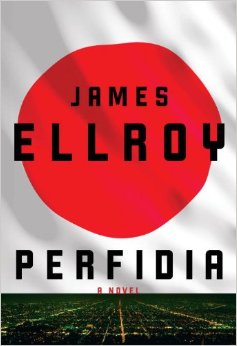 I’m currently rereading James Ellroy’s Perfidia, and, although I was very impressed when I first read it, I’m finding I’m enjoying it even more this time round. Below I’ve flagged up some issues and details that I felt were more pertinent on the second reading. This post is not meant as a standard review. If you want a introduction to Perfidia read my original review or any number of the excellent reviews that have been written of the novel.
Ellroy gives the reader Kay Lake’s viewpoint through her diary entries. The first entry is titled, or should I say catalogued, ‘COMPILED AND CHRONOLOGICALLY INSERTED BY THE LOS ANGELES POLICE MUSEUM‘. I think this reference to the LAPD museum will be a huge issue for the rest of the Quartet. Ellroy has always been fascinated by telling stories through newspaper articles, transcripts, memorandums and bureaucratic minutiae. They are interspersed throughout his Quartet and Underworld USA novels raising questions as to viewpoints and the authorship of the text. Blood’s a Rover (2009) ends with the death of J. Edgar Hoover and the mystery surrounding the fate of his massive archive of files. I suspect Ellroy will build the connection between Kay’s diary and the LAPD museum so that all of the Quartet and Underworld novels could be read as an archive of documents covering three decades of American history.
The archive issue makes me question why Perfidia was billed as ‘real-time narration’. I’m not an expert, but it seems real time is much easier to render in film and theatre because the basic premise is that events are revealed at the same rate that the audience experiences them. Even if you leave aside the issue that reading a novel is very different from watching a film, there is still a problem with the real-time narration as this is historical fiction with clues, as detailed in the paragraph above, that events have been compiled by an archivist and historian in a specific order, which skewers any simultaneity between reader and text.
A mild criticism but there are a number of scenes wherein a man and a woman argue, i.e. William H. Parker and Kay. Every time the scene plays the same way. The man shouts and screams while the woman stays cool and makes a remark so cutting that the man smashes something and runs out. I don’t want to sound anti-Feminist, but I found this annoying personally. Have some respect for your own gender Demon Dog!
I’m not sure how I feel about Elizabeth Short being the illegitimate daughter of Dudley Smith. This is established early in the novel, and is not built up to be a big revelation, so I don’t think I’m giving away any spoilers here. The author’s original plan was to have Dudley Smith falling for Ellroy’s mother, Geneva Hilliker, thereby implying that the Demon Dog of American Literature was the son of his character Dudley Smith. Ellroy’s editor Sonny Mehta dissuaded him from this ambitious, and potentially distracting, metafictional plot line in Perfidia, but I doubt we’ve heard the last of it.
Spectre – A Tribute to Ian Fleming
 I had a rather drunken punt with a friend last night that the title of the next James Bond film would be ‘Risico’. I lost my bet, but I’m delighted that Bond 24 is titled Spectre as it is a fine tribute to Ian Fleming and the official EON film series. My gut instinct that it would be ‘Risico’ was rooted in the fact that the producers have tried to honour Fleming through the film title choices in recent years even though they are running low on his original titles. Goldeneye was the name of Fleming’s house in Jamaica, and The World Is Not Enough is referenced in Fleming’s novel On Her Majesty’s Secret Service as the family motto of Sir Thomas Bond, a supposed ancestor of the fictional spy. ‘Risico’ is a Fleming short story. As a title, it is a lot punchier than the other Fleming titles the Bond producers have yet to use such as ‘The Property of a Lady’ and ‘The Hildebrand Rarity’.
Spectre is a strong and brave title choice that would have been unthinkable ten or twenty years ago, as it goes to the heart of the biggest controversy there has ever been about the literary and film character James Bond — Kevin McClory’s titanic struggle with Ian Fleming and EON Productions regarding the rights to Thunderball. Spectre is the acronym of the Special Executive of Counter-Intelligence, Terrorism, Revenge and Extortion, the wonderfully malevolent, much-parodied evil organisation with the enigmatic, cat-loving arch-villain Ernst Stavro Blofeld as its leader. The mysterious organisation first appeared in the novel Thunderball, but Fleming had based the novel on a rejected screenplay he had co-written with the litigation-obsessed, wannabe celebrity McClory (there were other contributors but McClory is the key to this story). McClory sued Fleming successfully, and many commentators (see Stevan Riley’s excellent documentary Everything or Nothing: The Untold Story of 007 for chapter and verse on this) claim the stress led to Fleming’s untimely demise at the age of 56. Bond producers Albert ‘Cubby’ Broccoli and Harry Saltzman did not want McClory producing his own rival Bond series so they made him sole producer of the film adaptation of Thunderball released in 1965. In the event, Thunderball still ranks as one of the most commercially successful Bond films of the series, and Broccoli and Saltzman must have thought McClory was satisfied. They were mistaken. Ten years after the release of Thunderball, the rights to the story reverted back to McClory. By this time Roger Moore was playing Bond in the EON series and former 007 star Sean Connery held a very public grudge against Cubby Broccoli. McClory lured Connery back to the role of Bond, possibly through the temptation of spiting Broccoli, in the Thunderball remake Never Say Never Again. And so in the summer of 1983, the famous ‘Battle of the Bonds’ occurred with Roger Moore and Sean Connery going to head to head in Octopussy and Never Say Never Again respectively. Spectre featured prominently in Never Say Never Again, but they have not been seen in the official series for years. Having made two film productions of Thunderball, it was really just the rights to Spectre and the Blofeld character that was the basis of McClory’s claim.
During the 1960s, McClory seemed unable or unwilling to hamper the importance of Spectre to the films. Spectre is mentioned briefly by Dr No in the first Bond film, and then forms a major part of the story in the follow-up From Russia with Love. In fact, of the six official Bond films starring Connery, Goldfinger is the only entry not to feature Spectre. Blofeld reappears and brutally murders Bond’s wife Tracy in George Lazenby’s only Bond film On Her Majesty’s Secret Service. However, once we get to the Roger Moore years, Spectre and Blofeld have all but disappeared. There were plans to bring back Spectre for Moore’s third appearance as Bond in The Spy Who Loved Me, but McClory put a stop to that by filing an injunction. EON’s riposte to this was to have an unnamed villain in the pre-credits sequence of For Your Eyes Only look and sound identical to Blofeld (bald, white cat, heavy European accent etc). In the sequence, Bond visits the grave of his beloved wife Tracy. Shortly thereafter, the Blofeldesque villain is killed off by being dropped from a helicopter into a massive chimney. Symbolically, it represented a shift in tone moving away from plots featuring the fantastical Spectre to a more realistic, gritty style. It was probably also Broccoli and EON’s attempt to kill off McClory’s artistic, if not legal, claim on the series. McClory made several more faltering attempts to make Bond films before his death in 2006. Everything I’ve read and learned about him suggests he was rather a tragic character. He seemed to have plenty of money, as he led a glamorous lifestyle, but he only really had one story to tell. Instead of moving on from Bond and making other films, he let the obsession consume him. It led to huge setbacks to the Bond films, and I’m in no doubt that it was detrimental to McClory himself. Now, thankfully, it’s all over.
It has been over thirty years since there has been even a hint of Spectre and Blofeld in a Bond film, but presumably that is about to change. I say presumably because at the press conference at Pinewood Studios this morning, no plot details were released with the title, but this feels too big to be some kind of metafictional MacGuffin. For the first time since EON wrestled back the rights to Casino Royale it will feel like the James Bond series has finally come home. There could be no finer tribute to Ian Fleming fifty years since his passing.
As for ‘Risico’, give it time. One day it will be the title of a Bond movie, and I’ll win my drunken punt.
PD James
I was saddened to hear of the death of PD James. Often described as the grand dame or Queen of Crime, James managed to embrace the conventions of the Golden Age of Detective fiction while simultaneously raising the mystery story to new literary heights. She had one of the most beautiful and poetic writing styles of any crime writer I have come across. I have spent this evening reading the many tributes to her. Jake Kerridge’s piece in the Telegraph is very informative:
James was one of the first writers to combine a pleasingly complicated Christie-esque mystery with the depth of literary fiction, and she was the first of these new-style crime writers to be taken to the reading public’s heart. In her novel Devices and Desires (1989) she has a character reading an old-fashioned crime novel in which there is a “detective who, despite his uncertainties, would get there in the end because this was fiction; problems could be solved, evil overcome, justice vindicated, and death itself only a mystery which would be solved in the final chapter.” The implication is clear: no such comforting falsehoods are to be expected at the end of a James novel. Everything will not be alright again once the murderer is caught. But millions of readers adored her uncompromising view of the evil lurking in ordinary life.
I have not read all of James’ work, but I would include The Private Patient (2008) and Innocent Blood (1980) as two of the best novels of their kind.
Thank you Lady James.
The UK and US House of Cards: A Special Relationship
When the political historians write the obituaries for the present government one factor they may overlook is the brief revival of Whiggism. This has been spearheaded by two men who are not at the heart of government, on the contrary, Daniel Hannan and Douglas Carswell both relish their reputation as outsiders. Both men are quite brilliant in their own way, but like many brilliant men there is much that is also quite awful about messrs Hannan and Carswell, I refer specifically to their plan to Americanise the British constitution.
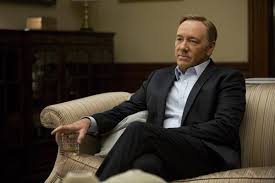
Kevin Spacey as Frank Underwood
House of Cards (1990) was one of the most seminal television dramas I can remember growing up, and that’s quite something considering it came at the end of a Golden Age of British television drama. Ian Richardson was superb as the machiavellian Tory MP Francis Urquhart plotting his way to the office of Prime Minister. When I heard that Kevin Spacey was planning an American version of the drama my natural cynicism kicked in, surely it couldn’t be as good as the original I told myself. I was glad to have been proven wrong. Spacey’s Frank Underwood is every bit as compelling and deliciously malevolent as the original Francis Urquhart. Both versions of the political drama are currently available on Netflix, but if you have yet to see one or the other you may find a few spoilers in the following post. The differences between the two adaptations highlight how our respective political systems have evolved separately and distinctly.
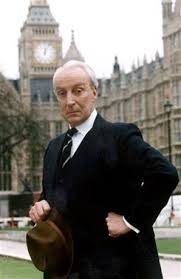
Ian Richardson as Francis Urquhart
The British House of Cards begins with Francis Urquhart brooding in a darkened office. He picks up a framed photograph of Margaret Thatcher and says with a wry smile ‘Nothing lasts forever. Even the longest, the most glittering reign must come to an end some day’ After being passed over for promotion by a new, mild-mannered and hapless Prime Minister Urquhart starts to plot his downfall. As a Chief Whip he is skilled in the dark arts and is fully aware that he can become PM without ever being elected. A Member of Parliament has to command the confidence of the House of Commons before he is invited to ‘kiss hands’ with the Queen. This confidence usually entails an overall majority, but a minority government sustained through a confidence and supply arrangement or Coalition are other options. Also, Urquhart is not the type to wait for the Prime Minister to lose office at a general election. That would make him a member of Her Majesty’s Opposition and his party would face a hard slog back to power. An incumbent Prime Minister could be overthrown through a vote of no confidence or a rebellion in his own party. However, Urquhart, brilliantly cunning, wins the trust of the Prime Minister while simultaneously undermining him. Eventually the PM is advised to do the honourable thing and fall on his sword. His last act is to advise his party to accept Urquhart as their leader, and by extension Prime Minister, oblivious to the fact that Urquhart has been betraying him throughout his brief premiership.
The US version begins at a similar point. A new President has been elected and Frank Underwood, Congressman and House majority whip, is expecting to be appointed Secretary of State. Finding himself denied the post, Underwood plots his revenge, but his path to power is a lot more difficult than Urquhart’s. The Presidency is a directly elected post. Unlike the UK, it theoretically doesn’t matter which party controls both Houses as it is next to impossible to dislodge a President mid-term. Underwood has to earn the trust of the President while simultaneously driving a wedge between him and the VP. If the VP can be pressured to stand down and Underwood nominated as his replacement, it would put Underwood a mere heartbeat away from the Presidency.
In the UK, House of Cards was followed by two sequel mini-series To Play the King (1993) and The Final Cut (1995). In To Play the King, Urquhart seems unassailable as PM until he is confronted by the reign of a new King with very different political views to his own. The King, expertly played by Michael Kitchen and clearly modelled on Prince Charles, is so repulsed by Urquhart he increasingly oversteps the constitutional limitations of his role to challenge Urquhart’s power. The series was broadcast at a time when the House of Windsor was mired in scandal and the monarchy seemed more at risk than at any time since the long seclusion of Queen Victoria. However, we see another side to Urquhart; a glimpse of the principles that guide him in spite of the evil acts he is driven to. He does not seek to abolish the monarchy as his family have been Royalist since the Civil War. The King is pressured to abdicate and is replaced as Sovereign by his teenage son: a Head of State who can be easily manipulated by Urquhart. Clearly this is a narrative which the American House of Cards cannot follow. That being said, once he is ensconced as Vice President, Underwood resumes his clandestine war against the Head of State. He is not going stay in an office that John Nance Garner described as ‘not worth a bucket of warm piss.’ To date, fourteen Vice Presidents have become President. Eight of these were due to the death of a sitting President, including four assassinations. Gerald Ford assumed the office after Richard Nixon became the only President to have resigned the post. If you have yet to see the US version of House of Cards, I will leave it for you to guess what method Underwood uses to become leader of the free world.
Unfortunately, whoever you vote for at the next election I doubt it would stop the ongoing Americanisation of the UK constitution as devised by Hannan and Carswell and laid out in their book The Plan (2008). At this point in articles such as this it is customary to say ‘Now don’t get me wrong, some of my very best friends are…’ I’m not quite brave enough to forego the tradition. All I can say is having married an American, and spent most of my life studying American writers, I dearly love the US, but I do not wish to see American politics transposed onto this country. Hannan described the US system as ‘the most sublime Constitution devised by human intelligence.’ There may be some truth in his purple prose, but that doesn’t mean that ham-fisted attempts to impose it here will work. Most of my American friends and family agree incidentally. Some of the specific American style changes have been the creation of elected police commissioners and move to elected mayors. I’m sure there are readers who would lay bigger crimes at the government’s door, but take for example elected police commissioners. Every shrewd commentator on the left and right said it would lead to the politicisation of the police and was not the type of the reform that was needed, but the government ploughed on blindly with ideological certainty. Elected mayors were almost unanimously rejected by referendum as voters rightly feared the centralisation of power, but now we are told that Manchester will get one despite voting no anyway. At least they did get a vote, even if it was ignored. Here in Liverpool we were told we’d have to accept an elected mayor if we wanted one or not. To be fair, not all the changes to an American system can be laid at the government’s door; the move to a US-style paramilitary police force began long before the present lot came in. Hannan has since conceded that elected police commissioners have been disaster (although he blames the voters), and Carswell made the bizarre decision to defect to UKIP. Perhaps their ill-judged reforms can be reversed.
If you want to read one of the best fictional celebrations of both British and American culture, I would recommend George MacDonald Fraser’s Mr American (1980). The novel begins with Mark Franklin, the titular character, arriving in Liverpool on the RMS Mauretania in 1909. Ostensibly just another American prospector trying to discover his roots in the ‘old country’, Franklin hides a shadowy past as an outlaw but he is able to work his way to the very top of British society, including a friendship with King Edward VII ,until a criminal acquaintance from back home tracks him down and threatens everything. More than any other novel I’ve read, Mr American conveys the shared heritage and Romanticism of our two countries, whether it be the flashbacks to lawless American west or the bucolic life of the landed gentry, this book should appeal to anyone who is interested in the US or UK.
The quote below is taken from near the end of Mr American. The year is 1914, Britain is now at war with Imperial Germany, and Franklin is pondering whether he should return to the US or fight with the British. Whenever I think of the words below, they serve as a reminder that what our two countries share in kith and kin is far more valuable than politics:
to those imagined people on the road away, so very long ago, who had travelled so far and so well, so that he might travel back, and in the way of things, set out again. For he was going, and he could not really tell why; it was not that he was restless, or drawn like his ancestors by the horizon, or tired of his surroundings, or longing for the places of childhood – this was the place of childhood, far more than the Nebraska farm he could hardly remember, this was the place where the “free-born landholder, not of noble blood” had begun it in the unknown past, and where the generations of yeoman had tilled their land and planted their seed and courted their wives and watched their children grow, and in their time taken the terrible seven-foot staves cut from the hearts of these black twisted trees and gone out to the vineyards of Bordeaux and the passes of Spain in their country’s quarrel, and perhaps to Shrewsbury and Barnet and Bannockburn and Halidon Hill, and certainly to Edgehill and Naseby and Marston Moor – and to the long road of the pilgrims, across to the western sea to the place which in their homesick longing they had called New England. His people, and in a dim, half-understood way he had felt he was realising some great hope by coming home again, and now it was over, with the hope unfulfilled, and he could not tell why. He had wanted to stay, God knew but he wanted to stay, and yet there seemed to be nothing new to stay for.
James Ellroy in Manchester: In my Craft or Sullen Art

James Ellroy at the Dancehouse Theatre, Manchester
Shortly before I went to see ‘An Evening with James Ellroy’ at the Dancehouse theatre in Manchester I re-watched an interview on YouTube he gave recently with Craig McDonald in Iowa City. The interview ends with Ellroy fielding questions from the audience and, with a little prompting, they ask him ‘Why do you write?’ He responded by reciting from memory Dylan Thomas’ poem ‘In my Craft or Sullen Art’. It’s a magnificent performance, all the more touching in the centenary year of Thomas’ birth. And so last night in Manchester, I and many other Ellroy fans, the lovers ‘who pay no praise or wages’, crammed into the Dancehouse to see the great man speak.
The evening began with a representative from Waterstones introducing Ellroy. After enthusiastic applause, Ellroy appeared on stage and launched into a lecture on his work. Much of this section was humorous, with Ellroy stating that his new novel Perfidia was ‘a book for the whole family if the name of your family was the fucking Charles Manson family’. He then promised the audience that if each and every one of us bought 1000 copies or more of Perfidia we could have unlimited sex with whoever we desire and still get into Heaven through a special dispensation granted by him ‘the Reverend Ellroy’. He then spoke more seriously about his work as a historical novelist and his aims with Perfidia. Revisiting the first LA Quartet characters at an earlier point in their lives without writing himself into chronological error was a gargantuan task which required rereading his past seven novels, compiling graphs, fact sheets and character bios. However, this is a world and history that is alive to him, as he has lived it experientially through his characters and by growing up in LA in his time. He quoted TS Eliot:
If you came this way,
Taking any route, starting from anywhere,
At any time or at any season,
It would always be the same: you would have to put off
Sense and notion. You are not here to verify,
Instruct yourself, or inform curiosity
Or carry report. You are here to kneel
Where prayer has been valid. And prayer is more
Than an order of words, the conscious occupation
Of the praying mind, or the sound of the voice praying.
And what the dead had no speech for, when living,
They can tell you, being dead: the communication
Of the dead is tongued with fire beyond the language of the living.
No wonder then that the Second World War setting of Perfidia is so vivid to him despite the fact the conflict ended three years prior to his birth. Ellroy described how as an eight -year- old child he thought the war was still going on and his mother had to disabuse him of the notion. I’m not an Eliot expert, but a line from the same poem came to me when he was speaking, ‘History is now and England’. I felt it in the theatre that night.
Things progressed with Ellroy reading from Perfidia. He chose two passages, firstly the prologue, and then, a much more extensive and powerful quote from the diary entries of Kay Lake, originally a character in The Black Dahlia. Here at an earlier point in her life, she invites the reader into the inner sanctum of her thoughts on her country, as America prepares to enter the Second World War, and on her secret love for Bucky Bleichert. Dedicated Ellroy readers will recognise how these plotlines begin to build a new chronology of the LA Quartet. The quote begins with Kay seeing from her bedroom terrace ‘A line of armored vehicles chugged west on Sunset, to fevered scrutiny and applause’. Knowing that it portends her country going to war, the image instigates a chain reaction of memory in Kay: her upbringing in Sioux Falls, South Dakota, the brutal murder of a black man by the Ku Klux Klan, her ill-fated involvement with Jazz drummer and dope peddler Bobby DeWitt and how this led her to Lee Blanchard and the heart of the LAPD. The memories stop as the convoy passes out of her view, and the quote ends ‘Nothing before this moment exists. The war is coming. I’m going to enlist.’ Incidentally, at the Iowa City event Ellroy described how the idea for Perfidia began when he looked out of the window in his home in LA and suddenly the image came to him of Japanese-Americans being driven away for internment in Army trucks. The similarity between this vision and the opening of Kay’s diary makes me think this is one of his favourite passages in the novel.
Perfidia has split the critics. Were there any readers in the audience I wondered who would voice dissent? Not as such, but when Ellroy stated that he expected his readers to obsess over his work due to the sacrifices he’s made one plucky woman asked him what exactly had been the sacrifices. Ellroy explained that he’s sixty six years old, divorced, with no family and very little social life. If you think that would make him sound miserable, you’d be wrong. I’ve never seen a man brimming with so much energy. He seemed delighted to be in the UK and extolled a very anglosphere view of the world: one of the main themes of the new Quartet, he explained, was the defence of the West which he described as, Britain and America, the defence of civilisation as we know it. Ellroy also tied the UK and America to his love of the American idiom: ‘Hipster patois, Yiddish, Klan hate spiel’, he said it originated from writing in English, ‘the language of Shakespeare’.
The Q and A ended with Ellroy giving the same word perfect Dylan Thomas recitation that he gave in Iowa. It inspired me to do some digging later that night. Ellroy has always been a poetry buff and his novels feature poetry quotations from WH Auden to Anne Sexton. In his debut novel, Brown’s Requiem (1981), the lead character Fritz Brown is readying himself for his final violent confrontation with the chief villain Haywood Cathcart when a poem suddenly comes to him in a dream:
There’s an electric calm at the
heart of the storm,
Transcendentally alive and safe and warm.
So get out now
And search the muse,
The blight is real,
You have to choose,
The choice is yours,
Your mind demurs,
It’s yours, it’s his, it’s ours, it’s hers.
Moral stands will save us yet,
The alternative is certain death.
Ellroy would have written this poem knowing he had no guarantee that the novel it appeared in would ever be published. At the time he was a recovering alcoholic and drug addict working as a golf caddy with dreams of becoming a great writer, but no experience of ever being published. That was over thirty years ago. It’s been a long road from caddying to Perfidia, but if any writers life-story could inspire you to search the muse it would be Ellroy’s. His barnstorming performance in Manchester was yet more proof of that.
Postscript: A large crowd stayed around afterwards to talk to Ellroy and get their copy of Perfidia signed. He acted with tremendous generosity and joie de vivre, chatting to everyone individually and treating them like royalty. Is it any wonder people love this man? When it came to my wife and I’s turn I reminded him of the interviews he gave to me by phone and at his home in LA. He responded by flattering me outrageously about my scholarship, pulled me in close and whispered ‘Steve, your work is iconic, KKK, iconic, KKK.’
It may be over-reading on my part (but hey, I’m a dreamer so humour me), but I wonder if this was a reference to his 1984 interview with Duane Tucker for Armchair Detective. The interview is the first to appear in Conversations with James Ellroy and, as I state in the book, there is reason to believe that the interview was never actually conducted by Tucker but written by Ellroy himself, possibly as an attempt to boost his profile as a young writer. One of the clues that Ellroy may have written the interview is the repeated spelling of icon as ikon in the text. The ikon spelling is common in Ellroy’s novels but seems unusual in the interview given that it should have been transcribed by Tucker.
As I say, possibly over-reading, but the words ‘your work is iconic, KKK, iconic, KKK’ were reverberating in my mind as I took the train home that evening.
The Paradox of Anti-Establishment Fiction
 The 1960 film The Angry Silence begins with a train arriving at the station of a provincial English town. A mild-mannered looking man in a crumpled suit disembarks, and his eyes pass over his new surroundings. It would be an innocent enough scene, but the man is an union agitator and agent provocateur on a mission to wreak havoc at a local factory.
We live in an age where politicians are now trying to claim the label ‘anti-Establishment’. The SNP want to liberate Scotland from Westminster rule, and UKIP claim they are the only alternative to the homogenised LIBLABCON political parties (read Allan Massie for the link between the two parties). While this relatively new phenomenon has occurred as the Tories and Labour have gradually lost their core support, anti-Establishment feeling has long been an important cultural influence in plays, novels, books and songs. Defining what exactly is the Establishment is no easy task. There have been only two post-war governments which have successfully created a political consensus by which we might say the Establishment operates. The Labour government led by Clement Attlee continued and expanded rationing after the war, nationalised heavy industry, raised taxes and created the NHS. Most of the workforce was unionised, thus giving the unions tremendous leverage over government, and some trade unionists became household names. Although it’s easy to be nostalgic about this bygone age, many writers at the time viewed it with disdain. Angry Young Men dramas and Kitchen Sink Realism portrayed how miserable life could be for much of the working class in 1950s and 60s Britain. DH Lawrence Sons and Lovers style novels about young men sent to work down mines but who yearn to be poets (a literary tradition wonderfully sent up in this Monty Python sketch) were winning the Booker Prize as late as 1976.
The Angry Silence was one of the most interesting and overlooked British films of the era: a sort of kitchen sink thriller which is anti-establishment in tone through its portrayal of unaccountable and sinister trade union power. Richard Attenborough plays Tom Curtis, a factory worker who simply wants a quiet life and the chance to care for his Italian wife (Pier Angeli) and their two children. Their differing nationalities are reflected in the fact that she cooks him a pasta dish which he covers in ketchup and eats with a side plate of bread and butter. When the shop steward Bert Connolly (Bernard Lee) calls an unofficial, wildcat strike, Curtis decides to cross the picket line, angered by the union’s easily manipulated show- of- hands vote. Curtis is then subjected to the full vengeance of strikers determined to punish him and his fellow scabs. Bricks fly through windows, cars are set alight and the scene is set for a violent showdown that can only end in tragedy. The Angry Silence shouldn’t be dismissed as merely right-wing propaganda. Connolly is portrayed as an easily manipulated man who believes in trade union ideals but is powerless to stop the more thuggish strikers who are simply looking for a fight. Also, the film benefits from the then radical directing style of Guy Green. In the union meetings you can almost feel the sweaty tension as men cough, fidget and talk over each other. The sexual discussion is frank and progressive. Michael Craig (who shares a writing credit) has an interesting role as Curtis’ lodger and fair-weather friend Joe Wallace. More at home seducing young women than with union politics, Wallace falls for the one woman who won’t love him back unless he is prepared to take a stand against the men out to destroy Curtis.
 Twenty years on from the scathing critique of trade union power in The Angry Silence and the consensus established by the Attlee government was on the brink of collapse, the Wilson and Heath governments tried and failed to reform trade unions through In Place of Strife and the Industrial Relations Act respectively. The Winter of Discontent in 1978-79 enabled the Thatcher government to enact the most radical changes since the Attlee years, dismantling the consensus he had created. Industry was privatised, exchange controls abolished, taxes slashed and unions lost most of their power through the abolition of the show of hands vote and flying pickets. Perhaps the struggle that symbolized the changing structure of the British Establishment more than anything else was the miners’ strike of 1984-85. David Peace was just a teen growing up in West Yorkshire when the strike was at its height. His sympathy lay firmly with the miners and against the government. I was lucky enough to see Peace speak at the States of Crime conference in Belfast. He described how he felt compelled to write GB84 (2004), his epic novel on the miners strike, after looking back on events and realising how little he had done to help the miners in their struggle. The novel traces the government, police, media and security services attempts to subvert and undermine the strike. Peace’s hellish vision of England is a country far more dystopic than anything George Orwell could have imagined in 1984. However, like The Angry Silence, it would be wrong to label GB84 as just propaganda of a different stripe. The novel portrays the paranoia, casual racism and sometimes plain stupidity which was ingrained in the upper echelons of the National Union of Mineworkers. One of the more unsettling features of the novel is the bigotry extended towards the character of Stephen Sweet, businessman and political adviser to Margaret Thatcher. Sweet, allegedly based on David Hart, is a fanatically loyal servant to Thatcher and is referred to throughout as simply ‘the Jew’ by his driver. This portrayal of characters for whom racism is a casual attribute and not a defining characteristic owes a great deal to Peace’s reading of James Ellroy. Stylistically, this is a challenging novel with a non-linear narrative comprised of dreams, diaries, newspaper reports, biased and skewered perspectives. It is as though Peace has transposed Ellroy’s vision and narrative methods of the LA Quartet onto 1980s Yorkshire. While not all of Peace’s Ellrovian experiments have been successful, it does lead to some of the most exhilarating parts of the novel, as in the first-person prose of one striking miner:
Day 239. I get my orders from envelope. I go and do my picket. Kiveton Park again today. I take Tim and Gary and this other young lad. I drive down back roads and side-streets. I park car a good two mile or so from pit gates. I fall in and walk with rest of lads. I take abuse from police on way to front with rest of lads. Krk-Krk. I get stopped and searched for fireworks with rest of lads. I get to front with rest of lads. I stand in dark and cold. I squint into their searchlights with rest of lads. I blink with rest of lads. I tell television crews to fuck off home with rest of lads. I push with rest of lads. I shove with rest of lads. I shout with rest of lads. I call them what they are with rest of lads. I call them scabs with rest of lads. I watch their bus go in with rest of lads. I listen to coppers laugh and chant and bang their shields with rest of lads. I turn and walk away with rest of lads. I take abuse from police on way back to car with rest of lads. I drive Tim and Gary back to Thurcroft with that other young lad. I go in Welfare with most of lads. I get my dinner with some of the lads. I have a pint in the Hotel with a few of the lads. I crack jokes about Gadhafi with a couple of lads. I give a lift up Hardwick farm to this one lad. Then I go back to my blanket on bedroom floor in middle of afternoon and I lie there and I think, Fuck this for a game of soldiers.
Peace portrays the miners strike as the last English Civil War, a battle for the soul of the country. In that sense, it is every bit as much an anti-establishment piece as The Angry Silence. The paradox of anti-establishment fiction is that in a changing political landscape the anti-establishment novel or film of today is the pro-establishment piece of yesterday or tomorrow. While some of the politics of The Angry Silence and GB84 might seem naive, they are still works of raw power, and I’m more inclined to forgive a lack of nuance in the politics of culture than in today’s anti-establishment SNP and UKIP politicians. It’s time for a protest against protest, celebrating the achievements of the two main parties while protecting their legacy from the fringe elements of UK politics.
Cherish the Establishment, as we’ll miss it when it’s gone.


 The Venetian Vase