Perfidia Reviews – The Good, the Bad and the Ugly
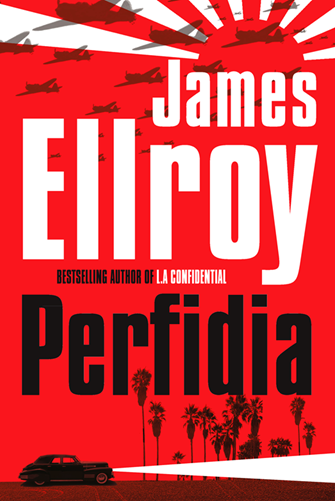 Perfidia has been out for a while now and many James Ellroy fans will have read it and formed a judgment. Personally, I thought it was a strong novel and an improvement on its predecessor Blood’s a Rover (2009), but reading what the other critics have said makes me think I’m in the minority. Don’t get me wrong, plenty of critics praised the book. It’s just that the praise felt a bit muted and the criticism more prolonged than Ellroy has come to expect. I wonder if this is the beginning of critical opinion turning against Ellroy. I think that would be an over-reaction, but to give you a sense of what I mean, I’ve compiled an overview of the mixed comments that came from reviewers.
Barry Forshaw, usually an Ellroy admirer, describes Perfidia as ‘the Finnegans Wake of crime novels’ and ‘for diehard enthusiasts only; the casual reader will melt away.’ However, he does add ‘at least Ellroy is still trying to expand the parameters of the crime novel – and perhaps we must pay him the compliment of cracking the prismatic (but exhilarating) prose that is his speciality.’
Forshaw acknowledges that Ellroy broke free of genre boundaries in his previous work, but as this is a return to the Los Angeles-set noir that Ellroy had sworn he’d left behind, can the Demon Dog of American Crime Fiction effectively live up to the standards he created for the genre? Dennis Lehane, whose themes of political corruption and of a criminal underworld often mirror Ellroy’s work, writes that some of the old motifs are looking tired:
while the endless and uncomfortable racial epithets feel true to the times and the men who utter them, the ceaseless “outing” of rumored homosexuals grows monotonous and, worse, predictable. Before I even saw the “Roosevelt” that followed “Eleanor,” I knew reference would be made to her rumored homosexual tendencies, and it was. Same went for Barbara Stanwyck and Cary Grant. The effect isn’t revelatory; it’s puerile.
But he’s more positive about the return of Dudley Smith and Ellroy’s ability to work magic with his most famous character:
In Dudley Smith, Ellroy has found the hellhound guide for his neon-noir Los Angeles underbelly. Smith, a demon removed from any concept of restraint, says at one point: “I destroy those I cannot control. I must be certain that those close to me share my identical interests. I’m benevolent within that construction. I’m ghastly outside of it.” Smith casts the same shadow over “Perfidia” that Judge Holden cast over Cormac McCarthy’s “Blood Meridian.” He’s writ large and writ evil, a monolith of corruption and utilitarian expediency. But unlike what Ellroy did with Smith’s previous appearances, here he sets his sights, to varying degrees of success, on the devil’s heart and the ways in which satanic charms often coexist with paternal benevolence. For Smith engenders loyalty as much as he does fear. In a world as sordid and chaotic as the one Ellroy depicts, the simple purity of Smith’s evil attains a kind of nobility.
Writing in the Seattle Times, Mark Lindquist is mostly positive, describing the novel as a ‘great read’ and hailing the return of Kay Lake as ‘the most engaging for me, illuminating the motives and desires of the men who are intertwined by the investigation.’ But he adds that this is unlikely to win Ellroy any new fans with so much of the narrative connected not just to the original LA Quartet, but also to the Underworld USA trilogy: ‘Your appreciation of Ellroy’s unabashed attempt at the Great American Novel will depend, in part, on your familiarity with his oeuvre.’
On Amazon the reader reviews have been more unambiguously positive, with one reviewer comparing Ellroy’s work favourably to Walter Scott’s Waverley novels. Surely the biggest compliment a historical novelist could hope for.
In the Guardian, Edward Docx is similarly awestruck, describing Perfidia as ‘a genuinely impressive feat of sustained literary energy: 90% of novelists couldn’t get anywhere near it.’ And yet Docx senses a certain inverse proportion to Ellroy’s writing. For all the brilliance of the stylistic experiments, they appear to be in equal parts maddening, a problem not helped by Ellroy’s now inescapable literary persona:
Great novelists disappear so that their characters no longer seem to partake in their creator’s sensibilities but instead become real unto themselves and thus to the reader. But Ellroy cross-infects his cast list with such similar traits and strains that they begin to flatten into collage rather than come forward as people.
The baffling contradiction of Ellroy’s persona is that he can criticise his past work in a way that bolsters his confidence about the new novels. Forshaw states that Ellroy ‘disowned’ The Cold Six Thousand (2001) before Blood’s a Rover was released. In a recent interview with Craig McDonald at the Iowa City Book Festival, Ellroy emphatically stated that his second novel Clandestine, which features Dudley Smith and references to the Black Dahlia case, does not fit into his new larger Quartet narrative. I wonder why any author would be so scathing of their past work when they’ll always be critics happy to do that for you, and what does it do to your sales when potential readers think you don’t believe in your own work?
The answer, I suspect, is that for Ellroy no standards of writing are too high. He’s already reinvented the genre several times, but with Perfidia and the Second LA Quartet, he’s come back for one more go.
Mr Campion’s Farewell – Review
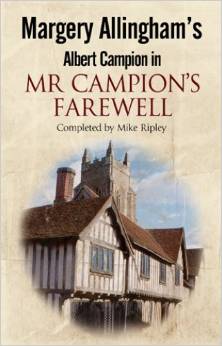 The year is 1969: Man has just walked on the moon, progressive values have led to a cultural revolution and a new age of consumerism is changing every British household. But in the sleepy Suffolk village of Lindsay Carfax, time stands still. Aristocratic detective Albert Campion arrives on the scene to discreetly investigate the Carders, a shadowy group of nine local bigwigs who are rumoured to run the entire village between them and have a demeanour that would make the Masons seem welcoming. It’s not long before Campion begins to unearth some disturbing secrets hidden beneath the bucolic veneer of Lindsay Carfax. People in the village have been disappearing and then reappearing after nine days, a number that reappears with cryptic regularity. Were the Carders involved in the fatal overdose of two archaeology students, and, if so, how long before they devise a similar end for Campion?
Albert Campion was one of the most impressive characters of the Golden Age of Detective Fiction and beyond. Mike Ripley’s triumphant resurrection of the character reads not just as a fine novel in its own right but also a remarkable piece of scholarship. Campion was the invention of Margery Allingham. The first novel in the series appeared in 1929, and after Allingham’s death in 1966, her widow Philip ‘Pip’ Youngman Carter completed one Campion novel and wrote two others before he died in 1969. With the full cooperation of the Margery Allingham Society, Ripley has completed this new Campion novel from a manuscript Pip was working on shortly before he died. The manuscript ‘contained revisions and minor corrections but no plot outline, character synopsis or plan’, and must have been a Herculean task to complete after lying untouched for over forty years. I had wondered at the outset whether I would be able to spot which parts were written by Pip and which bits were clearly Mike Ripley at work. I soon gave up on that task. The story unravels seamlessly with excitement and lashings of Wodehousian wit. Knowing a little about Ripley’s previous work such as Angel’s Unaware, I like to think Campion’s humorous encounter with a rather unimpressive archaeologist is pure Ripley:
If he had ever given the subject much thought, which he had not, Mr Campion’s ideal archaeologist would have been a tall, muscular, sun-bronzed figure; a man of military bearing, with a pencil dark moustache and gleaming teeth, dressed in jodphurs, riding boots and pith helmet. He would be fluent in at least a dozen languages – ancient and modern – of the Middle East, and be accompanied everywhere by a fiercely loyal Sikh manservant with a ruby in his turban and several curved daggers concealed about his person. He would be the sort of man who was fatherly to his army of native diggers and who would not give a fig for a Pharoah’s curse.
Dr Mortimer Casson, however, was short, skinny to the point of emaciation and had buck teeth which made him lisp when he spoke. His hair was unkempt, unwashed and unruly and Campion thought he still detected boyish curls which had survived what were clearly Dr Casson’s attempts at self-barbering. At least, Mr Campion hoped the haircut had been self-inflicted; if it had been paid for, it had been a fee extorted under false pretences.
The story is never too reliant on humour however. I was quietly moved by the portrayal of Campion who, in this story, is pushing seventy and knows he is more suited to the last days of the Victorian era in which he was born rather than the rapidly changing society of Post-War Britain. All of the old favourites are here and struggling to cope with modern society: Campion’s wonderfully caustic wife Lady Amanda, not to mention Magersfontein Lugg, a gruff ex-burglar and now Campion’s loyal servant. This makes the premise of the novel fiendishly clever. Campion walks into a village straight out of the Golden Age of Detective Fiction but this is a world in which the old rules of the genre don’t apply. A splendidly Ruritanian sub-plot involves Campion’s son and daughter-in-law visiting Monte Carlo to investigate the aging doyenne of the Carder’s spending an unaccounted for fortune in the world famous casinos.
Mr Campion’s Farewell is a crime fiction event which should appeal to new readers and long term Campion devotees. Severn House have commissioned another Campion adventure from Ripley titled Mr Campion’s Fox.
Perfidia – Review
James Ellroy’s new novel Perfidia begins with a ‘Thunderbolt Broadcast’ on K-L-A-N Radio. The salacious gossip, casual bigotry, hyperbolic and alliterative language will be familiar to Ellroy readers who remember the Hush-Hush tabloid articles which appeared in the novels of the first Los Angeles Quartet. For this second Quartet, Ellroy begins by implying he’s going to give us the Ellrovian style we have grown to love but not how we have come to expect it.
Los Angeles, December, 1941. The Japanese attack on Pearl Harbor has brought America into the war. The Japanese of LA, as American as any other immigrant group, are suddenly designated ‘enemy aliens’ and are about to suffer the indignity of internment. The LAPD’s top police chemist, Hideo Ashida, is given an exemption on the grounds of his exceptional skills and usefulness in investigating a brutal murder of a Japanese family of four, which the killer has designed to look like a seppuku. Ashida has conflict raging inside him. Guilt-ridden at how he has avoided the fate of his fellow Japanese-Americans, Ashida is quiet and precise but burning with attraction for the sultry Kay Lake. Japanese by temperament, Ashida is nevertheless fully aware he’s part of a Noir world and in love with its danger: ‘He chose this male world. He’s learning its customs and codes. It’s unbearably thrilling.’ From a quadruple murder, Ellroy weaves a typically complex plot involving eugenics and plastic surgery, red-baiting and Japanese hating, internment and shady property deals and, bizarrely, rumours of a Japanese submarine off the west coast. As a prequel, all the old stars of the Quartet are here: Dudley Smith, Lee Blanchard, Bucky Bleichert. I was also pleased to see the return of more minor characters such as Saul Lesnick, Nort Layman and Sid Hudgens, not to mention characters from the Underworld USA trilogy. Be warned, if you’ve never been inclined to prequels you probably won’t enjoy Perfidia. As a lifelong Ellroy reader, I enjoyed many of the incidental pleasures the novel provides. Ellroy fans will delight in connecting the dots from previous books. Incest has often been a theme in Ellroy’s work but here the writing feels incestuous. I couldn’t decide whether he went too far with a few details, such as the connection between Dudley Smith and Elizabeth Short. However, there is plenty of fully original material here to complement the revisionism of his regular Quartet characters. Ashida is a compelling figure, and Ellroy’s portrayal of future LAPD Chief William H. Parker, who is equally brilliant and inadequate in everything he does, ranks among his best writing.
With Perfidia, Ellroy has proved once again he is a master of historical fiction. This is World War Two told as Noir. Ellroy strips away the hindsight the reader has in viewing history. No character has any contrived understanding of what the future holds for their country. Instead there is paranoia and drug-induced madness. Dudley Smith hits on the uncertainty everyone feels when he quotes Shakespeare:
The bay trees in our country are all withered
And meteors fright the fixed stars of heaven.
The pale-faced moon looks bloody on the earth
And lean-looked prophets whisper fearful change.
This is another reference to an earlier Ellroy novel, but not from the Quartet, the quotation served as the epigraph for Ellroy’s novel Blood on the Moon (1984). Ellroy was an almost unknown crime writer when he wrote that novel. Now he is perhaps the most famous crime writer in the world. Perfidia didn’t quite leave me as moved or thrilled as his best novels such as The Big Nowhere (1988) and American Tabloid (1995), but I was gripped nonetheless, and by the last page I was left eagerly wanting more in what is bound to be an incredible Second Quartet.
Flashman and the Greatest Chronicler of the Victorian Age
The following article is taken from a talk I gave for Waterstones Lunchtime Classics series:
The character Flashman first appeared in the 1857 novel Tom Brown’s School Days written by Thomas Hughes. Hughes was a lawyer, judge, social reformer and Liberal MP. The novel is set at Rugby boarding school , which Hughes had attended, and he wrote the book for his young son who was about to attend. Hughes intended the book to be a treatise against bullying but also a celebration of school life. As the critic Naomi Lewis put it:
What makes the book live is that the whole thing is seen throughout from a boy’s view, and the boy who sees it relishes it all. Was there ever such a first day at school as Tom’s? After riding by coach through the frozen night (coffee and hard biscuit at three am.; pigeon pie and hot kidneys at 7:30) he is regaled with fearsome Rugby legends by the local John: watches two boys run a mile in 4 minutes 56 seconds; arrives at noon; goes on a tour with East; gets some new togs; takes part part in that vast rugger match (50 to 60 boys to a side – can it be?); is noticed by the giant head boy Brooke; has tea of toasted sausages; does his solo turn in the evening’s singing; gets his first impact of Doctor Arnold taking prayers and ends up being tossed in a blanket. No wonder that dayschool boys through the years have read the book with a sigh.
It’s a remarkably moral book: the sympathetic Tom and his schoolfriend’s nemesis is the bully Flashman, who roasts Tom over a fire and throws boys around in a strange game of blanket tossing. About halfway through the book, Flashman is abruptly expelled and the reader doesn’t see him again:
One fine summer evening Flashman had been regaling himself on gin-punch, at Brownsover; and, having exceeded his usual limits, started home uproarious. He fell in with a friend or two coming back from bathing, proposed a glass of beer, to which they assented, the weather being hot, and they thirsty souls, and unaware of the quantity of drink which Flashman had already on board. The short result was, that Flashy became beastly drunk. They tried to get him along, but couldn’t; so they chartered a hurdle and two men to carry him. One of the masters came upon them, and they naturally enough fled. The flight of the rest excited the master’s suspicions, and the good angel of the fags incited him to examine the freight, and, after examination, to convoy the hurdle himself up to the School-house; and the doctor, who had long had his eye on Flashman, arranged for his withdrawal next morning.
Tom Brown’s School Days was an incredibly successful work. It’s been in print consistently since the initial publication, and there have been film and TV adaptations. It was a huge hit in the US, admired by, among others President Ulysses S Grant, and Tom Hughes helped to develop a small utopian community in Tennessee based on his ideas which he named Rugby and which still exists today.
The ripples and ramifications of Arnold’s work would continue to be felt much closer to home than Tennessee however. Jumping forward into the twentieth century, in the late 1930s a young Cumbrian boy by the name of George MacDonald Fraser read Tom Brown’s School Days. Fraser loved the character of Flashman, and was deeply disappointed when he was abruptly cut from the narrative. This made a lasting impression, and 30 years later the Flashman series was born.
Fraser had a passion for reading as a child, but he was not academically gifted. His father was a doctor who wanted his son to study medicine at university. He paid for Fraser to attend grammar school (as Fraser never passed the eleven plus), but he dropped out with no qualifications. Aside from this similarity with Flashman, one can also draw connections with Fraser’s father, who also had a small role in literary history, which provides some perspective to the tone of the Flashman novels. As Fraser liked to say ‘my father buried Allan Quatermain’. The hero of H Rider Haggard’s King Solomon’s Mines (1885) and its sequels, Quatermain was based on Captain Frederick Courtenay Selous a famous big game hunter, explorer and conservationist who served with the British South Africa Company in the Matabele Wars. Fraser’s father was a medical officer attached to Selous’s Legion of Frontiersman in German East Africa, modern day Tanzania, during World War One and was present when Selous was shot dead by German Colonial police in January 1917.
In regards to his own military career, service in India gave Fraser what he regarded as a privileged insight into a vanishing world. Fraser joined the army towards the end of WWII and served in the Border Regiment and the Gordon Highlanders. He was stationed first in India and saw fierce fighting against the Japanese in the latter stages of the Burma campaign. This was important to his later development of the Flashman novels as he caught a glimpse of the dying days of the British Raj. He met a ‘Punjabi princeling’ and served with soldiers who swore allegiance to the last Emperor of India George VI. India achieved independence only a few years later.
After the war, Fraser worked as a journalist back in the UK and in Canada. He eventually rose to the position of acting editor of the Glasgow Herald. About the age of forty he decided he didn’t want to be a journalist for the rest of his career and told his wife Kathleen he was going to ‘write his way out of it’. He would claim later in interviews and his memoirs that ever since reading Tom Brown’s School Days he had long pondered the question whatever happened to Flashman; and he began writing a novel structured as Flashman’s memoir. Tom Brown and Flashman are at school together during the relatively short reign of William IV so when Flashman is expelled it is right at the dawn of the Victorian age and a wealth of narrative possibility. Fraser buttressed this with an elaborate backstory, claiming in the introduction to the first novel that the Flashman papers were discovered in a sale of household furniture in Ashby de la Zouch, Leicestershire, carefully wrapped in oilskin covers and that he had been asked by Flashman’s only living relative, a Mr Paget Morrison of Durban, South Africa, to edit and arrange them for publication.
About halfway through writing the manuscript of the first novel Fraser broke his arm and couldn’t type and that brought on a period of self-doubt as to whether he should continue. It was Kathleen, a fellow journalist, who persuaded him to keep at it. She read the unfinished manuscript, and her response was to quote a line from the film Treasure of the Sierra Madre (1948): ‘Boy, you don’t know the riches you’re standing on.’ Fraser finally completed the manuscript, revising as he went along (he never did a full redraft), and he estimated the entire process had taken him about ninety hours. Alas, Flashman (as the first novel was titled) was turned down by publisher after publisher for over two years before it was picked by the small firm of Herbert Jenkins and was published in 1969.
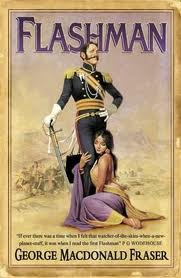
Cover artwork from the 2005 reprinting of Flashman. The background image is taken from William Barnes Wollen’s 1898 depiction of the last stand near Gandamak village during the Retreat from Kabul
The novel begins with Flashman (Fraser gave him the first name Harry which was not specified in Tom Brown’s School Days) recounting his expulsion from Rugby. He joins the 11th Regiment of Light Dragoons and is at first stationed in India and later stumbles into the Afghan mutiny. The basic premise of each novel is that despite his cowardice, through a mixture of skulduggery, cunning and sheer devil’s luck, Flashman always emerges the hero. Another feature is that Flashman is irresistible to women and has a penchant for Royal blood, some of his ‘conquests’ (or perhaps did they conquer him? Modern feminists have nothing on Victorian women) include a Maharani, Tsarina and Chinese Empress. Despite this, he has a sincere love for his wife Elspeth who, if anything, is just as adulterous as he is. Flashman recounts the disastrous Retreat from Kabul in which 4,500 British Empire troops and 12,000 civilian workers were killed in attacks led by the Afghan prince Akbar Khan. In reality, only one man survived the retreat, a surgeon by the name of William Brydon. But in the novel, Flashman survives and undeservedly becomes a hero. Over the course of the next eleven books, he would equally undeservedly accrue every conceivably honour from the San Serafino Order of Purity and Truth to the Congressional Medal of Honour, Legion D’Honneur and Knight of the Order of Bath. Aside from winning honours, Flashman also has a remarkable impact on the modern view of the Victorian age. The novels make you question your view of history and suggest that history is not made by idealistic men pursuing noble pursuits but by cockup and cowardice. For instance, Flashman inadvertently starts the Charge of the Light brigade after a heavy drinking session leaves him flatulent and frightens the horses.
Flashman runs into many historical figures in the stories, some of whose names resonate throughout history, Disraeli, Abraham Lincoln, Bismarck, General Custer, Lord Palmerston. But there are also another set of historical characters he comes across not quite as famous but equally distinctive such as Lola Montez, the actress who became the de facto ruler of Bavaria, Suleiman Usman a Borneo pirate educated at Eton, and Josiah Harlan an American adventurer who became Prince of Ghor. Harlan is a character in Flashman and the Mountain of Light (1990) set in the Punjab during the First Sikh War, he and Flashman get into a tussle over the Koh-i-Noor, one of the diamonds of Queen Victoria’s Crown Jewels. Each Flashman novel has voluminous endnotes written by Fraser to contextualise much of the history. They’re a joy to read as not only are they deeply informative, but Fraser has a dry sense of humour which contrasts with Flashman’s bawdy wit. The endnote on Josiah Harlan is particularly revealing and makes me think that Flashman is at least in part based on the characters he meets:
Josiah Harlan (1799-1871) was born in Newlin Township, Pennsylvania, the son of a merchant whose family came from County Durham. He studied medicine, sailed as a supercargo to China, and after being jilted by his American fiancée, returned to the East, serving as surgeon with the British Army in Burma. He then wandered to Afghanistan, where he embarked on that career as diplomat, spy, mercenary soldier, and double (sometimes treble) agent which so enraged Colonel Gardner. The details are confused, but it seems that Harlan, after trying to take Dost Mohammed’s throne, and capturing a fortress, fell into the hands of Runjeet Singh. The Sikh Maharaja, recognising a rascal of genius when he saw one, sent him as envoy to Dost Mohammed; Harlan travelling disguised as a dervish, was also working to Dost’s throne on behalf of Shah Sujah, the exiled Afghan king; not content with this, he ingratiated himself with Dost and became his agent in the Punjab – in effect, serving three masters against each other. Although, as one contemporary remarks with masterly understatement, Harlan’s life was now somewhat complicated, he satisfied at least two of his employers: Shah Sujah made him a Companion of the Imperial Stirrup, and Runjeet gave him the government of three provinces which he administered until, it is said, the maharaja discovered that he was running a coining plant on the pretence of studying chemistry. Even then, Runjeet continued to use him as an agent, and it was Harlan who successfully suborned the Governor of Peshawar to betray the province to the Sikhs. He then took service with Dost Mohammed (whom he had just betrayed), and was sent with an expedition against the Prince of Kunduz; it was in this campaign that the patriotic doctor “surmounted the Indian Caucasus, and unfurled my country’s banner to the breeze under a salute of 26 guns… the star-spangled banner waved gracefully among the icy peaks.” What this accomplished is unclear, but soon afterwards Harlan managed to obtain the throne of Ghor from its hereditary prince. This was in 1838; a year later he was acting as Dost’s negotiator with the British invaders at Kabul; Dost subsequently fled, and Harlan was last seen having breakfast with “Sekundar” Burnes, the British political agent.
Incidentally Rudyard Kipling’s The Man Who Would Be King (1888) was partly based on Harlan, and the Flashman books are full of literary references suggesting that Flashy has inadvertently inspired some of the great works of literature. Royal Flash (1970) is based on Anthony Hope’s The Prisoner of Zenda (1894), and at the end of the novel Flashman describes his story to Hope in a London club. There is another wonderful endnote by Fraser about Flashman’s reading habits:
The Flashman papers abound in erratic literary allusions – the present volume contains echoes of Donne, Shakespeare, Macauley, Coleridge, Voltaire, Dickens, Scott, Congreve, Byron, Pope, Lewis Carroll, Norse mythology, and obscure corners of the Old Testament – but it would be rash to conclude that Flashman had any close acquaintance with the authors; more probably the allusions were picked up second hand from conversations and casual reading, with two exceptions. He knew Macaulay personally, and had certainly read his Lays, and he seems to have had a genuine liking for Thomas Love Peacock, whose caustic humour and strictures on whiggery, political economy, and academics probably appealed to him. For the rest, we may judge that Flashman’s frequent references to Punch, Pierce Egan’s Tom and Jerry, and sensational fiction like Varney the Vampire, more fairly reflect his literary taste; we know from an earlier volume that the word Trollope meant only one thing to him, and it was not the author.
There are also many metafictional and paratextual details. In two of the books Fraser states in the intro that the text was edited before him by Flashman’s sister-in-law Grizel de Rothschild who takes a very dim view of his choice language and blasphemy (and you can see the swear words edited on the page) so we are led to believe we are reading a manuscript with one author and two editors working generations apart. In Flashman in the Great Game (1975) Flashman actually reads a copy of Tom Brown’s School Days making him a fictional character in a novel reading a novel featuring him as a fictional character. Oddly enough, there is very little scholarship on Fraser’s work, but I can help thinking that if an author such as Paul Auster or director like David Lynch were to do something as inventive that the critics would laud it for being heavy with postmodern symbolism.
There are allusions in the Flashman novels to adventures, which were never actually published as individual books. Flashman served on both the Confederate and Union side during the American Civil War and claims to have tipped things in the North’s favour during the Battle of Gettysberg, although how he managed this he never reveals. He also makes references to being aide-de-camp to the ill-fated Emperor Maximillian I of Mexico. It’s a shame these adventures did not appear in standalone volumes, possibly because Fraser claimed he didn’t like Flashman, and he couldn’t write the novels back to back as he had to pursue other projects in between. Flashman does have his redeeming features, however: he is a skilled linguist with a fantastic memory and a skill for reportage. Although he lies frequently to save his skin, in his memoirs he assures the reader he being honest to us. The reader gets a vivid picture of life in a time and place that seem completely alien to us. In Flashman’s Lady’s (1977) Flashman is stranded in Madagascar and reluctantly becomes the lover of the tyrannical Queen Ranavalona I. He gives a scary and funny portrayal of one of the most primitive, archaic, brutal and isolated societies that existed at the time. I quote the scene where Flashman first meets Ranavalona at length because it is one of the best combinations of bawdy wit with razor-sharp reportage found in the Papers:
She paced slowly to the front of the balcony and the sycophantic mob beneath went wild, clapping and calling and stretching out their hands. Then she stepped back, the girls with the silk tent contraption carried it round her, shielding her from all curious eyes except the two that were giggling down, unsuspected, from above; I waited, breathless, and two more girls went in beside her, and slipped the cloak from her shoulders. And there she was, stark naked except for that ridiculous hat.
Well, even from above and through a muslin screen there was no doubt that she was female, and no need for stays to make the best of it, either; she stood like an ebony statue as the two wenches began to bathe her from bowls of water. Some vulgar lout grunted lasciviously, and realizing who it was I shrank back a trifle in sudden anxiety that I’d been overheard. They splashed her thoroughly, while I watched enviously, and then clapped the robe round her shoulders again. The screen was removed, and she took what looked like an invalid ebony horn from one her attendants and stepped forward to sprinkle the crowd. They fairly crowed with delight, and then she withdrew to a great shout of applause, and I scrambled down from my window thinking, by George, we’ve never seen little Vicky doing that from the balcony at Buck House – but then, she ain’t quite equipped the way this one is.
What I’d seen, you may care to know, was the public part of the annual ceremony of the Queen’s Bath. The private proceedings are less formal – although, mind you, I can speak with authority only for 1844, or as it’s doubtless known in Malagassy court circles, Flashy’s year.
The procedure is simple. Her Majesty retires to he reception room in the Silver Palace, which is the most astonishing chamber, containing as it does a gilded couch of state, gold and silver ornaments in profusion, an enormous and luxurious bed, a piano with “Selections from Scarlatti” on the music stand, and off to one side, a sunken bath lined with mother-of-pearl; there are also pictures of Napoleon’s victories round the walls, between silk curtains. There she concludes the ceremony by receiving homage from various officials, who grovel out backward, and then, with several of her maids still in attendance, turns her attention to the last item on the agenda, the foreign castaway who has been brought in for inspection, and who is standing with his bowels dissolving between two stalwart Hova guardsmen. One of her maids motion the poor fool forward, the guardsmen retire – and I tried not to tremble, took a deep breath, looked at her, and wished I hadn’t come.
She was still wearing the sugar-loaf hat, and the scarf framed features that were neither pretty nor plain. She might have been anywhere between forty and fifty, rather round-faced, with a small straight nose, a fine brow, and a short, broard-lipped mouth; her skin was jet black and plump – and then you met her eyes, and in a sudden chill rush of fear realised that all you had heard was true, and the horrors you’d seen needed no further explanation. They were small and bright and evil as a snake’s, unblinking, with a depth of cruelty and malice that was terrifying; I felt physical revulsion as I looked at them – and then, thank G-d, I had the wit to pace forward, right foot first, and hold out the two Mexican dollars in my clammy palm.
She didn’t even glance at them, and after a moment one of her girls scuttled forward and took them. I stepped back, right foot first, and waited. The eyes never wavered in their repellent stare, and so help me, I couldn’t meet them any longer. I dropped my gaze, trying feverishly to remember what Laborde had told me – oh, h–l, was she waiting for me to lick her infernal feet? I glanced down; they were hidden under her scarlet cloak; no use grubbing for ’em there. I stood, my heart thumping in the silence, noticing that the silk of her coat was wet – of course, they hadn’t dried her, and she hadn’t a stitch on underneath – my stars, but it clung to her limbs in a most fetching way. My view from on high had been obscured, of course, and I hadn’t realised how strikingly endowed was the royal personage. I followed the sleek scarlet line of her leg and rounded hip, noted the gentle curve of waist and stomach, the full-blown points outlined in silk – my goodness, though, she was wet – catch her death…
One of the female attendants gave a sudden giggle, instantly smothered – and to my stricken horror I realised that my indecently torn and ragged trousers were failing to conceal my instinctive admiration of Her Majesty’s matronly charms – oh, J—s, you’d have thought quaking fear and my perilous situation would have banished randy reaction, but love conquers all, you see, and there wasn’t a d—-d thing I could do about it. I shut my eyes and tried to think of crushed ice and vinegar, but it didn’t do the slightest good – I daren’t turn my back on royalty – had she noticed? H–l’s bells, she wasn’t blind – this was lèse-majesté of the most flagrant order – unless she took it as a compliment, which it was, ma’am, I assure you, and no disrespect intended, far from it…
I stole another look at her, my face crimson. Those awful eyes were still on mine; then, slowly, inexorably, her glance went down. Her expression didn’t change in the least, but she stirred on her couch – which did nothing to quell my ardour – and without looking away, muttered a guttural instruction to her maids. They fluttered out obediently, while I waited quaking. Suddenly she stood up, shrugged off the silk cloak, and stood there naked and glistening; I gulped and wondered if it would be tactful to make some slight advance – grabbing one of ’em, for instance… it would take both hands… better not, though; let royalty take precedence.
So I stood stock sill for a full minute, while those wicked, clammy eyes surveyed me; then she came forward and brought her face close to mine, sniffing warily like an animal and gently rubbing her nose to and fro across my cheeks and lips. Starter’s gun, thinks I; one wrench and my breeches were a rag on the floor, I hooked into her buttocks and kissed her full on the mouth – and she jerked away, spitting and pawing at her tongue, her eyes blazing, and swung a hand at my face. I was too startled to avoid the blow; it cracked on my ear – I had a vision of those boiling pits – and then the fury was dying from her eyes, to be replaced by a puzzled look. (I had no notion, you see, that kissing was unknown on Madagascar; they rub noses, like the South Sea folk.)
With its epic narratives, exotic locations, remarkable characters and thrilling set pieces the Flashman Papers would appear to be ripe for cinematic adaptation, but in fact there has only been one film made from the Flashman novels. Royal Flash, released in 1975 directed by Richard Lester from a script by Fraser and starring, in a terrible piece of miscasting, Malcolm McDowell as Flashman. It doesn’t work as a film for a number of reasons. Firstly, the film just doesn’t let you inside Flashman’s head in the same way that the first-person narration of the books does. Secondly, although the humour of the books is often broad it comes across as lewd onscreen. Finally, there’s no mechanism onscreen akin to the endnotes and appendices of the books which contextualises the history and gives another avenue of humour. I doubt there will be any more attempts to make Flashman films. When Fraser was working on the script of the James Bond film Octopussy (1983) Cubby Broccoli expressed an interest in making Flashman films but added that they would probably cost more to make than the Bond films.
Flashman’s impact on popular culture has been huge. Christopher Hitchens wrote that when the first Flashman was released in the late 1960s, it seemed wonderfully surreal that in the age of free love, hippies and and anti-Vietnam war protest here was a character seeing the most exotic sights in the age of empire, seducing Maharanis and inadvertently becoming a hero of Victorian society: ‘It somehow didn’t seem to “fit,” amid all the feverish enthusiasms of the late sixties, that one should be so thoroughly absorbed by the doings of a racist-sexist-imperialist-you-name-it military officer’. About a third of American reviewers, many of them academics, thought Flashman was a real character. One academic described the Flashman Papers as the most important literary discovery since the Boswell Papers, and Fraser said he always felt that no American university was going to give him an honorary degree because he had duped too many intellectuals. The impact of Flashman can still be felt today, either on twitter or in the fact that David Cameron was nicknamed Flashman after he told a lesbian MP to ‘calm down dear’. It led to a very funny spoof article in the Guardian written as Flashman claiming that he wanted to no association with the ‘squirt’ Cameron ‘pink cheeks, slick hair and I’d bet two shillings to the pound he’s never been further east than Calais’, but wouldn’t mind being compared to the Right Honourable Gideon George Osborne. Fraser wrote a few books connected to the series, Black Ajax (1997) is set in Regency England and features Flashman’s father, a hero of the Napoleonic Wars and Mr American (1980) is a novel set in England from 1909 and to 1914 featuring Flashman, now in his nineties, as a supporting character. The novels ends with the outbreak of the First World War and Flashman’s observations are quite interesting in centenary year, especially when we consider modern wars in Iraq, Afghanistan and Libya.
You think if we can keep Belgium green, or whatever colour it is, instead of Prussian blue, then hurrah for everyone. But war ain’t between coloured blobs – it’s between people. You know what people are, I suppose? – chaps in trousers and women in skirts, and kids in small clothes.” The General took a pull at his wine and grimaced. “I wish to God that someone would tell the Hungarians that their wine would be greatly improved if they didn’t eat the grapes first. Anyway, imagine yourself a Belgian – in Liege, say. Along come the Prussians, and invade you. What about it? – a few cars commandeered, a shop or two looted, half a dozen girls knocked up, a provost marshall installed, and the storm’s passed. Fierce fighting with the Frogs, who squeal like hell because Britain refuses to help, the Germans reach Paris, peace concluded, and that’s that. And there you are, getting on with your garden in Liege. But –“ the General wagged a bony finger. “Suppose Britain helps – sends forces to aid little Belgium – and the Frogs – against the Teuton horde? What then? Belgian resistance is stiffened, the Frogs manage to stop the invaders, a hell of a war is waged all over Belgium and north-east France, and after God knows how much slaughter and destruction the Germans are beat – or not, as the case may be. How’s Liege doing? I’ll tell you it’s a bloody shambles. You’re lying mangled in your cabbage patch, your wife’s had her legs blown off, your daughters have been raped, and your house is a mass of rubble. You’re a lot better off for British intervention, ain’t you?”
Fraser was personally opposed to the War Against Terrorism. Although he advocated helping the US through intelligence sharing, he was appalled to see British troops deployed to Afghanistan and Iraq. What he would have made of the present crisis we can only guess. His pacifist streak was derived from his experiences as a soldier. Unlike Flashman, there was nothing affected about his heroism. I’d recommend his memoir Quartered Safe Out Here (1992) of his time fighting the Japanese in Burma. But he was more than a good soldier and sage commentator on the futility of modern warfare: he built his writing career, despite having no educational qualifications, to become through the Flashman novels one of the foremost experts on the Victorian era. History is never dull in the Flashman Papers.
PS. I’ll be taking a break from the blog to focus on work and take a short holiday. I hope to read James Ellroy’s Perfidia and Mike Ripley’s Mr Campion’s Farewell while basking in the Mediterranean sun. I’ll blog about both in late September.
Bond Directors at their Best
There’s a lot of online debate as to who was the best actor to play James Bond. There’s a lot less, I suspect, as to who was the best director the Bond series ever had. I don’t intend to try and answer that question here, but I do want to draw attention to the directors who worked on some of the early and middle films. Dating back to the time when Pierce Brosnan revived the series as Bond, the convention has been to use a different director from film to film. The exceptions would be Martin Campbell, who directed two films, and Sam Mendes, who is currently directing his second. When the Bond series began, most of the directors helmed several films each, and thus set a fairly consistent tone for the series. Terence Young directed three films, Guy Hamilton four, Lewis Gilbert three and John Glen holds the record with five. Below I’ve embedded a clip and brief description of some of the best work of Young, Hamilton, Gilbert and Glen. I’ve tried to find scenes which exemplify the romanticism and fantasy of the series, some of which I think has been lost with recent emphasis on torture and Daniel Craig’s moody, introspective Bond.
Thunderball (1965) – Terence Young
As Fiona Volpe, Luciana Paluzzi played the greatest villainess the series has ever seen and her demise, a dance of death with Sean Connery’s Bond only a few hours after they sleep together with ‘the gun […] under the pillow the whole time’, is a wonderfully playful and wicked scene. Paluzzi retired from acting in the 1970s after never quite making the front rank, another example of the Bond girl curse. Such a shame. She was certainly one of the most compelling and sexiest actresses to have appeared in the series.
You Only Live Twice (1967) – Lewis Gilbert
Lewis Gilbert directed three of the most spectacular films in the Bond series: You Only Live Twice, The Spy Who Loved Me (1977) and Moonraker (1979). There were times when the spectacle swamped the creativity, such as in the Amazon boat chase in Moonraker when Bond is simply pushing the buttons on his gadgets to take out the bad guys. At his best though, Gilbert could perfectly convey the escapist fantasy of the series, such as in this scene from You Only Live Twice when Bond visits the Kobe docks with the Japanese agent Aki and ends up being pitted against a seemingly endless series of henchmen. I love the moment when the fight moves to the rooftop and the camera pans away to capture the full breadth of the scene. Magic.
Live and Let Die (1973) – Guy Hamilton
Guy Hamilton directed two Sean Connery Bond films– Goldfinger (1964), Diamonds are Forever (1971)– and two starring Roger Moore, Live and Let Die and The Man with the Golden Gun (1974). Perhaps the greatest moment from his four films comes in Live and Let Die: when Bond finds himself surrounded by crocodiles, he has to employ an inventive method of escape. Even the unflappable Roger Moore looks scared near these things and bear in mind no stuntman would ever be asked to do this today. It wouldn’t be quite as impressive with CGI crocodiles that’s for sure:
Licence to Kill (1989) – John Glen
Ok, ok, Licence to Kill was the film that ushered in much of the sadistic violence of the later films. Still, it was Glen’s fifth consecutive Bond film and the last film he directed in the series. It’s a film that still possesses some of that old movie magic. I can just imagine how the screenwriters came up with this scene: ‘We start with Bond shooting a guy on a boat, then he jumps underwater while the bad guys are shooting at him, has a fight with some scuba divers and escapes by water skiing behind a plane. Then the plane takes off with him holding onto the wings, he climbs inside throws out the bad guys and is on his way. Got that?’
The opening scene of the first episode of The Devil’s Crown (1978) begins with a shot of Henry II‘s tomb at Fontveraud Abbey, Anjou. Sonorous narration declares:
Henry, by the grace of God, King of England, Duke of Normandy and Aquitaine and Count of Anjou. Eight feet of ground doth now suffice for whom the earth was not enough.
Alas, burial would be an apt metaphor for this remarkable BBC drama about the early Plantagenet kings, as it was to disappear from view and was believed lost for years.
I have always regarded the early 1970s to the mid-1980s as a Golden Age of British television drama. Just look at the number of classic dramas that were produced in that period: Elizabeth R, The Six Wives of Henry VIII, The Shadow of the Tower, I Claudius, Tinker Tailor Soldier Spy (a personal favourite), Smiley’s People, The Jewel in the Crown, Edge of Darkness and The Singing Detective to name just a few. And then there are the character-actors who appear, to quote Richard Dawkins out of context, with all the ‘likable familiarity of senior partners in a firm of Dickensian lawyers’. Actors such as Peter Vaughan, Sian Phillips, Bernard Hepton, Charles Kay and Terence Rigby. Of course, there have been many brilliant dramas since the mid-1980s. But I think in later years, a certain conservatism set in. The BBC started to produce more and more Dickens and Austen adaptations, which all feel very safe. Looking back at the Seventies (I was born in the early Eighties mind you) TV drama just seemed more radical, daring and exciting. It’s probably no coincidence that the Seventies was an era when the British film industry collapsed and seemed to churn out nothing but sleazy sex comedies (do you remember such classics as Confessions of a Window Cleaner and Adventures of a Plumber’s Mate?), and some of our best creative talent would have flocked to TV. Indeed, parallels are striking today with the decline of Hollywood and rise of American TV channels, such as HBO, producing knock-out television.
A year or two ago, I had just finished watching a copy of the superb To Serve Them All My Days (1980). Impressed by John Duttine’s performance in the leading role, I looked up what other roles he had played. One title stuck out on his resume: The Devil’s Crown in which he played King John. At first I couldn’t find out that much about the series. The information online was minimal and at that time the episode titles on the BFI and IMDB were incomplete. The show had never been repeated or released on DVD and was listed in some sources as lost. All I could find were comment threads where people shared their memories of the show and this scratchy recording of the theme tune on YouTube. I was stunned that a major BBC drama from the late Seventies could be lost because the information that was available on the show was very intriguing. The Devil’s Crown was an epic 13 episode drama series covering the Angevin kings, Henry II, Richard the Lionheart and King John. The cast was impressive and read like a who’s who’s of thespians from British film and television: Brian Cox, Charles Kay, Jane Lapotaire, Michael Byrne, Jack Shepherd, Thorley Walters and the aforementioned John Duttine. I kept an eye on the comment threads from time to time in the hope that a copy might resurface. Then the Wikipedia page was updated to say that the BFI had a copy that was available for viewing on request. I was just about to make arrangements to visit the BFI when – a miracle! – all thirteen episodes were uploaded online by some benevolent YouTube user. The following review is based on my viewing of the drama on YouTube, but I’m not going to link to it because that will increase the chances that some killjoy will have it taken down. The upload appears to have been taken from a broadcast on French television. All of the credits are in French, but thankfully there are no French subtitles or dubbing. According to the chap who uploaded it, someone has been peddling poor quality bootleg DVD copies, but I really think it’s about time The Devil’s Crown became available through the BBC Shop, and a full television repeat is also overdue.
 The Devil’s Crown begins with England ravaged by Civil War in the period known as The Anarchy. Henry Plantagenet (latterly Henry II), played with boundless charm and energy by Brian Cox, sees his opportunity to seize the crown and create a kingdom of law and order. He cuts a deal with King Stephen in which Stephen will name him his heir, excluding his sons Eustace and William in exchange for a fragile truce. Stephen’s sudden death elevates Henry to the throne. He may have been King of England, but the bulk of the Angevin Empire was in modern day France, and it was this that Henry regarded as the Jewel in his Crown, maintained through a series of political marriages and complex allegiances. Henry pays homage to Louis VII, King of the Franks, for these lands, but it is clear that Henry is the shrewder and more ambitious of the two kings, having married Louis’ ex-wife Eleanor of Aquitaine. This is a complex story to render on screen and there was a wonderful book The Devil’s Crown: Henry II and his Sons by Richard Barber which was written in conjunction with the series to clarify many of the political intricacies. Barber does a good job of separating fact from fiction in the Medieval period, but some of the myths (or should I say debatable points?) such as Eleanor’s ‘Court of Love’ are kept in the TV series as they make for good drama. This allows the writers to embellish the role of the famous troubadour Bertran de Born, played with wonderful worldly cynicism by Freddie Jones.
Henry’s first real test as king comes from his former friend Thomas Becket (Jack Shepherd). Elevating Becket to Archbishop of Canterbury from his position as Lord Chancellor seems at first to Henry to be a canny decision. It soon backfires when Becket starts using the Church as a rival power to the Crown. This is a daring portrayal of the Henry/Becket feud. Other depictions I have seen, such as the 1964 Becket with Richard Burton in the the title role, have portrayed the Archbishop as becoming pious and devout in office, ultimately achieving martyrdom for his faith. Jack Shepherd plays Becket as malevolent and power-hungry, hellbent on trying to keep the Church above the law. Upon Henry’s death Richard the Lionheart (Michael Byrne) succeeds him and this is where, in my opinion, the series starts to flag. A huge amount of screen time explores Richard’s reputed homosexuality, nothing wrong with that per se but it only seems to contribute to Richard’s endlessly sullen, introspective and unreliable character. Byrne is a good actor but he struggles to make this Richard interesting. There are still compensations in these middle episodes. Zoe Wanamaker has a wonderful early role as Richard’s neglected wife Berengaria of Navarre and when Richard is on Crusade there is one of the most quietly effective scenes of the whole series. Richard fails to take back Jerusalem from Saladin and his Saracen warriors. A truce is negotiated whereby Crusaders and Christian pilgrims are allowed to visit the holy city, but Richard doesn’t go thinking that he only wants to walk into the city having taken it back from Saladin. Lying in his bed, weak from disease, he imagines one of his soldiers visiting the city. We then cut to a monologue by a Crusader describing the city. What makes this scene truly brilliant is that although we are interested in historical fiction to see how life was different in the past we are also interested in how it was similar to life now. The Crusader of the scene could be a loquacious working class man of the present day and his monologue is all the more interesting in that he describes the city in colloquial, unfussy language before ending with his disappointment that they never took it back for Christendom. Richard quietly sobs, just as heartbroken that he has let down this man as much as he has failed God. The final episodes focus on the disastrous reign of King John. By this time Louis VII has been succeeded by his much more ambitious and cunning son Philip II (Christopher Gable), who is determined to rid France of Angevin influence. John has developed a reputation for evil in popular culture and this is how he first appears in the show, a libertine coveting power to dispel his nickname of John Lackland. His brutal revenge on the young rebellious Arthur, Duke of Brittany is reminiscent of Richard III and the Princes in the Tower. Gradually though John becomes more sympathetic. The collapse of the Angevin Empire had become inevitable even before his reign but naturally he gets the blame for it. Unlike his brother or father however John has a sincere love of England, and his defeat at Philip’s hands, forcing him out of France, only serves to reinforce his love of a country his ancestors regarded as a nation of serfs. The events surrounding the signing of Magna Carta also provides much intrigue. It has long been claimed that John never intended to honour the terms of the Great Charter, but The Devil’s Crown shows how the Barons had never expected him to sign anyway and, knowing this, John decides to sign to wrongfoot them.
You might think having waited so long to see The Devil’s Crown I would either be inevitably disappointed or slightly biased to believing the show is a lost classic. Truthfully, I would rank The Devil’s Crown among the very best of television dramas that were made in the period. It’s compelling, intriguing and often moving. Brian Cox himself described the show as ‘very ahead of its time’. However, there are flaws, and not just the lull in the episodes focusing on Richard which I mentioned. Memorably, all historical TV dramas during this period were shot on set, even the exterior scenes. The BBC just did not have the money to stage big battles or build convincing sets of castles and the like. It could lead to some imaginative storytelling as the sets were quite malleable. On being told that Louis VII has married Constance of Castile, Henry, then in Normandy, sees it happening before his eyes on the same set. There are downsides. For some outdoor scenes they simply paint the floor green and the walls blue. A modern audience especially might find this jarring. The Devil’s Crown may have been commissioned following the success of I Claudius, indeed there are some striking parallels between the two stories. A wise and mostly benevolent monarch Henry II/Augustus is undermined during his long reign by his scheming and cunning wife Eleanor of Aquitaine/Livia who strongly favours her son for the succession Richard/Tiberius who ultimately is more suited to soldiering than leadership and has a brief and unhappy reign. The parallels only go so far, however, as Eleanor of Aquitaine is just not as malevolent as the arch-villainess Livia. There were several historical dramas made during the period that tried to follow the I Claudius model of political intrigue and murder in a Royal Court. The Borgias and The Cleopatras were both panned for being lurid as they lacked the benevolent central character that Derek Jacobi’s Claudius provided, the stammering, much-mocked boy who grows up to become historian and Emperor. The Devil’s Crown also suffers a little in comparison to I Claudius, but ultimately it’s a drama that deserves to be judged on its own merits of which there are many. This is a fascinating rendering of a very complex and brutal period of history. I’m delighted to have seen it after first hearing of it a few years ago. It now belongs to television history. I hope that it finally reaches the wider audience it deserves.
American Psycho: The Novel With a Killer Soundtrack
I finally read Bret Easton Ellis’ American Psycho (1991) earlier this year. It had been on my bookshelf for ages, but I was rather intimated by its reputation for gory violence, so I put off reading it. Friends of mine who read the novel said it made them feel physically sick. Anyway, having read it, I can see why American Psycho is considered such a brilliant work, but I did feel Ellis went too far with the gory images. Patrick Bateman is an investment banker in late 1980s New York. By day he obsesses over his routine, which seems to include very little working and mostly indulging his taste for clothes, drugs and fashionable restaurants. Bateman’s string of consciousness narration can go on endlessly about these things and to the most minute detail. There’s a great deal of black humour here. Bateman and his colleagues swagger around like pre-Revolutionary French Aristocrats. There is another side to Bateman that he hides from his colleagues and from his fiancee. Whether he is acting the role of a yuppie or that of a serial killer, Bateman seems to be the walking embodiment of the banality of evil. Be warned, this novel is not for the squeamish, and it tends to get more violent as it goes on. There is a startling twist in the conclusion (which I won’t give away here). I will say,however, it’s not the sort of twist that throws attention from one suspect to another, but rather one that questions the status of the entire text. It’s what you might call Keyser Soze syndrome, although American Psycho was published four years before Soze appeared (or did he?) in The Usual Suspects. Reading this novel after the 2008 economic crash only adds to it prophetic feel, although perhaps Ellis’ negative view of Wall Street and consumerist society is just too simplistic.
For me, the highlight of the novel was the short essays on Bateman’s favourite pop groups– Genesis, Whitney Houston and Huey Lewis and the News– which appear sporadically in the narrative, although I was left slightly puzzled as to the reason for their inclusion. Was Ellis trying to say that Bateman’s love of music was every bit as shallow and consumerist as his other obsessions (some of Bateman’s musical analysis is hilariously superficial) or does it point to a deeper side to him? According to this essay in The Tech it is definitely the former: ‘Being a vapid soul, he likes only the most vapid bands […] By taking these pop bands so seriously, so analytically, Ellis succeeds in showing just how soulless and transparent these bands are.’ Still, if the essays are deliberately flawed, they are still as well written as anything you would find in a music magazine, and are a joy to read in what can be a gruelling book. Below, I’ve quoted some passages on music from the novel and embedded the relevant group’s music video.
Genesis
My favourite track is “Man on the Corner,” which is the only song credited solely to Collins, a moving ballad with a pretty synthesized melody plus a riveting drum machine in the background. Though it could easily come off any of Phil’s solo albums, because the themes of loneliness, paranoia and alienation are overly familiar to Genesis it evokes the band’s hopeful humanism. “Man on the Corner” profoundly equates a relationship with a solitary figure (a bum, perhaps a poor homeless person?), “that lonely man on the corner” who just stands around.
Whitney Houston
The ballad “Saving All My Love for You” is the sexiest, most romantic song on the record. It also has a killer saxophone solo by Tom Scott and one can hear the influences of sixties girl-group pop in it (it was cowritten by Gerry Goffin) but the sixties girl groups were never this emotional or sexy (or as well produced) as this song is.
Huey Lewis and the News
“Give Me the Keys (And I’ll Drive You Crazy)” is a good-times blues rocker about (what else?) driving around, incorporating the album’s theme in a much more playful way than previous songs on the album did, and though lyrically it might seem impoverished, it’s still a sign that the new “serious” Lewis – that Huey the artist – hasn’t totally lost his frisky sense of humour.
Two Eurosceptic Thrillers
The controversial appointment of Jean-Claude Juncker as President of the European Commission brought to mind two novels I read recently. Both could be described as Eurosceptic thrillers and feature the European Union greatly increasing its powers through the office of an EU President. I first wrote about Eurosceptic crime fiction for the British Politics Review and examined this increasingly promising genre through the works of conservative writers such as Andrew Roberts, Michael Dobbs and Alan Judd. Since then, I’ve been on the lookout for anti-EU novels by authors on the other side of the political spectrum. I’ve haven’t quite found them, but I have discovered an interesting diversity of opinion, i.e. degrees of Euroscepticism.
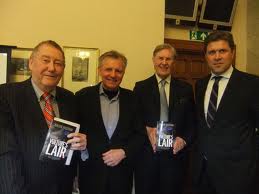
Hallur Hallson with Eurosceptic MP’s
Firstly, we have the Icelandic thriller Vulture’s Lair (2012) by Hallur Hallson. The 2008 economic crisis was particularly severe in Iceland, and their poor financial state prompted Iceland’s political class to discuss the possibility of joining the EU. This prospect seems to have filled Hallson with dread. Set in a dystopic future where the Icelandic Republic has been abolished and become a mere province in the ‘Great European Empire’, Vulture’s Lair includes a myriad of sub-plots, which mostly revolve around Krummi, a patriotic fisherman who begins the narrative making a minor protest in Brussels against EU regulations. Krummi is eventually spurred on to uncover a vast conspiracy with parallels to the assassination of JFK.
Perhaps something is lost in translation, although its impressive to think that one in ten Icelanders have written and published a book, but I struggled through large sections of this novel. Hallson seems much more at ease propagating nationalism than other Eurosceptic writers I have read, and the novel is just bogged down by too much preachy flag-waving. That being said, there are some wonderfully diverting passages on Icelandic poetry and folklore, and the plot really picks up to an exciting climax if you can wade through the first two-thirds.
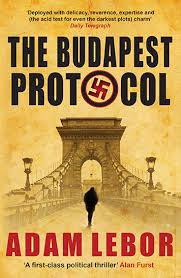 Do you remember Nigel Farage’s ill-judged comments about people not wanting Romanian neighbours? Adam Lebor’s The Budapest Protocol (2009) provides a nice antidote to them. Another dystopic thriller set in a Europe where the EU has greatly increased its power and the first directly elected President of Europe holds crypto-fascist views, Lebor wrote The Budapest Protocol to highlight the plight of the Romani or Roma people in Central Europe. Indeed, a donation of every copy sold goes to the Medical Foundation for the Care of Victims in Torture. In the novel, Alex Farkas is a British journalist based in Hungary, much like Lebor. After the murder of his grandfather, Farkas begins to investigate a conspiracy centered round the titular document, which turns out to be an agreement signed by Nazis in the last days of the Second World War to create a Fourth Reich through a new economic empire (if you think that’s far-fetched read some of Lebor’s research on this issue). Part of the narrative concerns sinister plans to implement a mass sterilisation of the Romani population under the guise of being a fingerprinting program. Lebor is a writer who writes movingly and sympathetically about ethnic minorities. The appendix documents real cases of abuse against the Roma people including sterilisation.
All in all, two very interesting Eurosceptic thrillers. Although if any readers could highlight some more examples from this small but growing genre I’d like to hear from you.
Birthday Blog
WordPress have notified me that it has been five years since Chris Routledge and I started the Venetian Vase together. At first the stats were low. It wasn’t until I wrote a piece on the wonderful book A Friendship: The Letters of Dan Rowan and John D. MacDonald 1967-1974 that we started to build a readership, and I began to see blogs were a great place to publish original research. Thanks to everyone whose either been regular reader or just dropped by, and here’s to the next five years.
Perfidia – New Video on Front Cover
A regular reader has alerted me to this cool video of how Print Club London have created screen prints for James Ellroy’s new novel Perfidia. Note that this is different, and I would argue better, artwork than the front cover I blogged about back in March:
And here is the finished cover:


 The Venetian Vase