Orson Welles’ Touch of Evil Memo
The 2008 50th anniversary DVD of Orson Welles’ film noir masterpiece, Touch of Evil includes the three principal versions that exist of the film. Firstly, there is the theatrical version, which audiences saw upon the film’s release in 1958. This version had been re-edited by Universal Studios’ staff editor Aaron Stell after Welles had submitted his rough cut. It also includes several additional scenes that were directed by Harry Keller. After viewing this version, Welles wrote a 58 page memo to Universal’s head of production Edward Muhl, suggesting multiple editing changes and essentially pleading with the studio to respect his original artistic vision. This memo was largely ignored. The second version is the preview version shown to audiences before the film’s release, which incorporated some of Welles’ requests. This was discovered by Universal in 1976, and was regarded as the definitive version for some time. Finally, there is the restored version that was re-edited by Walter Murch in 1998. Murch, along with producer Rick Schmidlin attempted to restore the film to Welles’ original vision by following his suggestions in the memo as closely as possible. The result is impressive and definitely makes for the most dramatically satisfying version of the film. Welles was an extraordinary creative artist, and like many great artists he was also a controversial figure. Whether anyone can truly be faithful to an artist’s conception of his work is of course open to debate. Filmmaking is a complicated process involving hundreds of people. Critics of Welles have argued that his constant battles with the studios over the editing of his films during his career may have been to protect his reputation as a creative genius. Did Welles invent these battles with the studios to protect his reputation? Not in this case. Reading the original memo, it is clear that Welles is trying to restore the clarity of individual scenes and the coherence of the overall narrative. For instance, in the now famous opening tracking shot, the viewer sees an anonymous figure place dynamite set to a timer in the boot of a car. Then, a man and a woman get into the car and the camera follows them as they drive around the border town of Los Robles. This incredibly tense scene loses some of its effect in the theatrical version, as Henry Mancini’s score is the background music, and the opening credits appear throughout the scene, distracting from the car bomb . Welles wanted the music to change as the car passes the various clubs of Los Robles, each club playing different music. As Welles put in his memo:
I assume that the music now backing the opening sequence of the picture is temporary…
As the camera moves through the streets of the Mexican border town, the plan was to feature a succession of different and contrasting Latin American musical numbers – the effect, that is, of our passing one cabaret orchestra after another. In honky-tonk districts on the border, loudspeakers are over the entrance of every joint, large or small, each blasting out its own tune by way of a “come-on” or “pitch” for the tourists. The fact that the streets are invariably loud with this music was planned as a device throughout the entire picture. The special use of contrasting “mambo-type” rhythm numbers with rock’n’roll will be developed in some detail at the end of this memo, when I’ll take up details of the “beat” and also specific of musical color and instrumentation on a scene-by-scene, and transition-by-transition basis.
It is clear from Welles’ words that his vision of the film is so complex and intricate that to remove or change even the smallest detail creates a negative effect which ripples throughout the whole film. What seems curious and unusual in one scene is given perfect clarity by later events in the film. Welles’ artistic vision suffered as he was ahead of his time. Tracking shots have become reasonably common in films today, and DVD releases almost always feature multiple deleted scenes that never made it into the final cut. Welles ended his memo:
I close this memo with a very earnest plea that you consent to this brief visual pattern to which I gave so many long hard days of work.
Now at last audiences can finally see a version of Touch of Evil edited as close as possible to the film Welles intended it to be:
Wellesnet has the full text of Welles’ memo to Universal, with their own annotations. Below you can watch the opening tracking shot as Welles intended it in the restored version:
Mitchum Plays Marlowe
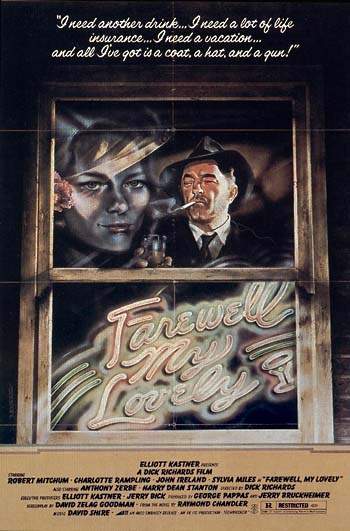 Browsing Roger Ebert’s archive of film reviews at the Chicago Sun-Times I came across a 1975 review of Dick Richards’s adaptation of Farewell, My Lovely. Robert Mitchum, who plays Marlowe, was 57 years old at the time. He was too young for the role in the 1940s, when Dick Powell chose to revitalize his career playing Marlowe in the stylish 1944 Edward Dmytryk adaptation, Murder, My Sweet. Back then Mitchum was making a name for himself in B-Westerns and would probably not have matched the performances of Powell or of Humphrey Bogart in Howard Hawks’s 1946 classic, The Big Sleep. But by 1975 Mitchum was a perfect Marlowe, with his hang-dog expression and tough, world-weary eyes. Where Bogart made Marlowe a real tough guy, we can imagine Mitchum as a Marlowe who is genuinely “tired and full of no coffee”. He was so perfect in fact that he was persuaded to star in Michael Winner’s bungled, transplanted adaptation of The Big Sleep (1978). There Mitchum looked the part, but the film was a mistake.
Roger Ebert’s review of Farewell, My Lovely is glowing. It is worth remembering this often overlooked film as one of perhaps three adaptations of Chandler’s work that manage to do justice to Chandler’s vision. Late in his career Mitchum was a truly great Marlowe. Worth a read:
Los Angeles, 1941. A run-down street of seedy shop fronts and blinking neon signs. Music from somewhere features a lonely horn. The camera pans up to a second-story window of a flophouse. In the window, his hat pushed back, his tie undone, Philip Marlowe lights another cigaret and waits for the cops to arrive. He is ready to tell his story.
These opening shots are so evocative of Raymond Chandler’s immortal Marlowe, archtypical private eye, haunting the underbelly of Los Angeles, that if we’re Chandler fans we hold our breath. Is the ambience going to be maintained, or will this be another campy rip-off? Half an hour into the movie, we relax. “Farewell, My Lovely” never steps wrong.
London in Detective Fiction
Back in November 2009 Esme Miskimmin, the editor of 100 British Crime Writers, gave a talk at the Bishopsgate Institute in London on the subject of “Investigating the City: London in Detective Fiction from the Victorian Era to the ‘Golden Age'”. Her talk is part of the Bishopsgate Institute podcast and is available here, or via iTunes.
The Pitfalls of the True Crime Genre
David Peace gave a recent interview on the US publishing website Galleycat in which he argued that crime fiction writers should focus on real life cases in their novels:
There’s so much that happens in real life that we don’t understand and we can’t even fathom. I don’t really see the point of making up crimes. The crime genre is the perfect tool to understand why crimes happen.
There is much to admire in Peace’s argument. After all real life crimes have formed the basis for his successful Red Riding Quartet novels and his current Tokyo trilogy. Peace has claimed his biggest literary influence is the novels of James Ellroy, and again there is a strong historical foundation to Ellroy’s LA Quartet and Underworld USA novels. If I were to add one caveat to Peace’s argument it would be that crime novelists should avoid meddling in what is commonly called the ‘true crime’ genre.
After the phenomenal success of his novel based on the unsolved murder of Elizabeth Short, The Black Dahlia (1987), Ellroy became much sought after for his opinion on theories as to who killed Elizabeth Short. A Los Angeles Times journalist named Larry Harnisch developed a theory in which he named a Dr Walter Bayley as a plausible suspect in the murder of Elizabeth Short. Ellroy endorsed Harnisch’s theory despite the evidence being entirely circumstantial and suppositional. Dr Bayley was suffering from a rare form of Alzheimer’s disease at the time of Miss Short’s murder and died shortly thereafter. Harnisch claims that Bayley’s condition was capable of inducing homicidal urges which may have triggered the murder. Most Dahlia commentators including the crime novelist Joseph Wambaugh, believe Bayley’s condition would have rendered him unable to commit such a physically and psychologically challenging act.
In 2003, a retired LAPD Homicide Detective named Steve Hodel was to publish his own theory in the book Black Dahlia Avenger. Steve Hodel’s hypothesis bears striking resemblance to the fictional solution Ellroy posited in his novel fifteen years earlier. Hodel’s father, Dr George Hodel was a physician who was based in LA for many years. Upon his father’s death, Hodel found two photographs in his belongings which he believed to be of Elizabeth Short. This led Hodel to begin an investigation into the connection between his father and the Black Dahlia. Ultimately Hodel came to the conclusion that his father was the murderer of Elizabeth Short, and his mutilation of the body was inspired by the work of the Surrealist artist Emmanuel Radnitsky, better known as Man Ray. Dr Hodel was good friends with Man Ray, and Detective Hodel claims he was inspired by Man Ray’s painting Les Amoureux (the Lovers) (1933) and his photograph Minotaur (1934) in how he tortured and posed the body of Miss Short at the site she was found, an abandoned lot at 39th and Norton, Los Angeles. Aside from the unusual parallels with his own fictionalisation of the murder being inspired by the Comprachios in Victor Hugo’s The Man Who Laughs (1869) , Ellroy was at first reluctant to accept Hodel’s theory. By now Ellroy was a sager judge of the many pitfalls of true crime writing, and he could see flaws in Hodel’s theory that he had not originally spotted in the work of Harnisch. There is contention as to whether the photographs Hodel discovered amongst his father’s belongings are actually Elizabeth Short, or even the same woman in either photograph. However, between the publication of the hardcover edition of Black Dahlia Avenger and the paperback one year later, documents were released which showed Dr Hodel was the LAPD’s prime suspect for the murder during the original investigation. This was enough to convince Ellroy to give a measured endorsement for Hodel’s theory in the introduction to the paperback edition. But the controversy surrounding Black Dahlia Avenger would not end there. Ellroy was angered that Hodel hypothesised that his father’s friend and associate Fred Sexton is a plausible suspect in the murder of Ellroy’s mother. The murders of Geneva Hilliker Ellroy and Elizabeth Short have always been symbiotically and elliptically linked in Ellroy’s work so for a True Crime writer to make the link literal seems both implausible and opportunistic.
Bizarrely, Hodel is not the first writer to theorise a similar connection. In 1992, Janice Knowlton published a much ridiculed book titled Daddy was the Black Dahlia Killer. In it she claimed that she witnessed her father murder Elizabeth Short when she was a child, and the memory had only recently resurfaced after years of being psychologically repressed. Upon discovering Ellroy was writing a factual book on his mother’s murder, My Dark Places (1996), Knowlton contacted Ellroy claiming her father also killed Geneva Hilliker Ellroy. Thus, Ellroy the novelist has inadvertently inspired a true crime sub-genre in which two writers have theorised that the murderer of Elizabeth Short is the same man or a man who was connected to the murderer of Geneva Hilliker Ellroy. Both Hodel and Knowlton claimed their father was the guilty man.
The parallels between Hodel’s theory and Ellroy’s original fictional solution in The Black Dahlia may just be odd coincidence. On the other hand, it does highlight the flaws of the true crime genre as a whole. Crime novelists write stories as part of a narrative structure in which, more often than not, the mystery is resolved in the denouement. True crime writers often attempt to do the same thing, but real life is more complex and often does not produce such neat resolutions. Thus, true crime writers often twist the facts to suit their narrative.
Below is a video of Steve Hodel describing the compelling evidence that strongly suggests that his father was the Black Dahlia killer. He also describes his more contentious theories that his father is a plausible suspect in the Zodiac killings and several other notorious murders:
Read my follow-up post, A Message from Steve Hodel on the Black Dahlia Case.
YouTube and the Louise Paxton Mystery
I like YouTube and I find myself spending more and more time on there. My visits are usually spent watching clips of American television comedic stars of the 1950s, 60s and 70s such as Jackie Gleason, Dean Martin and Johnny Carson. You watch these guys and you realise what is missing on television today. Recently, I discovered a series of videos that are very different and much more modern. Louise Paxton’s channel page and her series of strange and frightening videos has caused some fierce debate in other YouTube videos and on the comment threads. Her videos use the medium of YouTube to create a mystery narrative video-by-video in a more updated form of serialisation. In the first few videos (which were all made and posted in 2007), the twenty-three-year-old Louise Paxton explains how she is starting a video blog to keep in touch with her friends, as she is moving from her home town of Norwich to an apartment in London. She is rather vague about her reasons for the move, and a number of motives are subtly suggested. She is trying to make a new start after a difficult end to a long-term relationship, and her grandmother has passed away leaving her inheritance money, which Louise uses to put down a deposit on an apartment. The first few videos are not menacing at all. They mostly show her enjoying her new home. But then a new narrative begins to emerge. Louise starts to believe she is the victim of a stalker. The videos show her up late at night too terrified to sleep: she can hear strange noises at her door, shadows flicker across the screen and things begin turning up in her flat for no apparent reason. Is it all in her mind? Is she really the the victim of a stalker or is it a case of the paranormal? The tension builds and the final video contains a truly shocking climax. It is of course all a hoax, although there appears to be plenty of internet users who think it is genuine. The videos are supposed to be casual blogging but they are in fact well acted and directed episodes in a serial internet drama. The videos seem to be partially inspired by Gothic drama and are vaguely reminisicent of Orson Welles’ 1938 radio broadcast of War of the Worlds, which fooled thousands of Americans into believing they were genuinely being invaded by aliens. To perform such an elaborate hoax is ethically dubious, but the videos are genuinely compelling and the perfect alternative to television in our internet age.
Below you can watch one of the first videos in which Louise believes the stalker is at her flat. Although it is well worth watching all 38 episodes in order.
Read my follow-up post, Zoe Richards and the Louise Paxton Hoax. Also, here’s my interview with writer-director Andrew Cull who created the Louise Paxton mystery.
Reuniting Raymond and Cissy Chandler–Updated 09.09.2010
 For the past year or so Raymond Chandler aficionado Loren Latker has been working to have the ashes of Cissy Chandler reunited with the remains of her husband Raymond Chandler, who is buried in Mount Hope cemetery in San Diego. Loren has spent quite a lot of time investigating Chandler’s relationship with Cissy and his detective work helped with putting together my post last year to commemorate the 50th anniversary of Chandler’s death. Loren has a useful Raymond Chandler timeline on his Shamus Town site which corrects many errors and omissions from the two Chandler biographies.
Chandler had a difficult relationship with Cissy, who was almost 20 years older than he was, but she was the love of his life and there is little doubt that he wanted them to be together in death. Yesterday an application was filed on Loren’s behalf by lawyer Aissa Wayne in the San Diego court to have Cissy’s ashes disinterred and moved to the Mount Hope cemetery. The application goes before a judge on April 26th at 2.30pm
Update 18.03.2010: Loren is starting an email campaign to persuade the judge that the Chandlers should be together. He says “Have people email me and cc Aissa Wayne at aw@waynelawgroup.com, and tell us that they wish to see Pearl Cecily Eugenia Chandler reunited with Raymond Thorton Chandler.” Update 8.04.2010: A campaign web page, which includes copies of Raymond Chandler’s will and codicil, is here.
Loren explains more about Cissy’s family, about the process of having her remains moved in this segment from his wife’s show on Talk Radio One.
Updated 09.09.2010: Yesterday the San Diego court granted the petition to have Cissy’s remains moved to the grave of her husband. More here.
Great Crime Reporters – Jerry Capeci
Perhaps you haven’t been reading about the legal problems of Danny ‘the Lion’ Leo, the current Boss of the Genovese Crime family. But for those of you who are, like me, grimly fascinated with all things to do with the Mafia (or La Cosa Nostra as it is known to its members) then there is only one place to read about Danny ‘the Lion’ and a host of other Mafia-related stories and that is Jerry Capeci’s Gang Land News website. Capeci is America’s leading Mafia expert. He began writing his Gang Land column for the New York Daily News in 1989, and the column went online in 1996. Capeci has also co-authored (with Gene Mustain) three major books concerning the Mafia: Mob Star: The Story of John Gotti (1988), Murder Machine: A True Story of Murder, Madness and the Mafia (1992) and Gotti: Rise and Fall (1996). What sets Capeci apart from other crime reporters is that he understands people’s fascination with the traditions and the rules of the criminal secret society. Public fascination is one of the factors that led to Mario Puzo’s Mafia family drama The Godfather (1969) becoming one of the bestselling novels of all time. Capeci leaves no ambiguity that he personally finds the Mafia’s actions to be morally repugnant. Although he is prepared to occasionally criticise the F.B.I. if he feels they are subverting justice to ensure a conviction, which has often happened through their use of the controversial RICO Act, in many ways a precursor to the anti-terrorism Patriot Act.
Capeci is particularly knowledgeable about the late Boss of the Gambino Crime family, John Gotti. Gotti is perhaps symbolic of the public’s fascination with the Mafia as he revelled in his reputation as a gangster who was elevated to celebrity status. Gotti became the Boss of the Gambino family after orchestrating the assassination of its then Boss Paul Castellano in 1985. He was found not guilty of a host of criminal charges in three separate criminal trials, subsequently earning the nickname ‘the Teflon Don’, as nothing would stick to him. Gotti was finally found guilty on charges of murder and racketeering in 1991 and sentenced to life imprisonment. Capeci’s book Gotti: Rise and Fall is widely regarded as the definitive biography of the Mob Boss. Capeci wanted Gotti to write the introduction to the book himself. Gotti refused, so Capeci wrote the introduction as John Gotti, using his extensive knowlege of the gangster to try and imagine how Gotti would introduce his life story.
You can read a segment from the introduction below:
Back in ’87, when I beat this case a little girl prosecutor tried to fuck me up with, a real frame job, a guy comes running down the street. This was when the fuckin’ Mets weren’t no lay-down Sally team. The guy says, “Queens has two world champions. The Mets and John Gotti!”
I was on the cover of Time. People. New York. I don’t know how many fuckin’ others. I lose track. They wrote songs about me and played’ em on Howard fucking Stern. Fuckin’ public television did a big show on me. It was right after they did one on Eleanor Roosevelt or maybe Winston Churchill, some famous fuck, I don’t even remember.
They called me lots of names. Johnny Boy. Dapper Don. Teflon Don. Prince of Mulberry Street. Two with fuckin’ “king” in it – King of the Volcano. King of Queens. Naturally, they also called me the Godfather. You gotta go read the book to understand them all, but just John suited me fine. People get famous, they only need one name. Cher. Madonna. Magic. Michael. John.
Recently I wrote a post about a wonderful book of correspondence, A Friendship: The Letters of Dan Rowan and John D. MacDonald 1967-1974. Dan Rowan was a nightclub comedian who found tremendous success on television with his anarchic variety show Rowan and Martin’s Laugh-In. At the advice of a mutual friend, Rowan became pen-pals with the crime novelist John D. MacDonald. The book covers the seven years of their correspondence and the letters end when their friendship ended suddenly in 1974.
One aspect of the book that I am beginning to rediscover is the penetrating insight that the letters express regarding the complexity of the creative process. The majority of Rowan and MacDonald’s conversation is focused on the inner workings of the production of Laugh-In. Rowan frequently vents his frustration about issues such as trying to get certain sketches past the censors, the omnipresent threat of cancellation and maintaining the high quality of the show through all six series. By comparison, MacDonald is slightly more guarded in describing his writing process for the Travis McGee series of novels. At one point in the correspondence, when their friendship was at its closest in 1968, it seemed that Rowan and MacDonald might actually work together on a television series. Rowan describes his vague idea to MacDonald:
One day at the beach at Manasota Key I was lying in the sun waiting for the Dutchman to come and take a walk in search of shark’s teeth. As usual there were no people in hearing distance and it was naturally silent. A sudden loud squawk made me blink my eyes open, and peering through that red, bright haze I first saw a crab just emerging from his hole not three feet from me and his open mouth aped the sound I had heard which had come from a large blue heron. It struck me as funny at the time and made me think that the relation between sight and sound is tenuous; that we are often in the midst of wondrously fascinating things and are unaware of them.
Rowan’s idea developed out of vagueness into something more substantial, albeit he would never get to the stage of having a finished working script. Rowan wanted the show to consist of an abstract series of scenes which would explore the relation between sight and sound, or more importantly man’s unawareness of this wondrous connectivity:
EXAMPLE: The guard in the Metropolitan Museum, surrounded on all sides by some of the world’s art treasures, reading Playboy. Bored and unseeing he spends his life with beauty and isn’t aware of it.
EXAMPLE: The steelworkers in the open hearth of the mill, surrounded by gigantic wonders, blazing heat and ear-splitting noise, looking at a print on a workshop wall of one of the art works at the Met.
Rowan’s idea for two scenes do not contain a linear structure but do have some striking parallels. This was abstract and original material for a comedian. Perhaps it is even more revealing to read that MacDonald was very interested in being involved with the show:
About your idea. I like it. D likes it. I want to let it sit on one of my back shelves for a time and ripen before I make any comment. I know right now that it is a highly creative and stimulating and kind of timeless thing. It is what just here and there, infrequently, the best of the foreign directors will do. And there is so much scope in making visual comment on the way people anthropomorphize things.
Son, I would be right proud and happy to have something to do with a thing like that. Once upon a time Dorothy walked through the main public park in St. Pete and saw a lady on one of the benches, so withered and frail she looked a hundred and nine. She was reading, with avid concentration, a magazine called Your Future.
It is remarkable to think what a unique addition this project would have been to the careers of Rowan and MacDonald. It would have been unlike practically anything Rowan had done before, but at least Laugh-In was renowned for its quickfire, zany sketches with little or no connectivity. That mad-cap style evidences itself in this idea, but comes through in a more sombre art-house form. For MacDonald it would have been an even bigger departure in style. Critics have argued that in crime fiction every scene, character, even line of dialogue has to connect as part of a larger narrative puzzle. In this unnamed project the connectivity is deliberately more fluid and allusive. Only MacDonald’s science fiction novels could be seen as a comparable career shift from his main identity as a crime novelist. Of course all of these points are now academic. The television show never happened. Laugh-In proved to be the peak of Rowan’s career, not the launch-pad to better things he had hoped it would be. Rowan and MacDonald’s friendship came to an end and they never worked together professionally other than to publish their correspondence in A Friendship, shortly after they reconciled in 1986. But the idea itself has been explored by other artists before and since Rowan conceived his never producued television series. As MacDonald comments Rowan’s idea is similar to the work ‘of the best foreign directors’. He is probably referring to European film directors of the time such as Luchino Visconti and Federico Fellini. But in those cases stylised sequences are part of a wider, coherent narrative. Rowan’s idea is perhaps too slight for a television series. Once the viewer finishes marvelling at the originality of the concept, the whole thing is in danger of becoming tedious very quickly. Still it is remarkable to imagine a crime writer and a comedian working on a project that was completely different from anything they had done before. It is a testament to Rowan and MacDonald’s skill as creative artists that they would attempt such a project, and it is a terrible shame that it was never completed.
David Cage’s Heavy Rain
Heavy Rain, the new Playstation 3 video game is released today, and it is receiving a lot of good publicity for its innovative, groundbreaking style. Written and directed by David Cage, Heavy Rain takes the form of a mystery thriller with the player in charge of one of four main characters hunting a child killer. Unlike a mystery novel or film, the moral choices the player makes affect the outcome of the story. It is ironic that this particular game is billed as artistic, since mystery fiction is often dismissed as not being an art form of itself. Yet with this game David Cage hopes to elevate the video game format to a new level of respectability. The reviews so far are mixed, the Telegraph argues that the dialogue is poor, but the Evening Standard has an interview with the American writer and director Neil LaBute in which he talks of the excitement that Heavy Rain is generating in Hollywood. All in all, we will have to wait to see if Heavy Rain becomes the Citizen Kane of video games.
You can watch the trailer to Heavy Rain below:
Mildred Pierce Remake and Homosexuality
The A.V. Club has the story that H.B.O. has finally greenlit a remake of Mildred Pierce. Mildred Pierce (1941) is one of James M. Cain’s best novels and it was originally adapted into a film noir classic by Michael Curtiz in 1945 with Joan Crawford in the title role. Kate Winslet is to play Mildred, ‘the woman of stone’ and it will be directed by Todd Haynes. Unlike the film version the remake will be adapted into a five part mini-series, and according to early reports, homosexuality will be a major theme. Haynes is openly gay and homosexuality has been a theme in much of his past work. Crawford is a gay icon, although only in retrospect is that term applied– it is fair to say that she did not intend to be. I find it difficult to see where homosexuality is a major theme of the novel. Unless you read Mildred’s obsessional love for her horrible daughter Veda as being rooted in sub-conscious lesbianism, but this would be a reductive analysis of the narrative. Not every adaptation has to be literal, Michael Curtiz’s version is a brilliant film, but a murder is added to the narrative which is not in the novel to make the story seem more traditionally film noir. Another reason to consider that homosexuality is not important to the novel is that it is fairly well known that Cain was homophobic. In another classic Cain work, Serenade (1937), the lead character John Howard Sharp is an opera singer who is being blackmailed by a male colleague and probable former lover. Although the character of Sharp is sympathetic, the portrayal of homosexuality is not. Sharp says of his affliction:
Every man has five per cent of that in him, if he meets the one person that’ll bring it out, and I did, that’s all.
Cain claimed to have scientific backing for his views on homosexuality, but he never considered it to be a valid form of love. There is an intriguing anecdote in Roy Hoopes excellent biography of Cain. Cain was friends with the British actor Charles Laughton. Laughton liked Cain because Cain could spot things in his film performances that were lost on his other friends. One night Laughton took Cain to see his film The Ruggles of Red Gap (1935). The film is a comedy in which Laughton plays an English butler who, through an unusual set of circumstances, ends up working for a hick family in the American West. When Cain mentioned to Laughton that the butler was merely a comedic exaggeration of Laughton himself, Laughton burst into tears as Cain had inadvertantly reminded him of his very poor former life in England. Laughton recovered from this embarrassing moment and invited Cain to his house to look at some of his recently acquired art pieces. Cain accepted, but while he was looking at the art he noticed that Laughton was staring at him intensely, which made Cain feel uncomfortable. Cain made his excuses and left. He would never see Laughton again. Hoopes’ take on the situation was that Laughton had broken the convention of friendship which states that friends should not be too intimate with each other. However, there are differing accounts as to what happened. Laughton’s wife Elsa Lancaster claimed that Laughton was a homosexual and that their marriage was a sham to conceal his sexuality. Did Cain break off contact with Laughton because he discovered he was a homosexual? And if so, was Laughton staring at Cain out of desire that night at his house?
Of course these questions are academic. It would be a shame to remember one of the greatest American crime writers, which Cain was, as merely a homophobe. That being said, it is difficult to see how homosexuality is a major theme of Mildred Pierce, and it will be interesting to see how Todd Haynes intends to make it one.
Below is a clip of Joan Crawford as Mildred Pierce. Crawford won an Academy Award for her performance, which definitely ranks as one of the finest of her career:


 The Venetian Vase