The Secret In Their Eyes: Campanella, Borges, Bolano
I was predisposed to suspicion about Juan José Campanella‘s crime drama The Secret In Their Eyes (El Secreto De Sus Ojos) as it had beaten two absolutely stunning films – Michael Haneke’s The White Ribbon and Jacques Audiard‘s A Prophet – to the best foreign film Oscar earlier this year. I had suspected the traditional conservatism of the academy to have won out – a conservatism that saw Guillermo Del Toro’s bold political fantasy Pan’s Labyrinth lose to the rather stolid drama The Lives Of Others in 2007. However, my interest was piqued about Campanella‘s film for a number of reasons – the critical comparisons to Borges, the fact that I had never seen any cinema from Argentina before, and the (admittedly more tenuous) proximity of the film’s release to the English translation of Roberto Bolaño’s Central and South American masterpiece 2666, which (amongst many, many other things) played upon the conceits of the whodunnit and police procedural with a decidedly Borgesian narrative strategy. Borges is, of course, Argentina’s 20th century literary godhead, and the idea that this Buenos Aires crime drama could have absorbed some of the narrative genius of that city’s great writer was too exciting to resist.
The relatively sedate, two-shot approach to the film’s first half-hour lulled me into thinking that perhaps the academy had indeed plumped for relatively safe territory, and that I might be in for a repeat of the tiresome experience I had watching the cinematic adaptation of The Girl With The Dragon Tattoo earlier in the year. However, to my delight this initial approach merely lays the groundwork for a subsequent narrative fragmentation that both beguiles and devastates. Campanella bides his time carefully, building character’s histories and circumstances delicately and indirectly, before employing an ever increasing set of technical and formal flourishes which, rather than providing style for their own sake, actually mirror the insecurity and unsteadiness that underpins the central murder case. The tipping point – around halfway through the film – is a dazzling continuous five-minute take involving a police pursuit around a football stadium that begins with a helicopter shot hundreds of metres above the arena. From this point onward, the preceding solidity of the film’s narrative – the shot technique, the camera movement, the framing – begins to loosen and fragment, analogous to personal loyalties and hidden betrayals spiralling outward and muddying already murky waters. Campanella also sets up a series of mirroring counter-plots within the main narrative, principle among which is a genuinely affecting unrequited love story that visually and thematically touches against the central murder plot on a number of occasions without feeling the need to amplify or overstate the connections.
I will not spoil the film’s climax – during which the narrative fragmentation reaches hitherto unprecedented levels – but I will state that Campanella manages to deliver a quietly devastating ending that resists the kind of cheap clean-up and closure favoured by many detective dramas while still remaining narratively satisfying. I wish that the film had ended about three minutes before it actually did – if you see the film or have seen it you may know what I mean – but this cannot damage the excellent and emotionally satisfying climax already laid down.
So, is it like Borges? Well…no. The comparisons turn out to be erroneous – any film that could claim to be strongly influenced by Borges would have to lean more strongly toward avant-garde narrative technique – David Lynch’s Inland Empire (with its circular record-groove narrative motif) is a good recent example. The Secret In Their Eyes is ultimately too technically ‘straight’ to narratively resemble the finest works of Borges. This is not Campanella‘s fault of course – as far as I am aware he made no such narrative claims for the film personally. Is it like Bolaño? It is certainly closer to the spirit of his writing than to Borges, particularly in its focus upon the emotional correlation between the lives of policeman and killer, as well as the spectre of political corruption that lies over both this film and 2666. The baffling decision to give the film a mid-August release date, when it would have found a very appreciative home in October or November (and the inevitable and depressing shortage of UK prints) has meant that despite critical acclaim the film has failed to make the optimum impact. As it still lingers around cinemas nationwide, there remains time to appreciate this film before its diminishment on the small screen.
Ray and Cissy Chandler to be Reunited
I’ve written before about the campaign to have the ashes of Cissy Chandler, wife of Raymond Chandler, moved from the storage facility where they have been since her death in 1954, and placed next to those of her husband. This morning, Loren Latker, who has been leading the campaign, wrote to say that on Wednesday a San Diego court granted the petition to have the ashes moved. Naturally, he plans to celebrate with Gimlets at the grave.
Loren, his wife Dr. Annie Thiel, lawyer Aissa Wayne, and many others, have put a lot of effort into getting this result and I’d like to thank them and everyone who signed the petition that was at the top of this blog over the summer. Sign On San Diego has more:
An unfinished chapter in the life of Raymond Chandler has all the drama,Hollywood links and detective work of one of the author’s suspense novels.
It began 56 years ago when the cremains of his beloved wife, Pearl Eugenia “Cissy” Chandler, wound up on a storage shelf at San Diego’s Cypress View Mausoleum.
The celebrated detective novelist, who was despondent after her death and died 4½ years later in La Jolla, is buried a mile away at the city-run Mt. Hope cemetery.
Update: I was interviewed a few weeks ago by John Rogers of the Associated Press about Chandler, his wife, and Loren Latker’s efforts to reunite them. The article has shown up in The Guardian, among other places.
The Flaws in Stieg Larsson’s Millennium Trilogy

Noomi Rapace as Lisbeth Salander
Stieg Larsson’s Millennium trilogy was a part of my Summer reading, and it was a very enjoyable experience to spend hours of my time completely hooked on the dark and riveting tales of computer hacker Lisbeth Salander and crusading journalist Mikael Blomkvist. So much has been written about the Millennium trilogy that I doubt I could add much to the praise, but what struck me in particular was Larsson’s brilliant handling of many varied plots and crime sub-genres. The narrative seamlessly moves between and merges elements of the locked room mystery, whodunnit, corporate intrigue, political conspiracy thriller and historical fiction.
However, as Chris has argued on these pages, the concluding volume of the trilogy, The Girl Who Kicked the Hornet’s Nest, is certainly the weakest of the series. I suspect the editing process had not been completed at the time of Larsson’s death as the novel seems far too long and needs refining. Without meaning to sound killjoy or to give away any spoilers, here are a few other areas where I felt the third novel was disappointing:
There is a long sub-plot involving Blomkvist’s occasional lover Erika Berger leaving Millennium magazine to become editor of a powerful national newspaper. While this is an entertaining and suspenseful diversion it seems to go on forever and the payoff is underwhelming.
I never found the character of Ronald Niedermann to be plausible. Niedermann is a psychopathic giant who is incapable of feeling pain, and whenever he is around the story descends into hokum.
About two hundred pages before the end of the third novel it becomes fairly obvious that the bad guys are screwed and the good guys become annoyingly self-righteous and verbose. The climactic courtroom trial seems to lose all suspense as a consequence.
Again, these are minor quibbles which, on the whole, don’t take away from Larsson’s brilliance as a writer and the Millennium trilogy’s reputation as a stunning achievement in crime fiction. There is an element of tragedy in reading the novels as we know Larsson never lived to see their remarkable success. I was left hungry for more and would love to see a fourth novel if the manuscript ever emerges, and if Larsson’s partner Eva Gabrielsson is ever awarded the fair settlement that she deserves. Although I would hope a fourth novel, despite Larsson’s passing, would receive a more vigorous editing and even redrafting process than The Girl Who Kicked the Hornet’s Nest.
The Hellish Majesty of Robert Aldrich’s Kiss Me Deadly
From the downward-scrolling opening credits onward, everything is going south in Robert Aldrich’s extraordinary screen adaptation of Mickey Spillane’s Kiss Me Deadly. Indeed, those bizarre credits give the viewer an early indication that they aren’t in the stately John Huston-era of film noir anymore. Made in 1955, a mere half-decade after Huston’s darkly majestic The Asphalt Jungle, Kiss Me Deadly makes like that movie’s punk half-brother – a screeching, disreputable, amoral and finally apocalyptic scrape through the gutter, where the death of honour and morality are allied to something far more universally sinister.
The first ancestor the film thumbs its grubby nose at is none other than Spillane himself. Screenwriter A.I. Bezzerides, who described his feelings towards the material as ‘contempt’, wrote P.I. Mike Hammer as a sadistic bullying misogynist and pimp – a more grotesque take on the character than Spillane had explicitly outlined. Moreover, Bezzerides added a completely new element to the screenplay – a mysterious suitcase with a lethal secret – which takes the film from being an unusually tough noir into altogether stranger territory (Spillane’s response to the film, according to Bezzerides, was not a happy one).
Differences from the more established noirs of the period are immediately obvious through a series of audacious technical manoeuvres on Aldrich’s part. Camera angles are ‘dutched’, shots float much looser that the straight framing of earlier works like Jacques Tourneur ‘s Out Of The Past and Huston’s The Maltese Falcon, and most surprisingly cameras are perilously mounted to real cars, unlike the back-projection driving we so strongly associate with the Hollywood of that period. In a sense this risky last technique is closely tied to the atmosphere of the film – this is dangerous noir, freed from the moral dilemmas of Humphrey Bogart and Sterling Hayden, and Ralph Meeker’s portrayal of Hammer creates an anti-hero in the truest sense, a man not so much immoral as operating on his own personal distorted plane of ethics. The portrayal of violence is absolutely astonishing for a film of the time – the shot of Cloris Leachman’s writhing naked legs as she is tortured at the beginning of the film proved too much for the British censor, who trimmed several minutes from the print. A later scene in which Hammer interrogates a corrupt coroner allows the audience to anticipate some imminent trouble through the coroner’s refusal to hand over a key found on a dead body. When Hammer inevitably resorts to violence – smashing the coroner’s fingers in a desk drawer – the audience is doubly horrified to see several inserted shots of Hammer’s grinning face as he indulges in his favourite pastime. The ethical complexity of Bogart’s closing speech in The Maltese Falcon feels like something from a different planet, let alone the previous decade.
All of these elements make the film feel noticeably more contemporary than many other noirs of the period – indeed the mobility of the camera seems to prefigure the Nouvelle Vague techniques of Truffaut and Godard that would presently dominate cinema. In fact, Kiss Me Deadly has proved surprisingly influential as the years have passed. The most obvious comparison to make is the direct homage (practically an in-joke) paid by Tarantino with Pulp Fiction’s glowing suitcase, but the film’s techniques and imagery have also been referenced by Alex Cox, Steven Spielberg and David Lynch (the beginning and ending of Lost Highway contain shots of a rushing highway and an exploding beach-house that are startlingly similar).
While the majority of the film follows the traditional noir plot template – a death followed by a convoluted search for a mysterious MacGuffin – it is in the final twenty minutes of Kiss Me Deadly (specifically the new material added for the adaptation) where the film leaves reality behind and becomes something truly special. Hammer finally locates his strange suitcase in a locker. The box is hot to the touch and when partially opened emits a blinding light and a deeply unnerving guttural noise. The contents of the box are later indirectly referred to as radioactive material by a secondary character, and this has remained the received opinion when the film is discussed, and while the second world war is never explicitly referenced, there seems to be a sense in which Aldrich and Bezzerides suggest that the horrors of the box are closely allied to it (the piece of music playing shortly before the climactic opening of the box is Chopin’s Revolutionary Etude – allegedly the last piece of music played on free Polish radio before the Nazi invasion). However, both director and screenwriter are clearly far too canny to allow this to remain simply a Cold-War era nuclear reference. Indeed, the contents of the box appear ultimately to embody the hell that the characters have been circling for the majority of the film’s running time. The visual and sound design of the contents of the box suggest that Aldrich was interested in far more than a ‘nuclear panic’. The disturbing noise that accompanies the light sounds like a series of tape loops of white noise and human voices. Biblical and mythological references (Pandora and Lot’s wife among them) litter the second half of the film. When Spielberg melted a bunch of high-ranking Nazis at the climax of Raiders Of The Lost Ark a quarter of a century later, the visuals and sound effects employed to depict metaphysical wrath were strikingly similar. The fate of those who open the box is closely tied to an implied judgement on their belief that it has some kind of financial value, and constitutes old-testament punishment in the most grandiose style.
Inevitably, in the final scene the box is fully opened – by Lily Carver (Gaby Rodgers) – and the blinding light and fire engulfs everything. In the original version of the film, Hammer and his secretary Velda were not seen to escape and the final shot was of the beach house containing the box exploding – the implication being that everybody died in the apocalypse. A recently found full ending (from Aldrich’s own collection) actually shows the couple escaping into the sea and watching, purgatorially half-submerged, as the house burns. This uneasy, unsettling ending – that deliberately allows its characters to dodge judgement while leaving precisely nothing resolved – feels much more apt for this horrible, amoral world, a conclusion as iconoclastic as everything that has preceded it in this brilliant, infernal film.
David Hering is the editor of Consider David Foster Wallace, released by Sideshow Media Group on August 30 2010.
Elmore Leonard’s Cat Chaser
I first started writing reviews for The Reader Online in 2007, and I have written sporadic pieces for them since then. I have just written a review of Elmore Leonard’s 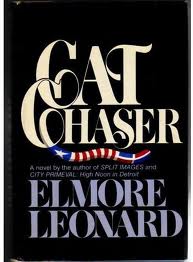 Cat Chaser as part of their ‘Recommended Reads’ series. You can read it here. If you’re interested in reading some of the other reviews of crime books I’ve written for the Reader, you can click on the links below:
The Secrets of Harry Bright by Joseph Wambaugh
The Wycherly Woman by Ross MacDonald
Tinker, Tailor, Soldier, Spy by John Le Carre
Prison in the Work of Eddie Bunker
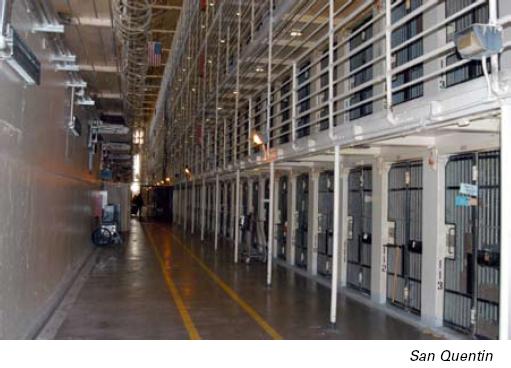
San Quentin Prison
I have just finished reading Stark by Eddie Bunker. Bunker apparently wrote the novel some time in the late 60s and/or early 70s. The manuscript was discovered after his death and published by No Exit Press in 2008. It is an entertaining, somewhat driftless novel which follows the misadventures of the drug addict and grifter of the title, Ernie Stark. Any Bunker fan will enjoy reading some more of his work (No Exit Press also published several posthumously discovered short stories of Bunker’s in the collection Death Row Breakout), but both works fall far short of Bunker’s best novels. One of the reasons Stark is just a tad disappointing is that it lacks the graphic and harrowing depictions of the American prison system and the discrimination against ex-cons which made No Beast So Fierce (1973) and Dog Eat Dog (1995) so gripping and powerful.
Bunker’s knew the prison system well from his own experiences. For the first forty years of his life, Bunker was in and out of prison (mostly in) for a series of violent crimes. In 1950, at the age of seventeen, Bunker became the youngest inmate ever to enter the notoriously brutal San Quentin prison. The death row inmate Caryl Chessman‘s cell was back-to-back with Bunker’s. According to Bunker’s widow, Jennifer Steele, in the afterword to Stark it was Bunker’s contact with Chessman that may have indirectly inspired him to start writing:
They (Bunker and Chessman) spoke through the ventilator pipes about literature. One day a convict surreptitiously brought him a folded magazine under a hand towel and handed it to him through the bars. He opened it up. It was a copy of Argosy magazine. On the cover, the lead piece was “Cell 2455, Death Row by Caryl Chessman” A light bulb exploded. He couldn’t believe it! Writers went to Harvard or Yale or Princeton. Chessman had also been raised by the State. If Chessman could write a bestseller, then why couldn’t he?
It would be a long journey from being a San Quentin inmate to becoming one of America’s greatest crime writers, and it is exactly this journey that makes Bunker’s life-story as extraordinary as any novel. Perhaps the final chapter of this story should be what we could learn today about Bunker’s grim depiction of the realities of the U.S. penal system–that is not to say that Bunker regarded everyone who worked for the Justice system as perpetrating an injustice and that criminals are always wronged and harmless beings. Bunker was skilled at playing moral tricks on the reader, as all of his novels are told from the point of view of unapologetic criminals, and the reader is inclined to root for the leading character no matter how heinous his crimes become. Despite, or perhaps because of this criminal viewpoint, it is fair to say that Bunker’s work could soften even the sternest opponents of prison reform. On this side of the Atlantic, the two big American debates that are most frequently reported are usually gay marriage and healthcare reform. A reappraisal of Bunker’s work might add prison reform to that list, thus if a crime writer can be a good direct or indirect advocate of social change then Eddie Bunker would be one of the best of them.
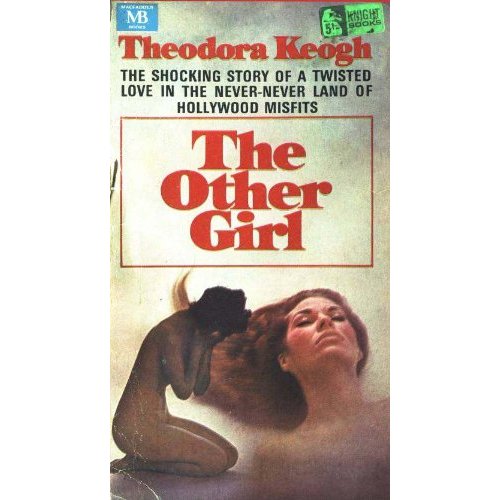
Theodora Keogh’s The Other Girl
It was a privilege to write a piece for The Rap Sheet’s ‘Forgotten Books’ series. I wrote a review of Theodora Keogh’s The Other Girl (1962). You can read it here.
The Killer Inside Me and the Problem of Perspective
David Hering is writing his PhD thesis at the University of Liverpool, where he is currently researching the works of David Foster Wallace and Mark Z. Danielewski. His literary reviews have appeared in the Journal of American Studies and Movable Type. He is the editor of the essay collection Consider David Foster Wallace: Critical Essays, released August 2010.
‘Just keep on using the first person. It’s easier that way’: Billy Boy Walker’s advice to psychopathic protagonist Lou Ford towards the end of Jim Thompson’s blistering novel The Killer Inside Me (1952). Walker’s suggestions slyly nods toward the evasive form Thompson adopts for his novel, whereby the reader is inescapably immersed in Lou’s sick, tormented psyche as his murderous urges boil over into several horrendous acts of violence. However, rather than a straight set of ‘seeing eye’ descriptions from Lou’s perspective Thompson employs a rhetorical device which incorporates Lou’s awareness of an audience– the reader– and his potential unreliability as a narrator. Much of the narrative suspense within the novel relies on the reader’s understanding of Lou’s duplictious nature and the discrepancy between what is said, who is being addressed and what is actually happening. Several sequences appear to be either fantasy or wilful misdirection. How does a reader square Lou’s polymath boasts about erudition and intelligence (‘I fiddle around Dad’s desk working out a couple of problems in calculous just for the hell of it’) with his lover Amy’s assertion that ‘you’re twenty-nine years old […] don’t even speak good English’? Even Lou’s confessions of his ‘sickness’ to the reader– something he witholds from others– may be only a partial admission of events, and apparently traumatic sexual events from his childhood are obscured and surpressed, even to Lou himself. Moreover, this duplicity of language is endemic to many of the general conversations held between Lou and others, notably in the dizzying double-talk with Joseph Rothman over the death of Mike (where the truth is always held at one remove or referred to indirectly), and later during Lou’s evasiveness with the police over his alibis despite both parties knowledge that he is the killer. This rich interplay between address and intention is what makes Thompson’s novel so involving. Far from a hackneyed account ‘ from inside the mind of a killer’, Thompson continually draws the reader’s awareness to the value, or lack of it, in a singular account.
Imagine now having to film this novel. How do you make this process visual without utterly compromising the ambiguity of the accounts given by Lou. Moreover, how do you represent the first-person account visually without burying your viewers under great swathes of voiceover? It’s a difficult–very difficult– task, and it has to do with what for argument’s sake we’ll call a problem of ’embodiment’. Immediately you visually embody a first-person narrator you have reduced the ambiguity with which the person refers to him or herself. A written narrative can incorporate sustained ambiguity about the person’s appearance- and not just whether the person is handsome or not, though as soon as anyone is cast then your at the subjective mercy of your audience on that point– whereas the concrete acuality of a person’s appearance on the screen is an immediate reduction of that narrative ambiguity. Any further embodied action in turn reduces the possibility of an ambiguous account of behaviour. It might be possible to retain some of the original narrative voice verbatim by including it within the film as voiceover, but as film is an inherently mimetic medium– it should, as much as possible, show rather than tell– you risk redundancy by simply importing one form into another without adaptation. Films that incorporate too much direct narration risk drowning in words, becoming a glorified audio book with accompanying moving pictures. Try to be faithful to the ‘seeing eye’ approach and you end up with a bizarre curio like Robert Montgomery’s 1947 Chandler adaptation The Lady in the Lake, which is entirely shot from the first-person perspective of Philip Marlowe, a feature-length experiment that proved unsurprisingly uninfluential.
Michael Winterbottom’s 2010 screen adaptation of The Killer Inside Me is therefore faced with this daunting challenge, plus the additional quandry of how to represent the novel’s violence, which is both gruesome and deliberatly ‘blank’, in that Lou’s narration calls attention away from his own responsibility for the acts he commits. How to adapt into a visual medium this evasive narrative voice, to give it body, a face? How to retain the protean nature of Lou’s single ‘confession’ and keep it vital for a film’s audience? The answer is necessarily to do with form, and while Winterbottom attempts some interesting formal strategies (including one absolutely masterful technique that I will discuss shortly) the resulting film simply cannot replicate the vivid ambiguity conjured by Thompson on the page, and the whole project finally collapses in a welter of narrative confusion and ugly, misjudged violence. However, the ultimate failure of the film still results in something that is often innovative and on occasion very good indeed.
I’ll elaborate. In cinema, of course, environment can become formally and visually conflated with the psyche– think, for example, of the tiny characters in vast industrial landscapes in Cassavetes’ A Woman Under the Influence (1974) or the elaborately mannered compositions of Kubrick’s Barry Lyndon (1975). Winterbottom sucessfully visually recreates the sparse nature of Central City, Texas, a place where the very scope of the landscape encourages the internalising of deviant behaviour, where a man is ‘always out where people could see him’. In one of the film’s most successful moments– notably not from the source material– Ford dreams, while asleep on a flight to Fort Worth, that he is freefalling, in a point-of-view shot, from the sky towards the vast unforgiving spread of Texas below, the enormity of the land rushing up to destroy his freefall. This tantilisingly brief and fantastical conflation of the viewer’s eye with Lou’s– the combination of perspective, psychology and environment– is frustratingly not complemented stylistically anywhere else in the film. More problematically on this point, Winterbottom later uses another POV shot to depict another character spying on Lou. This shot embodies much of what is problematic about the adaptation. If you’re going to honour the original source material’s perspective (which Winterbottom is evidently trying to do) to then include an explicitly framed perspective outside of Lou– to conflate someone else’s eye with the camera in a film that has made it clear that we are receiving mediated information from one source– is surely a massive formal mistake.
Winterbottom’s presentation of Joyce Lakeland’s beating is, unfortunately, far more than a brief mistake– it’s a complete misjudgment of the source material that has the unfortunate consequence of being so unnecessarily graphic that it sends the rest of the film’s narrative spinning, obliterating pretty much everything else about the film from the viewer’s mind. In the novel, Lou’s brutal battering of Joyce – mediated, of course, through Lou’s narration – is brief, barely half a page. However, it is the very indirect and evasive nature of Lou’s relation of the horrendous attack that makes the event so disturbing: ‘It was like pounding a pumpkin. Hard, then everything giving away at once.’ Winterbottom is faced with the question of how to visually relate this terrible assault and, unfortunately, he reaches for the gore and prosthetics. The scene – which must last a good two minutes – involves a series of cuts between a shot of Lou administering the attack and Joyce’s face in increasing, ever more brutalised condition. The scene is horrendous, a horror-movie-style ordeal for the audience , and entirely unnecessary for the adaptation. Winterbottom’s rather conflicted comments about the controversy generated by the scene – variously that he wanted to make a point about screen violence and also that he wanted to bring the horror of Lou’s psychopathic behaviour to the audience’s attention – seem to suggest a lack of confidence with how the scene eventually turned out. What needs addressing in a visualisation of that scene and indeed any of Lou’s attacks is the manner in which, in the original narrative, Lou’s narrative voice evades personal responsibilityfor what he is doing, even as he is doing it. One of the truly disturbing aspects of Thompson’s novel is the reader’s increasing realisation that despite extensive reasoning about the necessity of the killings Lou doesn’t really need to kill anybody, and that his murderous acts are actually serving a far more deeply embedded psychology that Lou will not admit to the reader or perhaps, most disturbingly, even to himself. Graphically representing Joyce’s beating simply reminds the audience – as if it needed reminding – that beating someone’s face to a pulp is a horrendous act to perpetrate and witness. The scene therefore reveals nothing about the psychology of the characters involved, and due to the misjudged lingering close-ups of gory make-up has come in for erroneous criticism that the act is somehow being relished, that the violence was amped up for publicity and even worse, that the film has misogynist intent. Such ill-informed calls – as is traditional – come from those who are unfamiliar with both novel and film, but Winterbottom has been the architect of these problems through his deviating from Thompson’s narrative structure.
It is worth mentioning here in contrast the generally positive critical reaction to the depiction of first-person violence in Mary Harron’s 2000 adaptation of Bret Easton Ellis’ American Psycho in order to further outline the difficulties in adapting Thompson’s novel. The similarities between the first-person murderous apologias of American Psycho and The Killer Inside Me are manifold. Harron made the well-judged decision when adapting Ellis’ novel to concentrate on the comic elements while scaling back the depictions of violence that would have most likely rendered the film unreleasable, and the final result is essentially a broadly played gruesome farce, deriving bonus laughs from the anachronistic depictions of 1980s fashion and technology. Unfortunately for Winterbottom, Thompson’s novel is not exactly a wellspring of humour – there is simply nothing else to adapt but the relentless torment and violence which, ironically, Winterbottom makes far more graphic than anything in Harron’s adaptation of Ellis’ much more graphic book. (Ironically, Winterbottom has previous form in successfully adapting difficult novels for the screen, with his 2005 film A Cock and Bull Story an inventive and comedically well-pitched translation of Laurence Sterne’s Tristram Shandy). The opening titles to Winterbottom’s film seem to suggest a play for the camp or the pastiche – fifties-style fonts and design – but this aesthetic is not qualified sufficiently in the film that follows for the viewer to become aware of the intentionally wry tone.
The scale of the aforementioned problems might lead one to wonder if the film manages to successfully adapt any aspect of Thompson’s narrative to the screen. In fact, Winterbottom deserves credit for employing a particular device that comes close to providing a cinematic – rather than literary – answer to the problem of how to represent the different layers of Lou’s narrative on the screen, and this most successful element is based around the film’s soundtrack. The soundtrack (as opposed to the original orchestral score, which appears very intermittently) comprises, alongside occasional snatches of Mahler, a series of honky-tonk numbers contemporaneous with the film’s early 1950s setting. One track in particular appears more than once – Spade Cooley’s hit ‘Shame on You’, crooned by Tex Williams to an unfaithful lover. Cooley notoriously murdered his wife by savagely beating her to death, and once the connection between music and murder becomes clear, Winterbottom’s strategy begins to reveal itself. The honky-tonk songs of the 1940s and 1950s, epitomised by the work of Hank Williams (who is absent here, though the point remains valid) play on a peculiar paradox – the cheerful, major chords, sweet strings and smooth vocals alongside lyrics detailing almost unimaginable pain and suffering, as well as suggestions of violence and promises of retribution. An example – Williams’ song ‘Never Again Will I Knock On Your Door’ plays out a brisk waltz rhythm as Williams details the many nights he has wept over his lost love, before the song takes on a sinister cast as the sentiment turns bitter. ‘Someday you’ll be so lonely and blue’, sings Hank, his sadness curdling into something far more unpalatable. Even a deliberately comic song like ‘Howling at the Moon’ begins with the line ‘I know there’s never been a man in the awful shape I’m in’ and ends with Williams getting beaten about the head with a monkey wrench. To include this manner of music is a genuine masterstroke on Winterbottom’s part – it enables a soundtrack to function both as a scene-setter and also a representation of the layers of cheerfulness and good manners that mask a terrible torment – an analogue to not only Lou Ford’s character, but also the manner in which Ford conducts himself and speaks to the reader. In Thompson’s novel Ford needles other characters by repeating endless cheery cliches and homilies, a habit contrived to keep other, more murderous urges beneath the surface.
In these moments, Winterbottom gets closest to articulating Thompson’s first-person narrative in a genuinely cinematic manner – to have Lou’s narrative functioning at the level of dialogue and soundtrack, something not possible on the page. This dual-track approach also effectively mirrors Thompson’s employment of two different levels to Lou’s narrative in the novel – the more murderous and uncensored thoughts appear in italics, a kind of sub-level narrative. In effect, this is a satisfying riposte to the problem of ’embodiment’ – you can represent your character physically, but also extend that character to encompass the soundtrack too, so that effectively the whole of the film is the character. The movie is Lou Ford’s character represented through sound and moving pictures. In this manner, when you’re seeing Lou physically represented onscreen you are actually only seeing a component of him. The whole cinematic experience – visuals and sound – completes the man.
It is when experiencing Winterbottom’s employment of the soundtrack in this manner that one longs for this narrative consistency throughout the rest of the film. Imagine, for example, a film that visually adopts the misdirection of Lou’s narration, so that the viewer is as confused as the reader as to whether what Lou is telling them is true and, as we hurtle towards the apocalyptic climax – which Winterbottom plays apparently straight – whether things are actually taking place at all. ‘Shame on you’ sings Tex Williams as the explosive denouement burns up the screens, and we are presented with a chintzy, 1950s-style card reading ‘The End’, further clouding our understanding of the extent to which Winterbottom considers this a pastiche. It is indeed a shame – both that the film falters so fundamentally in places but also that it comes so close to synthesising the essence of Thompson’s narrative into something cinematic, and finding a solution for the problem of the embodiment of a first-person perspective.
By David Hering
Saving Undershaw, Sir Arthur Conan Doyle’s Surrey Home
The story of Undershaw, the 1897 house which was designed by Sir Arthur Conan Doyle, and where he wrote The Hound of the Baskervilles, among other things, has been dragging on for years. In 2006 the Daily Telegraph reported that plans were afoot to convert it into separate dwellings, and that there was a risk that Conan Doyle-specific fixtures and fittings, including stained glass windows, would be lost. Since then, the house has lain empty and neglected. Developer Fossway was served with a repair order in 2008, but according to The Guardian, the house is continuing to decline. John Gibson has been running a campaign since 2004 to save Undershaw, and now he is appealing to the High Court to overturn planning permission to divide it up:
A leading expert on Sir Arthur Conan Doyle is pursuing a high court review to overturn planning permission for a developer to carve up the author’s house into separate homes.
John Gibson is using his own money to fight the case to save Undershaw in Hindhead, Surrey, one of few houses in Britain so intimately connected with a major literary figure. The house was designed by Conan Doyle, who oversaw its construction in the 1890s. It was there that he wrote Sherlock Holmes novels including The Hound of the Baskervilles. Several stories and letters refer to the house.
…
It was bought in 2004 by a developer, Fossway, but Gibson says it has since fallen into decay: “Water was running through it like waterfalls. They put in no security, and heraldic stained-glass windows were partially broken.”
In 2008, Waverley council served a repair notice on Fossway. Gibson accuses the council of failing to serve a compulsory purchase order, as it remains derelict.
Here’s a link to the Guardian article, and another to the Save Undershaw campaign website.
Back in 2007 I rounded up writers’ homes at risk for The Reader Online. It is a terrible shame that Conan Doyle’s house should still be on the list, given its significance.
A Message from Steve Hodel on the Black Dahlia Case
Back in March I wrote a piece for this blog titled The Pitfalls of the True Crime Genre. I argued that many true crime books are inherently flawed by their need to conform to novel- style narratives and clear resolutions which may be suited to fiction, but do not necessarily lend themselves well to factual reconstructions of historical cases. I had read several of the books and theories regarding the unsolved murder of Elizabeth Short, a.k.a the Black Dahlia, and used these as examples. There have been many books written about the Black Dahlia, some of them too ludicrous to be worth mentioning, but two Dahlia theorists in particular interested me: LA Times journalist Larry Harnisch and retired LAPD homicide detective Steve Hodel. Through his research on the case, Harnisch identified a Dr Walter Bayley as a plausible suspect in the murder of Elizabeth Short. After an extensive reinvestigation chronicled in his book Black Dahlia Avenger, Hodel named his own father Dr George Hodel as Elizabeth Short’s killer. What is unique about Harnisch and Hodel’s theories is that they both received endorsements from crime novelist and author of The Black Dahlia (1987), James Ellroy. Ellroy endorsed Harnisch’s theory in the documentary Feast of Death (2001), but he later changed his mind and endorsed Hodel’s theory and wrote the foreword to the 2004 paperback edition of Black Dahlia Avenger.
When I first published the post, I received an instant and somewhat critical response from Harnisch in the comments section. Then, just last week Steve Hodel contacted me. He gave me his response to some of the issues I raised regarding his theory and also an update as to what he has recently discovered in his continuing research into the case (also his thoughts on Ellroy’s various endorsements). Mr. Hodel has very kindly allowed me to post his response on this blog– you can read it below. Before reading it, however, it may be helpful for the sake of clarifying Harnisch and Hodel’s differing theories to read my original post, including the comments section. Here’s the link.
Dear Steve:
Greetings from Los Angeles.
I chanced upon your blog tonight and thought I’d pass on a couple of thoughts to keep the record accurate.
First off since your doctorate is focused on James Ellroy, I thought you and your readers might enjoy a fairly recent email letter I sent in response to a reader’s conversation with James Ellroy in France. In his email to me, Stephane Boulan passed on James’ response to his question related to his [Ellroy’s] current (2010) position on my book and the Dahlia investigation.
See my letter (here’s the link) to Stephane, which accurately lays out all of the facts surrounding Ellroy’s original contact with me and his offer to write the Foreword to the HarperCollins 2004 ed. of Black Dahlia Avenger, and the subsequent chronology of events that followed in 2004-2006.
As far as the L.A. Times copyeditor, Larry Harnisch’s vitriolic comments I will continue to ignore them as I have since my book was originally published in 2003. As most readers know, Mr. Harnisch has been “writing his own Black Dahlia book since 1997.” For the past seven years, I have tried to limit my responses to my critics with fact based follow-up investigation. In fact, for the most part, I have them to thank for pushing me on to discover additional linkage through either new witnesses, DA documents and hard physical evidence.
There has been a massive amount of “new evidence” since my original publication. Two new chapters in the paperback editions have been added and some of the most compelling new findings have come in just the past two-years. I refer only to the new evidence in my Black Dahlia investigation, not the sequel, MOST EVIL, which is a separate issue. (As those who have read it know, I make no claim that the ZODIAC case is solved, only that I believe that George Hodel needs to go to “the top of the list” of possible suspects and that DNA may well support and confirm what I believe to be a strong circumstantial case pointing to him as the likely suspect.)
For those interested in discovering all of the new Black Dahlia information and evidence I would suggest they review my extensive FAQs and “Squad Room Blogs” at my website. Too much to attempt to summarize here. One of the most dramatic new links are the 50 lb paper sacks used to carry Elizabeth Short’s body from a residence to the crime-scene, which are circumstantially linked to cement sacks documented to be at our “Franklin House” residence just three days before the body was discovered. (LAPD at the original Coroner’s Inquest testified that the large paper sacks found and photographed near the body, were used to carry the bisected parts to the crime scene.)See Frank Lloyd Wright /Cement Sack link at my Squad Room Blog:
Another interesting fact that many readers were/are unaware of was that Mrs. Betty Bersinger, the original Black Dahlia witness after discovering the bisected body on the vacant lot, then ran south with her daughter and telephoned the police from a neighbor’s residence. She made the call from the home of DR. & MRS. WALTER BAYLEY. (Unfortunately for Dr. Bayley, who died one year after the murder, some modern day self professed “experts”, discovering that the good samaritan’s husband was a surgeon, would attempt to turn Dr. Bayley into “a prime suspect.”
Another interesting fact is that in 2006 I was able to identify, locate and personally interview one of the women in the two pictures originally found in my father’s album. It turns out she was a friend of my father and the photo was taken at the Franklin House circa 1946. After obtaining a detailed in-person interview of her recollections of all the events, including her incriminating statements in support of Tamar being a victim of incest and child molestation, I then personally and publicly eliminated her photo as “not being Elizabeth Short”. This was done nearly four years ago, in November 2006, on CNN NEWS Anderson-Cooper 360. For those interested in the full story, just enter the key word “Maganda” at my website. (To date, no other investigator/researcher but myself has had contact with this witness. I am the sole source of her “elimination” as not being Photo #1. My critics readily inform readers that “her photo has been eliminated” but they never include the fact that it was done by me and me alone. The second photo (reclining nude) remains unidentified and may well be Elizabeth Short.
Finally, as to Mr. Harnisch’s comment/response to you that he, ” never claimed to have solved the Dahlia case. Never.” I would suggest he is playing with semantics. Here are two separate posted verbatim quotes written and posted by Mr. Harnisch in 1999. (That date was two years before he appeared on James Ellroy’s FEAST OF DEATH documentary in 2001 (Toronto Film Festival) and four years before the publication of my book, Black Dahlia Avenger: A Genius for Murder.):
“On the 52nd anniversary of the murder of Betty Short, nicknamed the “Black Dahlia,” I am announcing that I have identified an individual who is quite probably the killer. This is not conjecture nor coincidence, but irrefutable, concrete evidence.”
Larry Harnisch, website posting, 1999
“We may never know exactly how Betty Short was murdered. The probability is extremely high that Walter [Dr. Walter Bayley] was the killer, but there is no signed confession. “
Larry Harnisch, “A Scenario for Murder”, 1999
Wishing you the very best from across the pond.
Steve Hodel
Los Angeles
www.stevehodel.com


 The Venetian Vase