Double Indemnity House
Underthehollywoodsign has a nice piece about the house used in the film Double Indemnity as the home of Phyllis Dietrichson, played by Barbara Stanwyck. James M. Cain (author of the novel), Raymond Chandler (the co-scriptwriter) and Billy Wilder (co-scriptwriter and director) all describe the Spanish Colonial style house in sniffy tones, but it’s also interesting to note that time and shrubbery have ‘softened’ the exterior making it less noir-ish:
Few houses in the movies are better known than Barbara Stanwyck’s Spanish Colonial in “Double Indemnity.” The director Billy Wilder first shows it in an establishing shot that highlights not only its architectural features but its distinctive site–a hilly corner lot on a sparsely-built suburban street.
Though the script states the house is in Los Feliz, it is actually located in the Hollywood Dell. I’ve always thought the house beautiful and well-suited to its penninsula-shaped lot, but Billy Wilder and Raymond Chandler, who co-wrote the screenplay, could not have agreed less.
Book Trailers
Book trailers are becoming an increasingly popular method of advertising since the L.A. premiere in 2003 of the book trailer for the novel Dark Symphony by Christine Feehan. The concept is simple: a book trailer is similar to a movie trailer in that it is a short video which may feature action, animation or photographs to advertise the product.
The video below is a fine example of the medium. The trailer for John Le Carré’s most recent novel A Most Wanted Man (2008) features a short commentary by the author. The video is a well-paced, tense and atmospheric evocation of Le Carré’s world of spying and deceit:
Lawrence Block on Donald Westlake
Lawrence Block is one of the most successful crime fiction writers of his generation. He was a college dropout who began his writing career in the late 1950s churning out pornographic novels. He has managed to write roughly a novel a year for the past fifty years, creating series detectives such as Matt Scudder and Bernie Rhodenbarr, protagonist of the innovative ‘Burglar Who …’ novels. Block’s early books were often written, pseudonymously, in collaboration with Donald Westlake, who died on the last day of 2008. Here is a short video from a talk at the Mysterious Bookshop in New York in which Block talks about his friend and his novel Memory, due for release in 2010.
Ellroy in LA
I visited Los Angeles recently to interview James Ellroy, the subject of my PhD. While I was there I took some photographs of places around the city that have played an important role in Ellroy’s life. Here are a couple of them:

LA County Jail
During his years of alcoholism and substance abuse, Ellroy was arrested a total of fourteen times for offences such as shoplifting, burglary and drink driving. He served a few short sentences of ‘soft time’ in Los Angeles County Jail. At that time, the processing of new prisoners took up to ten hours and included skin-searching, delousing and blood testing.

The Bel-Air Country Club
Ellroy nearly died of a lung abscess in the late 70s, and the near-death experience made him turn his life around. Ellroy got a job as a caddy at the exclusive Bel-Air Country Club. He wrote his first novel Brown’s Requiem (1981) on a bench outside the caddyshack at the club and in his small apartment after work. He wrote the novel in a little over ten months. Two of the leading characters of the novel are to varying degrees based on Ellroy: Fritz Brown is a German-American repo man and P.I. who (like Ellroy) is obsessed with classical music; Freddy ‘Fat Dog’ Baker is an unhinged anti-semitic golf caddy, who is very loosely based on Ellroy as a younger man.
Hush-Hush
James Ellroy was only a kid in the 1950s when he started to read the infamous tabloid scandal rags of the age: Confidential, Lowdown, Rave, and Whisper to name just a few. These publications were immensely popular as they played on the public’s fascination with Hollywood celebrities and sought to expose sleazy details about famous people’s private lives. The magazines followed a quasi-McCarthyite editorial policy and often sounded more right-wing than Mickey Spillane’s Mike Hammer novels in their tone. Confidential was the most successful and longest running of the scandal rags. It ran stories on Liberace’s sexuality and Robert Mitchum’s marijuana bust. The magazine had a lurid fascination with miscegenation and would often run front page exclusives if a film star had been spotted with an African-American member of the opposite sex. Confidential often justified running these stories by claiming they were in the national interest.
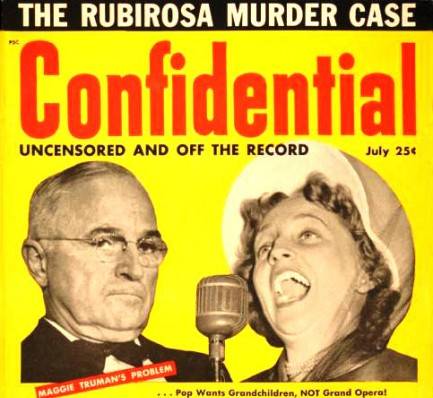
Confidential magazine cover, July 1954
Ellroy loved reading the scandal rags as they mocked idealised conceptions of American society by exposing movie stars’ dirty little secrets. The 50s scandal rags were a huge influence in Ellroy’s L.A. Quartet novels and on American Tabloid. In these novels, Ellroy’s narrative is interspersed with articles from a fictional magazine by the title of Hush-Hush. Hush-Hush is based on Confidential, but there was also a tabloid publication called Hush-Hush in the 50s. These inserted documents serve to update the reader of narrative events which have taken place outside of the leading characters purview. In the novel White Jazz, they alleviate the burden of reading Dave ‘the Enforcer’ Klein’s fractured, staccato first person narration. However, the articles are also difficult to read, as Ellroy cleverly parodies the sensationalist tone of Confidential by filling Hush-Hush articles with comically excessive use of alliteration and onomatopoeia. Ellroy uses Hush-Hush as a form of contemporary Greek choric narrative, commenting on the action with a knowledge and style that goes beyond the limits of the main characters. There are moments when the magazine becomes more directly part of the story, such as in American Tabloid when the magazine, backed by anti-Castro Cuban exiles, hastily publishes a special edition reporting the success of the Bay of Pigs invasion of Cuba– only to be humiliated when the invasion is an outright failure. This leads to the demise of Hush-Hush in the novel. In reality, the heyday of the scandal rag ended due to ongoing legal problems and declining circulation. Yet, their seedy and outrageous portrayals of 50s society have been immortalised in Ellroy’s fiction.
Agatha Christie Week: September 13th-20th
The Bookseller has a run-down of events taking place in honour of Agatha Christie this September (she was born on September 15, 1890):
Agatha Christie fans Kate Mosse, Val McDermid and Jasper Fforde are to appear at the Southbank Centre in London on 16th September to discuss the work of the mystery author, as part of this year’s Christie Week.
Besides events at libraries and at festivals around Britain, BBC Radio 4 will be broadcasting a series of afternoon readings. [Link]
Meanwhile, here’s Monty Python’s Christie tribute:
Jack Webb and The Badge
Jack Webb will forever be remembered as the creator, producer and star of the phenomenally successful television series Dragnet. Dragnet began as a radio show in 1949 and made its television debut two years later. Webb starred as the hero, Sergeant Joe Friday of the Los Angeles Police Department. Webb wanted the show to be as realistic as possible and every episode was shot in a semi-documentary style. It also featured many genuine police terms, such as MO (method of operation), PV (parole violator) and 488PC (petty theft). Webb had tremendous respect for people who worked in law enforcement, and the show was actually designed as propaganda for the LAPD. The LAPD had earned itself a horrendous reputation for corruption after numerous scandals in 30s and 40s. Webb worked closely with LAPD Chief William H. Parker to clean up its image in the public mind.
When viewing Dragnet today, it does not seem to be a particularly Realist work. Webb gives a suitably rigid performance as the morally rigid Sgt Friday. Perhaps a better example of Realism and the LAPD is The Badge (1958), the book Webb wrote as a companion piece to Dragnet. Censorship laws of the time were more relaxed in publishing than they were for television. Webb used The Badge to portray the LAPD’s investigation into some of the City of Angel’s most infamous crimes, crimes too violent and disturbing for 1950s television. The book contains a famous ten page synopsis into the Elizabeth Short (a.k.a. the Black Dahlia) murder investigation. There are also pieces on the Brenda Allen scandal, the murder of the Two Tonys, the Club Mecca arson case and many more dark moments in LA history. But what is more important now than both Dragnet and The Badge is how the latter inspired the greatest crime fiction writer alive today. In 1959, a young boy named Lee Earle Ellroy was given a copy of The Badge from his father, Armand Ellroy, as a gift for his eleventh birthday. Since his mother’s murder the previous year, Lee had become a voracious reader of kid’s crime books, but it was the gripping and terrifying crime stories in The Badge that would inspire him for life. Lee Earle Ellroy changed his name to James Ellroy upon publication of his first novel Brown’s Requiem in 1981. That novel includes a fictionalised account of the Club Mecca arson case (renamed as Club Utopia). Ellroy’s masterpiece The Black Dahlia was published in 1987, twenty-eight years after he first learned of the case in The Badge. The Brenda Allen and Mickey Cohen scandals that rocked the LAPD appear in The Big Nowhere (1988). The gangland slaying of the Two Tonys, Tony Brancato and Tony Trombino, appears in White Jazz (1992). L.A. Confidential is less inspired by material gleaned from The Badge, than it is in paying tribute to the book itself, as the character Detective Sergeant Jack Vincennes works as a technical consultant on the fictional television programme, Badge of Honour, which is based on Dragnet.
In his introduction to the 2005 republication of The Badge, Ellroy paid tribute to Webb and the impact his book had on his literary career:
Books attract the inner brain and leave their virus there. Books rarely shape a writer’s curiosity whole. Books rarely give him sustained subject matter and a time and place to re-create anew. I’m anomalous that way. I got lucky at the get-go. It was one-stop imaginative shopping. I found all my stuff in one book.
Today Ellroy is as staunch a supporter of the LAPD as Webb ever was. Ellroy has defended the LAPD’s actions during the Rodney King and Rampart scandals. In recognition of this, the LAPD presented Ellroy with a replica police badge inscribed with Sgt Friday’s number 714. Also, Ellroy has been awarded the LAPD’s highest honour, the Jack Webb award.
Here’s a clip of Webb as Sgt Friday in a famous scene from Dragnet.
Louis Menand on Pynchon’s ‘Inherent Vice’
Thomas Pynchon’s new novel Inherent Vice, appears on August 4th 2009 and it is a detective novel of sorts. Pynchon has dabbled in detective fiction before–The Crying of Lot-49 is nothing if not a mystery story–but Inherent Vice is more explicitly genre-driven. According to Louis Menand’s review in this week’s New Yorker, it is ‘a spoofy take on hardboiled crime fiction’, with a pothead for a detective, named Larry “Doc” Sportello. Spoofing the hard-boiled novel is easy to do and by now probably a little pointless, but maybe Pynchon can do something new with it.
Like the concept he outlines for Pynchon’s book Menand himself seems a little tired. His research into what makes private eye stories tick seems to extend only as far as Chandler’s famous essay ‘The Simple Art of Murder’ (1944) and certainly no further than the old chestnut about Howard Hawks and what happened to the chauffeur. It’s lazy stuff. The review is based on the conceit that all private eyes are more or less alike and as a result makes some serious mistakes. Maybe they are the same mistakes Pynchon makes, maybe not, but they are stupid and lazy nonetheless. Here are a few.
Menand uses Ross Macdonald’s Lew Archer as evidence that the most important element in private eye fiction is the detective. The general point is arguable I guess. But anyone who knows anything about Archer knows that the books are not really about him, at least not in the same way as Chandler’s books are about Marlowe. And this lack of understanding also leads Menand to say, of Pynchon’s detective, ‘Philip Marlowe or Mike Hammer would have eaten this guy for breakfast’. Oh dear. There is of course a yawning gulf between these two characters. Chandler disliked Spillane’s books and even has Marlowe throw one of them in the trash in his last completed novel, Playback (1959). It would probably be in character for Mike Hammer to get a little frustrated and physical with Doc Sportello, but Marlowe would just shake his head and go back to his chess game.
Menand tells us that the twist in Pynchon’s novel is that it is set in the 1970s. Some twist. It is certainly true that the heyday of the Hammett-Chandler-Macdonald school of crime writing was the mid-twentieth century, but there is no shortage of 1970s private eye crime fiction in books, on film, and on TV. Of Menand’s own examples Macdonald continued to write Archer novels well into the 1970s. Spillane published Mike Hammer novels regularly throughout the 1970s and 1980s, the very last appearing, after a long hiatus and the author’s death, in 2008.
Menand declares that ‘mystery writers have tended to be screenwriters as well (or wished that they were), and so have lived near Hollywood’ and implies that by convention they have mostly, like Pynchon, set their stories there. Yet many of Menand’s key examples don’t fit into his limited version of the history of American crime fiction: for instance, Spillane’s Mike Hammer stories are set in New York, another city with excellent ‘noir’ credentials, while The Maltese Falcon is set in San Francisco. It’s not that Menand is actually wrong here–LA is of course prominent in the hard-boiled canon–but he seems to be looking at crime fiction through a hole in the fence.
Who knows how Pynchon’s book turned out–I haven’t read it yet–but I find reviews like this rather depressing. Despite the many thousands of good, serious, well-written, but above all entertaining crime and detective novels published every year, when it comes to the literary establishment the crime novel is still subject to the same lazy neglect, the same churning of clichés and lack of real enthusiasm as it ever was.
Scene of the Crime
For a visual history of Los Angeles’ most famous and infamous crimes, you’d be hard-pressed to find anything better than Scene of the Crime: Photographs from the L.A.P.D. Archive. The book (which has an excellent introduction by James Ellroy) is a collection of over one hundred L.A.P.D crime scene photographs taken from the 1920s to the1970s: the graphic and haunting photographs from cases such as the Black Dahlia, the murder of the Two Tonys, the Onion Field killing and ransom notes from the Symbionese Liberation Army are included. Perhaps more moving than the images from these famous cases are the pictures of crimes that happen everyday. There’s one of a beaten woman. Her face looks slightly away from the camera as though unsuccessfully trying to hide her wounds. A man is hanging from an unseen ceiling beam. Why did he commit suicide? The image will haunt you more for not knowing.
If you can’t get your hands on the book right away, take a look at some photographs of historic crime scenes that I took on a recent research trip to L.A.
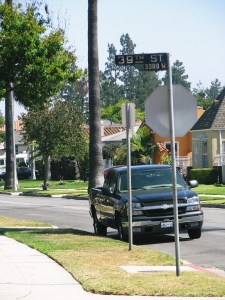
On January 15th, 1947 the tortured, severed body of a Miss Elizabeth Short was found at Leimert Park, 39th and Norton, in L.A. Miss Short was dubbed the ‘Black Dahlia’ by the press, most likely due to her black hair and the black clothing she often wore. The ‘Black Dahlia’ case is still officially unsolved, and it is the most publicized case in L.A.P.D history. At the time, the area where her body was dumped consisted mostly of vacant lots, now, like the demographics of L.A., it has changed irrevocably and become part of the city’s wealthy suburbs— a fact alluded to in John Gregory Dunne’s excellent novel based on the Dahlia case, True Confessions. In Dunne’s novel, the prologue is first person narration by Detective Tom Spellacy. Spellacy’s words are both racist and strangely elegiac about the changing face of L.A.
Anyway. 39th and Norton two weeks ago. It’s a Jap neighbourhood now, Jap and middle-class colored. No empty lots, no bungalows, no Hudson Terraplane. The Neighbourhood Association has put up streetlamps that look like gaslights and there are topiary trees and over on Crenshaw there’s a Honda dealer and a Kawasaki dealer and Subaru and Datsun and Toyota dealers. The colored all have Jap gardeners and the Japs have colored cleaning ladies, and right where Frank Crotty said, “You don’t often see a pair of titties as nice as that,” there’s this Jap-style house and just about on the spot where we found Lois Fazenda’s bottom half, this Jap family has put up one of those cast-iron nigger jockeys.
Son of a bitch if they haven’t.

June 22nd 1958, El Monte, California, the body of Geneva Hilliker was discovered by some kids playing baseball. The body was lying face down in an ivy patch on a road beside the playing field of Arroyo High School. She had been strangled with a thin white cord and her own nylon stocking. The case is still unsolved. Her son James Ellroy was merely ten years old at the time. Unlike 39th and Norton, the crime scene has barely changed with the passing of time, although much of the ivy is now gone. In 1994, Ellroy (now the legendary Demon Dog of Crime Fiction and the author of The Black Dahlia) would reopen the case with Bill Stoner a retired homicide detective from the Los Angeles County Sheriff’s Department. The subsequent reinvestigation is the basis of Ellroy’s book My Dark Places.
Arroyo High School gained another footnote in crime history when in 1969 a recently graduated student, Steven Earl Parent, became one of the victims of the Charles Manson Family. My thanks to the indispensable local resident Ronda Logan for her help in El-Monte.
Read my follow-up post, Ellroy in LA.
Lawrence Block on Writing Mysteries
In an essay at mysterynet.com Lawrence Block has the following to say about writing:
If you’ve got something to say, hire a hall. If you want to send a message, call Western Union. But if you’ve gotten nothing more than the urge to write and a talent to amuse, just sit down and write your book. Even if you don’t change any lives, you might get somebody through a bad night or two. [Link]


 The Venetian Vase